Recent Developments in the Jain Tradition
Given that there are fewer than 6 million Jains in India, living alongside over 1 billion Hindus, the Jain influence on contemporary Indian culture is quite remarkable. To some extent, this influence can be measured in financial terms.
For centuries, Jains have been very successful in business, perhaps because of their religiously motivated focus on trade as opposed to agriculture. Also, the Jain community is highly respected for its charitable giving. In keeping with their profound emphasis on ahimsa, Jains commonly take in and care for animals that are maltreated or are targeted for slaughter. Although they generally do not actively seek converts to their religion, Jains tend to be outspoken advocates of universal vegetarianism, and so they have exercised wide influence in this regard.Among Jains of recent times, Shrimad Rajacandra (1867-1901; also spelled Rajchandra) is especially known outside of India because of his connection to Mohandas (Mahatma) Gandhi. Both from the state of Gujarat, they met in 1891, and according to Gandhi’s autobiography, Rajacandra made a strong impression and had a very positive impact on his spiritual development. Gandhi, of course, is perhaps the most famous advocate of ahimsa the world has ever known, even though he never overtly adopted Jainism as his religion.
Jain influence has also reached well beyond India through the Indian diaspora population. Their centuries-old focus on business has made life in the modern world a relatively natural thing for the Jain laity. For ascetics, of course, life outside their traditional homeland is especially challenging; and indeed, it is quite rare, as only the Sthanakvasi and Terapanthi sects even allow monks and nuns to journey in the world at large. The Terapanthis are responsible, too, for having founded the first Jain university, recently established at Ladnum in the state of Rajasthan.
GLOBAL SNAPSHOT
Jains Beyond India
Until the late nineteenth century, virtually all Jains lived in India, and very few people outside of India took much notice of them or their religion.
In 1893, at the World’s Parliament of Religions in Chicago, Virchand Gandhi, a Jain layman, delivered a lecture on Jainism that, for the first time, conveyed to Westerners Jainism’s relevance with regard to such modern issues as peace and tolerance for others. At about this same time, the first significant emigration of Jains from India was taking place, to East Africa. In the late 1960s, Jains began to emigrate from Africa and from India to Great Britain, the United States, and Canada. Today there are also sizeable Jain communities in Asian countries outside of India, including Nepal, Myanmar (Burma), and Malaysia.Jainism in the diaspora tends to be less orthodox than Jainism in its traditional Indian homeland. To some extent, orthodox teachings—for instance, the prohibition held by all but the Sthanakvasi and Terapanthi sects against monks and nuns ever leaving India—themselves serve to impede an orthodox form of Jainism in the diaspora. The main factors, though, that foster a less traditional mode involve the challenges of living in nontraditional situations and the pressures to conform to modern ideals.
The Jain community in Singapore exemplifies ways of being Jain in the diaspora. Numbering about 700, the community, organized as the Singapore Jain Religious Society (SJRS), maintains a website and a main place of worship that offers regular prayer meetings, classes, and celebrations of religious festivals. Its youth group, Young Jains of Singapore, was formed to help Jains of age thirteen to twenty-five years organize communal events and activities benefitting Singaporean society. About 95 percent of Singaporean Jains have roots in the Indian state of Gujarat. Whereas in the traditional homeland of India distinctions between Jain sects are more noticeable, the SJRS center encourages participation by Jains of various sects. Indeed, its constitution insists on Jain unity. The SJSR worship space features side-by-side sculptures favored, on the one hand, by Shvetambaras and, on the other, by Digambaras.
Established in 1972, the SJRS has since managed to make Jainism one among the ten members of the Inter-Religious Organisation Singapore, which actively supports interreligious dialogue and educational events aimed at enhancing understanding across traditions.
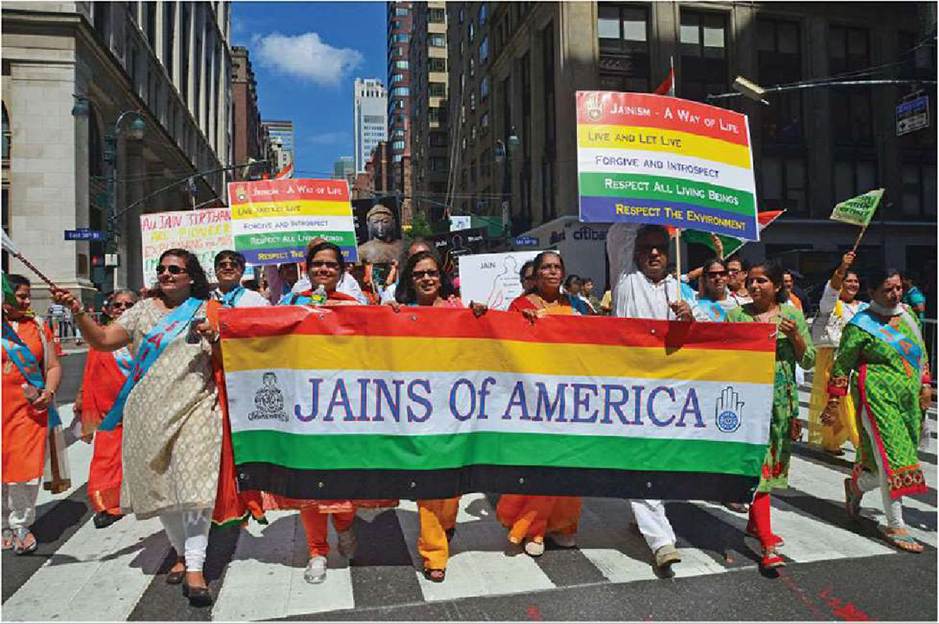
Members of Jains of America march in a parade in New York City.
Self-Assessment 6.2
[Please note: You must be using an online, browser-based eReader in order to view this content.]