The Legacy of the Tirthankaras: Jainism Through the Centuries
In the ninth century ce, about the time that the influence of Buddhists was severely diminishing in India, the country’s religious landscape was undergoing a rather sudden shift with the influx of Islam.
Muslim rule was established in 1192 in the form of the Delhi Sultanate, which was succeeded in 1526 by the Mughal Empire. During the early centuries of Muslim rule, relations between Muslims and Jains were not always friendly. There are accounts of large-scale destruction of sacred Jain sites, for example, the Muslims’ pillaging of Mount Shatrunjaya, a major Jain pilgrimage site in the western state of Gujarat, in 1313. But during the period of Mughal rule, and especially at its apex during the reign of Akbar the Great (1556-1605), remarkably close relations developed. Akbar himself was the close friend of a Jain leader, and he issued several decrees promoting the protection of animals, motivated apparently by learning about the Jain emphasis on ahimsa.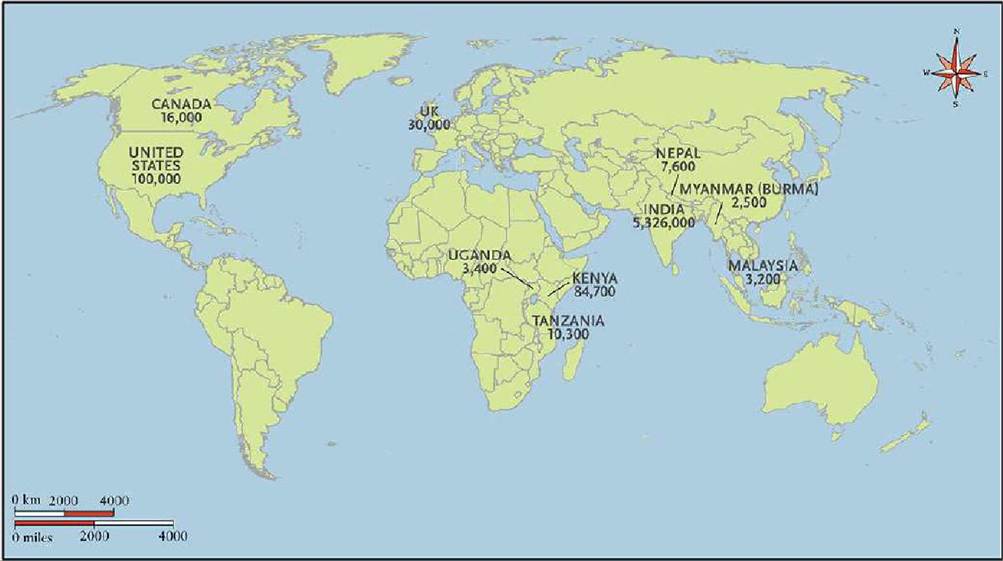
Countries with significant Jain populations (all figures are approximate, as estimates vary widely).
During the eighteenth and nineteenth centuries, Jainism became somewhat more diverse through establishment of the Sthanakvasi and Terapanthi sects. In the twentieth century, immigration led to the establishment of Jain communities in various places around the globe.
More on the topic The Legacy of the Tirthankaras: Jainism Through the Centuries:
-
Conflictology -
Ecology -
Economy -
Finance -
History -
Law -
Medicine -
Philosophy -
Religious studies -