(Re)Configuring Spatial Context
Jacob's Well was ideally suited to foreground questions of community identity, located as it was just east of ancient Shechem, along land routes linking Samaria to Jerusalem.[323] Yet in John 4 the spatial context of most interest to John is a
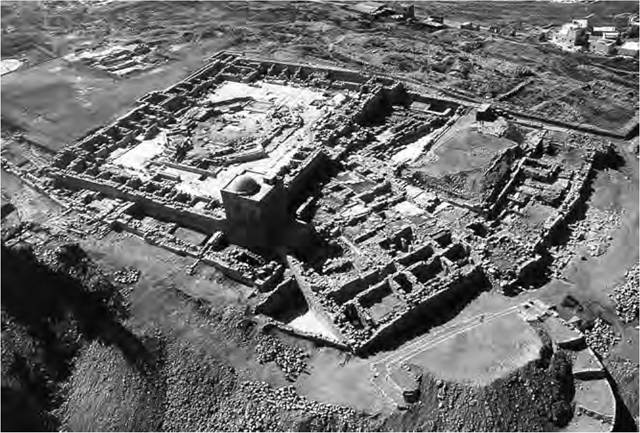
Figure 4.
Mount Gerizim, view of the sacred precinct; image reproduced from NEAEHL Supplementary Vol. 5, courtesy of Israel Exploration Society.cultic one. The Samaritan woman introduces this subject when, after acclaiming Jesus as prophet, she remarks, “our fathers worshiped on this mountain, but you say that in Jerusalem is the place where people ought to worship” (4:20). With these words John places a mental map before his readers and introduces the ramifications of Jesus for space-centered worship.[324]
John offers misplaced preoccupation with Mount Gerizim as a foil for the worship he desires of his community. First, a word about the temple signaled by the Samaritan woman. Combined evidence of pottery, coins, burnt animal bones, and radioactive dating indicates that the Mount Gerizim temple originated in the mid-fifth century BCE, and was joined by the building of a neighboring city in the fourth century (see fig. 4), after Alexander’s destruction of Samaria (Magen 2008, 1742; Magin, Misgav, and Tsfania 2004, 9). The six-chambered gates and open courtyards inside the precinct wall resemble Ezekiel’s visions of the Jerusalem temple (Ezek 42; 46:22-24), seeming to corroborate Josephus’s assertion that the Gerizim temple was built in imitation of its southern counterpart (A.J. 13.256; Magin, Misgav, and Tsfania 2004, 9). Rebuilding and expansion began at city and temple, respectively, during Antiochus Ill’s reign but this time followed a Greek architectural course. John Hyracanus destroyed the temple during Hasmonean rule, so that by Jesus’s day it lay in ruins.[325] However, Mount Gerizim continued to be the fulcrum for Samaritan political and religious identity, as evidenced by the attempt to locate Moses’s vessels there, which the Roman prefect Pilate’s prevented by force of arms (Josephus, A.J.
18.85-89). The clash, together with the subsequent Samaritan clamor against Pilate, underscored the tensions generated by Roman rule over the region and its sacred site. It is probable that the Samaritan woman’s comments (4:20) would have recalled for John’s readers much of the foregoing troubled history of Mount Gerizim, along with relevant political fault lines. Yet far from a rallying cry, the woman’s reverence for Mount Gerizim embodied the antithesis of John’s approach to the sacred.John aims not to endorse a particular sacred space but rather to delocalize cult. Responding to the Samaritan woman’s assertion, Jesus forecasts that “the hour is coming when neither on this mountain nor in Jerusalem will you worship the Father” (4:21). Thus, he does not prioritize the Jerusalem temple over Mount Gerizim, as might be expected of the Judean, but altogether revises conventional notions of territoriality and the sacred. As Neyrey puts it, Jesus “declassifies the entire system represented by a temple and so logically abolishes control of ‘this mountain’ and ‘Jerusalem’” (Neyrey 2009, 70 [emphasis original]). This move is consistent with Jesus’s perspective in the Fourth Gospel that the world and its representative systems have become estranged from God (Koester 1990, 668-69). For Mount Gerizim John’s readers were meant to understand other such places of estrangement in their own environment.[326] As Jesus followers, living in the hour inaugurated by their lord (4:23a), they are to resist identifying with these spaces (cf. 4:20; Carter 2008, 82).[327] Rather, they ought to cultivate a different mode of worship altogether, “in spirit and truth,” as a prerequisite to becoming “true worshipers” (4:23).[328] This is the only compelling response to a world under the thumb of Rome.
The narrative thus entails a significant shift for the relation of John's community to its civic environment, but what validates the spatial reconfiguration depicted in the passage? According to John, Jesus's identity authorizes the perspective taken on sacred spaces.
Jesus's knowledge once again plays a significant role in facilitating the disclosures about himself, with there being two relevant dimensions to such knowledge. In the first place, Jesus can claim a privileged understanding based on his descent. Jesus says to the Samaritan woman: “You worship what you do not know; we worship what we know, for salvation is from the Judeans” (4:22a). Alluding again to Samaria's colonized history (v. 18), Jesus's words here trade on the common association of ignorance with idolatry (Koester 1990, 673). The evangelist thus presents delocalized worship as a desirable alternative to uninformed worship such as the Samaritans', leveraging Jesus's Judean heritage to do so. The claim that Jesus's superior knowledge was based on his descent would have resonated with John's community, in part because it was wedded to the further principle that “salvation is from the Judeans” (4:22b).It is in his role as the bringer of salvation that Jesus's greater claim to knowledge rests, as well as his ultimate authority to delocalize worship. Jesus's awareness of Samaria's troubled political history certified him as prophet (4:17— 19), but his cognizance and ushering in of future (4:23) realities presupposes an even more eminent stature. As before (vv. 9, 11-12, 20) the Samaritan woman's words precipitate Jesus's self-disclosure: “When... [the Messiah] comes,” she remarks, “he will tell us all things” (4:25). Jesus has only to announce, “I who speak to you am he” (4:26), and he adopts the prerogatives aired by his interlocutor.[329] Through this process the narrative makes clear that Jesus's status as messiah entitles him to reorder sacred realities. Jesus's messianic identity has at least two implications for John's community. The first relates to the fruit of Jesus's mission, amounting to nothing less than “eternal life” (4:36). In the narrative, the presentation of this benefit, as the goal of Jesus's labor among the Samaritans, recalls the comparison of Jesus's water to that of the well earlier in the passage (4:9, 14).
If there the implication was that Jesus's eternal life surpassed the water's beneficial offering, here it is that such life renders spatialbased worship outmoded. By dispensing salvation, Jesus in effect transfers to himself the role of mediation formerly associated with such places as Mount Gerizim and the Jerusalem temple.[330]But there is a second implication of Jesus's identity for John's community, pertaining to the scope of his benefits and authority. This time it is the villagers, in response to the Samaritan woman, who precipitate the disclosure. Hearing about and encountering Jesus, they declare, “we know that this is indeed the Savior of the world”! (4:42).[331] John's use of this title, unique here in his Gospel, suggests the extension of Jesus's messianic role beyond the narrative confines of Judea.[332] In doing so the title claims for Jesus pretensions previously associated with Hellenistic and Roman rulers (Carter 2008, 188—191).[333] John's message for his community of Jesus followers is unmistakable: express allegiance to Jesus, for he alone gives the gift of life.[334]