Religious Conflict and the Future of Zionism
The history of the state of Israel since 1948 has been one of remarkable material success and continuing religious and political conflict, both in its relationship with its Arab neighbors and in relation to its own population.
Nowhere is the latter more obvious than in the circumstances surrounding the assassination of Yitzhak Rabin, Israel’s prime minister, on November 4,1995. Rabin’s murder has laid bare deep ideological differences that had been building in Israel for decades between the generally secular majority of its Jewish population and the more religiously intense segment of Israeli society, often called “Haredi” Jews. The term haredi means “those who tremble” (before God), and in English they are often designated as “ultra-Orfhodox” Jews, whose view of the state of Israel, from 1948 to the present day, ranges anywhere from violent opposition to its very existence, to an equally fervent and opposite belief in Israel’s religious identity, and in its messianic future and goals.Rabin’s assassin, Yigal Amir, belonged to this latter group, and his decision to kill Israel’s elected leader sprang from his belief that any peace settlement with the Palestinians—and particularly one involving the return of land seized by Israel after the 1967 war, which Rabin had proposed—constituted an act of national betrayal on Rabin’s part, and therefore a religious crime deserving of death. In Amir’s eyes, Rabin was a rodef—a criminal predator, in Talmudic terminology—and one whose very existence threatened the future of the Jewish state. Therefore, for Amir and his supporters, his assassination became a deed sanctioned by political necessity and religious law.
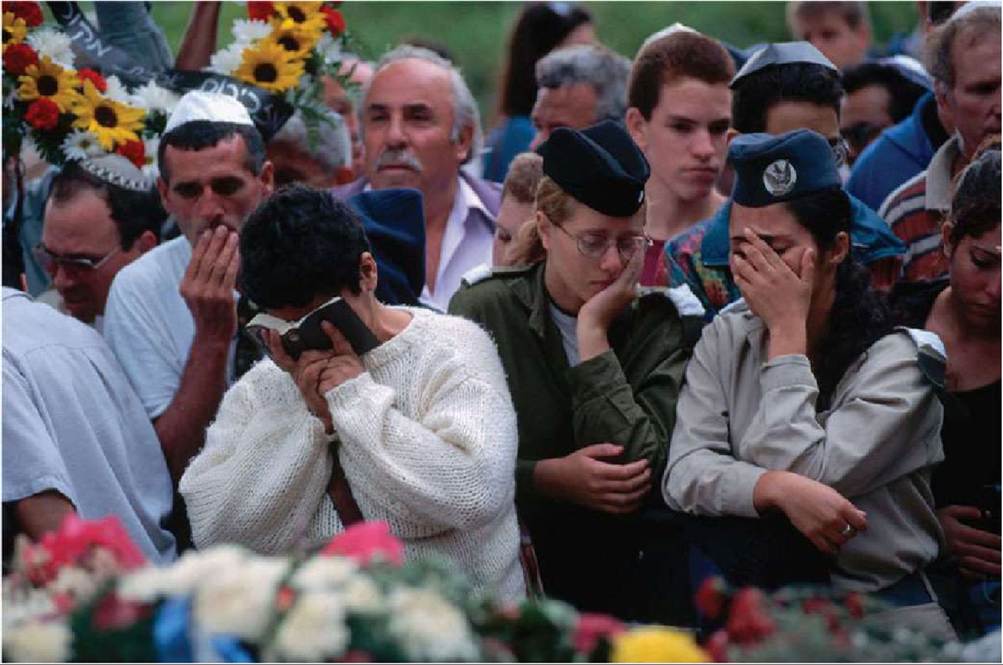
Mourners gathered at Rabin’s funeral.
Amir’s crime shocked the overwhelming majority of Israelis and was condemned throughout the Jewish Diaspora. At present, he is serving a life sentence in Israeli prisons, but the conflict between theocratic violence and democratic rule which this killing embodies remains a troubling shadow hovering over the possibility of political unity in Israel and, more broadly, over the Zionist ideal of collective Jewish renewal.—