The Shoah and the State of Israel
During the twentieth century, two of the most extraordinary events in Jewish history occurred: one traumatic, the other transformative. Both events have had a profound effect on the beliefs and practices of contemporary Judaism.
The first event, referred to in Hebrew as the Shoah—or, more commonly, as the Holocaust—can be seen as the single greatest tragedy of modern Jewish life: the most successful attempt in history by anti-Semites to rid the world of both the religion Judaism and the Jewish people.The Shoah The word Shoah itself requires some explanation, if only because it has a different connotation than the more familiar word, Holocaust. In Hebrew the word shoah means “whirlwind,” and as a metaphor it captures—as well as any image can—the insane rage of anti-Semitic hatred that was loosed on Europe’s Jews during World War II. Many Jews prefer this term, unfamiliar as it may be to English-speaking audiences, precisely because it avoids the connotation of a divinely commanded sacrifice, which is exactly what the biblical term holocaust (or “burnt offering”) brings to mind.
For centuries Jews had been the targets of Christian and occasionally Muslim hostility and persecution, but until Adolf Hitler and Nazi Germany embarked on the “Final Solution,” no ruler or regime ever entertained the idea of total extermination. In Hitler’s autobiography, Mein Kdmpf (1925), he described the Jews as a disease organism within the body of European society that he and his followers proposed to destroy forever. The genocidal policies that his government pursued represented a logical outcome of this essentially racist conception of the Jews and their faith. To carry out this genocidal campaign, Hitler mobilized not only the resources of Germany but also the support of willing collaborators throughout Europe. There is little doubt that had German armies defeated the United States, Britain, and the Soviet Union during World War II, the annihilation of the world’s Jewish population would have been one of Hitler’s proudest accomplishments.
Even in defeat, however, the Nazis destroyed roughly one-third of the world’s Jewish population, and the legacy of torture and mass murder they left behind has deeply scarred the Jewish consciousness.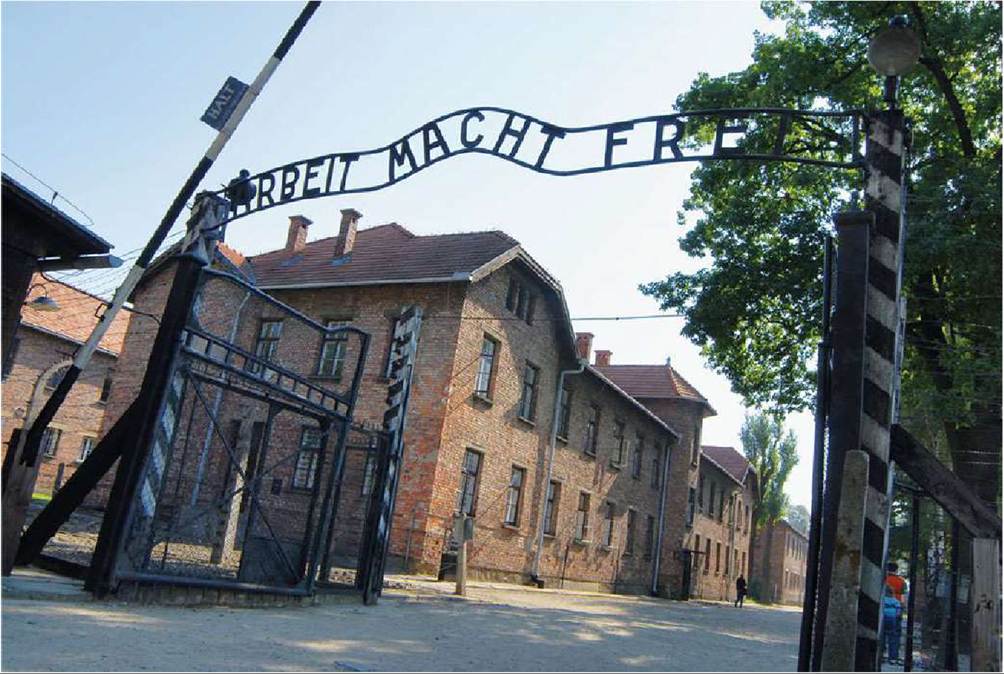
The entrance gate at Auschwitz.
Contemporary Jewish philosophers have responded to the tragedy of the Shoah in remarkably diverse ways. For one theologian in particular, Ignaz Maybaum (1897-1976), the slaughter of innocents can be seen as a kind of churban (Hebrew, “divinely willed sacrifice”), through which the Jews perform an act of vicarious atonement for the sins of the world. 7 For theologian Richard Rubenstein (b. 1924), such logic is morally insane. Rubenstein insists that the random killing of 6 million Jews (not to mention the untold suffering and murder of many more millions of non-Jews) challenges, at the most fundamental level, Judaism’s belief in a just and benevolent Creator who values eveiy single human life. In his book After Auschwitz, Rubenstein insisted that Judaism’s historic God concept is “dead” and that no religious philosophy that is still committed to biblical ideas of divine justice and retribution can withstand scrutiny in an age of genocide and mass destruction.- For philosopher and rabbi Eliezer Berkovits (1908-1992),9 however, the mystery of God’s presence in history is deepened by the Shoah, not refuted by it, and ours is not the first generation to reflect on God’s “hiddenness” or on the terrible consequences of human freedom. For human beings to be capable of choice, he argues, God must “restrain” himself and allow his human agents to exercise their moral will, even if the consequences of divine restraint are catastrophic.
None of these theologians, however, is willing to see the Shoah as an instance of merited (and therefore inevitable) divine punishment. Their refusal to accept that now-archaic model of God’s judgment and response to human sin marks a definitive break with traditional Jewish thought.
If much of the world’s Jewish population can no longer declare—in the words of the traditional liturgy—“because of our sins were we exiled from the land,” then what model of covenant relations can now be invoked to make both human suffering and world redemption meaningful?For theologian Abraham Joshua Heschel, the only defensible Jewish theology after the Shoah is one that posits God’s need for, and yearning after, humankind. The covenant relationship, as Heschel understands it, is a reciprocal one in which human moral intelligence and divine “pathos” join in the act of worship and of love. God’s longing for us does not, Heschel insists, annul the reality of evil or the terrible freedom with which human beings have been invested. It does, however, establish what Heschel calls an “analogy of being,” that is, a hint of divine likeness in every soul, and thereby the capacity to mend a broken world. If all we knew of God, Heschel argues, was a theory of omnipotence or omniscience, then the Shoah might very well sweep away that merely conceptual reality. But the truth is, he continues, that we know God at a much deeper level of moral consciousness, and that form of the divine presence abides even in the midst of the most appalling evils.—
Statehood for Israel The second pivotal event of modern Jewish history is the establishment of the State of Israel in 1948, what one philosopher has called the “the Jewish return into history.”11 The Zionist philosophy on which the State of Israel rests is really several philosophical/religious arguments in one. In its earliest form, “Zionism” is simply a feeling of attachment to an ancestral homeland in which a vast majority of Jews, past and present, have never lived. Even though a comparatively small population of Jews continued to live in Palestine for centuries after the Exodus, most Jews were content to sing “next year in Jerusalem” at the Passover Seder without ever really contemplating a return to the land of biblical Israel.
A decisive shift in such thinking occurred, however, in the course of the nineteenth century. Two Orthodox rabbis—Yehudah Hai Alkalai (1798-1878) and Zvi Hirsch Kalischer (1795- 1874)—argued passionately for a messianic view of Jewish history, urging their contemporaries to emigrate to Palestine in the expectation that the redemption of Israel was about to be accomplished, but only if the Jews took the first practical step of occupying and restoring the land.— Their writings were largely ignored within their lifetimes, but the arguments of an assimilated Austrian Jew, writing near the end of the century, attracted much greater attention.
For Theodor Herzl (1860-1904), the rapid growth of anti-Semitism had made the condition of eastern European Jews so precarious that something had to be done—apart from continuing mass emigration to the United States—to deal with the poverty and desperation of the Jewish masses. Herzl’s solution was the establishment of an internationally recognized Jewish state, either in Palestine or Argentina. He laid out his ideas in an extended tract entitled “The Jewish State” (1896)13 and later in a utopian novel, The Old New Land (1902).-4 Herzl died in 1904 and never lived to see any of his ideas come to fruition. The Zionist movement he helped to found continued to solicit support for his ideas, and in 1917 British Zionists found a sympathetic advocate in the foreign minister of Great Britain, Lord Arthur Balfour (1848- 1930).
Balfour’s private letter (now known as the Balfour Declaration) to the most prominent Jew in England, Lord Walter Rothschild (1868-1937), is the earliest sign that any major power was willing, for whatever reason, to validate Zionist claims to a political stakehold in Palestine. In carefully guarded diplomatic language, Balfour declared his government’s willingness to establish a “national home for the Jewish people,” provided that “nothing shall be done which may prejudice the civil and religious rights of existing non-Jewish communities in Palestine.”15 Within a decade of this proclamation, however, both Great Britain and the rapidly growing Jewish community in Palestine discovered just how intense Palestinian Arab opposition to increased Jewish immigration really was.
By the late 1930s, as Great Britain sought to limit sharply the number of Jews who could legally enter Palestine, the stage was set for a succession of wars between Arabs and Jews—wars that have continued to the present day.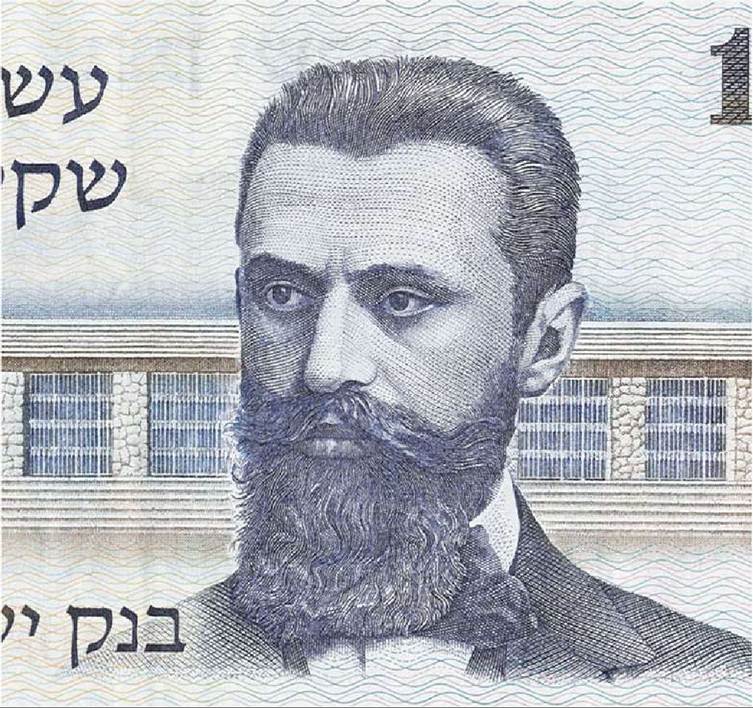
This painting of Herzl is one of many that appear on Israeli currency.
As a secular ideology, Zionism (in all its variations) rests on a few basic assumptions. The first assumption holds that anti-Semitism may abate from time to time, but it will never disappear, and as long as Jews are hated anywhere in the world, their lives are in peril. The second assumption is that the only guarantee of physical survival in a hostile world is national sovereignty—because only a nation-state can effectively defend its citizens. Third, the guesthost relationship Jews have lived under, whether in Christian or in Muslim lands, has always been inherently unstable, and on occasion threatening to Jewish survival. If Jews are to have any hope of a secure future, they will have to regain their collective autonomy, which can be accomplished only through political means. And if one adds to all of this the specifically religious belief that the rebirth of the State of Israel represents the beginning stage of messianic redemption of the world, one has a totality of ideas that have been employed to rationalize the transformation of the world Jewish community back into a politico-religious entity. Viewed from this perspective, Jewish history has come full circle in our time, as Jews search for ways to reconnect their religious lives with their enduring sense of peoplehood.