Religious minorities
Among the early migrants into the subcontinent were three religious streams, which became a permanent if small part of the Indian “quilt.” These were Jews, “Syrian Christians,” and Zoroastrians or Parsis whose story is worth noting, even if in brief.
Jewish communities
There were at least three separate migrations ofJews into India - one group, known as the cochin Jews, settled in the southwestern area now referred to as Kerala; another known as “Bene Israel” settled largely in what is now Mumbai; the third was a small nineteenth-century migration of entrepreneurs and their families known as Baghdadi Jews. Of the three, the first two groups are clearly the oldest and the most striking for what they reveal about continuities and accommodations.
“Cochin Jews”
The earliest settlements of Jews were in cranganore on the Kerala coast. It is possible these folks came early in the common Era as Roman traders are said to have referred to them. However, it is more likely most of them came and settled around the seventh century along with Arab merchants. These communities were primarily mercantile; indeed, their economic and political rights were affirmed in a copperplate inscription struck around the late eighth century by a local Hindu monarch. In this inscription, we learn that Jewish settlers were given economic property rights, apparently including land grants such as were commonly given to groups which a local monarch wanted to include under his hegemony. The inscription affirms the right ofJews to hold public festivals and declares that one Joseph Rabbani (who may have been an adviser in the royal court) was the leader of the community.2
The community came to be comprised of “white” Jews and “black” (literally, “copper”)Jews. The “black” Jews were those who had been there from the earliest days and whose number had been increased by intermarriage or conversion.
Extant synagogues, dating from the twelfth century ce were associated with these Jews. “White” Jews were apparently descended from Spanish Jews migrating around the thirteenth to fifteenth centuries; early generations of those immigrants spoke Spanish and were Sephardim in orientation.3When Cranganore was razed in 1524 by Islamic marauders, theJews scattered, most of them settling in cochin. There, they were caught in the colonial battles between the Portuguese and the Dutch. The Dutch were generally supportive, and hence received Jewish cooperation; however, when the Portuguese captured Cochin, Jews were generally harassed. Cochin is the site of the oldest extant synagogue associated with the “white” Jews. It was built in 1666 with Dutch help and with products imported from many sources, including tiles of Chinese origin (these tiles had been imported by the local ruler, but were rejected for building purposes because they were said to have been made at the cost of bullocks’ blood!).4
The customs retained by these Jews were a mix of local and traditional Jewish practice. The “black” Jews, for example, were said to dress like local Muslims - wearing a turban in the temple and skullcap outside; they dressed in multicolor tunics, a waistcoat, white trousers, and wooden sandals, spoke Malayalam (the local vernacular), and used Hebrew liturgically. Their adaptations of “Hindu” customs included the practice of tying a tali (marriage cord) around the neck of the bride at the time of marriage and locating the synagogue at the center of streets populated by Jews, a practice emulating brahman tradition.
The communities practiced a number of Jewish rituals: circumcision on the eighth day; Sabbaths; Passover with its distribution of unleavened bread; the festivals of Pentecost, Trumpets, and Tabernacles (perhaps the most elaborate of all their festivals). Fasts were held on the day of atonement and the remembrance of the destruction of the temple.
“White” Jews celebrated seven days for marriage, culminating on a Sunday; “black” Jews celebrated fifteen days of marriage, culminating after sundown on a Tuesday.Bene Israel
Those Jews who call themselves the Bene Israel have an even more obscure past.5 Their myth of origin claims their ancestors landed on the Indian coast in the first century ce as the result of a shipwreck. They claim that their ancestors maintained Jewish traditions consistent with the Israelite communities prior to the destruction of the first temple. These are said to include performance of circumcision by “cohens,” the reciting of the “shema Israel” before or during all rites of passage, the celebration of Yom Kippur at home in silence, and use of a funeral shroud exactly as described in the Hebrew Bible. Certain festivals, dating after the destruction of the first temple (e.g., Hanukkah and Purim), were celebrated, though Rosh Hashanah, Passover, and Sabbath have also been celebrated.
Whatever their origins, members of the community trickled into Mumbai in the late 1740s, working largely as oil pressers, who, because they refused to work on the Sabbath, came to be known as the Sabbath oil pressers “caste.” Three events brought about a renaissance in the community which theretofore had little conscious sense of their religious identity. The first of these events was the visit of David Ezekiel Rahabi from Cochin in the eighteenth century. Rahabi was said to be Arabic and a member of the Maimonides family. He imparted religious and biblical education to young and old alike, taught prayers in Hebrew, and trained cantors orally (a method of teaching common in the Indian tradition). A second event was the establishment of the first Bene Israel synagogue in 1796. The third event was the work of John Wilson, a Scottish Presbyterian missionary who founded a college and some twenty-five Marathi-medium schools and published a Bible translated into the vernacular. In some of the schools and in the college (eventually known as Wilson College) Jewish religion and Hebrew were taught.
Many Jews took advantage of these educational opportunities.The “Bombay Jews” in the modern period have maintained some nine synagogues, three of these for the exclusive use of BaghdadiJews (the oldest of these built in 1851). The size of the community at its largest was some 20,000 in 1951, but since then increasing numbers of them have emigrated to Israel so that only a handful of families remain in the Mumbai area. An interesting measure of the community’s adaptations to the Indian landscape was the extent to which “Hinduization” has occurred in its ritual life. The tying of the tali, for example, is used to mark a marriage, though a locket is tied to the tali with the husband’s name inscribed in Hebrew; similarly, the bride’s hands are adorned with henna as in local tradition. Elders of the community speak of the “faith of Abraham” as consistent with the monism of Advaita.
While virtually all Indian Jews will have disappeared from India within the next generation, their presence on the subcontinent for well over a millennium is testimony to the hospitality of their neighbors and their capacity to adapt and respond in the Indian environment.
Syrian Christians
There is abundant evidence that Christians, generally called “Syrian Christians,” were living along the coast of Kerala by at least the mid-fourth century. Legends claim this community was founded by the apostle Thomas who is said to have died in South India. Historical reality is much less clear. It is believed from references in Greek texts that Thomas did visit the court of Gondophernes, a Bactrian Greek “king” situated in the upper Indus Valley. What is also known is that one Thomas Cana of Edessa in Syria landed on the southwestern coast around 345 ce together with a group of followers apparently fleeing persecution by more “orthodox” Christians.6
These early communities of Christians were supplemented by other heterodox Christian groups. These included some Nestorians who were considered to have unorthodox views of the Christ figure and refused to accept the doctrine of Theotokos (Mary as “Mother of God”).
Many Nestorians, however, moved further eastward into China. Another unorthodox group that migrated into the southwest were the Monophysites, a group founded by Eutychus, who claimed Christ had only a single, divine nature. Both of these movements provided clergy for the Kerala Christians. These early Christians came to be known as Jacobites, who maintained ties to the Syrian ecclesiastical hierarchy and followed Syrian ritual and creed.Like the Jews of Kerala, these early Christians were granted certain rights and property by local rulers as evidenced in three separate copperplates struck in the late eighth century. These rights included space for a township or even “mini-kingdom” complete with church.7 The Syrian Christians remained relatively prosperous and peaceful through the fourteenth century.
Circumstances changed for these Christians with the coming of the Portuguese in the sixteenth century and the Dominicans, Franciscans, and Jesuits patronized by the Portuguese colonialists. The low point in Catholic- Syrian Christian relations came in 1599, when a Bishop Meneze burned many of the books of Syrian Christians and ordered their conversion to Catholicism.8 Many did so, but some defected and sought to resume their ties to Antioch. The result of these machinations was the emergence of three separate church bodies by the seventeenth century: the Romo-Syrians, who used a Syrian rite, maintained adherence to the pope and hence were Catholics of the Syrian rite; “Jacobite Syrians,” who maintained their adherence to the Syrian hierarchy and not to the pope; and finally, Catholics who followed the Latin rite due largely to conversions by Portuguese-sponsored
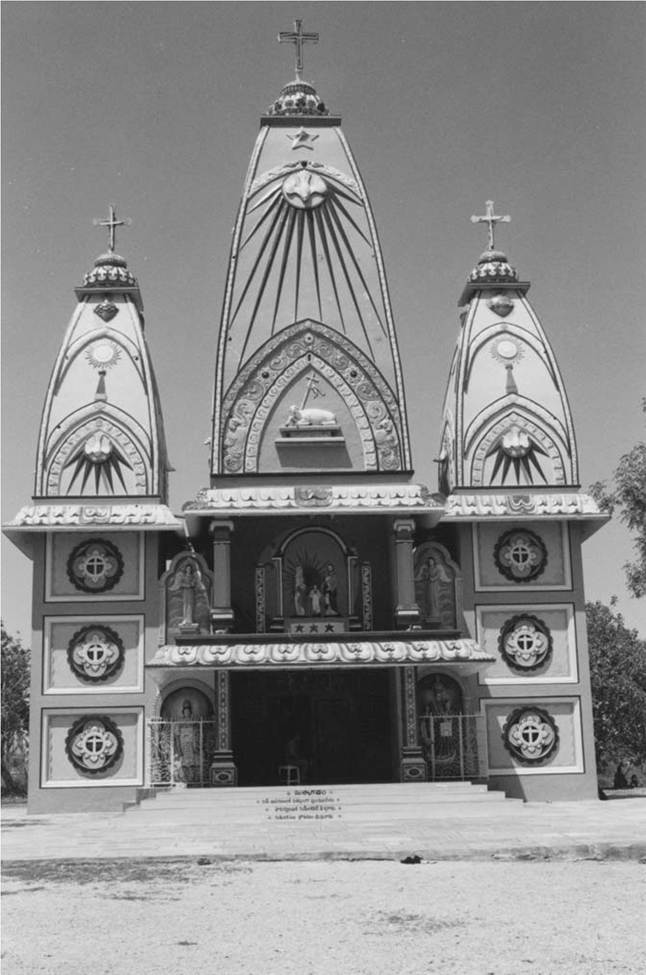
Figure 7 Roman Catholic Church near Nagarjunakonda, Andhra Pradesh, showing indigenous features. Photograph by Rob F. Phillips.
groups. A fourth branch emerged in the eighteenth century as an offshoot of the “Jacobite Syrians.” This “new” group followed the leadership of a local bishop, one Mar Thomas Athanasius, and became an autonomous church known as the “Mar Thoma” Christians, whose headquarters are in Kerala itself.
The “Jacobite Syrians” tended to be more nearly “Catholic” in their orientation. For example, they affirmed that tradition was as important as the Bible in matters of interpretation; relics were venerated; communion was understood more as a sacrifice than as a commemoration; their clergy were not to marry. Further, they observed certain fasts and feasts, which were regarded as “superstition” by the more nearly “Protestant” Mar Thomans.
Most of these groups, nonetheless, have appropriated customs from their Indian or Hindu neighbors which were observed into the twentieth century: there has been some use of horoscopes, especially in the case of newborn babies; the tali has been used to mark marriages; death pollution was observed for ten to fifteen days; and there have been anniversary ceremonies for the dead not unlike the Hindu sraddha ritual. In addition, the rite of passage, known to Hindus as annaprasana (the first feeding of solids to an infant of six months), was observed; intermarriage between sects remains rare as some claim their ancestors to have been converted brahmans or high-caste nayars (landowners). Indeed, in some settings, low- caste persons were not permitted into the church premises well into the twentieth century.
Zoroastrians or Parsis
Zoroastrianism started as a reform movement founded by an Iranian priest named Zoroaster (the Greek term for Zarathustra), who probably lived in the seventh century BCE. The religion was based on certain ancient Iranian practices, which were similar to those found in Vedic India. There had been a fire cult; the sacrifice of hoama, thought to have been the intoxicating sap of a plant; the sacrifice of animals; a cult of twins leading to notions of a cosmic dualism. In this ancient religion, certain forces of nature were considered sacred, especially the sun, moon, earth, fire, water, and wind. Varuna and Mithra personified water and fire respectively and Ahura Mazda came to be seen as ruler of the cosmos. Ahuras (good spirits) and daevas (bad spirits) peopled the cosmos.9
Zoroaster campaigned against the “excesses” of this ancient religion, especially its polytheism, animal sacrifice, and intoxication by the priests (magi) during hoama sacrifice. He established a form of monotheism which posited that Ahura Mazda, the primal one, fathered twin spirits, Spenta Mainyu, the demiurge or creator of all things good, and Angra Mainyu, the demiurge of evil. Zoroastrianism was apparently the first religious tradition to posit an eschatology (doctrine of end times) at which good would triumph over evil, a resurrection of the dead would occur, human beings would have the opportunity to become immortal, and a judgment bridge connecting the cosmic mountain at the center of the world to paradise would have to be crossed.
Zoroastrianism became the “state religion” of the Achaemenids (sixth century bce), and the Sasanids (224-637 ce). During the first of these periods the scriptures emerged, including hymns used for the rituals (yasnas), and the Gathds, poems ascribed to Zoroaster himself. These became known as the Avesta by the sixth century ce. By the time of the Sasanids, a greater degree of mythologization had developed - e.g., time was divided into mythological segments - and a ritual life had flourished. These rituals included the practice of six major festivals, the use of fire temples serving as microcosms in which the sacred fire could be maintained, and the use of dachmas (“towers of silence”) in the disposal of the dead. Because earth, fire, and water were sacred, these could not be used for disposal of the dead; rather, the dead were to be exposed so that birds of prey could convey the deceased symbolically to the upper reaches of the cosmos.
When Islam spread into Persia in the seventh century, Zoroastrians began to migrate into India to the area now known as Gujarat. While some Zoroastrians remained in Iran, where even today there are some 140,000, most of them eventually settled in Gujarat, between 651 and 963 ce. A local king was hospitable to the migrants, and, in due course, the community adapted the language and dress of Gujarat. They lived amicably with their new neighbors while retaining many of the religious traditions brought from Iran, thanks to those priests who had settled with them.10
In 1469, the community moved to another part of Gujarat, but by the nineteenth century had, for the most part, migrated into Mumbai. There the Parsis (as they came to be called in India) experienced a renaissance as the result of several factors.11 Not least important, Elphinstone College was founded by the British East India Company in 1827 to teach “the languages, literature, sciences, and moral philosophy of Europe.” Many Parsis attended here and studied Zoroastrian scriptures and religion, often through the eyes of such seventeenth- and eighteenth-century European scholars as Thomas Hyde and A. Duperron. Meanwhile, the Scottish Presbyterian missionaryJohn Wilson, on the basis of his reading of Zoroastrian scriptures, challenged a Parsi leader in 1843 as being out of touch with the “scientific” study of his own tradition. Other Western scholars offered varying views on what was “authentic” Zoroastrianism. A German philologist, Martin Haug, for example, teaching Sanskrit in Poona in the 1860s, argued on the basis of the oldest scripture, the Gadthads, that the religion should be a form of pure monotheism, free of rituals. On the other hand, E. W. Wiest, an English engineer studying Pahlavi literature, and Henry S. Olcutt, a theo- sophist, both maintained, on the basis of the later texts, that dualism and the practice of ritual was indeed the appropriate form of the religion.
In the context of these discussions, a Zoroastrian priest/scholar named Evachi published a catechism in 1869 in which he sought to reassert what he thought were the essential teachings of Zoroastrianism. He published a Pahlavi dictionary and made available to the community teachings from manuscripts only available theretofore in Avestan, Pahlavi, Persian, and Arabic.
Most Parsis in Mumbai today share certain common beliefs based on Evachi’s catechism. Ahura Mazda is now known as Ohrmazd; fire consists of sparks of Ohrmazd and embodies the sun and moonlight, healing warmth, creative power, purification, wisdom, and the force of righteousness (asha). Six festivals of creation are to be celebrated each year; appropriate litanies should be addressed to the sun three times daily, and to the moon thirteen times a month. In the fire sacrifices (yasna), elements representing “good creation” are offered and once consecrated, embody the good guardian spirits of the cosmos.
Ethics are an important part of the Zoroastrian lifestyle. Evil powers, led by Angra Mainyu, the spirit of evil, cause human beings to engage in evil acts such as causing pain, and polluting the earth. Good ethics lead to immortality in paradise. Such ethics consist of living the “good life”; being charitable and industrious; avoiding greed, arrogance, and vengeance; and seeking wisdom. Not least of all, it is important to engage in appropriate funeral rituals for the deceased over a three-day period, lest the earth be contaminated by a dead body.
Not all Parsis agree on everything, of course. For example, an “occult” group arose, which stressed reincarnation and multiple planes of being. Others venerate contemporary “gurus” in a manner emulative of Hindus. Yet another divisive element is the question of which “calendar” to follow: the “Gregorian” or “Western” calendar; the ancient Iranian (Qadimi) calendar; or the calendar believed to be that of ancient Persian kings. Despite the lack of unanimity, Parsis have been a significant presence on the landscape of Mumbai. Their impact far exceeding their numbers, the community has spawned major industrialists and philanthropists (e.g., Tata and Godrej), constructed hospitals, colleges, and schools; and in various ways contributed to the social welfare of the city.