The “colonial impact”
Starting in the sixteenth century, the Indian subcontinent became the venue for an acting out of European nationalisms, especially the desire for economic windfalls and the extension of political hegemony perpetrated by “East India” trading companies, in collaboration with the crowns of several European nations.
The Portuguese were the first on the scene, followed within a century by the Danish, Dutch, French, and British traders. These contacts brought about the era of colonialism, which led in turn to Indian responses and the dawning of modern India.The Portuguese, British and other Europeans
After the visit of Vasco da Gama to Calicut in 1498, the west coast of India became a main focus of Portugal’s worldwide naval hegemony. By 1508, Albuquerque and his men had defeated the local armies of the khan governing Goa and claimed the port as a Portuguese possession. He permitted his men to marry the widows of defeated soldiers and to settle along the coast. For generations, Portuguese culture permeated the west central coast of the subcontinent. Portuguese Indians farmed the soil and introduced a number of crops from other parts of the Portuguese empire: tobacco, pineapple, cashew nut, peanuts, sweet potatoes, even certain forms of red pepper. In addition, cash crops for export were developed: coconut, cotton, and such spices as pepper, ginger, and cinnamon. Because the Portuguese navy assumed hegemony of the Arabian Sea (theretofore controlled by the Arabs), the Portuguese language became the virtual “lingua franca” of the Indian ports of trade. The tight organization of the Portuguese militia was emulated by the Mughals and the Marathas alike. Not least of all, Goa became an outpost for the copying of Portuguese art, architecture, and religion. The European-style printing press was introduced. Grammars and translations of indigenous languages were spawned and Roman Catholicism became a vigorous part of the Indian landscape.12
Religion was an important part of the Portuguese legacy.
Catholic missionaries of various orders were sponsored - Dominicans, Franciscans, and especially Jesuits were a visible presence, as were seminaries in the training of new clergy. The work of threeJesuit missionaries, in particular, will illustrate the scope and nature of their work.Enrique Enriquez, who was in India from 1546-1600, was instrumental in developing lexicons and grammars of Tamil, Marathi, and Konkani (the language of the coastal region). The purpose, of course, was to make the vernaculars accessible for the foundation of Christian ideology; yet one of
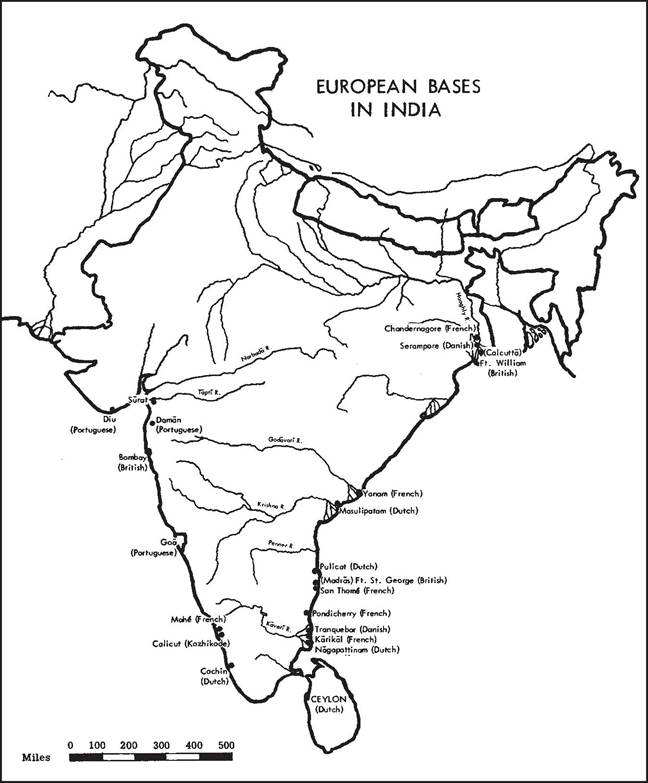
Map 5 European Bases in India
Reprinted with the permission of Professor Joe Elder, editor: “Lectures in Indian Civilization" (Dubuque, IA: Kendall/Hunt Publishers, 1970).
the ultimate results of this kind of language study was the stimulation of pride and renaissance amongst the speakers of such languages. Nonetheless, Enriquez started the process of developing an Indian Christian vocabulary in which Greek and Hebrew terms were expressed in Indian idiom.13
Robert de Nobili was noted for the experiments he started in the city of Maturai, Tamil Nadu, in 1605. He donned the robe of a samriyasi, lived the lifestyle of an ascetic, engaged in conversations with brahmans, and sought to present the Bible as a “fifth Veda.” A small mission was established in Maturai, primarily comprised of upper-class converts who were later joined by such foreigners as missionary scholar Constantine Beschi (1710-47), whose Tamil had native fluency.14
Francis Xavier spent several years in Goa before and after visiting China (1542-45 and 1948-49). Xavier’s legacy is mixed. He promised Portuguese protection for fisher folk (paravars) along the Kerala coast in exchange for their being baptized. Accordingly, he lined up and baptized thousands of them though their education into Catholicism was minimal.
It was also Xavier who wrote to King Joao II of Portugal to urge him to hold his representatives accountable for propagating Christianity and increasing conversions. In partial response, King Joao instructed his viceroy to “destroy all idols,” penalize any who “dare to make an idol” or “shelter... a brahman” and to afford special favor to Christians in filling appointments and receiving material aid.15 The inquisition had been imported to India and the converting or scattering of non-Christians in Goa had accelerated.The Dutch East India Company’s interest in India was not as intense as its commitment to the Indonesian islands, which were perceived to be richer in the spices and goods Europeans sought. Nonetheless, small Dutch outposts were established along the southern coast at Cochin, Nagapattinam, Pulicat, et al. As noted earlier, their greatest contribution to the subcontinent may have been their support ofJewish communities and their amelioration of Portuguese excesses. Otherwise, they had little religious impact.
The French were relative latecomers to the subcontinent. Founded in 1664, la Compagnie des Indes Orientales did establish seaport enclaves in Chandernagore (Bengal) and Pondicherry (Tamil Nadu). In fact, for two decades in the mid-1700s, under the leadership of the skilled administrator, Joseph F. Dupleix, the French had considerable hegemony in the south.16 However, by the end of the century, they were defeated near what is now Kolkata (once Calcutta) by British and local troops led by Robert Clive. By then the British were better funded, not only by their annexations in India, but also by their China trade. Nevertheless, Pondicherry remained a pocket of French access to India until 1954 and even now includes a center for the study of Indian culture and religion by French scholars.
The Danish East India Company established enclaves in Serampore (Bengal) and Tranquebar (Tamil Nadu), which were to prove significant for development in the religious life of India.
In the early years of the European trading companies supported by “Protestant” crowns, only chaplains were made available to work with the households of European nationals. The Danish crown was the first to make an exception. In 1709, the Danish crown sponsored the recruitment and support of BartholomausZiegenbalg, who with his colleague, Plutschau, became the first Protestant missionaries in India. Settling in Tranquebar, Ziegenbalg, a German seminary dropout, proved to be a resourceful addition to the landscape. He established elementary schools in both Portuguese and Tamil, contributed to the development of a Tamil lexicon, and, not least of all, wrote two manuscripts seeking to describe the religious life of South India. These manuscripts were deemed by his sponsors to be too supportive of Indian religion and were not published for over a century.17
Almost a century later, Serampore became the enclave in which the first English missionaries lived. William Carey, a Baptist cobbler, arrived in 1793, established an indigo factory and botanical gardens, set up a printing press, and began translating the Bible into several languages. Joined by Joshua Marshman and William Ward, the trio became active in the critique of Indian religion and culture. They lobbied the English East India Company to make changes in their “hands-off” policies, and were partially instrumental in the eventual decision to outlaw such practices as sati (widow burning) and infanticide. It was Ward’s scathing book, purporting to be a study of Hinduism, that informed the mind-set of evangelical Christians in Britain and North America for generations.
The British East India Company, founded in 1600, first established a trading post in Surat (Gujarat) with the permission of the Mughal court and eventually in Kolkata, Mumbai, once known as Bombay (a gift to the British crown from the Portuguese), and Chennai (once Madras). The British company’s presence can be divided into several stages.18 The first stage, running until 1813, was one of primarily economic and military activity: siphon off as much wealth and raw material as quickly as possible for marketing back home; ward off the French and those local princes perceived to be a threat to company interests; establish puppet regimes through whom the company could attain surrogate power and increased wealth.
By the 1770s, in fact, Bengal had been stripped of most of its surplus wealth.19 When the company’s coffers were depleted from waging wars with the Marathas and in the Southern Deccan, its leaders, like Warren Hastings, did not hesitate to “extort large sums” from their Indian allies.20 It is no wonder the British East India Company’s men during this period were perceived as robber barons by the local population and not a few historians.In 1813, the company became more “imperialistic.” Its hegemony was extended through alliances and conquest of local leaders. Laws restricting sati and other practices were passed. Missionaries were supported. Development of an infrastructure intended to strengthen British hegemony began: British-style policies and legal systems were established, replacing indigenous ones. Transportation systems of trains and roads were developed to facilitate the export and import of goods; money was set aside for the construction of schools and colleges, intended to educate an Indian elite in British “ideas.” By 1835, English was established as the medium of education and exchange, following the advice of economic utilitarians and evangelicals, but contrary to the advice of “orientalist” scholars. A greater priority was given to higher education and several English-medium colleges were founded (e.g., Elphinstone College in Mumbai and Fort Williams College in Calcutta).
These policies of development and education received a severe jolt in 1857, when Indian soldiers, trained by the British for service in the army, engaged in a rebellion, apparently supported by disaffected princes, peasants, and others. Known as the “Sepoy Mutiny,” it was triggered when some soldiers refused to use ammunition believed to have been lubricated with animal fat. These soldiers were imprisoned and their colleagues set out to free them. Though the uprising was quelled within nine months, the company lost its governance in India to the British crown. India was made officially part of the British empire, its parliament the official policy maker for Indians, and Queen Victoria was the Empress of India. Once India became part of the British empire, it became Britain’s “barracks” in Asian seas. By 1880, Britain had sold 20 percent of its goods in India and invested 20 percent of its overseas capital.21 There was now greater ambivalence about the wisdom of increasing higher educational opportunities and more discussion on the need to build on India’s past. In the face of Indian criticisms of British policies, a rationale for the British presence in India was now increasingly articulated: having trusteeship of India was the “white man’s burden”; the British could assure protection of minorities and “backward classes” (and there is some evidence of a policy of divide and conquer); the British claimed they were the most efficient of administrators and without their presence India would fragment into many parts.