Rites of Purification, Presentation, Petition, and Participation
The Shinto ritual event generally involves a four-step sequence of purification, presentation, petition, and participation. The first three steps are performed by priests, and the last one involves the entire “congregation” in attendance.
The rationale for the sequence is first to make the participants (both clergy and laity) physically and spiritually clean for their encounter with the kami. The second step is to present food offerings to the kami to show respect and good will and to pave the way for the third act of petitioning. This involves formally pleading with the kami, through beautiful and correct words intoned with reverence and awe by the chief priest, for the concrete benefits being sought. Finally, the last sequence of the ritual is to have the entire worshiping audience fully participate in the ceremony through the watching of performances, the sharing of ritual drinks, and the gift of shrine souvenirs.The Japanese word for the purification ritual performed by the Shinto priest is harae, the purpose of which is to please and soothe the kami. The ceremony is deemed necessary to prepare the faithful for their encounter with the deity or to remove the defilement that results from any contact with pollutants. All sorts of occasions call for the performance of harae, many of which take place at the shrine; but sometimes the priest may go to the place where it is needed. It is common to call in the Shinto priest to perform the harae before moving into a new home, occupying a new office building, opening a new highway, driving a new car, or even purchasing a new cell phone. The priest, dressed in sacramental vestments, waves an onusa (the wand of stripped paper or an evergreen branch) over the person(s) or the object(s) to be purified, first on the left, then the right, and finally back to the left. Ritual bathing is another form of purification.
In a practice known as misogi, Shinto believers purify themselves by standing under a waterfall or immersing themselves in ocean water. As is well known, theJapanese are a meticulously clean people who enjoy long and frequent baths during which they scrupulously clean and scrub themselves. This national trait certainly has Shinto roots.
Salt also plays an important role in the harae. Its snow-like appearance symbolizes purity, and its potency as a purifying agent is widely accepted in Japan. The Shinto priest often sprinkles salt over the place, the people, or the object to be purified. Sumo wrestling, a characteristic Japanese spectator sport, has strong Shinto connections. Each match begins with the wrestlers throwing salt into the ring to purify themselves and their opponents. This belief in salt as spiritual purifier also makes its way into many aspects of Japanese life. After attending a funeral service, people sprinkle salt in the doorway before reentering their homes so as not to carry the defilement of death inside. Shop owners also put small mounds of salt on either side of their storefronts to ward off evil spirits.
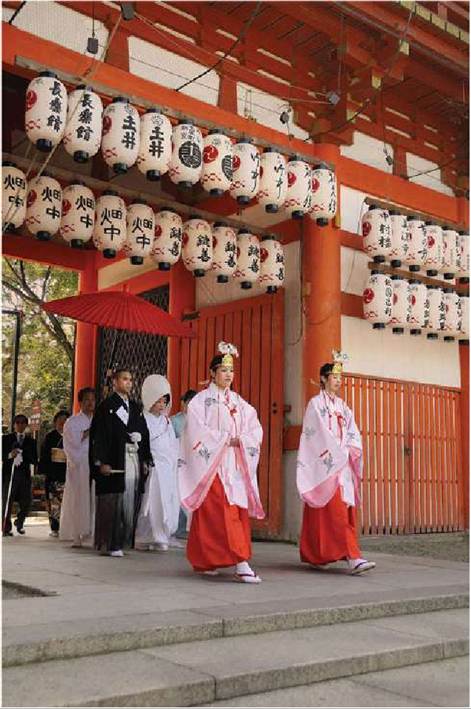
Entry of the bridal procession at a Shinto wedding, walking through the shrine gate, led by mikos. Yasaka Shrine, Maruyama Park, Kyoto, Japan.
The presentation component involves the offering of rice, fish, fruit, rice wine, water, and salt to the kami. There is absolutely no blood sacrifice in the offerings, as blood is considered repulsive and polluting in Shinto. The petition takes the form of the priest reverently reciting the norito (prayers or “words spoken to the kami”), which is usually written in advance in very elegant and flowery language and read aloud with a rhythmical cadence, ending with a vowel that slides down an octave in pitch with the volume tapering off slowly. The worshipers’ participation in the ritual event includes receiving purification by the priest, watching the dance of the miko, listening to the performance of the musicians, and, when over, taking small sips of rice wine called omiki, as well as bringing home leafy sprigs of the native Japanese sakaki tree to complete their encounter with the divine.
All of these activities are designed to create bonding between the worshipers and their kami, as well as among themselves.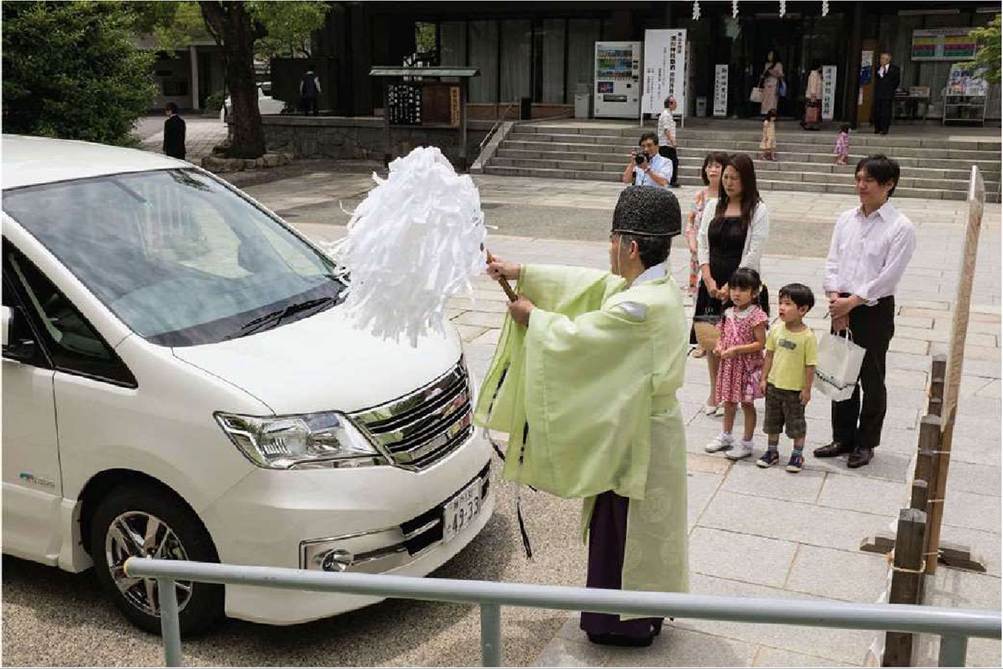
A family’s new car receives a blessing from a Shinto priest at Minatogawa Shrine in Kobe, Japan.
The Shrine
The Shinto shrine is generally the location where Shinto rituals are carried out. It is referred to as the jirya, the “dwelling place of the kami.” It is here that the kami can be approached and worshiped. In early Shinto and in some remote, isolated sacred locations today, the jinja can be a tree, a waterfall, or an extraordinarily shaped rock, which local people believe to be a source of spiritual power. These kami dwellings are filled with awe-inspiring mystery and great natural beauty. They are often marked with nothing more than a pile of rocks, or sometimes an ornamental rope to suggest the approach to sacred space. Most jinja, however, are enclosed areas with a few simple structures. Entry into them requires a purified body and, ideally, a purified mind, as godliness in Shinto is synonymous with cleanliness. Thus, the shrine is a holy space, of which the visitor is immediately reminded by two guardian stone lions, one on each side of the entry approach. (In the case of the shrines of the grain goddess Inari, the stone lions are replaced by foxes, which are believed to be her preferred messengers.) The entry path then passes under the distinctive Shinto crossbar gateway, known as the torii, whose literal meaning is “bird dwelling,” probably reflecting the earliest function of it as a roost for sacred birds.
In its most characteristic form, the torii of today is painted red and consists of two upright posts joined by one or two crossbeams, with the upper crossbeam gently curved in the middle toward the ground. This use of red paint and the curved line in the upper crossbeam indicates both Chinese and Buddhist influence and would not have been found in the early days of Shinto. The torii is not meant merely to be a decorative gateway.
It is a magical protective device that guards the shrine against all impurities and contaminants. Sometimes visitors have to pass under multiple torii, and on occasion an extended series of them are set so close together that they form a veritable tunnel.Video 9.1
[Please note: You must be using an online, browser-based eReader in order to view this content.]
X______________________________________________________________________________________________________________________________ >
Once inside the shrine grounds, all visitors perform a simple purification ritual by approaching a basin or trough of purified water called temizuya (usually a natural stone basin filled with clear water from the mouth of a sculpted dragon) and, using a bamboo dipper, taking a ladleful of water to rinse their mouth and hands. They are now ready for communion with the kami. The jinja generally has two buildings—the haiden and the honden. The haiden, the “worship sanctuary,” is the more public of the two. As its name implies, it is where the faithful can approach and worship the kami. One very noticeable feature of the haiden is the shimenawa, a huge rope made of rice straw that marks the boundaries of the building that has been purified or an area in which the kami might be present. Strips of paper called shide are hung from the rope.
Worshipers stand in front of the building, dap their hands twice, and ring a suspended bell to attract the attention of the deity. Then they bow their heads and, with hands clasped and sometimes eyes closed, silently utter their prayer of requests or thanksgiving. Occasionally, they also deposit offerings into a money chest. The haiden is also the place where the priests conduct their ordinary ceremonies on specific occasions on behalf of the community or the state but sometimes also purely private matters for individuals or small groups.
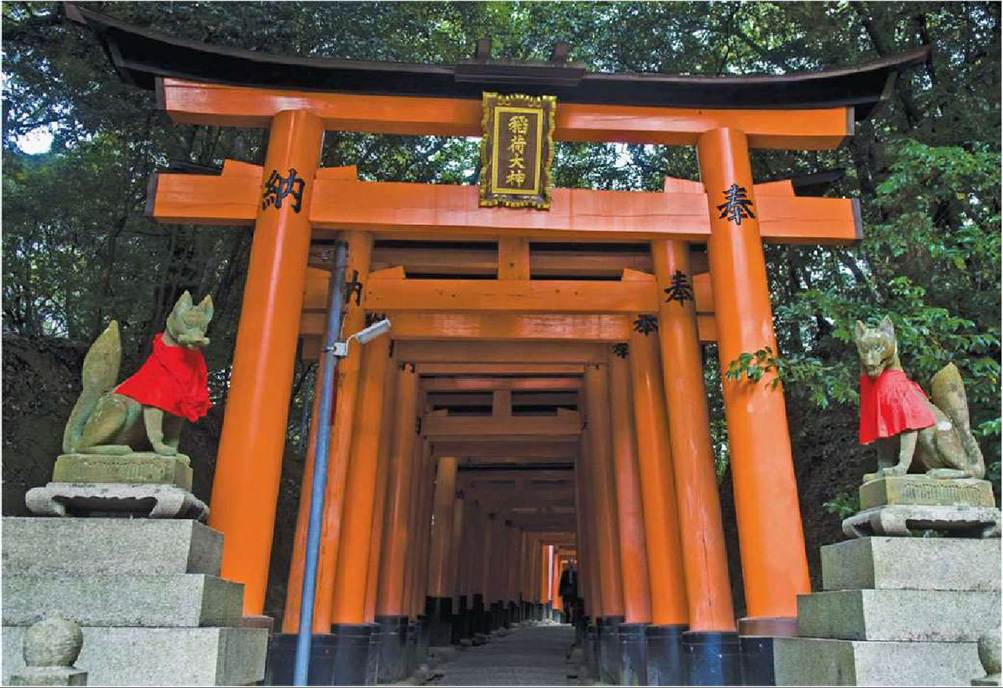
The Fushimi Inari-taisha Shrine in Kyoto, Japan, is dedicated to the god of rice and sake. Here, a tunnel of torii arches is guarded by a pair of foxes.
In the courtyard facing the haiden, visitors display their interaction with the kami through two specific objects: the ema, wooden tablets on which are written their pleadings with the kami for good marriage, safe childbirth, lucrative investment, even successful university entrance examinations; and the omikuji, paper fortunes wrapped around tree branches as a form of divination to gauge the future outcome of an undertaking.
Beyond the haiden and more hidden from public view is the honden (“main sanctuary”), the place where the kami supposedly resides. It is generally raised higher than any other structure on the premises and has steep access stairs in front and at the sides. Only priests can enter this building, for it is regarded as the shelter of the shintai, the “body of the deity” that is the very physical embodiment of the kami. This shintai is the kernel of sacredness, the symbolic representation of the kami honored at the shrine. In and of itself the shintai has little intrinsic value. It may be a stone, a scroll, a mirror, a sword, or a small statue. Yet it is regarded with such awe and reverence that even the priests are prohibited from gazing upon it or handling it except on special occasions. As the soul of Shinto holiness and cleanliness, the shintai is both inviolably sacred and pure.
The Grand Shrine at Ise, the main sanctuary of the Sun Goddess Amaterasu and the official shrine of the imperial family, deserves special mention in connection with this Shinto concern for purity and cleanliness. Though originally built more than thirteen centuries ago, it is completely tom down and rebuilt every twenty years for the purpose of regular purification and renewal. According to tradition, this practice was inaugurated in 690 ce by Emperor Jito.
The design, however, is meticulously replicated each time. The shrine we see today is supposedly an exact replica of the original one, and it was freshly built in 2013.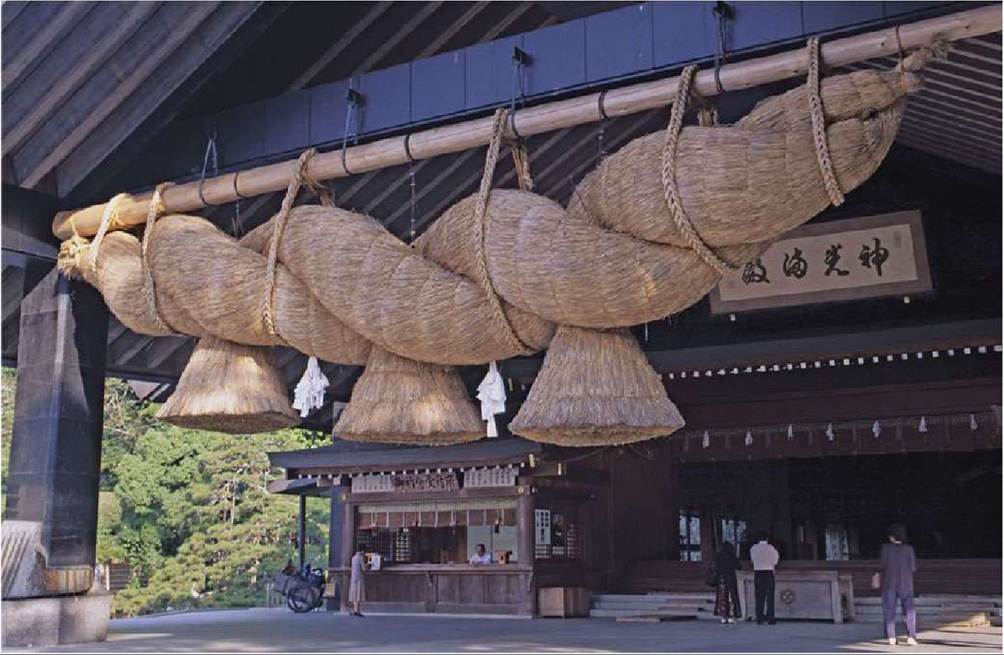
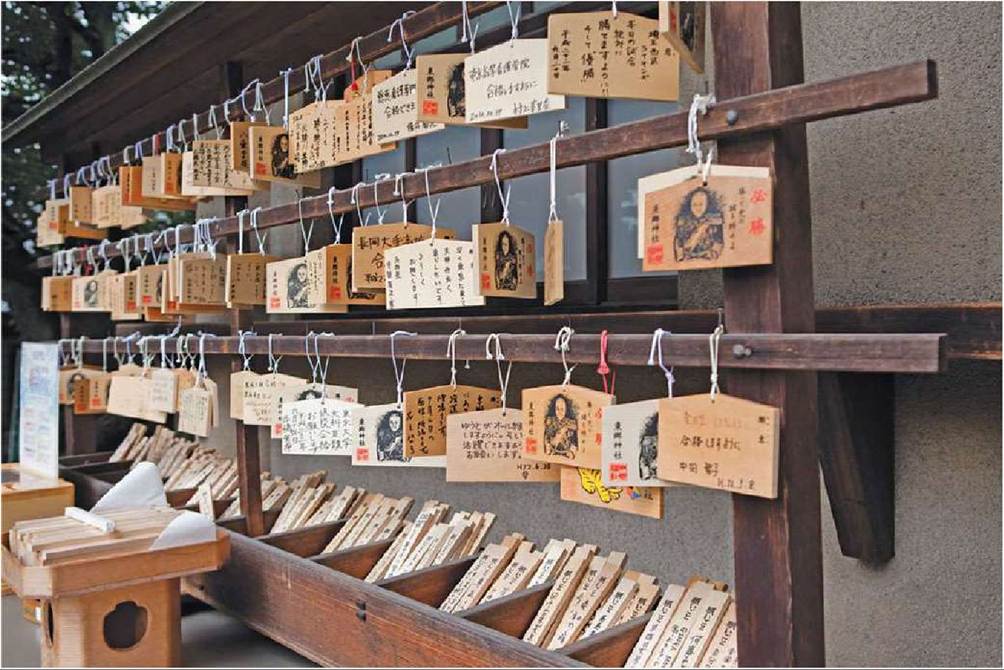
Top: The shimenawa marks off a sacred space at a Shinto shrine. Bottom: These prayer plaques express the hopes, aspirations, and requests for blessing of the shrine visitors.
The carpenters for the Ise Shrine come from families that have been hereditarily entrusted to undertake the task. Only natural cypress wood is used for the main structures, and only hand tools are allowed to work on the wood. There are no metal braces or nails used in construction, and the different parts of the shrine are held together by complex and intricate wooden joints. The cypress wood is carefully selected years in advance of the rebuilding and is paraded through different communities throughout Japan to drum up interest in and support for the shrine rebuilding project. Thus, the Ise Shrine is simultaneously the oldest and the newest, as well as the purest, shrine in Japan.
A shrine visit is a regular practice of most Japanese, even though many of them do not regard it as an overt or deliberate religious act.
The Family Shrine
In addition to worship at local, regional, and major national shrines, many Japanese also maintain miniature shrines at home for easy and ready access to the kami. Known as kamidana (“god shelf’), it has many components of actual shrines, induding the torii and shintai. The home shrine is usually hung on a wall or placed on a shelf above eye level. The kami worshiped is often the deity of the local shrine or that of the householder’s profession. Daily simple prayers are offered, as are fruit, water, and rice.