Rites of Renewal and Rites of Purification
As we learned earlier in this chapter, many Native American religions focus on humanity’s important role in maintaining balance with other elements of creation. This goal forms the foundation of many kinds of ritual practice, specifically those ceremonies known as rites of renewal.
Like the term suggests, rites of renewal seek to renew the sacred balance of all things. Such rites are often seasonal because they are designed to correspond with the cycle of planting and harvesting or moving herd animals for grazing. They may aim to enhance natural processes such as rainfall or the growth of crops.As mentioned earlier, the Yurok tell of the knowledge given to human beings by the Immortals, who lived on earth before humans. The Immortals taught human beings a ritual known as the Jump Dance, which restores the balance of the earth and renews the harmony that was present in the time of the Immortals. Along with a number of other rituals, the Jump Dance is performed during the World Renewal Ceremonial Cycle. This is a cycle of ceremonies that are performed by many Northern California peoples at various times of the year, and the purpose is to maintain the balance of all living things. In the Jump Dance, men march to a special place that has been sanctified by a priest, where they dance. By engaging in this religious practice, which imitates and repeats the words and actions that the Immortals taught humans, the mythic time is called into the present, and the earth is renewed. And because an entire community may participate in rites of renewal, they also enhance group solidarity.31
In North American religions from Mexico to Alaska, sweat lodge ceremonies are used to ritually purify and cleanse the body. They are rites of purification. In these ceremonies, participants build an enclosed structure that is filled with heated stones.
Pouring water over the stones generates steam. The steam has the power to cleanse the body and clear the mind of anything that might distract an individual from focusing on the divine. A sweat bath may be used to prepare for other ritual activities, such as the Sun Dance described in the opening part of this chapter. The ritual use of the sweat lodge encourages a bond between all those who bathe in it. And sometimes the cleansing power extends even beyond the inhabitants of the lodge to other elements of creation.3-In this way, this rite of purification also serves as a rite of renewal. The ritual use of the sweat bath is such an important part of religious practice that some states have been ordered by federal judges to provide Native prisoners access to sweat lodges.33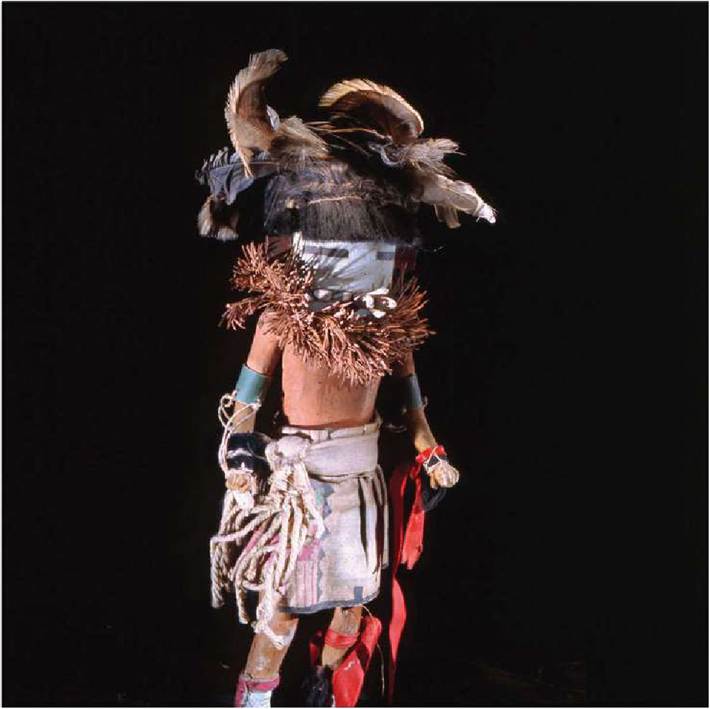
This Hopi kachina doll from the twentieth century might be used to remind children of the qualities of the kachinas.
Among Pueblo peoples such as the Hopi and Zuni, kachina dances are a type of renewal rite. As we discussed earlier in this chapter, when dancers wear the masks of the kachinas, they are thought to become imbued with the spirit of the kachina. Kachinas have the power to bring rain and enhance fertility. Among the Hopi, who recognize over 200 kachina spirits, several dances take place during the part of the year between the winter solstice and the summer solstice. The songs used with the dances often call for fertility of the land, for rainfall, and for the flourishing of crops. Rites of renewal also often have significance beyond these material aims. The Hopi dance for rain calls for nourishment not just of crops but also the cosmos. In the Hopi belief system, the spiritual qualities of rain underlie all of existence. Thus, rain dances rejuvenate the entire cosmos, not just the crops in a particular locale.34
The kachina dances also teach young people about ethics and morality.
Children are not allowed to see the dancers without their masks. This is so the children will strongly associate the dancers with the kachinas and think of them only as representing the idealized qualities the kachinas possess. However, when they are old enough, children learn that their parents or other relatives are behind the masks. This disillusionment is part of their religious development, as children learn that the world is not always as it seems.35Self-Assessment 2.3
[Please note: You must be using an online, browser-based eReader in order to view this content.]
North American Religions in the Twenty-First Century
Native American religions are not relics of the past but rather are living traditions that continue to develop and change. Today, more than 700 tribal nations are recognized in the United States, and Canada recognizes 650 First Nations. Mexico does not recognize tribal nations in the way the United States and Canada do, but it has a larger indigenous population: nearly 20 percent of the people of Mexico identify as indigenous, as opposed to only 1-2 percent in the United States and about 5 percent in Canada. One of the major challenges Native American religions have faced throughout North America is the spread of Christianity, particularly through European colonialism. However, even in those areas that have seen widespread conversion to other religions, elements of indigenous religions have often been maintained and even incorporated into the practice of the colonizing religions. Furthermore, many non-Native peoples have found Native American religions attractive because they offer a compelling and seemingly earth-centered spiritual alternative to other religions. However, Native peoples have responded to such interest from non-Native spiritual explorers in different ways. Some welcome this interest, and others reject what they view as a damaging appropriation of Native religious ideas by non-Native peoples.
As the twenty-first century continues to unfold, it is likely that Native peoples will continue to find great spiritual meaning and religious fulfillment in the teachings and practices of indigenous religions. Although many Native Americans are Christians today, Native religious ideas often coexist harmoniously with Christian teachings and practices. In many communities, Native Americans are advocating a resurgence of indigenous religious ways. This has been particularly important in social and environmental justice movements such as the Standing Rock resistance to the Dakota Access Pipeline and in discourses concerning mitigation of the effects of climate change, as we have seen with wildfires in the western United States and Canada. Pan-Indian or intertribal interest in certain types of religious practice and modes of mobilization, as we saw with Standing Rock, has been important thus far in the twenty-first century. Although it is important to recognize the diversity of Native American religious traditions, it is also essential to acknowledge that pan-tribal movements and ceremonies can be an important means of fostering a collective Native American identity.
In this chapter, we have learned about the teachings and practices of many indigenous North American religions. Although these religious traditions are numerous and diverse, we have identified some common elements that we find in many Native North American religions. Teachings are commonly passed down orally through sharing stories or sacred narratives. The narratives frequently recount the creation of the earth by sacred beings or powers, and the origins of humanity and ancestral peoples in the Americas. Many Native traditions also teach the interconnectedness of all living things—including humanity—and consequently emphasize the importance of maintaining balance in the natural world. We have noted that Native American religions do not usually make stark distinctions between religion and other dimensions of social life, and thus many aspects of everyday life might be seen as imbued with a sacred quality or religious dimension.
We have also learned about the consequences of colonization and the spread of Christianity in North America, and that even through the devastation of colonialism, indigenous spirituality has persisted in many forms.SEEKING ANSWERS
What Is Ultimate Reality?
Myths contain sacred knowledge about ultimate reality and the nature of the world. In Native American religions, the world is believed to have been created by creator deities. The entire world, and the many elements within it—including human beings—may be believed to be infused by the spiritual essence of a supreme being, or Great Spirit.
How Should We Live in This World?
In most Native American religions, myths provide the foundations for the way people should live their lives. Humans are one part of the general order of existence and live in a reciprocal relationship with the land, plants, and other animals. Myths teach that it is the responsibility of humans to maintain balance, order, and right relationships with other elements of creation.
What Is Our Ultimate Purpose?
Native American religions differ in terms of humanity’s ultimate purpose. Some religions focus on humanity’s role in maintaining balance with the natural world, and certain religious practices, such as the Jump Dance, aim to do this. Maintaining this balance can improve the human condition, and upsetting the balance can have terrible consequences. Many Native American religions conceive of life and death as cyclical in nature. In Native religions, the transition of a person from birth to death is thought to be comparable to the cyclical nature of the seasons of the year. In some religions, the deceased transitions to the land of the dead, which may resemble this life.
REVIEW QUESTIONS
For Review
1. Why is it difficult to make generalizations about Native American religions?
2. Many Native American religions emphasize the interconnectedness of all things. How does this play out in religious practice?
3. What are some common themes in Native American mythology? What do these themes teach the listeners?
4. What was the significance of the Ghost Dance? Do you see any parallels to more recent resistance movements?
For Further Reflection
1. How do Native American traditions answer some of the great questions that many religions address? What is unique to Native traditions? What do they share with other traditions?
2. How are Native American religions tied to specific places and landscapes? What are some examples of the significance of this connection? Do you see this in other religions described in this book? Why do you think some religions emphasize ties to specific locales?
Chapter 2 Self-Quiz
[Please note: You must be using an online, browser-based eReader in order to view this content.]
Chapter 2 Flashcards
[Please note: You must be using an online, browser-based eReader in order to view this content.]