Ritual Practices
Zarathushtra opposed many traditional Iranian rituals, especially animal sacrifice, but tradition says he established new rituals that were in accord with his teachings. To this day, Zoroastrianism is a tradition rich in ceremony and ritual, with regular activities carried out both within and without temples or other religious buildings.
The most commonly practiced ritual activity is prayer.GLOBAL SNAPSHOT
Zoroastrianism in New York
Far from the oldest Zoroastrian communities in Iran and India, many of today’s Zoroastrians live in a diaspora whose most significant populations are in the United States, Canada, Singapore, Hong Kong, and Australia.
Zoroastrians in the diaspora are well aware that their populations are at risk. The greatest threat is posed by assimilation into surrounding non-Zoroastrian communities, primarily through intermarriage and conversion to other religions. Because Zoroastrianism teaches that every individual must choose to do what seems right, decisions that contribute to the decline in the number of Zoroastrians must be respected. The key to their survival is to promote cohesion, inclusion, and education among those who choose to remain fully involved in the Zoroastrian tradition.
The members of ZAGNY, the Zoroastrian Association of Greater New York, have put these principles into action with great success. Founded in 1973, ZAGNY has a growing membership of nearly 250 households in New York, New Jersey, and Connecticut and has recently built a beautiful new temple in Pomona, New York. The association includes women as well as men on its board of directors, offers religious education classes for children, and sponsors a variety of social events, such as dinners, dances, an annual summer picnic, and celebrations of both Nowruz (the Zoroastrian New Year celebration) and the western New Year. ZAGNY strives to ensure that everyone feels welcome and supported, and so its temple includes a Teen Room where young people can socialize, a group for seniors who call themselves the Z-Goldies, and a scholarship fund for college students.
Members of ZAGNY keep up with their organization on its Facebook page and find valuable resources on its website, which offers links to news stories, Zoroastrian scriptures, articles on religious topics, and an online Zoroastrian Store.Adherents of one of the world’s oldest religions, the members of ZAGNY are also modern Americans who are working effectively to ensure Zoroastrianism’s place in the future.
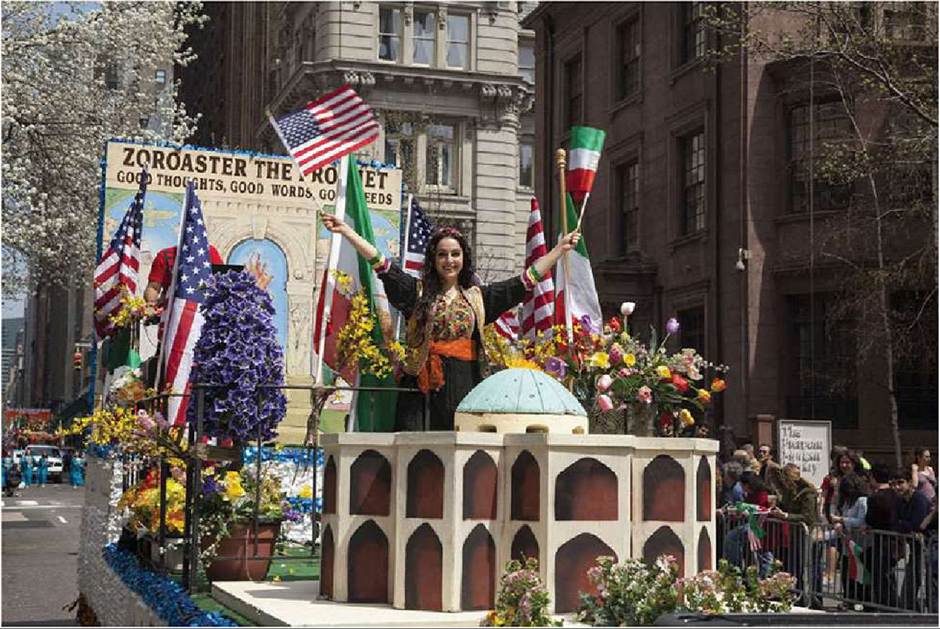
Afloat pays tribute to Zarathushtra (Zoroaster) and the Zoroastrian motto, “good thoughts, good words, good deeds,” at the Persian Day Parade in New York City.
VOICES:
An Interview with Rustom Ghadiali
Rustom Ghadiali is a resident of Singapore, home to a community of about 200 Zoroastrians. This community was founded in the early twentieth century by Parsis who immigrated from India. Mr. Ghadiali is a Zoroastrian priest with a strong interest in the history and transformations of the tradition through time.
Zoroastrianism is an ancient religion. Has it taken steps to adapt to new conditions in the modern world?
The Zoroastrian religion has taken steps to adapt to new conditions in the modern world in some countries. In Iran, as it is difficult to get young boys to join religious orders and become priests, eighteen girls for the first time have become initiated as priests and carry out all rituals. Zoroastrians in India are still very orthodox and do not accept the same.
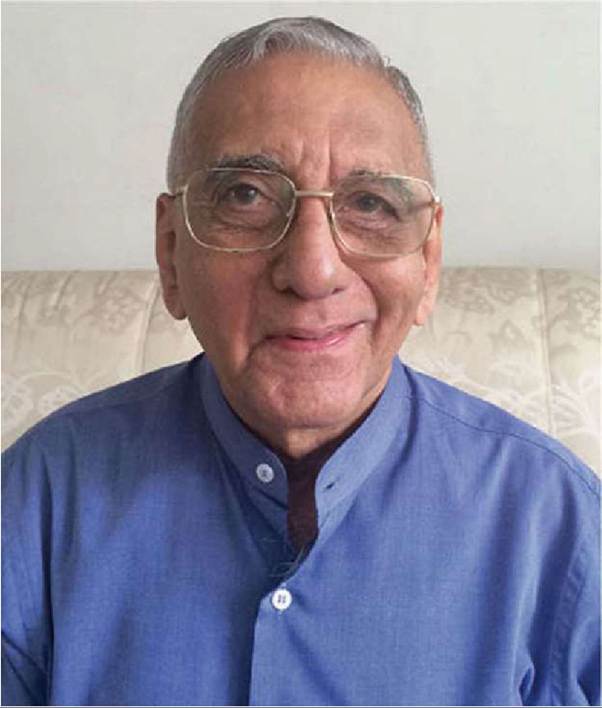
Rustom Ghadiali.
What are the greatest challenges faced by Zoroastrians and Zoroastrianism today?
The greatest challenges faced by Zoroastrians and Zoroastrianism is that their numbers are dwindling. This is because of late marriages, not having children, and not being allowed to marry outside the community.
What features of Zoroastrianism are most important to you in your daily life? Why?
Prayers are most important in our daily life, and thanking God for good health and happiness.
How common is the traditional Zoroastrian practice of exposing the bodies of the dead, and how is it carried out?
The practice of exposing the bodies of the dead to the birds is followed in India today, but it is slowly disappearing, as it is difficult to have vultures in urban settings. Also, vultures are dying as the bodies of sick Zoroastrians contain medicine which kills the vultures. The orthodox Zoroastrians in India are struggling to accept changes in traditional practices and to accept burial or cremation. It is only a matter of time when the practice of exposing the dead will disappear and burial or cremation will be accepted.
You are a Zoroastrian priest. What are your most important responsibilities in worship and in serving the Zoroastrian community?
The most important responsibilities of the priest are the carrying out of rituals and praying for any and all Zoroastrians. The religion as practiced in India and as practiced abroad has a lot of variance. If all were to follow the Gathas, the original verses of the Prophet, then there would be harmony. Scholars and the High Priest, however, enforce their own views. Also, the priests are not being looked after by the temples where they work and must depend on the community to pay them as they pray. They prefer to study and get educated in commercial subjects, so that they can earn and be independent.
Prayer and Purification
Zoroastrians pray five times daily, during five periods determined by the position of the sun: dawn until noon, noon until midafternoon, midafternoon until sunset, sunset until midnight, and midnight until dawn. For many Zoroastrians, this amounts to more than one hour of prayer per day. Zarathushtra himself is believed to have prescribed formal prayer. Its importance has endured throughout the centuries.
Daily prayers often coincide with the kusti ritual, which also should be performed several times per day. This ritual involves untying and tying the kusti cord while standing in a lighted space and reciting ritual texts.
Recalling Yasmin’s investiture ceremony described in this chapter’s opening, we can see that the kusti ritual is a repetition in shorter form of this very important rite of passage.The kusti ritual and the recitation of prayers require that the worshipper undergo ritual purification using water, washing the face, forearms, hands, and feet. Zoroastrians thus are expected to undergo rituals of purification on a daily basis. These ritual ablutions take only a few minutes. Longer, more elaborate rituals of purification are performed on special occasions. We have already seen, for example, that Yasmin took a sacred bath before her Navjote ceremony. This cleansing ritual, known as the Nahn, is also performed individually by men and women just before their wedding ceremonies. The Barashnum takes ten days and must be performed by a priest during the daylight hours and in rooms especially designated for this purpose. Special substances are consumed, including pomegranate leaves, ashes from a sacred fire, and consecrated bull’s urine. The Barashnum is required in cases of severe pollution or as preparation for major ceremonial events, such as marriage or initiation into the priesthood.
Where Zoroastrians Worship
The strong emphasis on purity is evident in the designation of certain spaces as appropriate for worship. By definition, temples and other sacred precincts are set apart from the impurities of the world outside. Spaces such as private homes can be used for religious activities as long as they are pure in a religious sense. In India and Iran, this means that no non-Zoroastrians may be present (elsewhere, such as North America, non-Zoroastrians are not considered to have a polluting influence). Indeed, rituals often are performed in private homes, especially in India and Iran. Older homes are particularly suitable as they are believed to be inhabited by the spiritual presence of deceased ancestors—making these spaces desirable for rituals performed on the souls’ behalf.
In India, and especially in large cities like Mumbai, most religious activities occur in temples.Temples include rooms and water wells specifically designed for purification rituals. All temples provide a source of clean water. Special kitchens are equipped for preparation of food, some to be used in rituals and some to be consumed in communal meals. Temples have various other rooms, including at least one meeting hall. The most important rooms are the ceremonial room and the fire chamber.
In the ceremonial room, the site of several important rituals, the floor is inscribed with grooves that demarcate a rectangular space 3.5 meters by 2 meters. The rituals performed within this space are of a special category and are named “inner liturgies.”
Partially open to the sky, the fire chamber consists of a stone floor with a domed covering, vented in order to permit the fire to bum. This in turn is protected from rain and from the sun’s rays by a partial roof.
Compare the Zoroastrian temple with places of worship in other religions.
Sacred Fire
The supreme significance of fire for Zoroastrianism is clearly evident in the meticulous categorization and care of fire and in its central role in ritual activities.
A fire is consecrated through ritual practices. Once consecrated (and thereby sacred), the dying out of the fire is held to be a catastrophe. Sacred fires therefore are tended veiy carefully. As we have already observed, the fire chamber in a temple is covered over in such a way as to prevent rain from falling on and extinguishing the fire. We have also seen that fires generally are not extinguished but rather are allowed to bum out. Fires are protected from coming into contact with various polluting objects, including corpses and the bodily fluids of the living, such as saliva. Fires are tended and fed with dried wood several times per day.
There are three main categories of sacred fires, the highest of which is the Atash Behram (“victorious fire”).
India had over 100 Zoroastrian temples at the beginning of the twentieth century. Today, only eight of these fires exist. One of them is said to have been consecrated in the eighth century; others did not begin to burn until the early twentieth century. Consecration of the Atash Behram takes a group of priests nearly a full year to accomplish, involving intricate steps of purification.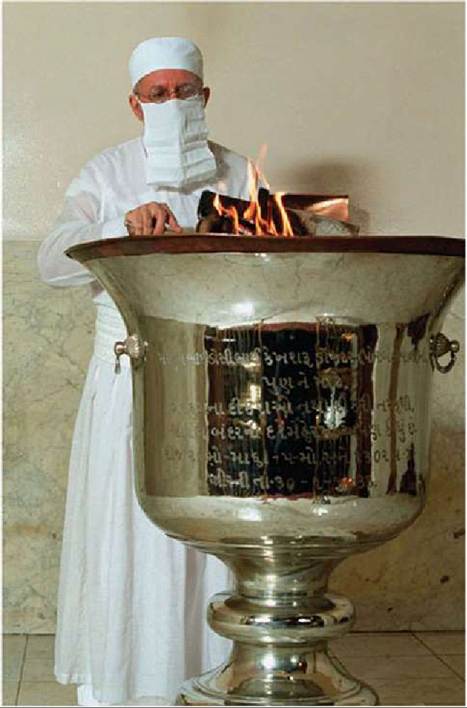
A Pars! priest tends the sacred fire within a temple in India.
Fire is employed in various ways in ritual practices. The most important of the inner liturgies, those that are performed within the specially marked rectangular space in a temple’s ceremonial room, is Yasna, the sacrifice of the sacred drink haoma before a fire. The extensive preparations for Yasna include the preparation of the haoma, a mixture of water, pomegranate, ephedra, and goat’s milk. During the three-hour ritual, the entire Yasna, the seventy-two-chapter portion of the Avesta, is recited while the sacred fire is fueled.
Priests
The Yasna liturgy and other ritual activities in the temples are orchestrated by priests, who also officiate at rituals outside the temple. As we have seen, Yasmin’s Navjote ceremony was at her family’s home, but such events can also be held in public places.
Priests have always occupied an important place in Zoroastrian society. As we have observed, in his description of Persia, the ancient Greek historian Herodotus emphasized the influence of Zoroastrian priests, whom he called Magi. The training and precise roles of priests and the organizational features of priesthoods have varied widely depending on cultural circumstances. Throughout the centuries, priesthoods have been made up of men.
Today, the nature of the priesthood varies somewhat between India and Iran. In India, training for initiation into the priesthood mainly involves memorization of sacred texts used in rituals. The training normally begins when the candidate for initiation is still a youth, and it takes several years. In Iran, where Zoroastrians are generally less insistent on maintaining traditional rituals, priests are not expected to be expert in the performance of rituals, and many work as priests in addition to having careers. It is normal for all Zoroastrian priests to many and raise a family, although until the twentieth century priests were expected to marry within priestly families.