Holy Days and Rites of Passage
To this point, we have considered Zoroastrianism’s strong emphasis on ritual activities as they are practiced daily and occasionally on a random basis. Here we consider the array of rituals and ceremonies that occur at specific times—on the various days of the year that are designated as especially holy and at the crucial points in a person’s lifetime that are marked out as rites of passage from one stage to another, as, for example, the investiture ceremony we observed in the chapter’s opening.
The Zoroastrian Calendar
Most religions feature their own special calendar of holy days and periods. The Zoroastrian calendar is more elaborate than most, connecting days of the month and months of the year to various deities.
Since ancient times, the Zoroastrian calendar has been based on twelve months of thirty days each, although during the Achaemenid period five days were added to the twelfth month. (Today, because of various attempts to align the calendar with the solar year, there are three Zoroastrian calendars, one or the other favored by each community.)
The first day of the month is named for (and dedicated to) Ahura Mazda. The next six days are named for the other six Amesha Spentas. The other days are named for various yazatas; for example, the sixteenth day is named for Mithra. The twelve months also bear names of divinities. Whenever one of the days aligns with the month, such that the same deity is honored for both, Zoroastrians celebrate a feast for that deity. And so, for example, the sixteenth day of the seventh month (September/October) is celebrated in honor of Mithra. To cite another example, the fifth day of the twelfth month (February/March) is celebrated in honor of Spenta Mainyu, the Holy Spirit of Ahura Mazda.
Annual Holy Days Zoroastrians observe seven obligatory holy days, traditionally believed to have been established by Zarathushtra.
Each of these holy days honors one of the Amesha Spentas, and each celebrates aspects related to its divine benefactor. For example, the holy day associated with Spenta Mainyu is named All Souls and celebrates, along with the Holy Spirit of Ahura Mazda, humankind, Ahura Mazda’s primary creation.Of the seven obligatory holy days, the one that is most popularly observed is Nowruz (or No Ruz), the Zoroastrian New Year’s Day. Nowruz honors the Amesha Spenta Asha Vahishta (“Righteousness”), who is associated with creation of the very special element, fire. Nowruz originally was celebrated at the time of the vernal (spring) equinox and still is by most Zoroastrians, regardless of which of the three calendars they use. Throughout western Asia, people of all religious and ethnic backgrounds celebrate New Year’s Day at the time of the vernal equinox. Even for non-Zoroastrians, these New Year’s celebrations tend to show vestiges of Zoroastrian influence, for example, the symbolic significance of fire.
For Zoroastrians, the spring equinox is a symbol writ large of the triumph of light over darkness. The holy day of Nowruz features a sense of renewal of personal commitment to righteousness and of communal ties. It is richly celebrated, with a special table on which seven treats are offered, all with names beginning with the same Persian letter: wine, sugar, milk, syrup, honey, candy, and rice pudding.
Video: Zoroastrian New Year
Death and Funeral Rites
In this chapter’s opening, we witnessed the investiture ceremony of Yasmin, a nine-year-old Iranian girl. This is Zoroastrianism’s primary rite of initiation, marking the passage from youth to adulthood. The most elaborate religious activities signifying a rite of passage occur at death.
According to Zoroastrian teachings, death involves the separation of the soul, the spiritual element of the person, from the physical body. As we have seen, the soul is believed to undergo judgment by crossing the Chinvat Bridge, where it encounters the Daena, a feminine being who embodies the individual’s ethical quality.
Zoroastrian funeral rites are intended to free the soul for this journey, while also attending to the body in a manner that ensures as much purity as possible.From a Zoroastrian perspective, a corpse is inevitably a polluting object. It needs to be kept at a distance from water, fire, plants, and even fertile ground. This insistence on the attempt to maintain purity helps to explain the famous Zoroastrian practice of exposing corpses on dakhmas, or “Towers of Silence” (a British neologism from the colonial period), elevated circular structures with a platform at the top on which bodies would be left. Rather than cremating or burying their dead—as fire is holy and unfit for contact with a corpse, and the ground is sacred because it bears life—corpses are exposed to the elements, to be devoured by vultures and other scavengers. This is deemed to be the manner of disposal that best maintains purity. Today, in part because of laws prohibiting this traditionally preferred manner of disposal, sometimes bodies are buried, provided that burial vaults are used that prevent any chance of contact between the corpse and the earth. A form of electric cremation, devoid of flames, is also sometimes used.
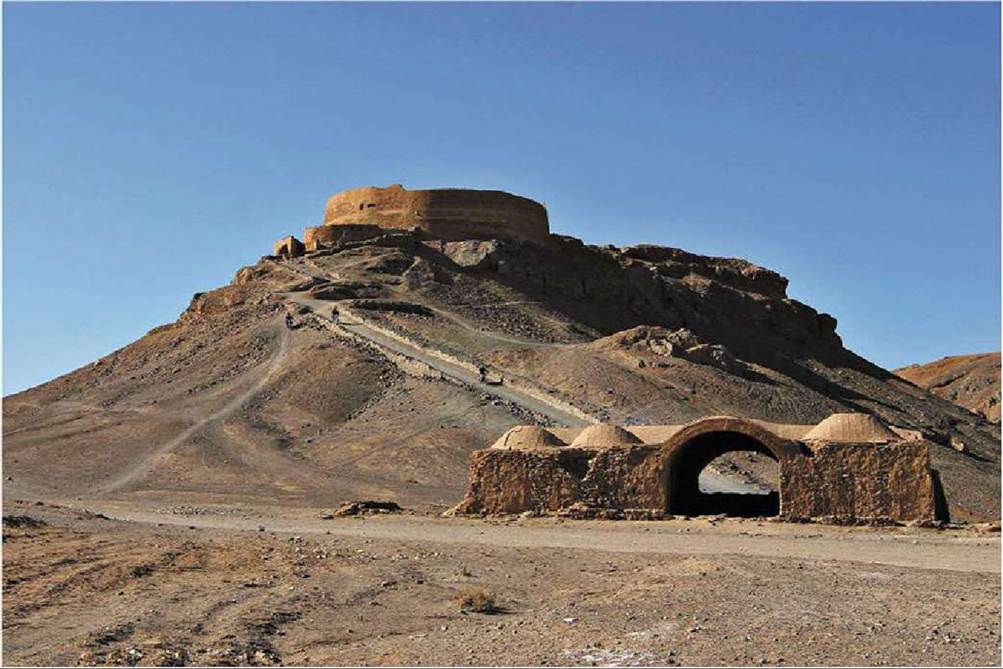
The dakhma, or “Tower of Silence,” provides a space for exposure of the dead body to vultures and to the sun. This dakhma is located in Yazd, Iran.
VISUAL GUIDE
Zoroastrianism
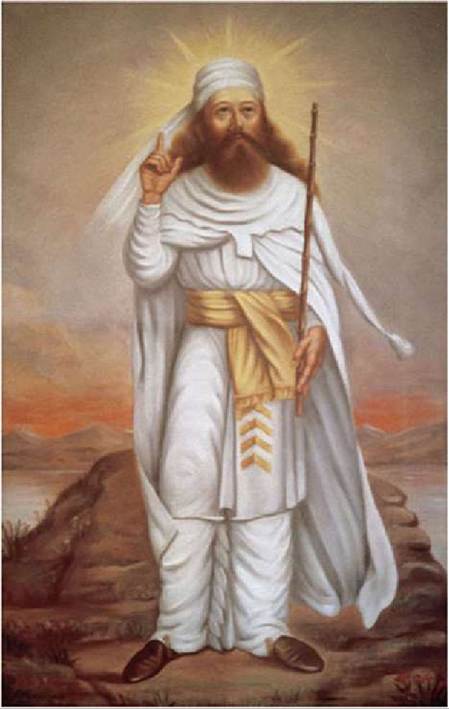
Zarathushtra. Copies of this painting of Zarathushtra are found in fire temples and Zoroastrian homes throughout the world. The original is found in the fire temple in Yazd, Iran.
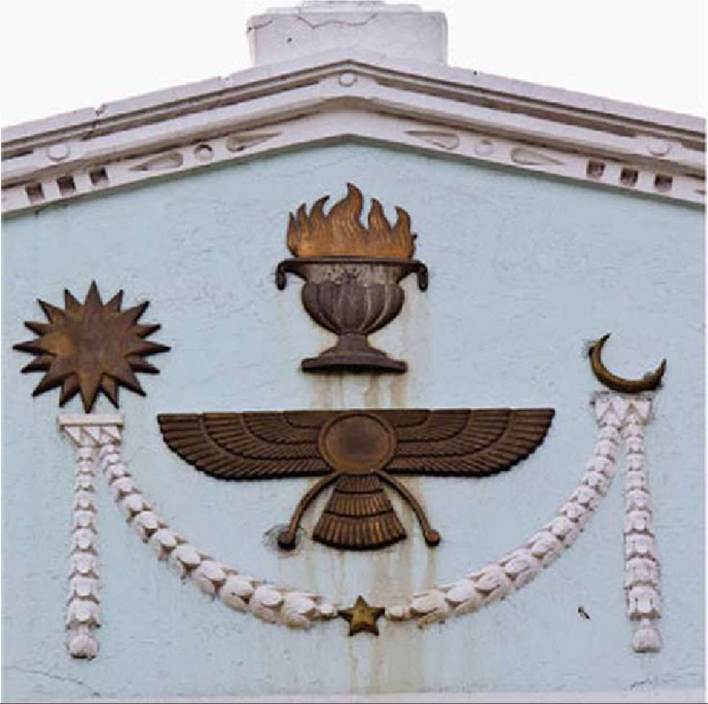
Zoroastrian symbols—the sun, a fire, the moon, and the Faravahar—thought to represent the fravashis. These symbols adorn a Pars! temple in Ahmadabad in the state of Gujarat, India.
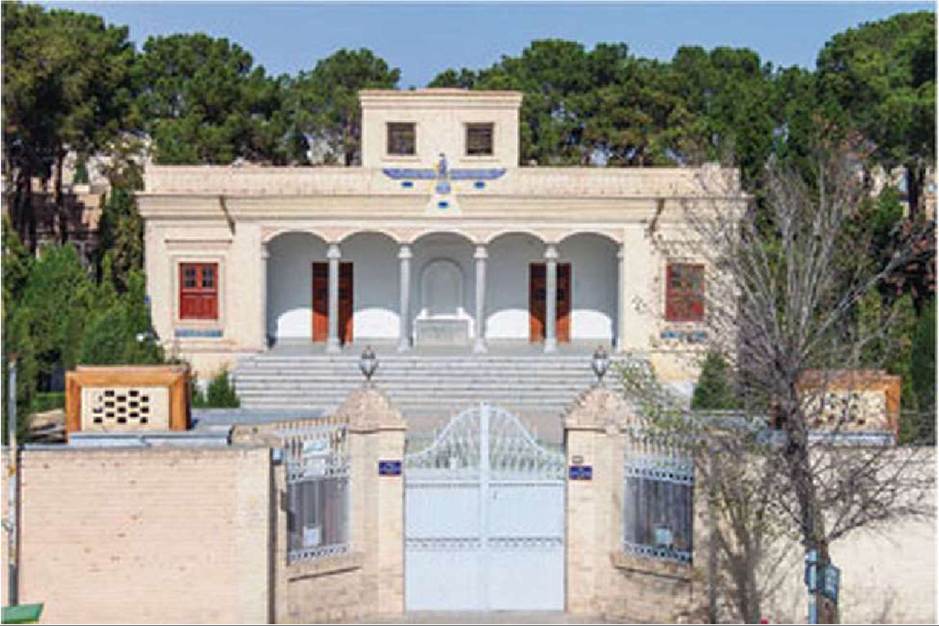
Ateshkadeh Fire Temple. The Ateshkadeh Fire Temple in Yazd, in central Iran, is perhaps the most famous of the fire temples found worldwide in Zoroastrian communities. Although the structure itself was built in the twentieth century, the sacred flame inside is said to have burned continuously since 470 ce. Zoroastrians believe that fire is symbolic of purity and of Ahura Mazda.
More on the topic Holy Days and Rites of Passage:
- Rites of Passage
- Fertility Rites
- THE BRONTOSCOPIC CALENDAR
- The Zoroastrian Community: Social and Ethical Responsibilities
- The Middle Passage
- Sanctuaries and rites
- 10 Zoroastrianism
- Rites of Renewal and Rites of Purification
- Brodd Jeffrey, Little L., Nystrom B., Platzner R., Shek R., Stiles E.. Invitation to World Religions. 4th edition. — Oxford University Press,2022. — 1196 p., 2022
- On 25 October 1714, Charles XII set out on his famous ride across Europe. Riding at breakneck speed and incognito, he covered the distance between the Ottoman outpost at Pitesti and the Swedish fortress in Straslund in an incredible thirteen days and four and a half hours.