10 Zoroastrianism
Jeffrey Brodd
California State University, Sacramento
Layne Little
University of California, Davis
Bradley Nystrom
California State University, Sacramento
Robert Platzner
California State University, Sacramento
Richard Shek
California State University, Sacramento
Ehn Stiles
University of Nevada, Reno
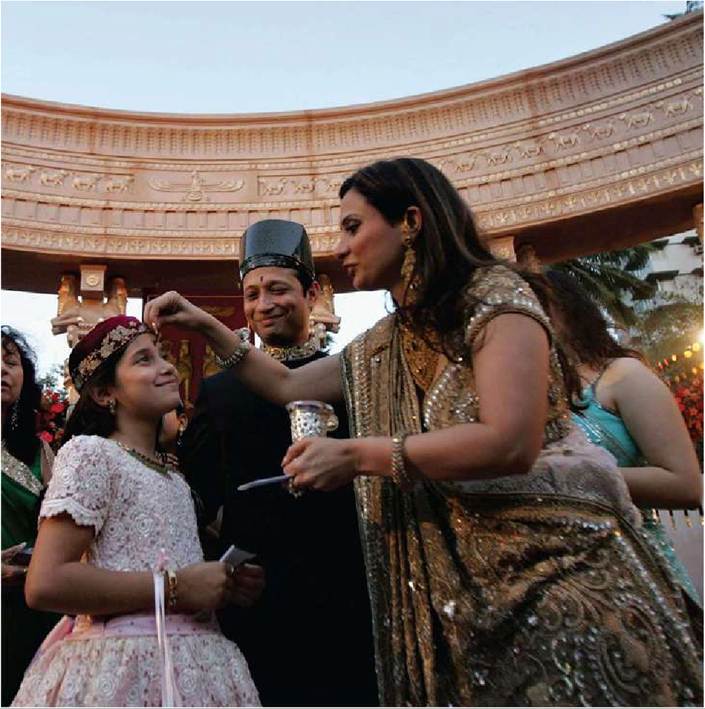
Her kusti cord tied around her wrist, a young girl beams during her Navjote ceremony in Mumbai, India, as her proud parents look on.
TODAY IS A JOYFUL DAY for nine-year-old Yasmin and her family, who belong to the community of Zoroastrians, or Parsis, in the Indian city of Mumbai. They are celebrating Yasmin’s initiation into the Zoroastrian religion in a ceremony that Parsis call Navjote. The Navjote is performed by Zoroastrians worldwide. Iranis, the Zoroastrians of Iran, where Zoroastrianism began, call it Sedreh Pushi—“putting on the sedreh”—which refers to a central feature of the ceremony.
Yasmin began preparing for her Navjote some time ago, learning the essential features of her religion and memorizing important prayers she would need to recite. Earlier today, she bathed in sacred water in a purification ritual. She then joined an assembly of her family and friends where, in the presence of a flame burning fragrant sandalwood and frankincense, she sat before the officiating priest, ready for the Navjote to begin.
The Navjote was a complicated ceremony with several essential parts. First, the priest led Yasmin in a prayer of repentance. This was followed by a declaration of faith in which Yasmin acknowledged Zoroastrianism as the true and perfect religion given by God to the prophet Zarathushtra. The priest then invested, or “clothed,” Yasmin with two sacred articles: The first was the sedreh, a white cotton vest, often called a “sacred shirt,” that symbolizes the path of righteousness.
From now on, Yasmin will make a practice of wearing this undergarment beneath her outer clothing. The second was the kusti, a sacred cord the priest tied around Yasmin’s waist. Woven from seventy-two threads spun from lamb’s wool— seventy-two also being the number of chapters in the Yasna, one of Zoroastrianism’s most ancient sacred texts—the kusti had been carefully produced by women in Yasmin’s community and then consecrated by a priest. From this day forward, the kusti will serve Yasmin as a visible symbol of her full membership in the Zoroastrian community. After her investiture with the sedreh and kusti, Yasmin recited a statement of faith in which she proclaimed her new identity as a Zoroastrian and her commitment to the Zoroastrian ethical ideals of good thoughts, good words, and good actions. The ceremony conduded with the priest’s benediction, in which he asked God to bless Yasmin with health, long life, and piety.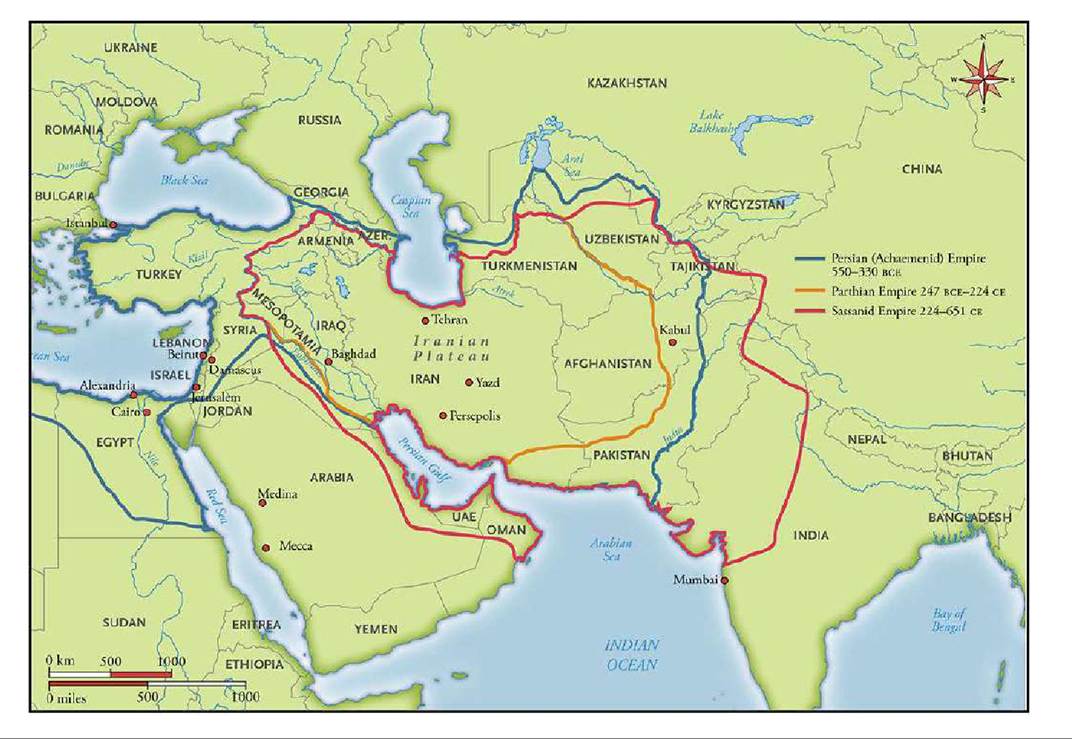
Significant sites in the development of Zoroastrianism.
Click here to learn more in an interactive map.
Yasmin’s Navjote has been a happy occasion for all involved. When the ceremony is over, she joins her family and friends in a celebration in which she is showered with gifts and congratulations. Everyone present is pleased to have witnessed the teachings of arguably the world’s oldest living religion passed on to a new generation.
TIMELINE
Zoroastrianism
| 2000 все | Indo-lranian tribes migrate to the Iranian Plateau. |
| 1300-800 BCE | Most scholars place the life of Zarathushtra within this period. |
| 1300-550 BCE | Composition of the Avesta. |
| 550-330 BCE | Persian (Achaemenid) Empire. Most of the Achaemenid kings were Zoroastrians. |
| 247 bce-224 ce | Parthian Empire. Zoroastrianism loses its royal endorsement, existing as one of many religions. |
| 224-651 | Sassanid Empire. Sassanid kings declare Zoroastrianism to be the official state religion. |
| 651 | Arab invaders topple the Sassanid Dynasty. Islam begins to eclipse Zoroastrianism in Iran. |
| 700-900 | Composition of most chapters of the Bundahishn. |
| c. ninth century | Iranian Zoroastrians flee to western India, where they are known as Parsis (Persian for “Persians”). |
| 900-1000 | Composition of the Denkard. |
| 1878 | The first fire temple in the United States is built in Florence, Arizona. |
Click here to learn more in an interactive timeline.
This chapter explores the teachings, history, and way of life of Zoroastrianism—also known as Mazdaism or Zarathushti din. Zoroastrianism has a very long history. Its founder, Zarathushtra (commonly spelled “Zarathustra,” and called “Zoroaster” by the ancient Greeks), may have lived as long ago as c. 1300 все, in which case Zoroastrianism is the world’s oldest living religion. This introductory study, while acknowledging that Zoroastrianism has taken different forms throughout its history, presents the religion mainly as it is practiced today by the majority of Zorastrians, who often refer to themselves as Zarathushtri or, especially in Mumbai, as Parsis (“Persians”). We begin by focusing on its principal teachings.