The Teachings of Zoroastrianism
Through the centuries, Zoroastrians have lived in evolving cultural circumstances—most notably the rise of Islam in the seventh century ce and the subsequent migrations of Zoroastrians to India and other lands.
In this chapter’s section on the history of Zoroastrianism, we explore some of these circumstances in more detail, paying careful attention to Zoroastrian texts from different eras and how they reflect changing perspectives. Here, we describe in more general terms the central teachings of Zoroastrianism that have endured until today. Some of these teachings date from the religion’s origins, whereas others have developed in much later periods.The two most notable Zoroastrian teachings are monotheism and dualism—the ongoing opposition between the forces of order and chaos, of good and evil, understood to be played out on a cosmic level.
Monotheism and Dualism
Zoroastrians are monotheists, believing in one God, Ahura Mazda, who is perfectly good, all-powerful, and eternal. Like the scriptures of other monotheistic religions—such as Judaism, Christianity, and Islam—those of Zoroastrianism speak of other supernatural beings. We will discuss these later, but two must be mentioned briefly here: Spenta Mainyu, the “Holy Spirit” of Ahura Mazda, and Angra Mainyu, the “Foul Spirit.” These “Twin Spirits” are emanations from Ahura Mazda and represent the realities of order and goodness, on one hand, and chaos and evil, on the other, that exist in countless oppositional forms; for example, life and death, growth and decay, and right and wrong. As we will see, Zoroastrians believe that Ahura Mazda is at work in history orchestrating the gradual process by which the cosmos will ultimately be purged of evil and chaos so that goodness and order will prevail.
Thus, there is an unmistakable dualism in Zoroastrianism. In fact, there are two forms of dualism.
Interrelated with the dualism of order and chaos is the dualism of spirit and matter.The Dualism of Spirit and Matter
Zoroastrianism teaches that reality is divisible into two realms: that of spirit and thought and that of matter and physicality. Everything in existence is the result of the incorporation of spirit within the realm of matter. Readers familiar with Platonic philosophy will recognize similarities with Zoroastrian spirit/matter dualism—and, indeed, Zoroastrianism might have influenced Plato. In turn, Greek philosophy, Platonic and also Aristotelian, might have influenced the ongoing development of Zoroastrian beliefs.
Human beings must orient themselves toward the spiritual realm in order to live righteously and in accordance with order and ultimately to achieve salvation. And yet Zoroastrianism teaches a healthy regard for the body and its enjoyments, within appropriate limits. The realm of spirit and thought is the true origin of human life, but embodiment is not a negative thing. In fact, as we will consider in more detail later in the chapter, it is a general religious duty for Zoroastrians to have children, thereby furthering the incorporation of the realm of spirit and thought within the realm of matter or body. And ultimately, the final triumph of good over evil depends on this incorporation. But in order to understand Zoroastrian teachings on this final triumph, we must first examine the dualism of good and evil and the opposing forces at work in the cosmos.
The Dualism of Order and Chaos
The Zoroastrian dualism of order and chaos involves two key concepts. Asha is “order,” the true, cosmic order that pervades both the natural and social spheres of reality, encompassing the moral and religious life of individuals. Asha is symbolized by light, and therefore by the sun and by fire.
Asha is opposed by the “Lie,” or druj. Whereas asha gives rise to good thoughts, words, and deeds, druj produces evil thoughts, words, and deeds. The two are fundamentally incompatible and locked in a cosmic struggle.
But Asha is eternal and every bit as steadfast in truth and goodness as Ahura Mazda; in fact, ancient Zoroastrian texts portray the two as good friends. The ultimate outcome of this cosmic struggle is therefore never in doubt. In the meantime, though, human beings must engage in their own struggle between order and chaos, a topic we will soon explore. First, we investigate how this dualism divides the Zoroastrian pantheon of divine beings.The Divine Realm
Zoroastrian teachings about a pantheon of divine beings are similar to teachings set forth in the sacred texts of other monotheistic religions. The Bible makes many references to supernatural beings—seraphim, cherubim, angels—other than the one God of Judaism and of Christianity. Similarly, the Qur’an, while strongly emphasizing belief in only one God, Allah, assumes the existence of other supernatural beings, namely, angels, devils, and jinn (who can be good or evil; see Chapter 13). All three of these monotheistic religions acknowledge the existence of an Evil One, named Satan.
Ahura Mazda
Zoroastrianism emerged from an earlier Iranian religious perspective that undoubtedly was polytheistic. Zarathushtra seems to have been responsible for declaring that one god is primary and qualitatively above all others: Ahura Mazda, the “Wise Lord” (ahura in ancient Iranian means “lord”; there is no other known ancient usage of the term Mazda). In later centuries, Zoroastrians came also to use the name Ohrmazd to refer to their God.
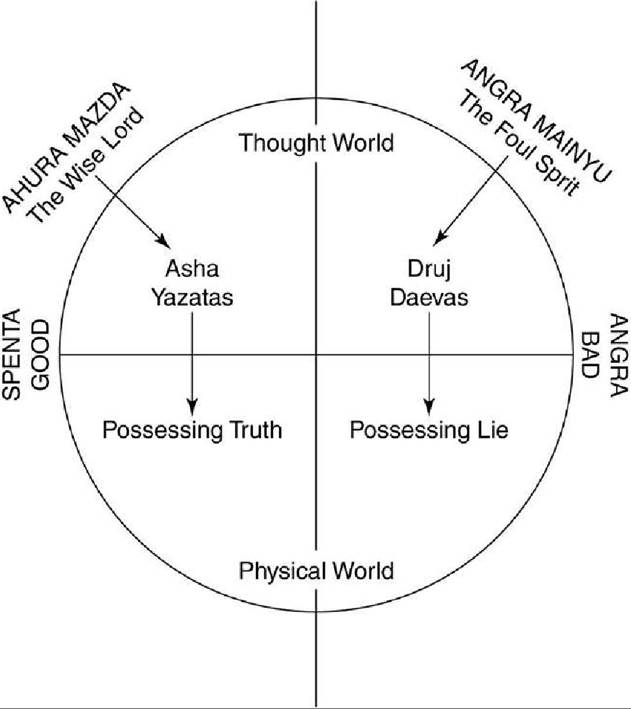
Integration of the dualism of spirit/matter and the dualism of order (good)/chaos (evil). The spirit of asha, personified in the yazatas (“ones worthy of worship”), is embodied in the physical world; so too is the spirit of druj, personified as the daevas, embodied in the physical world—the stage on which the cosmic struggle between good and evil is played out.
Zarathushtra worshiped Ahura Mazda as the only eternal deity, omniscient and omnipotent, and responsible for the creation of the world.
This does not mean that Ahura Mazda is responsible for the creation of evil in the world. This could not be the world of a God who is the source of good, not evil. Rather, Zarathushtra taught that Ahura Mazda ultimately will overcome evil, and that to do so he created this world. It is in the realm of the physical world that the embodied forces of order and good do battle against the embodied forces of chaos and evil. The final triumph will be accomplished through the forces of good aligned with Ahura Mazda.Divine Forces of Good
Especially prominent among the forces of good are the seven Amesha Spentas, the “Beneficial Immortals”—angels who help Ahura Mazda govern creation. Chief among these seven is Spenta Mainyu, Ahura Mazda’s Holy Spirit. The Amesha Spentas function together as semi-independent powers, all of them in service of Ahura Mazda. Among them is Asha, the cosmic principle of order that we have already encountered. Each of the Amesha Spentas constitutes an element of the cosmos; Asha, for example (whose full name is Asha Vahishta, “Best Order”), constitutes fire.
The seven Amesha Spentas are assisted by a large number of deities called yazatas, “ones worthy of worship.” Eventually, their number was fixed at thirty, so that each day of the Zoroastrian month is represented by a different yazata (this includes the seven Amesha Spentas, who sometimes are classified along with the yazatas). One of the most important among them is Mithra, a god of light who works to keep human beings in harmony with asha. As we will see in the later section on the history of Zoroastrianism, Mithra was to become a very popular god in Roman culture, in the mystery religion of Mithras (his Greek and Latin name). Another yazata of particular note is Sraosha (“Obedience”), the caretaker of the souls of the dead who also plays an important role in overseeing ritual practices.
The “Lie” and Forces of Evil
From the beginning of time, Spenta Mainyu, Ahura Mazda’s Holy Spirit, has battled against his adversary Angra Mainyu, the “Foul Spirit,” who in later texts also is named Ahriman.
This battle is at the basis of the cosmic dualism between order and chaos, also manifested in the struggle between asha and the “Lie,” or druj. One of Zoroastrianism’s earliest texts provides us with insight regarding the battle and its participants, chief among them being the twins Spenta Mainyu and Angra Mainyu:Truly there were two primal Spirits, twins renowned to be in conflict. In thought and word, in act they are two: the better and the bad. And those who act well have chosen rightly between these two, not so the evildoers. And when these two Spirits first came together they created life and not-life, and how at the end Worst Existence shall be for the wicked, but (the House of) Best Purpose for the just man. Of these two Spirits the Wicked One chose achieving the worst things. The Most Holy Spirit, who is clad in hardest stone, chose right, and (so do those) who shall satisfy Lord Mazda continually with rightful acts. The Daevas indeed did not choose rightly between these two, for the Deceiver approached them as they conferred. Because they chose worst purpose, they then rushed to Fury, with whom they have afflicted the world and mankind.
—Yasna 30.3-6, from the Gathas-
The daevas mentioned here are the various demonic powers (daevas in ancient Iranian originally meant “gods,” but eventually came to mean “demons”). Notably, as this text reports, the daevas came to be demonic because they chose “worst purpose.” As we will see, this same opportunity for choice presents itself throughout the lifetime of each human being.
Compare other religions with Zoroastrianism on how they explain the presence of evil in the world.
More on the topic The Teachings of Zoroastrianism:
- The Zoroastrian Community: Social and Ethical Responsibilities
- Literature and the Training of Imperial Elites
- The Middle World
- Postscript
- COMMUNISM AS THE TWENTIETHCENTURY ISLAM
- Defining the purposes of the law and their role in law finding in the pre-modern period