Shinto on Gender Issues
We have pointed out that original Shinto has a strong emphasis on the feminine, its principal deity being the Sun Goddess Amaterasu. As a matter of fact, early Shinto can be deemed matriarchal in its orientation.
The imperial family, the most important lineage in Shinto Japan, claims an unbroken succession from generation to generation as descendants of Amaterasu. Chinese historical records also confirm this female-dominant feature of the Yamato regime—the likely precursor to the imperial line—in the fourth century ce. As we have seen in an earlier discussion of the feminine in Shinto, it includes many powerful female figures and forces. Scholars today speculate that Empress Jingo’s account (touched upon earlier in the History section of this chapter) is reminiscent of the story of Himiko in Chinese historical records dating back to the fourth century ce. They describe a female shamanic ruler of a region called Yamatai (suspected to be a variation of Yamato) in the country of Wa (Japan) whose bewitching control over the people is the source of her power. One possible interpretation of the term Himiko is “miko of the Sun (hi).” Now, miko in Shinto refers to unmarried women attendants at shrines who possess shamanic power to communicate with the kami through dance and other ritual performances. Practically all Shinto shrines have miko performing a variety of important, though subordinate, functions. Because of the persistent belief in the shamanic power of these young women to communicate with the kami, they are entrusted to perform the sacred dance of kagura (“music of the kami”) at festivals and other ritual occasions as an indispensable complement to the prayers and purifying acts of the priests. In addition, they serve as secretaries in shrine offices, sell amulets and other trinkets at shrine gift shops, and generally interact with the public by providing a feminine touch on behalf of the shrine.It should also be noted that, though small in number and usually more junior in rank, fully credentialed Shinto priestesses are part of the Shinto clergy today, and they can be found in some of the larger shrines. They participate fully in all the Shinto rites performed by their male counterparts, though serving as chief ritualist remains rare. One reason for the junior role played by female priests can be found in the patriarchal influences of Confucianism that have infiltrated the otherwise rather feminist Shinto tradition. Another reason is menstruation, which disadvantages the female priests, as blood is considered a defilement in Shinto. A menstruating priestess is deemed unfit to perform the purification rituals for the faithful. Yet it is also true that the most supreme religious figure at the Grand Shrine of Ise, the home of the Sun Goddess Amaterasu, is the saishu, the female priestess who is usually a relative of the imperial family and is ranked above even the chief priest there!
It is worth noting as well that as late as the Heian period (794-1185 ce), women, specifically court ladies, were major cultural and literary figures—Murasaki Shikibu, author of the world’s first novel The Tale ofGenji, and Sei Shonagon, essayist of The Pillow Book, being the most prominent representatives. But since the sixth century ce, Japan has also borrowed heavily from, and influenced by, the two Chinese religious traditions of Confucianism and Daoism, as well as the Sinicized form of Buddhism. In time, particularly after the rise of the samurai class in the twelfth century, Japan changed radically into a male-dominated society, with strict gender roles informed by warrior values. The original feminine emphasis in early Shinto was driven underground, but it was not completely eradicated. While the samurai elite espoused strong patriarchal principles, their sway over the common people was tenuous. Among the illiterate and uneducated majority of Japanese society, gender roles and identities were rather fluid.
During the Tokugawa shogunate (1615-1868 ce), at the height of Confucian orthodoxy and indoctrination of the samurai class, village festivals and religious observances were conducted often with gender roles reversed, as the people saw themselves living—however temporarily—in a world “turned upside-down.” Peasant unrests, such as the “Yonaoshi”(World Correcting) movements, would stage such gender reversals as a brazen challenge to the ruling class. At the same time, traditional Japanese performances such as Noh and Kabuki also have men play female roles as a general rule. In modem Japan, the famed Takarazuka Entertainment Troupe, an all-female performing group, has male impersonators who enjoy huge popularity among a largely female fan base.
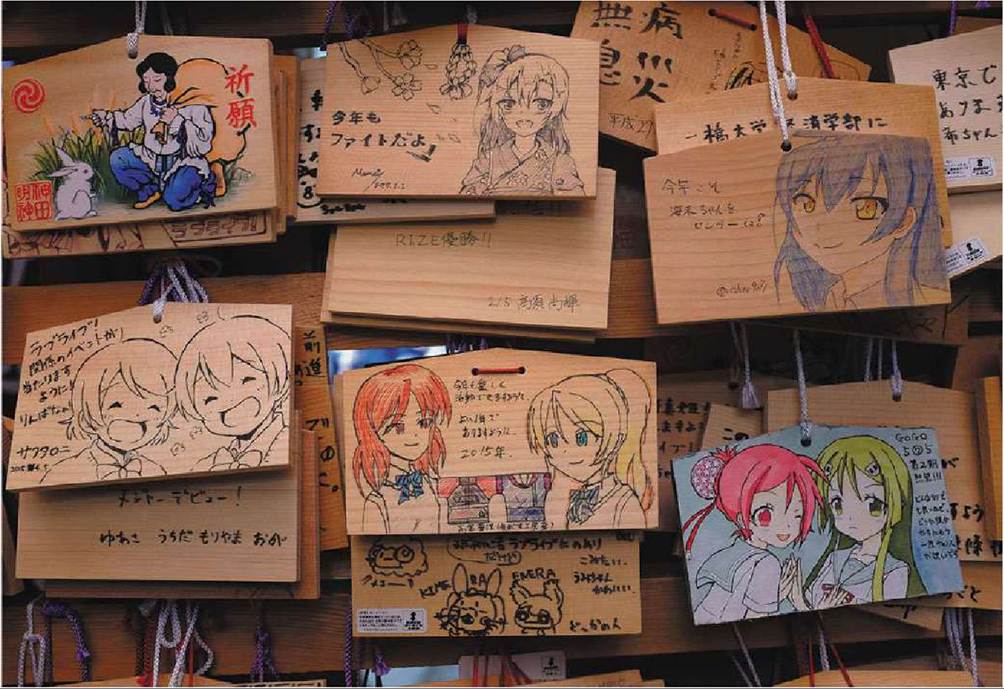
Prayer plaques offered to anime heroines at a Shinto shrine in Tokyo.
Self-Assessment 9.3
[Please note: You must be using an online, browser-based eReader in order to view this content.]
In this chapter, we have observed that Shinto is the longest surviving religious tradition in Japan. It pervades much of Japanese life and informs much of Japanese behavior. It also provides a sense of identity and unity to the Japanese people. Shinto belief in the ubiquitous presence of the kami, both in nature and in human society, informs the Japanese view on nature and human community. Though originally lacking an ethical code and detailed understanding of the afterlife, Shinto, when amalgamated with Confucianism and Buddhism, has been a vital force in Japanese culture and society. Shinto’s adjustment to and enrichment of popular culture such as manga and anime have allowed it to cultivate a wider and younger audience worldwide, thereby maintaining its relevance in the modem world.
SEEKING ANSWERS
What Is Ultimate Reality?
According to Shinto, the world is a sanctified place divinely created and ordained by the kami.
The kami reveal themselves in living and nonliving things, in nature and in the human world. They are responsible for the fertility of the world, and they prefer purity and cleanliness. Humans, some of whom are kami themselves, must pay constant attention to their relationship with the kami, for that is the only way that life can be fulfilled. Because the world is the creation of the kami, humanity is obligated to maintain the world’s sanctity by acting as its guardian and caretaker. Shinto believers are extremely sentimental about nature and are easily moved by its beauty. Many Japanese literary compositions express this Shinto affirmation of the divine and sanctified nature of the world.How Should We Live in This World?
Original Shinto places little emphasis on morality or ethical living. There is no revealed moral code. Instead, it teaches right living primarily as fertile and pure living. The human condition is defined more in terms of purity and defilement. Death, blood, improper food, and improper behaviors are sources of contamination that make humans unfit to interact with the kami. However, these are temporary conditions. Constant attention to maintaining cleanliness and purity will ensure favor from the deities. As a result, Shinto believers meticulously perform rituals of purification and sanctification in order to seek good interaction with the kami.
What Is Our Ultimate Purpose?
Unlike many other religions, Shinto does not perceive the human condition as a fallen state or intrinsically tainted by sin. Humans are therefore not evil by nature; thus, there is no need for salvation or transcendence. At the same time, Shinto has no belief in an almighty benevolent God who has made humans in an initial state of perfection. Humans are therefore not good by nature either. Instead, humans are very much a part of nature, striving to live in harmony with it through interaction with its various spiritual manifestations, the kami.
REVIEW QUESTIONS
For Review
1.
What is the Shinto version of creation?2. Why is the concept of kami so central to Shinto beliefs?
3. How does Shinto view death?
For Further Reflection
1. If Shinto does not address ethics in its original outlook, what is the source of morality for the Japanese?
2. Discuss the role of women in Shinto.
3. What role did Shinto play in bolstering the nationalistic sentiments of the Japanese people?
4. Although there are rivalry and competition among the three major religions in Japan, there has been a conspicuous absence of religious wars based on doctrinal or theological differences. Please explain.
Chapter 9 Self-Quiz
[Please note: You must be using an online, browser-based eReader in order to view this content.]
✓
Chapter 9 Flashcards
[P/ease note: You must be using an online, browser-based eReader in order to view this content.]
Anr
SUGGESTIONS FOR FURTHER READING
Ambros, Barbara. Women in Japanese Religions. New York: New York University Press, 2015. A new and welcome historical study of Buddhist and Shinto women in Japan. Ashkenazi, Michael. Matsuri: Festivals of a Japanese Town. Honolulu: University of Hawaii Press, 1993. An anthropological and sociological description of Shinto in practice at Yuzawa, a town in Japan’s northern region.
Breen, John, and Mark Teeuwen. A New History of Shinto. Wiley-Blackwell Books on Religion. Hoboken, NJ: John Wiley, 2010. A new interpretative work on Shinto and its history.
Dougill, John, and Joseph Cali. Guide to Shinto Shrines. Honolulu: University of Hawaii Press, 2013. An authoritative guide to most of the famous shrines in Japan, with a good introduction to Shinto.
Earhart, H. Byron. Religion in the Japanese Experience: Sources and Interpretations. 2nd ed. Belmont, CA: Wadsworth, 1997. An informative collection of source materials on Japanese religion, arranged topically and with insightful comments.
Hardacre, Helen. Shinto: A History. New York: Oxford University Press, 2017.
An authoritative work on the history of Shinto by a respected scholar.Kasahara, Kazuo, ed. A History of Japanese Religion. Tokyo: Kosei, 2002. An English translation of a two-volume work in Japanese that contains chapters written by scholars on different stages in the historical development of Japanese religion.
Kitagawa, Joseph M. Religion in Japanese History. New York: Columbia University Press, 1990. A detailed historical narrative of the development of Japanese religions.
Nelson, John K. A Year in the Life of a Shinto Shrine. Seattle: University of Washington Press, 1996. An ethnographical description of the ritual cycle at the Suwa Shrine in Nagasaki.
Ono, Sokyo. Shinto: The Kami Way. Tokyo: Charles E. Tuttle, 1962. This remains a very convenient single volume on Shinto.
Yamakage, Motohisa. The Essence of Shinto: Japan’s Spiritual Heart. Tokyo, Kodansha International. 2006. An insider’s view of Shinto and its history.
Click here for more suggested readings, weblinks, and other media for this chapter.
ONLINE RESOURCES
Encyclopedia of Shinto
eos.kokugakuin.ac.j p
This useful, English-language resource is maintained by Kokugakuin University in Japan. In addition to the Encyclopedia of Shinto, it includes various images and video clips of Shinto objects and rituals.
Tsubaki Grand Shrine of America
tsubakishrine.com
The Tsubaki Grand Shrine, located near Seattle, is the North American branch of one of the most ancient Shinto shrines in Japan. This English-language website provides information about Shinto, as well as a schedule of observances at the Tsubaki Shrine.
Green Shinto
Greenshinto.com
A website maintained by John Dougill, who teaches in Kyoto, Japan. It is a Japanophile’s work of love providing useful information about Shinto to an international audience.
Click here for web links to sacred texts.
LIST OF KEY TERMS
Amaterasu ema harae Izanagi Izanami jinja kami
Kojikl matsuri miko mikoshi misogi Nihon shoki norito omikuji shimenawa shintai Shinto temizuya torii