Shinto and the Environment
It should be recalled that the core belief of Shinto is the kami, the animistic element that dwells within certain objects in nature and certain people in the human world, which empowers them to be treated with awe and reverence.
These kami are believed to be in possession of an overwhelming spiritual energy which inspires a deep sense of mystery, even fear. Kami worship therefore neatly meets the criterion of “mysterium tremendum et fascinans” advocated by Rudolf Otto and discussed in Chapter 1 in this volume. Many impressive objects in nature—trees, mountains, waterfalls—have been regarded as hallowed, and the space they occupy has been designated as sacrosanct. That is why many Shinto shrines are located in natural settings and often at sites of great beauty, approached only with pure minds and pure bodies. The Shinto practice of horae (“ritual purification”) further solidifies the assertion that Shinto is a belief system centrally concerned with pristine cleanliness in nature and meticulous personal hygiene in humans. Almost by definition, then, Shinto is an ecological and environmentalist religion. To be sure, Japan has had its share of environmental disasters and human-caused pollutions, particularly during its early industrialization endeavors in the nineteenth and twentieth centuries. Nevertheless, it remains undeniable that Japan’s traditional belief in and practice of Shinto have contributed to her people’s love of nature and their dedication to its preservation.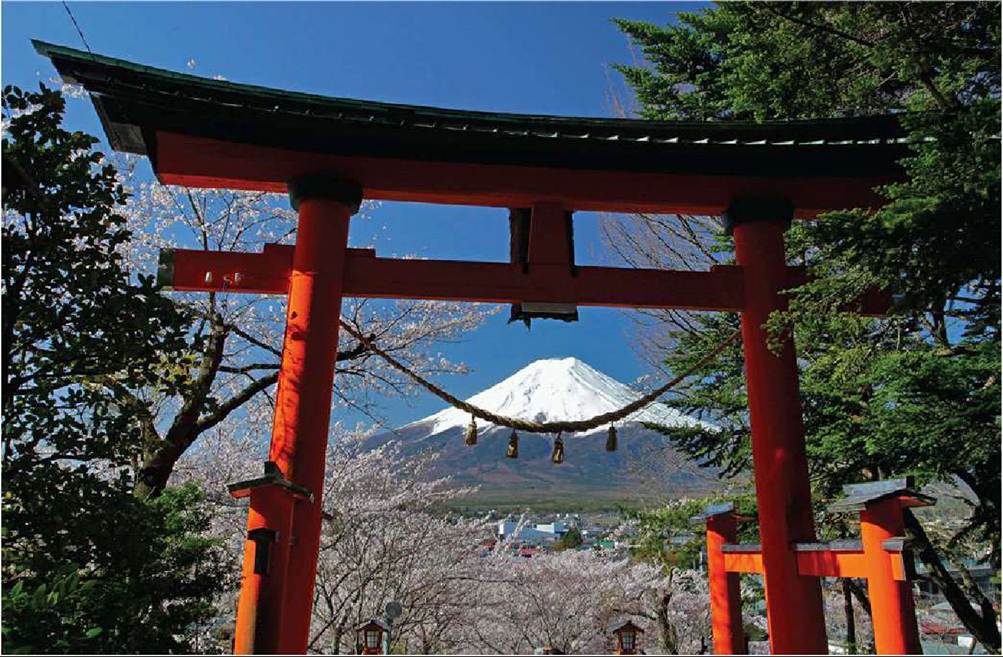
Photo of a torii framing Mt Fuji. This is a fitting illustration of the Japanese belief in Mt. Fuji as a kami, and the function of the torii as archway leading the faithful into the sacred ground where the kami is honored.
Japan’s sentimental worship of the iconic Mt.
Fuji, the Japanese people’s habitual ritual viewing of cherry blossoms in the spring and maple leaves’ color-changing in the fall, as well as the very prominent expression of environmentalism and love of nature in Miyazaki Hayao’s animated films, are all indicative of Shinto influence. Shinto beliefs and practices have provided much rationale for Japan’s environmentalist efforts and ecological programs.Shinto in the Twenty-First Century
Shinto has remained essentially a Japanese religion. As it has no initiation rites, no baptismal rituals, no parish lists, and no congregation registers, it is what some sociologists call a “diffused” religion. Its hold on Japan is evidenced by its practice among the people and the way of life its teaching has inculcated among them. Most Japanese are practitioners of Shinto, rather than believers of Shinto, as many of them do not even regard Shinto as a religion. For this reason, membership in organized Shinto is understandably small. A respected source on world religions population figures gives the number of Shinto believers as 3 million, an obvious under-count.2 However, according to the 2018 published statistics offered by the Agency for Cultural Affairs of the Japanese government, about 70 percent of Japan’s 127 million population are Shinto practitioners, thereby making the number close to 90 million. To be sure, Japan’s low birth rate has led to an almost irreversible population decline, hence a decrease in the number of Shinto adherents. But it can also be argued that Shinto sensitivities regarding the sanctity of nature, as well as the belief in the intimate relationship between the human and the spiritual worlds, may gain a much bigger, worldwide audience.
Shinto has made some attempts to spread beyond Japan. There were Shinto shrines built in Korea and Taiwan when they were colonies of imperial Japan. In recent decades some non-Japanese Shinto priests have been ordained. In the United States, the Tsubaki Grand Shrine of America is a foreign branch of the main Tsubaki Shrine in Suzuka, Mie Prefecture, which is one of the oldest and most distinguished shrines in Japan. It was initially located in California and was subsequently moved to Washington State. Its current chief priest is the Rev. Lawrence Koichi Barrish, a non-Japanese American.
\>
More on the topic Shinto and the Environment:
- Shinto and the Environment
- Christianity and the Environment
- Shinto as a Way of Life
- 8 Agri-Environment Schemes
- Chinese Religions and the Environment
- Segments of Environment
- 9 Shinto
- THE ENVIRONMENT AND MASTITIS
- Islam and the Natural Environment
- The Teachings of Shinto