THE ENVIRONMENT AND MASTITIS
A well-functioning milking machine and a correct milking routine are extremely important in the control of both contagious and environmental mastitis. Teat end impacts in particular can force environmental bacteria through the teat canal during milking.
However, there are some important aspects of mastitis control which are peculiar only to environmental organisms. Because the environment is the source of infection, transmission of infection by the milker and milking machine is less important, although the machine will obviously have some influence via teat end impacts. Pre dipping is a very important control measure, but dry cow therapy and post dipping are generally ineffective.Environmental infections are deposited on the teat between milkings and so control of environmental mastitis must be based on:
• reducing the challenge from the environment
• thoroughly cleaning the teats before milking
• maintaining the natural defences of the teat sphincter
The two most common environmental infections are Strep. uberis and coliforms including E. coli.
Streptococcus uberis
This organism is found in the mouth, vulva, teats and faeces of the cow, as well as in the environment. It is particularly associated with straw bedding and straw yards. Typically Strep. uberis will produce a hot, hard and swollen quarter and the cow may be off-colour and have a raised temperature for 24 hours, but she is by no means as sick as with a severe coliform infection. Most cases respond well to penicillin therapy, although there has been a recent increase in the number of chronic recurrent cases, with no obvious reason for their failure to respond to treatment. They may be caused by a different strain of Strep. uberis and as such can be categorised as a contagious organism. Pre dipping is usually very effective in the control of new Strep. uberis infections.
Coliforms, including E. coli
The problem starts with the cow’s own faeces. Each gram, a quantity no bigger than your little fingernail, contains between one and ten million E. coli bacteria and this figure can be even higher for an early lactation cow fed on a high concentrate/low fibre ration. Systems must therefore be designed and managed so that they result in the minimum contact between the cow’s teats and her faeces. This is why coliform mastitis normally declines dramatically in the summer months - the cows are no longer crowded and so there is a reduced risk of faecal contamination.
Environmental factors
Some of the factors which can reduce the incidence of environmental contamination and hence E. coli mastitis are as follows. Cubicle passages should be scraped at least twice daily, preferably during milking and before the cows are dispersed. If permitted, cows tend to lie down immediately after milking and if they can walk back along clean passages they are less likely to carry contamination onto the cubicle beds. Ideally they should be excluded from the cubicles until 30 minutes after milking to allow the teat sphincter to close fully (see Figure 7.3). Cubicle beds should also be clean and fresh bedding applied daily. Wet and soiled material (as in Plate 7.21) should be removed at least twice a day before scraping the passages; then if necessary fresh bedding should be applied before the cows return from milking.
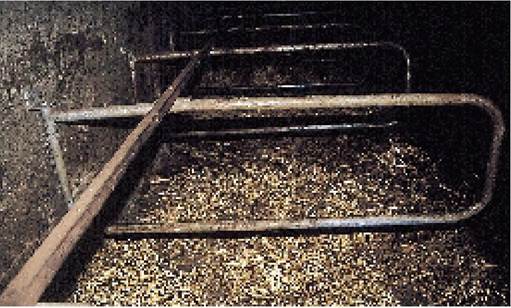
Plate 7.21. Badly soiled cubicles predispose to mastitis.
Cubicle design
Make sure that the cubicle dimensions are correct for the size of your cows, so that they are comfortable and dung in the passage and not on the bed. Cubicle comfort is discussed in detail in Chapter 9. Earth, ground limestone or sand floors may be used in cubicles. They have the advantage of being more comfortable than concrete, but the disadvantage is that urine pooling at the rear of the bed can leave a wet area for the udder and predispose to mastitis (Plate 7.21).
Concrete bases are more common, presumably because they are more easily managed - they are certainly not more comfortable! A rear lip may help to retain bedding, which improves comfort, but it may also prevent drainage of muck and urine, again leading to mastitis.Bedding
The choice of bedding material must be a compromise between comfort, cost and hygiene. Sawdust can be a dangerous source of coliforms, including Klebsiella, and this is particularly the case if it gets damp during storage. Coliform levels in bedding and on teats in Table 7.3 were much higher with sawdust than with shavings or straw. Other workers have shown that sand as cubicle bedding supports an even lower coliform population, although it may be less comfortable, more abrasive on the teats and can cause problems when handling the slurry. Chopped straw, applied fresh daily with a straw chopper into a lip-less cubicle, seems the best alternative, although straw supports the survival of Strep. uberis, and these infections are very common in straw yards. A small quantity of slaked lime sprinkled onto the beds twice weekly acts as both a drying agent and a disinfectant (Plate 7.22).
A word of warning, however: the level of E. coli in bedding material is not necessarily related to the degree of visual soiling. Unused sawdust may already contain high coli numbers if it has been allowed to get wet. It is the dampness of the bed as much as the degree of faecal soiling which affects the overall coliform numbers, and this is why slaked lime is beneficial. Care is needed, however, because excess lime can damage the teats.
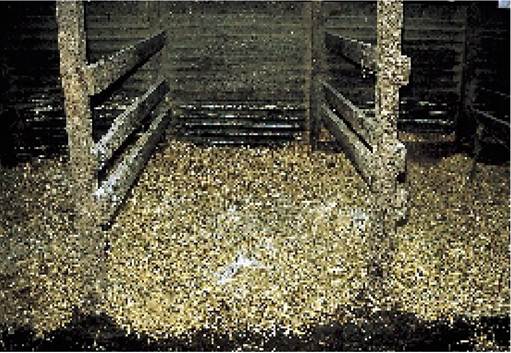
Plate 7.22. Lime on the cubicle beds has both drying and disinfectant properties.
Table 7.3. The coliform populations supported by different types of bedding, and their effect on the coliform numbers obtained from a teat swab.
| Mean no. of | ||
| Total coliform count | coliforms obtained | |
| in cubicle bedding | from a teat swab | |
| sawdust | 52.0 x 10⁶ | 127 |
| shavings | 6.6 x 10⁶ | 12 |
| straw | 3.1 x 10⁶ | 8 |
From Rendos, Eberhart & Kesler, J Dairy Sci 58 1492.
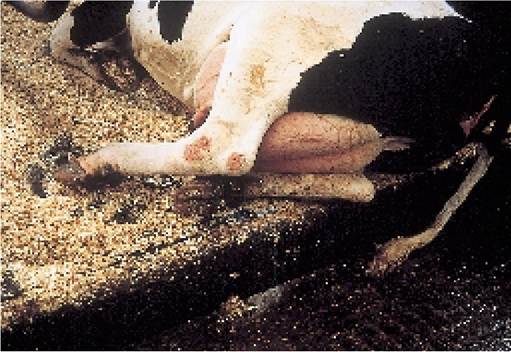
Plate 7.23. Milk leaking from the udder, as in this cow, is particularly dangerous, as the mixture of milk, faeces and bedding supports high levels of coliform bacteria.
Even after fresh bedding is added, E. coli numbers soon build up and then remain constant (unless the bed gets wetter or dirtier) irrespective of how long the cows are housed. The practice of thoroughly clearing out the cubicles and re-bedding them during the winter period has little to recommend it therefore, unless additional efforts are made with regard to cleanliness after the re-bedding. Ideally cubicles and straw yards should have clean bedding added every day. The mixture of milk, faeces and bedding which is sometimes seen where the cow has been lying is especially dangerous (Plate 7.23). Milk provides nutrients for E. coli, and the cow’s udder warmth, so that bacterial numbers can multiply to very high levels, for example one thousand million E. coli per gram (1000 x 106) in the very area where the cow’s teats are lying. This is at least 100 times higher than the level found in faeces, and 20 times higher than the levels shown for sawdust in Table 7.3. As early lactation cows are not only the most susceptible to E. coli mastitis but they also have the highest faecal E.
coli levels and are the animals most likely to be leaking milk, it is a good idea to keep them in a separate group. They can then have their cubicles cleaned and re-bedded at least once a day, the passages scraped twice daily, and they can be pre dipped.Overcrowding should be avoided. Cows which are packed together, rushed through passageways or simply have inadequate space are more likely to get faecal contamination of the teat ends. Overcrowding can also lead to inadequate ventilation and increased humidity, both of which may predispose towards a buildup of E. coli.
Calving boxes
Calving boxes should be kept as clean as possible. The dry cow is almost completely resistant to E. coli mastitis, but there is some evidence that infections contracted during the dry period, and especially during the final two weeks, remain dormant in the udder until after calving. At calving the cow is at her most susceptible to coliform mastitis. Cleanliness of the calving boxes and during the late dry period is therefore essential and if faced with a severe outbreak of down-calving mastitis, consider calving outdoors. Many farms have inadequate calving facilities, and the practice of having a single calving yard, used by the whole herd during the calving season, should be discouraged. Ideally each cow should have its own box, where the straw bedding should be kept meticulously clean and dry (see also page 206). The shorter the period of winter housing, the less will be the risk of E. coli mastitis. There are more outbreaks of environmental mastitis, and often of greater severity, if October and November are warm and humid, and this is particularly so in cows which have been housed since August.
Straw yards
Straw yards should be designed so that they are wide and shallow (as shown in Figure 7.11), rather than long and narrow. Long and narrow yards get badly soiled by the cows walking to and fro, and this is especially the case if the water trough is sited at the rear of the yard.
Ventilation is vital: cows produce around 55 litres of water each day from urine, faeces, skin and breathing, and unless there is good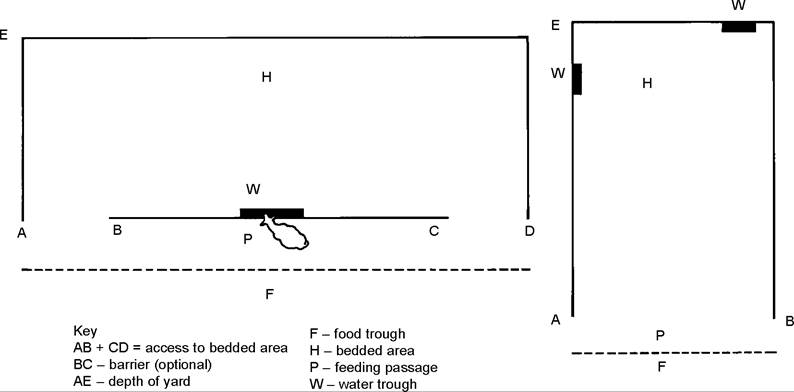
Figure 7.11. Design of straw yards: long, narrow poorly ventilated yards with badly placed water troughs should be avoided (right). A more useful design is shown on the left.
ventilation, the whole building ‘drips’ (Plate 7.24), predisposing to bacterial growth. If you are unable to see the rear of the building on a winter’s morning because of condensation, then the ventilation is inadequate! Straw yards should be cleaned out at least every six weeks; otherwise the heat produced by the accumulation of soiled bedding increases humidity and predisposes to mastitis.
The importance of new infections in the dry period
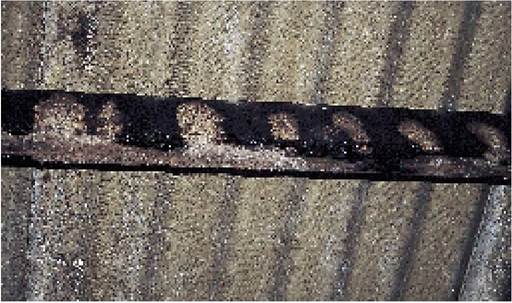
Plate 7.24. Condensation dripping from the roof onto the cubicle beds, as in this picture, is conducive to environmental mastitis. It also suggests inadequate ventilation.
Although the presence of lactoferrin in the udder of the dry cow prevents the multiplication of E. coli, it is now known that many new infections of the dry cow lie dormant in the udder to cause post calving mastitis. For example, a UK study by Bradley and Green showed that in 700 non-lactating quarters in dry cows sampled for E. coli
• 81 quarters cultured positive for E. coli, and of these 14.8% developed clinical coliform mastitis during the next lactation.
• 619 quarters cultured negative for E. coli, and of these only 1.8% developed clinical coliform mastitis in the next lactation.
Cows becoming infected during the dry period are therefore eight times more likely to develop coliform mastitis than those not infected, and DNA finger-printing studies showed that it was exactly the same organism contracted during the dry period which caused the post calving mastitis. Some of the cases of acute coliform mastitis are of course new infections contracted during lactation, but the importance of dry period infections is surprising. Of the total number of clinical E. coli mastitis cases seen during lactation
• 4.5% are thought to be contracted during the first half of the dry period.
• 65% are thought to be contracted during the second half.
• Only 30.5% of cases are new infections picked up during lactation.
The importance of this in terms of dry cow hygiene and management, the use of teat seals and the use of a dry cow therapy antibiotic that gives protection against E. coli is obvious.
More on the topic THE ENVIRONMENT AND MASTITIS:
- THE CONTROL OF MASTITIS
- WHAT IS MASTITIS?
- TREATMENT OF MASTITIS
- MASTITIS RECORDS AND TARGETS
- THE MILKING ROUTINE AND MASTITIS CONTROL
- TEAT AND UDDER DEFENCES AGAINST MASTITIS
- SUMMER MASTITIS
- Mastitis continues to be a major cause of economic loss to the national dairy herd and I suspect that, combined with teat injuries, it is one of the greatest aggravations to the herdsman.
- Chapter 7 MASTITIS AND CONDITIONS OF THE TEAT AND UDDER
- Types of Environment
- Management of Environment
- EQUIPMENT AND ENVIRONMENT
- Chinese Religions and the Environment
- Visual perspectives on environment and empire
- 1 Agri-Environment Measures and the CAP
- Components of Environment
- Buddhism and the Environment
- Christianity and the Environment
- Segments of Environment