MASTITIS RECORDS AND TARGETS
I am a firm believer in recording the incidence of all types of disease on a farm but it is particularly important for mastitis. General disease monitoring and how this is co-ordinated with veterinary advisory visits and general farm involvement is discussed in Chapter 8.
If you have a problem of increasing cell counts or a high incidence of mastitis, talk it through with your vet. It would probably be worth getting him to come along at milking time one day to watch. It is surprising how an extra pair of eyes can help. It may be that the cows are uncomfortable when being milked or they have an excessive degree of teat end damage, both being an indication of machine induced problems. Perhaps you are not applying the post milking teat spray evenly, or there is some way in which infection is being inadvertently transferred from cow to cow. A combination of observation, bulk milk bacteriology and analysis of records can solve the majority of problems.
The type of recording system used is not too important, but you must carry out the following procedures:
• Record every case of mastitis, giving the cow, date, quarter affected and tubes used.
• Record repeat treatments, so that chronic carriers are easily identified. Table 7.4 shows two types of recording systems. In the top method it is obvious that cow 42 has had several attacks in the left hind quarter. The same information is present on the second chart, but it is by no means so obvious. It is even better to keep whole lifetime records of individual cows, and the information can be used for culling and even selection decisions.
• Periodically analyse the records to calculate your own mastitis performance.
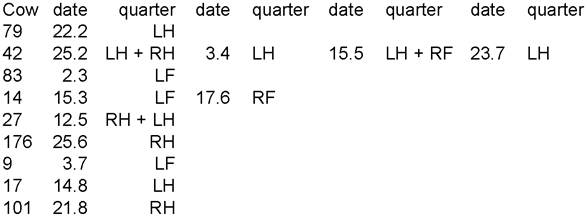
Table 7.4. Two types of annual mastitis records. The system on the left most easily identifies the problem cows as all information relating to the same cow is recorded on one line.
In the chart to the right separate cases of mastitits in the same cow are not related back to each other as they are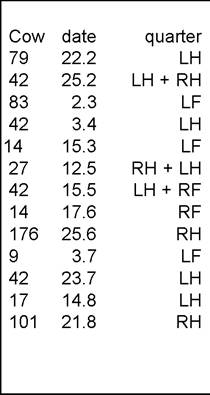
in the first chart.
A case of mastitis is defined as one quarter affected once. Hence a cow calving down with mastitis in all four quarters represents four cases of mastitis. Recurrence rate is defined as the percentage of cases which need one or more repeat treatments during a recording period. In Table 7.4 there is only one repeat treatment, namely cow 42 in her left hind quarter (although this quarter was treated four times). The total number of cases of mastitis is sixteen, so the recurrence rate is one divided by sixteen = 6.25%. Using these definitions, suggested target figures are:
• mastitis rate: 30 cases per 100 cows per year
• herd incidence: 20% of cows affected per year
• recurrence rate: 10%
• tube usage: 4.5 tubes per milking cow
These are target figures. Unfortunately, many herds have a considerably higher incidence of mastitis than this, and more effort should be put into mastitis control. If there is a mastitis problem in the herd, records can also be used to help differentiate between environmental and contagious organisms (see page 186). For example, in the classic case, an outbreak of environmental mastitis produces:
• a high mastitis rate
• a high herd incidence
• a low recurrence rate
• a low cell count but sometimes a high TBC
On the other hand, a typical contagious mastitis problem may produce:
• a high mastitis rate
• a lower herd incidence
• a high recurrence rate
• a high cell count but probably a low TBC
In practice the distinction is not always quite so clear and many herds will have a combination of both contagious and environmental mastitis.
Mastitis records should be examined just prior to drying off. Cows which have had four or more cases in one quarter in a lactation should be considered for culling or, if not, at least for some additional therapy, for example a course of tubes and injections just before drying off, or perhaps a second dose of dry cow tubes two weeks after the first.