SOMATIC CELL COUNTS
The cell count, or somatic cell count (SCC) of milk, is a measure of the number of cells present in the milk. Most of the cells present are macrophages, a type of white cell which responds to mastitis infection.
There are also lower numbers of neutrophils and epithelial cells. The cell count is therefore an indication of the degree of inflammation within the udder, or the amount of mastitis infection present. Cell count results are usually expressed in thousands, so a cell count of 250 means that the milk contains 250,000 cells per millilitre.Effects on manufacturing
All dairy companies in the UK pay a premium for milk with a low cell count. Within the EU it has been illegal since July 1997 to use milk with a cell count of over 400,000 for either liquid sales or manufacturing. This is because milk with a high count is less valuable for manufacturing, due to:
• a decreased casein content. It is the casein in the milk which coagulates during manufacture to produce cheese, yoghurt etc
• increased levels of plasmin. Plasmin is an enzyme which degrades casein, continuing to act even after pasteurisation and refrigeration
• increased levels of lipase. Lipase can inhibit yoghurt starter cultures and may also lead to taints in manufactured products
The combination of these factors can lead to as much as a 15% reduction in manufactured yield if poorquality milk is used.
Effects on yield
Cows with increased cell counts also have reduced milk yields. For example, Canadian work has shown that for every 100,000 increase in cell count above 200,000, yields decreased by 2.5%. This is shown in Figure 7.12.
The importance of cell counts is that they give an indication of the level of chronic infection in an udder. An acute infection with E. coli normally leads to a rapid increase in cell count due to the large numbers of neutrophils entering the udder, as shown in Figure 7.4.
However, because E. coli infections rarely persist, cell counts quickly return to normal. On the other hand, staphylococci, Strep. agalactiae and Strep. dysgalactiae all have adhesive properties. This means they may persist in the udder, producing continuous high cell counts. This is especially the case if they have not been treated adequately.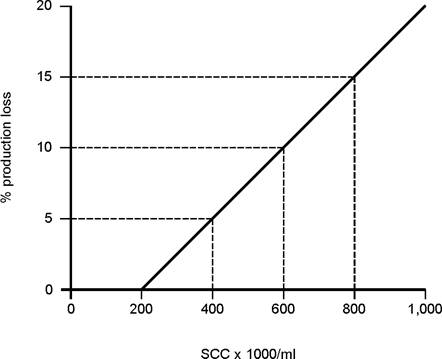
Figure 7.12. Effect of herd cell count on milk production: milk yield drops by 2.5% for every increase in cell count of 100,000 above a base figure of 200,000.
Adapted from Philpot, W. N. (1984), Veterinary Clinics of North America Food Animal Practice, 6.
Individual cow SCCs
Because of this variation in the effects of contagious and environmental organisms, no action should be taken on the basis of a single sample from a cow showing a high cell count. At least two, and preferably three, monthly samples need to be taken from that cow before we can be sure that a chronic infection is present. Many other factors, not related to mastitis, can also increase the cell count of an individual cow. These include age (heifers generally have lower counts), stage of lactation (counts are high in early and late lactation), milking frequency (once daily or alternate day milking leads to an increase), very low yields and stress, for example testing for tuberculosis.
Herd cell counts
If the herd has an elevated cell count it is likely that there will be a penalty on milk sales and that yields will be depressed. Action needs to be taken and a range of steps is possible. No action may be taken on a single high monthly herd figure, but if the problem continues, monthly individual cow cell counts will be needed. It may be that only two or three cows with a very high cell count are having an enormous effect on the bulk sample and if their milk is discarded (or fed to calves), then the herd count will return to normal.
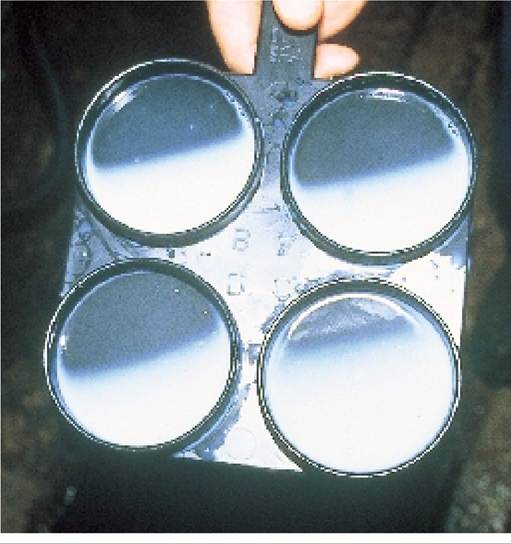
Plate 7.28.
The California Mastitis Test, a simple parlour technique to detect high cell count. Milk from affected quarters turns gelatinous.An alternative to cell counting is the California Mastitis Test (or CMT), which uses the chemical sodium dodecyl lauryl sulphate to detect high cell count milk. After discarding four to five squirts of foremilk, milk from each quarter is drawn into a tray divided into four separate dishes (Plate 7.28). An equal volume of reagent is added and the tray (or paddle, as it is often called) is slowly and gently rocked from side to side, so that the milk can be examined as it flows across the dish. If the milk turns gelatinous, or even totally solidifies, then it has a high cell count. The test is only a guide to the level of cell count, but it is reasonably accurate. For example, one survey showed that bacteria could be cultured from:
- 85% of CMT positive milks
- but only 15% of CMT negative milks
The great advantage of the CMT test is that it is cheap, easy to perform and the results are immediate. However, as with cell counts, the test needs to be positive three times at monthly intervals before any action is taken. Even before cell count or CMT results are available, it would be worth discarding the milk from any known chronic recurrent mastitic cows or quarters to see if that helps to reduce the bulk milk count.
Reducing herd cell counts
After individual cow cell counts or California Mastitis Tests have been carried out, or even while waiting for the results, there is a range of other measures which can be considered to reduce herd cell counts.
These include:
• Use bacteriology on high cell count cows. Table 7.1 shows that if the infection is Strep. agalactiae, it should be possible to treat successfully, even during lactation. Sometimes whole herd treatments are carried out. Known as blitz therapy, this needs careful planning with your vet.
• Check the milking routine and especially the efficacy of post milking dipping.
If contagious infection is present in the herd, meticulous post dipping is vital.• Check that dry cow therapy is being given to all cows.
• Ensure that cows are being dried off abruptly and that no cows with yields below 10 litres are being milked. Gradual drying off and very low yielding cows both increase cell counts. For example, in one trial a group of late lactation cows had a mean cell count of 237,000. When not milked for two days this increased to 540,000, and when left for a further four days this increased to 7,600,000, with one cow reaching 15 million!
• Monitor mastitis and ensure that all clinical cases are detected and that their milk is discarded, not added to the bulk tank.
• Make sure that milk from freshly calved cows is discarded for at least four days: colostrum has a high cell count. This includes heifers.
• Discard milk from aborted cows and heifers. The first milk from a dry cow or heifer that has aborted may have a cell count of 6 to 8 million! She needs to be milked to stimulate production, but milk for the first week should be discarded or fed to calves.
• Discard milk for longer after treatment. Following experimental infection it may take up to thirty milkings for milk from the infected quarter to fall below 400,000, even though treatment may have been effective and the clots disappeared within a few days.
• Try treatment of the infected quarter. Drugs such as tylosin accumulate in the udder, and may be effective if the mastitis has not been present for too long.
• Dry off the offending quarter and continue to milk the cow on three. There is some evidence to show that longer dry periods lead to improved spontaneous recovery.
As soon as two or three sets of monthly cell counts are available, action can be taken on individual problem cows, the main options being
• cull
• dry off early
• feed the milk to calves
• treat (do not expect a high success rate)
The problem with all except the first two options is that by continuing to milk high cell count cows there is a risk of spreading infection to other animals via the milking machine.
More on the topic SOMATIC CELL COUNTS:
- SOMATIC (ANTHROPOMETRIC) GROWTH
- CELL-ASSOCIATED AND CELL-FREE VIRUS DURING HAART
- Humility is held to be more valuable, more morally praiseworthy, than pride. Some make this point in terms of virtues — that humility counts as virtuous, whilst pride, if not a vice, fails to be a virtue.
- HIV PR AND CELL DEATH
- SICKLE CELL DISEASE
- OTHER FORMS OF CELL DEATH: NECROSIS AND AUTOPHAGY
- Late Infection - B-Cell Responses
- ROLE OF APOPTOSIS IN T CELL DEVELOPMENT
- AUTOLOGOUS CELL-MEDIATED KILLING VIA INTERCELLULAR CONTACTS
- VPR MEDIATES CELL DEATH
- HOST IMMUNE CELL INFECTION WITH HIV