SUMMER MASTITIS
This is a condition seen especially in pregnant cows and heifers, although it can also occur in non-pregnant animals, young calves and occasionally even in steers. The first sign that something is wrong may be that the animal is standing apart from the others and perhaps she is walking rather stiffly.
Careful examination of the udder shows that one or more of the quarters is hard, hot, swollen and, especially in a heifer, it will be very painful, so take care when handling her. If milked, a yellow, custardy material is produced which normally has a foul smell, although the absence of the smell does not completely rule out summer mastitis. Another characteristic, and one which is often not mentioned, is that the teat sinus becomes thickened. Squeeze and roll one of the other teats between your thumb and forefinger: you will find it feels soft and empty. In the quarter affected by summer mastitis the teat seems thicker, as if it has a fibrous cord through the teat cistern. Heifers are especially affected in this way. Sometimes heifers calving down with a blind quarter have a similar thickening of the teat and I suspect that these have had a low-grade summer mastitis which was not detected (see page 228 for a further discussion of blind quarters).In the early stages the affected animal will be running a high temperature, due to septicaemia and toxaemia. Untreated cases may abort or even die, while others may develop a permanent arthritis from infection localising in the joints. It has been shown that even if the calves of affected animals are born alive, they will probably be stunted and have a reduced viability.
Cause
There are four bacteria involved*:
• Actinomyces (Corynebacterium) pyogenes (85%)
• Peptococcus indolicus (62%)
• Streptococcus dysgalactiae (24%)
• a micrococcus (22%)
*It is interesting that two other bacteria, namely Bacteroides melaninogenicus and Fusobacterium necrophorum, both of which cause foul-of- the-foot, are commonly isolated from cases of summer mastitis in Denmark and The Netherlands, but are rarely cultured from cases in the UK.
The percentages shown express the number of times each organism was cultured from clinical cases of summer mastitis in a UK survey reported in 1988. Pure cultures of any one of these bacteria applied to the teat end will not produce disease, but mixed cultures will, especially using Peptococcus and A. pyogenes. Infection is transferred to the teat end by females of the sucking fly Hydrotaea irritans, also known as the sheep-head fly. H. irritans lives near woods, small copses and around wet ground, with sandy soils rather than clay being preferred. The adult fly deposits its eggs in the earth in October and these overwinter to emerge in June or July the following year. The adults roost in trees and bushes from where they fly out to feed. There is only one generation of adults each year and they are found during July, August and September. These are therefore the three worst months for summer mastitis and disease occurs most commonly when the weather is warm and humid, with humidity being the most important factor. This is because high winds (above 20 km per hour) and heavy rain inhibit the activity of the flies.
Although it carries infection, H. irritans probably cannot cause disease on its own. There must first be damage to the end of the teat, either by biting flies, or by the cow walking over sharp grass, thistles or thorns, or even by licking her own teats excessively. H. irritans then comes to feed on the small drops of blood or serum oozing from the tip of the teat and in so doing transmits summer mastitis infection.
Summer mastitis seems to affect the fore teats more often than the hind teats, possibly because the tail is more effective at removing flies from hind teats. Animals with hairy udders are less commonly affected, whereas cows which are easy milkers are particularly susceptible. Presumably this is because it is easier for infection to penetrate their teat ducts.
Treatment
Unfortunately, by the time summer mastitis has been noticed, the quarter has usually already been lost and treatment is mainly aimed at reducing the illness in the animal, thereby preventing abortion.
Occasional quarters do recover, however, especially if the cow or heifer calves soon after. Your vet will probably use penicillin, given both by injection and as tubes into the quarter, although some say that it is pointless applying any intramammary treatment.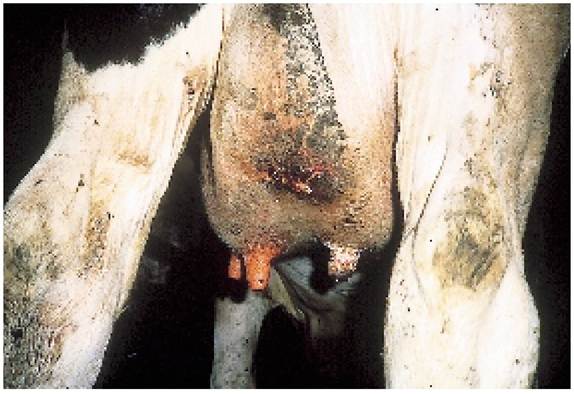
Plate 7.29. Summer mastitis. In this advanced case infection has burst through the rear of the udder. Note the swollen, painful teat.
Summer mastitis is effectively an abscess in the udder and, as such, drainage is vital. It is best achieved by regular stripping preferably several times each day until the quarter dries up, although as this can take several weeks and may be painful to the animal, some farmers prefer to have the end of the teat amputated to allow natural drainage. The affected animal should be removed from the group and kept separate to prevent infection from spreading.
Even after treatment, many animals are left with a focus of infection in their udder and this may burst out some time later, particularly after calving. A typical example is shown in Plate 7.29, where the shrivelled teat is still discharging pus, despite the fact that the udder has burst.
Prevention
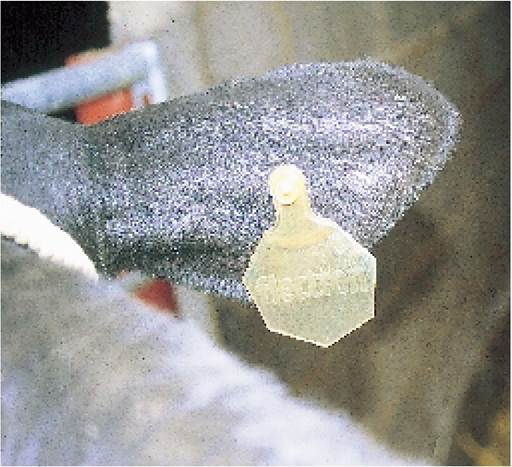
Plate 7.30. A fly repellent ear tag. The insecticide from the tag should flow over the whole body (except the teats) in the natural skin oils.
Prevention consists of two parts, dry cow therapy and fly control.
Dry cow therapy Dry cow antibiotic gives good protection, but it persists for only three weeks, so a second or even third infusion may be necessary for cows with a long dry period. However, with such cows additional care needs to be taken to avoid antibiotic contamination of the milk after calving. Dry cow tubes can also be given to heifers, especially if they are ‘bagging up’, although there should be at least four weeks before calving to avoid antibiotic problems.
The only difference in technique is that the tip of the dry cow tube is placed against the outside of the heifer’s teat sphincter, rather than through the streak canal as you would normally do for a cow. For both cows and heifers it is essential to clean the end of the teat first, so as to avoid introducing other infections.
Fly control In dairy herds fly control has several advantages in addition to preventing summer mastitis. If the cows are irritated by flies they tend to bunch together in the shade rather than graze and this will reduce their milk production. They may be restless when being milked and perhaps kick off the clusters, or, even worse, they can tear their teats when kicking at flies. This is particularly common in older cows with pendulous udders and close to calving, because there is often a drip of colostrum on the end of the teat which attracts the flies. In heifers fly control is an important preventive measure against New Forest eye (see Chapter 4).
By far the best method of fly control for summer mastitis is to apply insecticide directly onto the udder every one to two weeks. It is easily applied once the heifers or cows have been rounded up.
Alternatively chemicals which claim to give protection against flies for between two and eight weeks can be applied by knapsack sprayer or using a spray race. More popular are pour-on preparations in which a low volume of persistent insecticide applied along the animal’s back is absorbed and spreads all over the skin.
As the favourite landing place for H. irritans is along the animal’s abdomen and on its udder, this is the important area to cover with fly repellent. It is simply not sufficient to spray insecticide over the animals’ backs and then feel pleased that fewer flies are seen on their heads and shoulders. The fly is attracted by any discharge and very large numbers will be seen on the end of an affected teat.
Another possibility is a large plastic ear tag (Plate 7.30) which has been impregnated with an insecticide, usually a pyrethroid.
As the animals groom themselves they wipe the tag across their coat and the natural oils inthe skin (the sebum) dissolve the cyper- methrin, to give a complete body covering. There is a flow of body oil passing over the skin of the animal, especially from the shoulder backwards, and a complete coating of insecticide is achieved within 12 hours of applying the tag. Unfortunately this flow of sebum does not continue onto the teats, and this is probably one reason why experience with the tags has shown that they reduce fly numbers but do not control them totally and some cases of summer mastitis will still occur, even when a tag is used in each ear.
Another method of keeping flies away from the teat is to cover the ends with a permeable micropore plaster as in Plate 7.31. This can be left on for three weeks and does not seem to irritate the teats. First clean the teats with surgical spirit and allow to dry. Then spray on the adhesive, allowing 30 seconds for it to dry, before wrapping the tape twice round the teat, making sure that there is an overlap of 10-15 mm at the sphincter. The overlap can then be squeezed together to form a seal. Take care not to apply the tape too tight; otherwise blood flow may be restricted. Although this is clearly more laborious and more expensive than using other repellents, it is generally considered to be effective. The same tape can be used in the repair of teat wounds.
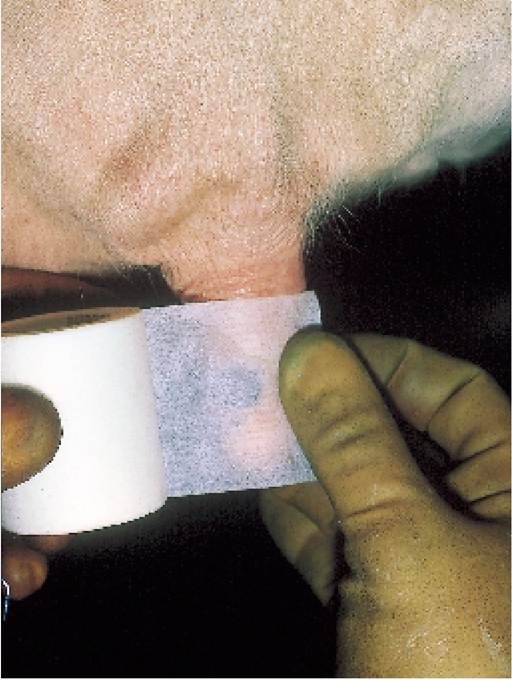
Plate 7.31. Permeable teat tape used to cover the teat end and protect against summer mastitis. It can also be used to aid healing of cut teats.
Finally, try to avoid grazing heifers and dry cows near woody or wet areas during the summer months. If you have had a bad outbreak of summer mastitis in a particular field in one year, you know it must be a good breeding place for H. irritans and should therefore be avoided in future years.
UNCOMMON CAUSES OF MASTITIS
We have dealt with the common causes of mastitis and their control, but there are a few odd infections which may not fit into the standard pattern.
A word of warning however: by definition these infections are not particularly common and if you have a difficult mastitis problem in your herd it is more likely that environmental or contagious organisms are involved. I will list the names of the unusual infections and give a few notes on their significance.Corynebacterium bovis, Staphylococcus epidermidis and micrococci
These three can be dealt with as a single group. They rarely cause clots or any other clinical signs, but they can lead to a high cell count. They are controlled by teat dipping and dry cow therapy. C. bovis is sometimes used as an indicator of suboptimal post milking teat disinfection. If there is a high C. bovis count in the bulk milk, extra attention needs to be paid to post dipping techniques. However, all three organisms may have some protective effects against coliforms (see page 200).
Mycoplasma
There are at least three species of mycoplasma which can cause mastitis in cattle. M. bovigenitalium is a relatively mild condition. M. californicum gives a chronic hard quarter with a dramatic decline in yield, thick clots almost like pus and an extremely high cell count (5-10 million). Affected animals are not sick in themselves, and both milking and dry cows can be affected. M. bovis causes the most severe syndrome. Although the changes in the udder may be similar, the cow is often seriously ill. She may abort, get pneumonia or develop an inflammation and swelling in the joints, producing extreme lameness. The fetlocks are the most commonly affected and although no treatment seems to alleviate the condition, many cases resolve on their own after three to four weeks. Lameness and mastitis are not necessarily seen in a herd at the same time.
Treatment of mycoplasma mastitis is difficult, since the organisms are not bacteria and only a few antibiotics (erythrocin, tylosin, spectinomycin and oxytetracycline in very high doses) are effective. Intramammary therapy is of very limited value and treatment needs to be by injection for several days. Teat dipping and parlour hygiene are extremely important in control. This is one instance where pasteurisation of the clusters between cows (see page 198) would be worthwhile.
Yeasts
Yeasts are another group of non-bacterial infections which can cause mastitis. They produce changes similar to mycoplasma, although the cow invariably has a significantly raised temperature. Yeasts are common in the environment, and this is the source of infection. They may be introduced when infusing intramammary antibiotic against a normal bacterial mastitis if careful aseptic precautions are not used, and they are totally unresponsive to antibiotics. Success in treatment has been reported from the infusion of 60-100 ml of a mixture of 1.8 g of iodine crystals in 2 litres of liquid paraffin, plus 23 ml ether, into the quarter once daily for two to three days, ensuring that it is thoroughly stripped out at the next milking. Concurrent administration of intravenous sodium iodide or oral potassium iodide may improve the response in refractory cases.
Leptospira hardjo
Leptospirosis causes a rise in temperature, the cow may be off her food and the small amount of milk present is rather thick, almost like colostrum. One of the most prominent clinical signs is the sudden and massive drop in yield, with all four quarters affected, and hence the names milk drop syndrome or flabby bag are sometimes used. Treatment with streptomycin is generally effective, although the cow may take several days to recover. There is a good vaccine available and you should ask your vet if it is worthwhile for your herd. The disease is dealt with in more detail in Chapter 13.
Pseudomonas
Pseudomonas normally leads to a slightly thickened quarter and white lumpy clots in the milk which would be indistinguishable from staphylococcal/ streptococcal infections. The bacteria can grow inside the udder cells, however, and this largely protects them from the action of antibiotics which tend to be mainly in the extra-cellular fluid surrounding the tissues and only reach low concentrations inside the cells. Response to treatment is therefore very poor. Many cases continue for days or weeks, or they may appear to recover but then recur a few days later. A proportion of cows develop chronic illness and weight loss. Pseudomonas can grow in the header tank which feeds the udder washing equipment and also in improperly cleaned milking machines. These are the most probable sources of infection where no antiseptic is being used, or if the plant cleaning routine is inadequate.
In freshly calved cows Pseudomonas can cause a very severe or even fatal mastitis and the symptoms of this are identical to an acute E. coli infection (described on page 183).
Klebsiella
This organism can also cause a very severe mastitis, with udder changes similar to those caused by E. coli in the fresh calver. Treatment is often unsuccessful. The infection is associated with sawdust as cubicle bedding, especially if the sawdust was damp and heated up before it was used.
Bacillus Species
Bacillus Iicheniformis causes a mild mastitis with a chronic thickening of the quarter. Even though the organism should be sensitive to most antibiotics, including penicillin, some cases can be surprisingly difficult to treat. Cases often occur when cows are allowed to lie outside on waste fermenting maize silage. B. Iicheniformis infections ascending into the vagina may also cause endometritis (‘the whites’, see Chapter 8) and poor fertility. Bacillus cereus is classically associated with brewers’ grains and can cause an acute, gangrenous mastitis.
Gangrenous Mastitis
At first the affected quarter feels cold to the touch, the ‘milk’ drawn from the teat will be dark red in colour and often mixed with gas, and the teat skin may start to blister, as in Plate 7.32. Some cows are very sick, while others appear surprisingly bright, alert and healthy. The former are best slaughtered. If the infection is allowed to progress, the tissue of the quarter may literally fall out (Plate 7.33), and although some cows eventually recover, the healing process can be quite lengthy, with an open festering sore being present for several months. B. cereus, Staph. aureus and E. coli can all cause gangrenous mastitis. Most probably a dramatic loss of udder immunity causes the problem, rather than a particularly virulent strain of infection. For example, if an antiserum against bovine neutrophils is infused into the udder of a chronically affected Staph. aureus carrier cow, all of her neutrophils will be removed and the cow will die from peracute gangrenous mastitis within a few days.
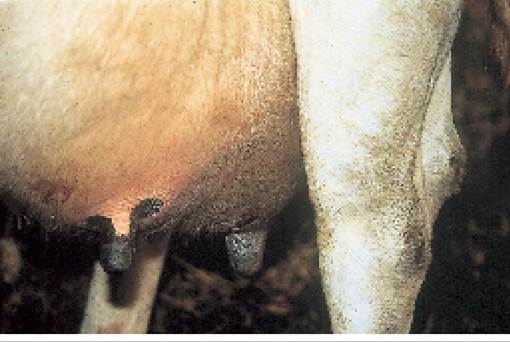
Plate 7.32. The cold, black lower area of the hind quarter and crinkled skin over the teat are typical of gangrenous mastitis. The blood on the cow's leg has been discharged from the teat.
More on the topic SUMMER MASTITIS:
- On a summer day in the year 1415 a fleet of Portuguese ships set off from Lisbon.
- WHAT IS MASTITIS?
- TREATMENT OF MASTITIS
- THE CONTROL OF MASTITIS
- THE ENVIRONMENT AND MASTITIS
- MASTITIS RECORDS AND TARGETS
- THE MILKING ROUTINE AND MASTITIS CONTROL
- TEAT AND UDDER DEFENCES AGAINST MASTITIS
- Mastitis continues to be a major cause of economic loss to the national dairy herd and I suspect that, combined with teat injuries, it is one of the greatest aggravations to the herdsman.
- Chapter 7 MASTITIS AND CONDITIONS OF THE TEAT AND UDDER
- Arcanobacterium infections
- TOTAL BACTERIAL COUNT (TBC) OF MILK
- DRY COW THERAPY
- MILKING THE MASTITIC COW
- SOMATIC CELL COUNTS
- Answers to Analyzing Data 3.1 Questions
- Survival of the Fittest