MILKING THE MASTITIC COW
When a cow Subclinically infected with mastitis (and particularly staphylococcal mastitis) goes through the parlour, the liners will become contaminated with bacteria. As a result, staphylococci will be transmitted to the next six to eight cows to be milked through that cluster.
Great care needs to be taken to avoid this cross-contamination, especially when milking cows under treatment or those cows with high cell counts. Ideally when such cows enter the parlour they should be milked through a separate cluster and into a dump bucket, as in Plate 7.19. This has the following advantages:• The cluster can be left soaking in a bucket of hypochlorite or similar, so that there is a longer time for disinfection before it is next used.
• The milk is transferred straight into a dump bucket and hence there is no risk of antibiotic or mastitic milk being accidentally transferred into the bulk tank.
A similar system can be used to take colostrum from freshly calved cows, but one word of warning; DO NOT transfer the cluster from a mastitic cow directly onto a fresh calver without first disinfecting it. You do not want to infect her at the start of lactation.
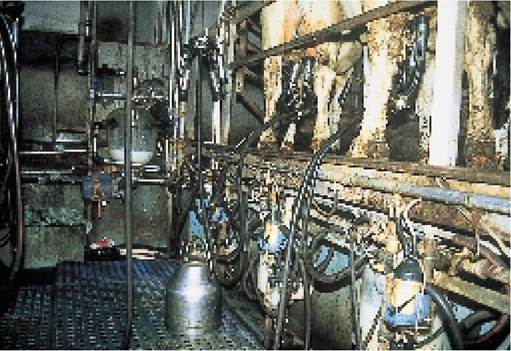
Plate 7.19. Adump bucket used for milking mastitic cows. This must also have a separate cluster which should be cleaned after
Cleaning of Clusters between Cows
As mentioned above, when a cluster is removed from a cow the liners may be contaminated by mastitis organisms which have arisen from either the teat skin or the infected milk of a subclinically infected animal, and these organisms may be transmitted to the next cow to be milked. One way of reducing the spread of mastitis is to clean the clusters between each cow by flushing with water; by dipping them into hypochlorite and then flushing; or by pasteurisation (that is circulation with water at 85°C). Only pasteurisation has any great effect. There is no doubt that a combined disinfection and heat treatment of clusters would reduce significantly the spread of mastitis organisms, but at the moment it is not included as a routine in a ‘package’ of mastitis control measures in the UK, partly because of the cost (hot water) and partly because of the time involved (allowing the disinfectant to act).
This is a good example of how the practical costs and problems of a mastitis control procedure outweigh its advantages. However, if you are faced with a herd outbreak of staphylococcal/streptococcal or mycoplasma mastitis it would be an excellent control measure to put into operation in the short term, even if you only did it after removing the clusters from clinical cases or from cows which had had mastitis earlier in their lactation. Even better, of course, would be to put all known infected cows into a separate group and milk them last, or to use a separate cluster for known infected cows.
More on the topic MILKING THE MASTITIC COW:
- THE MILKING ROUTINE AND MASTITIS CONTROL
- THE EFFECT OF THE MILKING MACHINE
- POST MILKING TEAT DISINFECTION
- THE ‘DOWNER’ COW
- THE REPEAT BREEDER COW
- DRY COW THERAPY
- Chapter 5 THE COW AT CALVING
- Lameness is not only a major economic problem, but it is also a major welfare issue - for both the cow and the herdsman!
- THE ENVIRONMENT AND MASTITIS
- COSTS OF AMISSED heat