THE REPEAT BREEDER COW
Over the years a good deal of effort has been expended in investigating the repeat breeder cow, that is the cow which has been served 5, 6 or even 7 times and continues to return to service every 21 days.
However, Table 8.7 shows that in a 100 cow herd with a good conception rate (60%), you would expect 2 cows to need 5 services before they conceived, whereas in a herd with a poor conception rate (40%) 13 ‘normal’ cows may need 5 services or more before conceiving. Many of the repeat breeder cows are therefore simply normal animals which, by chance, have not conceived. Having said this however, there will be a proportion of repeat breeders which do have problems and it would be worth getting them examined to see if there are any abnormalities which can be treated. Examples of problems found include:• endometritis
• thickening of the fallopian tube or adhesions of the bursa to the ovary
• ovarian cysts, which occasionally are present in the normally cycling animal
• pregnancy: although this is very rare, I have examined occasional repeat breeders which were pregnant!
Adhesions
Adhesions of the bursa to the ovary could be due to stretching or tearing at calving, metritis or rough handling of the ovaries on rectal palpation. (Manual removal of the corpus luteum or manual cyst rupture can lead to haemorrhage and subsequent bursal adhesions.) Abursa which is fused to the ovary may not be able to function properly, so that any eggs released at ovulation drop into the abdomen, rather than pass down the fallopian tube. This would obviously lead to a repeat breeder.
Use of GnRH
Pregnancy rate (%)
| No. of herds | No. of cows | Controls | Treated | Improvement (%) | |
| First service | >60 | 11,048 | 53 | 59 | 6% |
| Repeat services | 81 | 3,608 | 42 | 49 | 7% |
Data summarised from reviews by Mee et al.
(1990) and Stevenson et al. (1990).Table 8.11. The effect of GnRH at the time of insemination on the pregnancy rate of cows.
At 12 days after insemination (the timing is critical) GnRH works by prolonging the life of the corpus luteum and in so doing it increases the length of the cycle. This means that the embryo will be a few days older before the cow considers producing prostaglandin from her uterus to start the next cycle. By being slightly older, the embryo can produce a stronger signal and this may be sufficient to ‘alert’ the cow to her pregnancy and ‘cancel’ the next cycle. After the injection of GnRH at 12 days, the cow will have a slightly longer (1-2 days) cycle length. In fact, if repeated injections are given every 3 days, many cows will not come on heat at all!
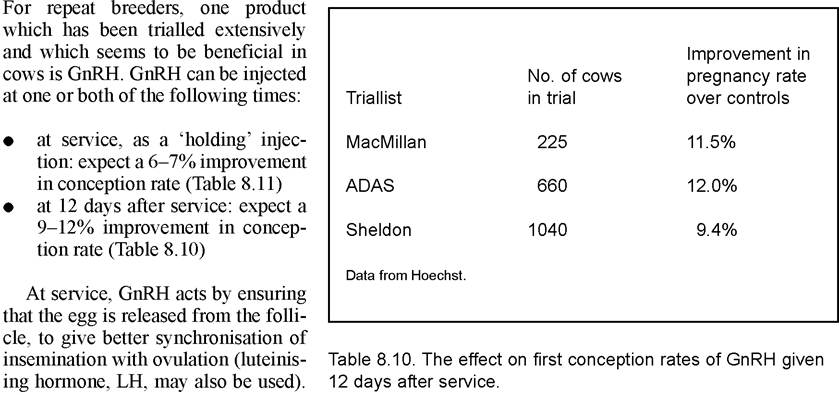
The use of GnRH is particularly good if the cows are stressed, for example following inseminations carried out just after turnout to grazing. Results show a 9-12% improvement in conception rates after the first service (Table 8.10), and in one trial this increased to 13% for cows at their second service and almost 30% at their third service. The number of animals involved at the second and third service was quite small, however, so the data needs to be interpreted with caution. Others have shown that the use of GnRH or LH at both service and at 12 days post service produces a better result in problem herds, viz where conception rates are inherently low.
Use of Embryos
An alternative approach is to implant an embryo into a repeat breeder cow. This would work even if the fallopian tubes were blocked or there were bursal adhesions present. The technique has become a practical possibility using embryos frozen in ethylene glycol, because these can be thawed in a single step, in much the same way as frozen semen. (Originally embryos were frozen in glycerol and had to be thawed in several stages.) Sometimes two embryos are placed in each cow, in the hope that twins will give double the amount of embryo ‘signal’ (bTb) and thus improve chances of conception.
Initial results suggest a 50% conception rate, so with relatively inexpensive embryos and no sophisticated equipment needed, the technique becomes a practical possibility.Dosing Individual Cows
A wide range of mineral, multivitamin and ‘nutrient boost’ products have been tried, some with apparent success. By all means try using them, especially if they are inexpensive, but do your own trial to monitor their performance. They may or may not work in your particular situation.
ABORTION
One of the final hurdles in our components of the calving interval (see page 233) is the maintenance of pregnancy to full term to allow the birth of a normal live calf. If early foetal death occurs, it is most likely that the foetus will be reabsorbed in the uterus and nothing is seen. If the calf is expelled from the uterus at any stage of pregnancy before full term, then this is called an abortion.
The age of the aborted calf in days can be estimated by the distance from the crown of its head to its rump (or anus), using the formula:
age = 2.5 x (crown to rump length in cm + 21)
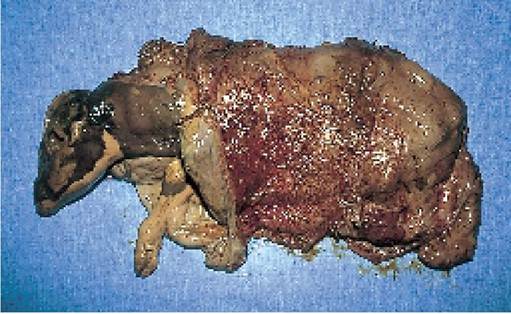
Most abortions are expelled from the uterus soon after foetal death and appear to be quite fresh. However, sometimes all of the placental fluids are reabsorbed and the calf becomes dry and chocolate-brown in colour. This is known as a mummified foetus and an example is shown in Plate 8.21. Mummified calves will often remain in situ, with some being expelled several months later - for example a 3 month old calf at 7 months of gestation - while others remain in the uterus and the cow simply fails to give birth.
Even with brucellosis eradicated, the average abortion rate for cattle in Britain in 1998 remains at approximately 4%. This is based on the number of abortions reported and checked for brucellosis by the Ministry of Agriculture, however, and so the actual abortion rate might be somewhat higher.
The incidence of abortion with twins is much higher than with single births. Some herds definitely experience a much higher rate than 4%, and it always seems worse when several cows abort over a short period of time.Plate 8.21. A mummified foetus may die in early pregnancy, although it may not be expelled from the uterus for several months.
In some countries (including the UK) the law obliges you to report all cases of abortion to the Divisional Veterinary Officer, so that samples can be taken to eliminate the possibility of brucellosis.
Most of the diseases causing abortion are dealt with in detail elsewhere in the book. They include:
• brucellosis, Chapter 11
• IBR (infectious bovine rhinotracheitis), Chapter 4
• BVD (bovine viral diarrhoea), Chapter 4
• leptospirosis, caused by Leptospira hardjo, Chapter 13
• salmonellosis, especially £ typhimurium and £ dublin, Chapter 11
• any peracute fever, such as summer mastitis, Chapter 7
• Bacillus Iicheniformis
Diseases discussed in this chapter are:
• mycotic abortion (Aspergillosis)
• Q fever
• listeriosis
• Neospora caninum
• chlamydia
Aspergillosis is the most common fungal cause of abortion. It is a mould with a green/grey colouring which is often seen growing on silage. A typical example was shown in Plate 1.1. Suspect food should therefore not be fed to late pregnant animals.
Neospora is thought to account for some 20-40% of all bovine abortions. A protozoan parasite, Neospora caninum originates in dogs, and one Canadian study showed a strong association between the presence of dogs on the farm and the number of cows which blood tested positive to Neospora. Little is known about its method of spread. The organism probably multiplies in the gut, spreads throughout the cow’s body and passes to the uterus, where it then invades the developing foetus. Infection may cause abortion, mummified calves or calves born alive with brain incoordination (cerebellar hypoplasia, see Plates 1.8 and 1.9).
The presence of Neospora cysts in the brain was one of the early diagnostic tests. Both monensin and decoquinate, drugs used against Toxoplasma, a related organism in sheep, have been used for treatment, as yet with unproven success. Once infected, cows can remain carriers and either abort every year or give birth to a calf congenitally infected with Neospora, which may then abort in later life.Chlamydia and Q fever are both members of the Rickettsia family, that is organisms which share properties of both bacteria and viruses. They are mainly associated with tick infested areas (see Figure 13.7), and both have been known to cause abortion.
Listeria monocytogenes more commonly produces abortion in sheep than cattle but can cause a brain infection in both species. The infection may originate from big bale silage.
Less is known about the causes of mummified calves. Possible factors include:
• BVD
• Neospora
• genetics (very occasionally particular sires will produce a high incidence in their offspring)
• stress in early pregnancy (proven in pigs but not in cattle)
Farmers tend to be more careful when handling heavily pregnant cows and this is probably a good thing in order to avoid teat and leg damage. I suspect that fairly severe mishandling is necessary to cause abortion.
More on the topic THE REPEAT BREEDER COW:
- THE ‘DOWNER’ COW
- MILKING THE MASTITIC COW
- DRY COW THERAPY
- Chapter 5 THE COW AT CALVING
- James E Byrne,[1]Soh Chee Seng, and Christopher Hare ‘Those who cannot remember the past are condemned to repeat it.'1
- Lameness is not only a major economic problem, but it is also a major welfare issue - for both the cow and the herdsman!
- Never forget that this has happened. Remember these words. Engrave them in your hearts When at home or in the street, When lying down, when getting up. Repeat them to your children. Or may your houses be destroyed, May illness strike you down, May your offspring turn their faces from you. Primo Levi, Survival in Auschwitz (1947)
- the Oestrous cycle
- HEAT DETECTION
- COSTS OF AMISSED heat
- WHAT IS MASTITIS?
- THE MILKING ROUTINE AND MASTITIS CONTROL
- Metabolic Disorders
- THE EFFECT OF THE MILKING MACHINE
- Penis Self-Mutilation
- PREGNANCY DETECTION
- THE CREATION
- A metabolic disease, or metabolic disorder, is the name given to a group of illnesses in dairy cows which are caused by an over-exertion of their normal metabolism.
- How to Read the Book
- Chapter 25 Of the Ideas of the Memory and Imagination David Hume