THE MILKING ROUTINE AND MASTITIS CONTROL
During the milking process contagious organisms may be transferred from cow to cow and environmental organisms which have become deposited on the teat end may be forced up through the teat canal to cause mastitis.
The milking routine is therefore vitally important in the control of mastitis and will be discussed in some detail.Teat Preparation
It is essential to adopt and maintain a constant routine for the cow in order to stimulate milk let-down. If cows are nervous entering the parlour or if there is some other change in their routine, then let-down may be inhibited. This could possibly lead to teat end damage, especially if the machine is applied one to two minutes before the teat fills with milk. It will certainly have the effect of reducing milking speeds.
Wash or dry wipe
Teats may be washed. This should be done with warm running water containing 250 ppm hypochlorite or 60 ppm iodine as a sanitiser. The supply tank providing the warm water must be covered with a lid to prevent contamination with dust and debris. Pseudomonas mastitis can be a particular problem with dirty header tanks.
Buckets and cloths are particularly liable to transmit infection and must never be used. Even if there is a high level of sanitiser or disinfectant in the water, it must be remembered that it takes up to 30 minutes for a disinfectant to work against Staph. aureus. It would be totally impractical to soak a cloth for that length of time. The disinfectant in the cloth cannot possibly destroy, say, the staphylococci from the outside of the teat of one cow before the next cow is wiped. Similarly, paper towels impregnated with antiseptic and sold for multiple use must be very dangerous.
It is the teats which should be washed, rather than the udder, and after washing, the teats must be dried, using individual paper towels. If the teats are not dried, there will be a small drop of dirty
water at the teat end and when the unit is applied, this could be forced up into the teat, especially if there are vacuum fluctuations.
In addition, excess water running off a wet udder may collect around the top of the liner, as in Plate 7.6, where it could be sucked into the milk and be the potential cause of increased TBCs and/or environmental mastitis. Washing and drying the teats is clearly important in reducing the TBC (total bacterial count) of milk (see page 214).Provided that the teats are clean and the TBC is low, an increasing number of herds have discontinued washing. The action of entering the parlour and being given concentrates is sufficient to stimulate the cow’s milk let-down, and omitting the washing certainly reduces milking time. There may be a small decrease in yield for the first few days after
washing has been discontinued, but this is only temporary. The mastitis risk is also reduced, but there
is an increased possibility of sediment and other contamination which might contravene the Milk and
Dairies Regulations.
An intermediate between the two extremes, and probably the best procedure, is to use a ‘dry wipe’. This removes the dust and debris from the teat pre milking, it provides some stimulation for let-down and it also enables a physical check to be made for the presence of mastitis. Alternatively use a medicated teat wipe for each cow. This cleans and disinfects both the cow’s teats and the milker’s hands between cows.
Of course, if the teats are obviously dirty, then they will have to be washed, but because washing
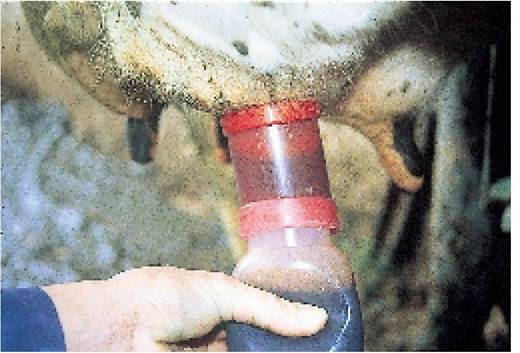
Plate 7.7. Pre milking teat disinfection is the ultimate step in producing a clean teat prior to milking and will reduce significantly the incidence of environmental mastitis.
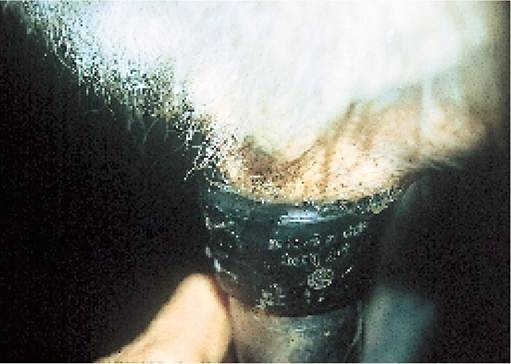
Plate 7.6. This clearly shows the effect of washing the teats (and udder in this case!) and not drying. The pool of dirty water on the top of the liner mouthpiece will soon be sucked into the milk and could easily be propelled into the teat by vacuum fluctuation, causing teat end impacts.
removes the normal layer of protective fatty acids and also the ‘natural’ bacteria from teat skin, unnecessary washing is undoubtedly detrimental. When the teats dry off they lose some of their natural elasticity and pliability, and this can exaggerate teat chapping. The answer is clearly to house and manage cows so that they keep clean and teat washing is not required.
Pre milking teat disinfection
The ‘ultimate’ step in producing clean teats prior to milking is to dip the teats in an iodine solution before milking, as shown in Plate 7.7. Special low iodine (0.1%) solutions with a high free (3-4 ppm) iodine content have been formulated for the ‘rapid kill’ effect required of a pre dip and these are the best products to use.
Diluted post dip solutions may not achieve this rapid action and are probably best avoided. The dip (or spray) must be left on the teats for a minimum of 30 seconds and then wiped off immediately prior to the application of the cluster.
Because of its higher concentration and disinfectant properties, pre milking disinfection is by far the best way of cleaning teats. It should be carried out as the final stage of teat preparation, after washing, drying and foremilking. Trials have shown that it can halve the incidence of environmental mastitis, and those people who use the technique say it also reduces TBCs and improves teat skin quality, which in turn reduces liner slip (see page 192). Pre dipping has an indirect effect against contagious mastitis, but its main effect is against environmental infections.
A comparison of the effects of pre and post dipping is given on page 200.
Use of Gloves
Mastitis organisms may be present on the skin of the teat or within the udder and these may contaminate the milker’s hands when he is washing the udder or stripping the foremilk for evidence of mastitis. Cracks and chaps in the milker’s hands may be harbouring bacteria and these may be a source of Staph. aureus mastitis infection.
Whatever the origin of the bacteria on the milker’s hands, they represent a potential source of danger to the next cow to be handled.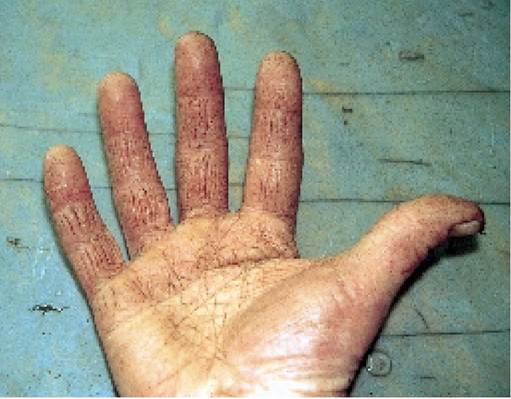
Plate 7.8. Hands with cracked skin, as here, could easily harbour bacteria.
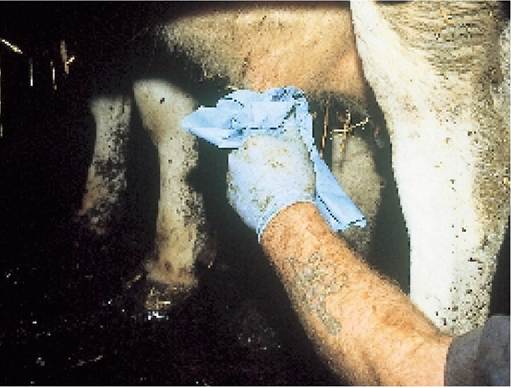
Plate 7.9. Dry wiping with a paper towel. Latex surgical gloves
are becoming very popular for milkers, due to improved comfort. To be effective, they must be regularly cleaned during milking.
The danger can be reduced by wearing rubber gloves. Not only are they less likely to harbour bacteria, but they are less likely to transmit infection from cow to cow. However, for gloves to be effective they must be cleaned, for example by dipping them into a bucket of hypochlorite or by rinsing in teat dip and wiping dry on a paper towel. Ideally, this should be done between cows, or at least between batches of cows, and certainly after handling a high cell count or mastitic cow. Plate 7.8 shows a typical cracked hand which could easily harbour bacteria and would be very difficult to clean. Compare this with the surgically gloved hand in Plate 7.9. This type of glove is becoming very popular. They are comfortable to wear and cheap enough to use a new pair at each milking. Gloves are particularly important in reducing the transfer of contagious infection.
Mastitis Detection
The early detection of clinical cases of mastitis is extremely important for three reasons:
• Affected cows can then be milked after the rest of the herd, or perhaps with a separate cluster, thus avoiding the risk of transferring infection.
• Prompt treatment can be given, thus reducing the risk to other cows as well as increasing the prospects of full recovery.
• Infected milk can be discarded: if it passes into the bulk tank, not only may this contravene the contract with the dairy marketing company, but it may also cause a massive increase in the cell count and the total bacterial count of the milk.
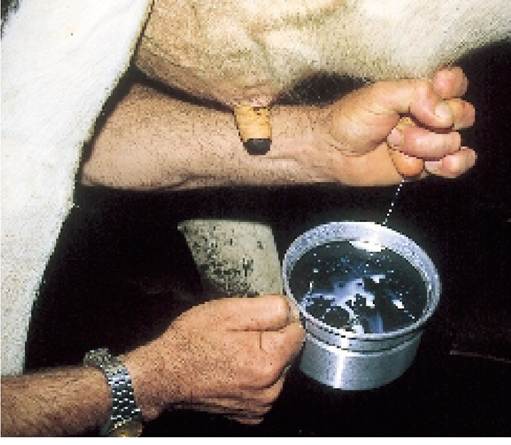
Plate 7.10. Stripping foremilk into a strip-cup for mastitis detection. Some say that milk splashing onto the black examination plate creates an aerosol which could infect other teats.
The best way of detecting clinical mastitis is by stripping foremilk into a strip-cup (Plate 7.10), but this is clearly a very onerous task. Simple stripping onto the floor of the parlour during the washing/wiping process is a useful alternative to the strip-cup Although mastitis is not so easily detected by this method, and there is the risk of spreading mastitis organisms into the environment, it does eliminate the risk of an infective aerosol splashing back up from the strip-cup onto clean teats and contaminating them.
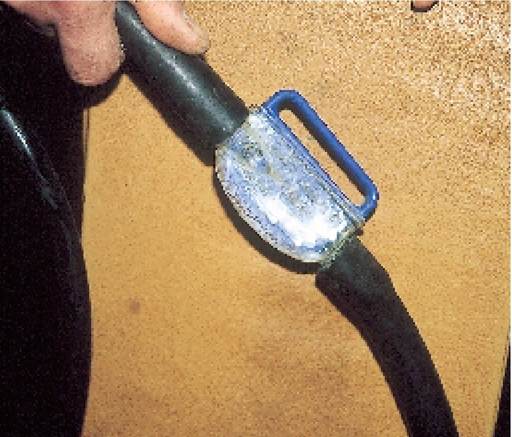
Plate 7.11. An in-line mastitis filter.
Checking foremilk
Although there are many advantages in checking foremilk, there are some potential disadvantages. In an average herd where there are only 35 cases of clinical mastitis per 100 cows per annum, the herdsman would have to strip almost 8000 teats to detect one case of mastitis! At this rate the risk of transmitting mastitis bacteria from teat skin and subclinical carriers by repeated handling of teats must be close to the risk of mastitis spreading by failing to detect a case quickly enough. This is one reason why an increasing proportion of people no longer foremilk. However, if yours is a herd with a high cell count and a high incidence of contagious mastitis, then I would certainly recommend foremilking.
Automated mastitis detection
Electronic systems based on changes in the electrical conductivity of mastitic milk are available, or in-line filters can be fitted, as shown in Plate 7.11. The disadvantage of both systems is that the milk has already entered the bulk tank by the time the mastitis has been seen. Even milk from a single mastitic quarter can increase both the TBC and cell count of bulk milk. Inline filters may also have the disadvantage that they disrupt milk flow through the long milk tube. However, they are an extra method of mastitis detection and provided that they are checked regularly and examined after every cow, then they can provide a useful addition to the mastitis control programme. Of course they would not detect the ‘watery’ E. coli mastitis where there are no clots present.
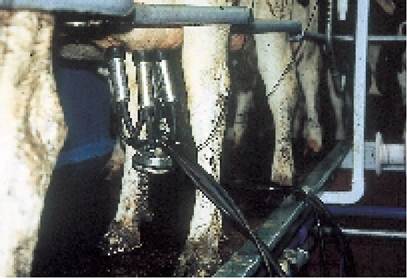
Plate 7.12. Poor unit alignment. Note how the weight of the long milk tube is pulling at the hind quarters.
More on the topic THE MILKING ROUTINE AND MASTITIS CONTROL:
- THE CONTROL OF MASTITIS
- POST MILKING TEAT DISINFECTION
- THE ENVIRONMENT AND MASTITIS
- MILKING THE MASTITIC COW
- THE EFFECT OF THE MILKING MACHINE
- ROUTINE health maintenance
- MASTITIS RECORDS AND TARGETS
- TEAT AND UDDER DEFENCES AGAINST MASTITIS
- WHAT IS MASTITIS?
- TREATMENT OF MASTITIS
- Chapter 14 ROUTINE TASKS AND DEALING WITH POISONS
- SUMMER MASTITIS
- Mastitis continues to be a major cause of economic loss to the national dairy herd and I suspect that, combined with teat injuries, it is one of the greatest aggravations to the herdsman.
- Chapter 7 MASTITIS AND CONDITIONS OF THE TEAT AND UDDER
- Sample Position Description—Critical Care Transport Medical Control Physician (also known as Medical Control or Command Officer)
- Sample Position Description—Critical Care Transport Medical Control Physician (also known as Medical Control or Command Officer)
- For William Byrd II, gendered violence was part of the daily routine. Born to wealth in 1674, Byrd owned thousands of acres in Virginia and oversaw dozens of people who made his estate profitable.
- Control
- Helplessness, Dependency, and Control
- Symptom Control