POST MILKING TEAT DISINFECTION
Even the most careful milking routine is likely to have produced some transfer of bacteria during the milking process. Although a few bacteria may have already penetrated the teat canal (due to teat end impacts), the majority will still be on the skin of the teat and teat end.
Disinfecting the teats after milking - post dipping - eliminates the majority of these bacteria. It is a vital step in mastitis control and should be carried out on every cow at every milking.Chemicals used
Most dips are formulated to persist for only two to three hours, but this is quite sufficient to exert their bacterial-killing action. Chlorhexidine possibly persists for slightly longer (four to six hours). There are five basic types of material used for post dips:
• hypochlorite - not less than 10,000 ppm (1%) and preferably 40,000 ppm (4%) available chlorine
• iodophor - not less than 5000 ppm (0.5%) available iodine
• chlorhexidine - not less than 5000 ppm (0.5%) chlorhexidine gluconate
• quaternary ammonium compounds (QUATs)
• dodecyl benzene sulphonic acid (DDBSAs)
Hypochlorite is the cheapest and may be adequate for use in the summer. However, it quickly loses its potency if it gets dirty from the cows splashing mud or slurry onto their teats, or from milk contamination in the teat dip cup. This is why any remaining dip should be discarded at the end of each milking and the cups should be washed. The other chemicals are less affected by contamination and in addition they can be mixed with emollients, that is substances like glycerine or lanolin which improve the condition of the teat skin. Concentrations of 10% glycerine or 2.5% lanolin are used, although these can be increased if chapping is a severe problem. Very high concentrations of emollients, that is above 15%, will reduce the bacterial killing action of the dip, however, and as bacteria growing deep in the crevices of the skin tend to make the chaps worse, a balance is needed between the emollient and bacterial-killing effects.
If hypochlorite is to be used with an emollient, it should be added immediately before milking to avoid excessive inactivation of the disinfectant.Barrier dips
Barrier dips attempt to achieve prolonged action and therefore provide some protection against environmental infections. These commonly combine a disinfectant, a gel and a solvent, often isopropanol. The isopropanol permits rapid drying of the teat, leaving a barrier film of gel over the teat end. Although products are continually improving, one of the disadvantages of some persistent dips is their sticky nature and the thick residual film of gel which has to be removed before the next milking or it will clog the milk filters. Dirt and debris can also adhere to sticky teats and will need to be removed at the next milking.
Dipping or spraying
Teat disinfectants are applied by dipping the teat into a cupful of liquid or by spraying. On average, teat dipping uses approximately 10 ml of dip per cow per milking, whereas spraying will use 15 ml.
Several different types of cup have been devised, the best probably being an anti-spill cup, an example of which was shown in Plate 7.7. Make sure the cup is deep enough to accommodate the whole length of even the largest teat (approximately 12 cm). If the cup is too full, immersion of the teat results in wastage of dip, whereas insufficient dip means that the teat does not get adequately coated. The whole teat needs to be covered with dip, because cracks can occur at any point on it.
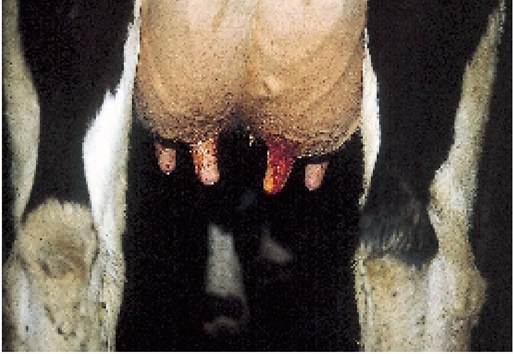
Plate 7.20. Poorly applied spray can lead to only partial teat cover and can predispose to mastitis.
Provided spraying methods are carried out conscientiously, they give a reasonable coverage to the teat and the spray material is always clean. However, it is easy to coat only half the teat as in Plate 7.20 and disinfectants with a high emollient content cannot be used. Sprays also use more ingredients and are therefore more expensive. Automated sprays, situated at the exit to the parlour and activated by a photo-electric cell as the cow passes, have not always proved successful.
They use up to 25ml per cow per milking. Teat disinfection is most effective if it is carried out as soon as the teat-cups are removed, ideally within 30 seconds, so that a film of dip covers the insideAcomparison between pre dipping and post dipping
| Pre dip | Post dip | |
| When applied | Immediately before cluster application | Immediately after cluster removal |
| Must it be wiped off | Yes | No |
| Speed of action | Must be rapid | Not important |
| Main effect against | Environmental mastitis | Contagious mastitis |
| Effect on: Cell count (SCC) TBC | Limited effect Decreases TBC | Decreases SCC Limited effect |
| Season of use | Housing and other periods of environmental challenge | Whole year |
of the streak canal as the sphincter is closing. This cannot be achieved by most automated methods. Post milking teat disinfection has three important functions:
• It kills bacteria transferred from an infected cow via the milker’s hands or the machine, and in so doing it prevents the establishment of a bacterial colony at the teat end.
• If mixed with an emollient it keeps the teats supple and prevents chapping and other lesions which can harbour Staph. aureus and Strep. dysgalactiae.
• Teat chaps with bacteria growing in them are slower to heal and so the antiseptic properties of teat disinfectants also promote the healing of teat lesions.
The overall effect of teat disinfection is to halve the rate at which new infections become established, and as such it is of considerable long-term benefit.
Potential Disadvantages of Post Milking Teat Disinfection
Post milking teat disinfection has no effect against existing infections. For example, in one post dipping trial a 50% reduction in new infections led to only a 14% reduction in existing infections over a 12 month period. Therefore the concurrent removal of existing infections by treatment, by dry cow therapy and by culling is important if mastitis incidence is to be decreased. Post milking teat disinfection alone cannot be expected to result in a rapid reduction of cell count or mastitis incidence.
There is even some evidence that in low cell count herds with a high incidence of clinical mastitis, post dipping increases the incidence of coliform mastitis, especially in heifers. In a Dutch study of five herds over an eighteen month period, two quarters of each cow were post dipped, whereas two quarters were left undipped. The undipped quarters showed:
• a 23% increase in clinical Staph. aureus mastitis (as would be expected)
• a 75-80% increase in subclinical coagulase negative staphylococcal and Corynebacterium bovis infections
• but a 41% decrease in clinical coliform mastitis
It was suggested that the presence of C. bovis at the teat end in some way prevented coliform infections. Clearly it would not be sensible to discontinue post dipping totally. However, if faced with an outbreak of coliform mastitis in freshly calved cows (and the majority of environmental mastitis occurs at this stage of lactation), a temporary stop to post dipping (or at least a stop for the first four to six weeks of lactation) might be a useful control measure. However, as yet there is no proof that this is a practical option.
More on the topic POST MILKING TEAT DISINFECTION:
- THE MILKING ROUTINE AND MASTITIS CONTROL
- DISORDERS OF THE TEAT AND UDDER
- THE EFFECT OF THE MILKING MACHINE
- TEAT AND UDDER DEFENCES AGAINST MASTITIS
- MILKING THE MASTITIC COW
- Disinfection
- CHAPTER 10 POST-STRUCTURALISM AND POST-MODERNISM
- The Politics of Post-structuralism and Post-modernism
- Chapter 7 MASTITIS AND CONDITIONS OF THE TEAT AND UDDER
- Post-Marxism and Post-Structuralism
- Mastitis continues to be a major cause of economic loss to the national dairy herd and I suspect that, combined with teat injuries, it is one of the greatest aggravations to the herdsman.
- Post-modernFeminism
- POST-MATURITY
- Post-divorce maintenance
- Post-truth rules
- The Post-Soviet Hero
- Law in the Post-Classical Period
- Recording of Religion in Post-Independence Census
- The Post-Scientific Stage
- OTHER POST CALVING COMPLICATIONS