THE EFFECT OF THE MILKING MACHINE
The milking machine can affect mastitis in several ways. For example
• in the way the milker uses the machine
• by the machine acting as a vector in spreading infection from cow to cow
• because inherent faults in the machine produce teat end damage or teat end impacts
These aspects are discussed in the following sections.
Unit Alignment
Once the udder is prepared, the cluster is attached and milking proceeds. It is important that the unit hangs evenly on the udder. This ensures that:
• all four quarters are milked at the same rate
• it is comfortable for the cow
• there is no liner slip, and hence teat end impacts (see next section) are minimised.
A unit with poor alignment is shown in Plate 7.12. The weight of the long milk tube is distorting the positioning of the cluster. An increasing number of parlours now install support arms so that this does not occur. A typical example can be seen in Plate 7.13. The unit is suspended very evenly from the udder. Old cows with pendulous udders, where the suspensory ligament has ruptured (as in Plate 7.14), are particularly liable to suffer from liner slip and should therefore be culled.
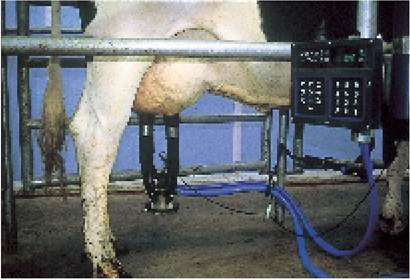
Plate 7.13. Perfect unit alignment is achieved with this support arm.
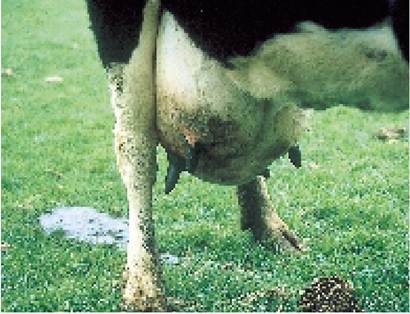
Plate 7.14. Rupture of the suspensory ligament of the udder. This can lead to liner slip and teat end impacts.
Liner Slip and Teat End Impacts
One of the most dangerous aspects of any milking machine in the causation of mastitis is the presence of liner slip and teat end impacts. Teat end impacts are defined as a reverse flow of milk hitting the teat end. When vacuum is applied to the pulsation tube, the liner starts to open to extract milk from the teat (Figure 7.6).
The vacuum at the end of the teat now reaches a peak. If in some way air leaks into the liner (right), milk will flow back through the claw to hit the other teat end (left) at speeds of up to 40 mph. This momentary reverse flow of milk from the claw produces an impact and of course it can easily carry with it infection from one of the other quarters. Admittedly many of the bacteria would be washed away again by the flow of milk from the teat itself, but some are not, and research has shown that milking plants producing a high number of impacts have far more mastitis.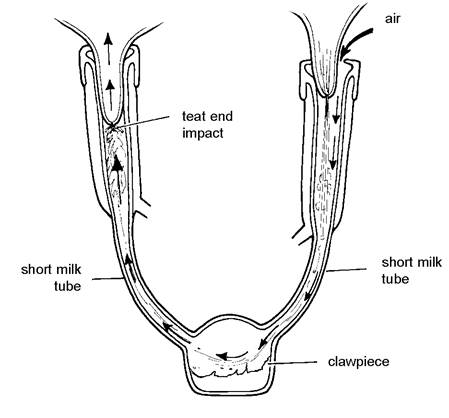
Figure 7.6. Teat end impacts (left) are caused when air enters between the teat and the liner (right), leading to an imbalance of pressure between the teat end and the clawpiece.
Teat end impacts can be increased as a result of faulty milking techniques. If air is allowed to enter the liner beside the teat, then milk rushes up from the clawpiece. This can occur if the cows are nervous and restless, perhaps because they have sore teats or possibly because the unit has already been left on too long. It can be the result of badly fitting liners which slip during milking, or it can occur when the cow is being machine stripped.
A teat end impact is a reverse flow of milk which can hit the teat end at speeds of up to 40 mph. Impacts are important causes of mastitis, often in association with:
• liner slip
• poor unit alignment
• excessively wet teats
• vacuum fluctuations within the plant
• machine stripping
• nervous or restless cows
• poor udder conformation, including rupture of the suspensory ligaments
• poor timing of ACR
• claws of insufficient volume or with blocked air-bleeds
Machine stripping
Machine stripping should not be carried out. There is ample evidence to show that leaving the last 1 or 2 litres of milk in the udder has no effect on total lactation production, whereas the accidental inlet of air while machine stripping will produce teat end impacts and predispose to mastitis.
For a similar reason, that is to avoid impacts, the vacuum should always be switched off before removing the cluster. Many modern parlours have automatic cluster removers (ACRs) and provided they are correctly adjusted, they will be beneficial in leading to a reduction in mastitis.Vacuum fluctuation
Probably the worst feature of the plant for producing teat end impacts is excessive vacuum fluctuation, especially if the fluctuation is at the teat end. Vacuum fluctuations in the whole plant are usually the result of a faulty regulator valve; for example one milking plant inspection service
reported that poorly maintained vacuum regulators, leading to excessive vacuum fluctuation, were by far their commonest finding. The regulator should be cleaned at least once a week. Any dirt or corrosion means that it may ‘stick’ and this can lead to fluctuating vacuum. Another common cause of fluctuation was inadequate vacuum reserve of the pump and this occurred particularly when an existing parlour was enlarged or if vacuum-operated feeders or gates were added, but the same vacuum pump was used.
Claw air-bleeds
An important feature of the clawpiece is the presence of a small air-bleed, a hole approximately 0.8 mm in diameter, which allows the entry of air. The reason for this is that a mixture of air and milk will flow more evenly along the milk tube and away from the claw. If the air-bleed is blocked, milk leaves the claw in ‘plugs’ and this leads to excessive vacuum fluctuation at the teat end. Even with an air-bleed, claws can get clogged when milk flow rates are high, so there has been a trend in recent years to increase the internal volume of the claw.
Afull discussion of all the causes of vacuum fluctuation would be outside the scope of this book; high-level recorder jars and even the nature of the pipe runs can have quite an effect. More detailed information is given in Mastitis Control in Dairy Herds which is listed in the Further Reading section.
I think it is sufficient for the reader to understand the significance of teat end impacts, their relation to mastitis and the way in which vacuum fluctuations can produce them.
It is then up to him to call in the specialist on milking machine function for the twice-yearly test or as a check when problems occur.Teat shields
One of the ways of preventing teat end impacts is by means of teat shields or deflectors, fitted into the base of the liner. An example is shown in Figure 7.7. The reverse squirt of milk is now deflected towards the sides of the liner so that teat end impacts under force cannot occur. Reverse flow can still occur, however, and the end of the teat may still get bathed in infected milk.
An alternative and much more effective system is to fit non-return valves. With these it is impossible for milk from one teat to pass across the claw to infect other quarters, and after a carrier cow is milked, only one teat liner will be contaminated. Trials have shown a 15% reduction in new infection rates when using teat shields and a 25% reduction in clinical mastitis with the ball valve claw (a, Figure 7.8). Other manufacturers have fitted a non-return valve into the liner (b) (Check-ball by Alfa-Laval) or into the short milk tube (b) (Hydramast by Deosan). Diagrams of these systems are shown in Figure 7.8. Although these are much cheaper designs, the closing of the valve is not gravity assisted and as yet there is no significant data available on their benefits.
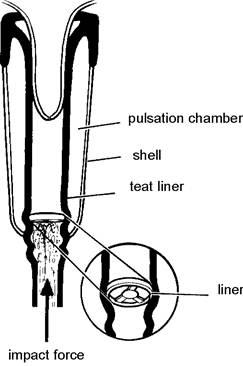
Figure 7.7. Liner shields help to reduce the effect of impact forces.
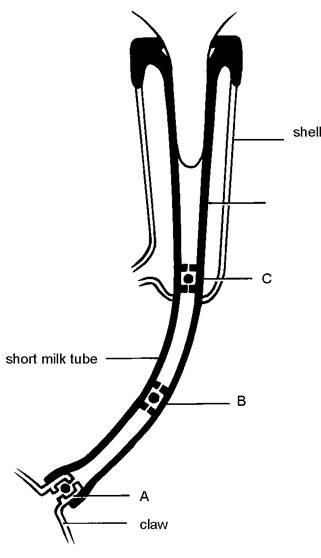
Figure 7.8. Reflux of milk from one quarter to another can be prevented by ball valves in the claw piece (A). Valves may alternatively be fitted in the liner (B) or inserted into the short milk tube (C).
Hydraulic milking
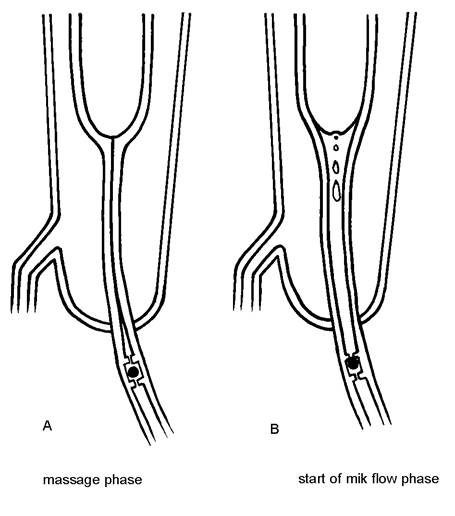
Figure 7.9. Hydraulic milking. (A) Massage (rest) phase: liner is collapsed but the teat remains bathed in a small quantity of milk.
(B) Extraction phase: the ball valve initially remains closed. Application of pulsation vacuum opens the liner and this draws the milk out from the teat. When the liner is full the ball valve opens and milk is drawn away.It was found that not only did non-return valves reduce new infection rates, but, by eliminating the air-bleed from the claw, they almost totally changed the principles of milk extraction from the teat to a process known as hydraulic milking. Figure 7.6a shows that during conventional milking, milk is drawn from the teat by the milk pump vacuum after the pulsation vacuum has risen sufficiently to open the collapsed liner. With a ball valve present in the claw, however, when the pulsation vacuum rises to open the liner, the valve remains closed (Figure 7.9B), thus cutting off the milk pump vacuum from the teat end. It is now the opening of the liner under the pulsation vacuum produced in the shell which creates a vacuum inside the liner and in this way milk is drawn from the teat end. The milk pump vacuum is used to remove the milk and this occurs only when the liner is fully open and full of milk, and during the early stages of liner collapse (at the ‘rest’ phase of the pulsation cycle - Figures 7.9 and 7.10). During ball valve milking, therefore, liners and short milk tubes are continually flooded, the teat is continually bathed in milk and the forces on the teat end are applied through a column of milk and not by air. This is why the process is known as hydraulic milking.
Extremely high vacuum levels (up to 90 kPa) are reached at the teat end during hydraulic milking, and unless the machine is carefully adjusted, this could have an adverse effect on the teats. Milking speeds are considerably faster when compared to conventional milking systems. In addition, the continually flooded liners make electronic measurements for milk yields, mastitis, heat detection and the like much simpler and more accurate than with the air/milk mixture which would be present in a conventional system.
If automatic cluster removal is required with hydraulic milking, then an air-bleed is needed in the claw, but used only immediately prior to cluster removal. Not all systems have been successful, however, and advice should be taken before installing hydraulic milking plants.The Importance of Pulsation
The teat is a very sensitive structure and if it is to function correctly and act as a reasonable barrier to the entry of mastitis organisms, it must be maintained in a healthy state. Pulsation during milking allows proper blood flow around the teat and if the pulsators do not allow sufficient rest, teat end damage as in
Plate 7.15 could occur. Figure 7.10 (top) shows the curve produced by a good pulsator. The vacuum outside the liner (in the pulsation chamber - see Figure 7.7) rises quite rapidly to induce milk flow and then falls to zero to rest the teat. The liner has now collapsed and blood flow is being restored. Figure 7.10 (bottom) shows a pulsator which barely reaches atmospheric pressure and certainly gives no rest period. This is bound to cause teat damage. Pulsators can also be adjusted to give varying periods of milking time to massage time (A:B in Figure 7.10). A ratio of 60:40 (milk- ing:massage) is generally satisfactory. Higher than this (e.g. 70:30) produces a faster milk flow rate but may allow insufficient rest and can cause teat end damage. More details are given in Mastitis Control in Dairy Herds.
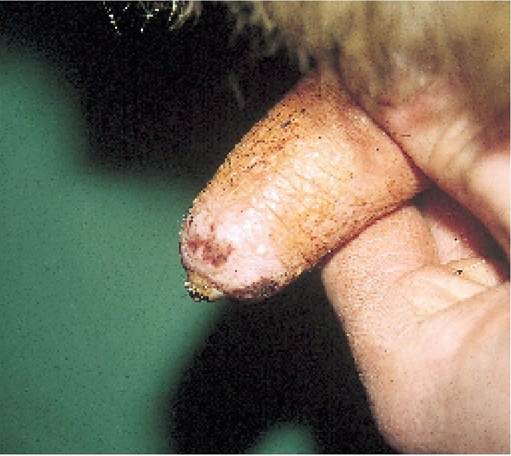
Plate 7.15. Haemorrhage and hyperkeratosis of the teat end are often associated with a machine fault.
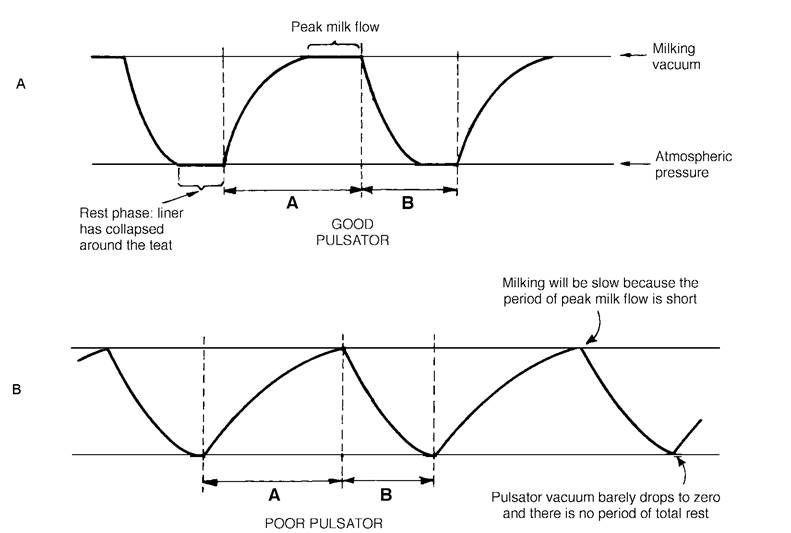
Figure 7.10. The pulsation curves of good (top) and bad (bottom) pulsators. The pulsation ratio is the ratio of A:B, viz. milk flow: massage periods.
Removal of the Cluster at the
End of Milking
Before the cluster is removed from the cow, the milk line vacuum must be switched off and sufficient time must elapse to allow the vacuum reservoir in the claw to be vented. If this is not done, there are two possible dangers:
• Air introduced beside one teat, while the other three are still under vacuum, will produce teat end impacts.
• If the cluster is pulled off before the vacuum is vented, this puts enormous strain on the teat end. Plate 7.16 shows a teat from a herd where badly adjusted ACRs meant that the cluster was being removed while still under vacuum. The amount of damage and hence the risk of mastitis are enormous. As claw volume has increased over recent years, the problem has
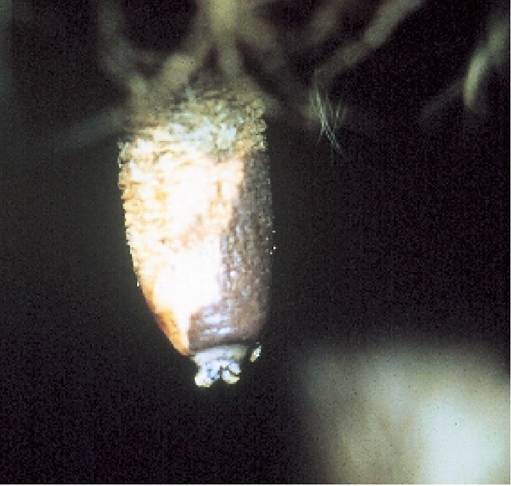
Plate 7.16. Severe teat sphincter eversion (hyperkeratosis) associated with poorly functioning ACR.
increased, because larger volume claws act as a greater reservoir of vacuum which must be vented before removal.
Cows which kick when the ACR is being pulled off, as in Plate 7.17, are obviously uncomfortable. Both the ACRs and teat ends need checking. Similar teat lesions can be caused by too high a vacuum, excessive fluctuation of the vacuum, or simply by excessively worn liners.
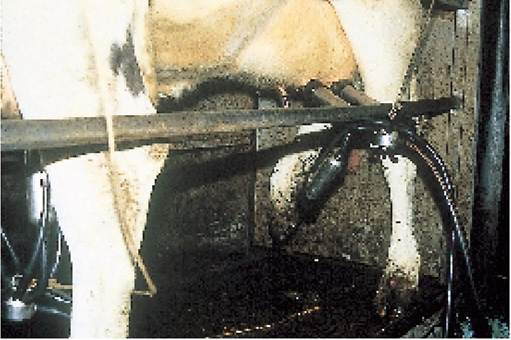
Plate 7.17. Cow kicking as the ACR pulls the cluster from the teats. It is likely that there is insufficient delay between vacuum shut-off and the ACR pull.
Liners and Other Rubberware
Worn liners lose their elasticity, resulting in poor pulsation and reduced milking speeds, and they may also cause teat end damage. Plate 7.15 shows a teat with both haemorrhage and hyperkeratosis (protrusion of the sphincter) at the teat end. The hard, dry and cracked skin not only promotes bacterial multiplication, but it also reduces the defence mechanisms of the teat canal and will predispose to the entry of infection and mastitis and to blackspot (Plate 7.35 and page 223).
Cracked liners are difficult to clean, and they are likely to transmit mastitis bacteria and to cause high
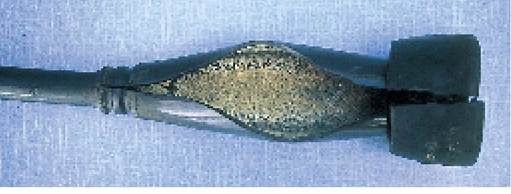
TBCs. Rough liner surfaces, due to a buildup of milkstone, as in Plate 7.18, can cause teat chafing and predispose to mastitis. If the short milk tubes or short pulsation tubes are cracked or split, this can lead to either teat end impacts or have a serious effect on pulsation. Both predispose to mastitis.
Poorly fitting liners can also be dan
gerous. If they are too large they may Plate 7.18. Severe milkstone buildup, as in this liner, can fall off, or they may allow air to suck transmit mastitis and increase TBCs. It may lead to teat in, producing teat end impacts and damage. slow milking. If they are too small, they constrict both blood flow and milk flow and increase teat end damage. Liners should be soft-mouthed so that they hang on teats of varying sizes without causing problems.
The most important considerations when using the milking machine are:
• unit alignment
• teat end impacts
• vacuum fluctuations and inadequate vacuum reserve
• inadequate claw bleed; small-volume claws
• poor pulsation and other factors leading to teat end damage
• poorly fitting and infrequently changed liners
• worn and cracked rubberware
Most manufacturers recommend that rubber liners should be changed after every 2500 milkings, or at six months, whichever comes first. If they are allowed to become old or worn, when air enters the pulsation chamber during the rest or massage phase (to restore blood flow - see Figure 7.9a), the liner slaps against the side of the teat, producing pain and teat damage. This pain may reduce let-down and lead to overmilking and further teat end damage.
The herdsman should regularly check that the oil level in the vacuum pump is adequate and that the belts are tight; that the vacuum regulator is functioning properly and is regularly cleaned; that all pulsators are operating correctly; and that leaking, cracked and worn rubbers are replaced. A regular twice-yearly check on machine function, combined with routine maintenance, is essential.
In summary then, even the normal milking machine is a major factor in transmitting mastitis organisms, and when it is not functioning correctly the risks are considerably greater.
Overmilking
At one time it was considered that overmilking was a major cause of mastitis. However, it is well known that 60% of the milk comes from the hind quarters. Assuming that milking speeds are equal in the hind and fore quarters, the fore quarters must milk out first and it is therefore likely that fore quarters are regularly overmilked. However, most mastitis comes from the hind quarters, so presumably overmilking is not an important cause of mastitis, provided that the milking plant is working well.
This conclusion has been acted on by one milking parlour manufacturer. By creating a more ‘gentle’ milking routine of very soft liners, a rapid pulsation speed of 70 cycles per minute and a 50:50 milk flow:massage pulsation ratio, the manufacturer has dispensed with ACRs and said that it does not matter how long the units are left on. Experience to date indicates that the system works well. Individual cow milk flow rates are slower, but parlour throughput (cows per hour) is kept high by milking larger numbers of cows per batch. This more ‘gentle’ milking system could be an important step forward to compensate for the increased mastitis susceptibility of our current higher flow rate cows (page 175).