COSTS OF AMISSED heat
Take a rather mediocre cow giving 5840 litres in a 305 day lactation, with a calving interval of 365 days. Averaged out to include her 60 day dry period, this gives a potential milk production of 5840 divided by 365 = 16 litres per day.
Other assumptions are:• milk price of 22p per litre
• concentrate price of £130 per ton (13p per kg)
• a high level concentrate use of 0.3 kg/litre over the whole year, namely 0.3 x 5840 = 1.75 tons per year. This high value relative to the cow’s yield is used to compensate for the additional forage which a milking cow eats compared to a dry cow
• a calf value at birth of £73.00
Using these figures it can be calculated that:
• cost of producing 1 litre of milk
= concentrate cost per kg x concentrate use per litre = 13 x 0.3 = 3.9p per litre
• gross profit margin per litre of milk
= milk price minus concentrate cost per litre = 22 - 3.9 = 18.1 p per litre
Our simplified example assumes that the maintenance costs and overheads of the cow - grazing, forage, utilities, finance, labour etc. - will remain constant, whether or not she is pregnant, that the profit comes from milk production and that there are no savings or increases in production associated with an extended lactation. (This is not entirely true of course.) Every day over 365 days that she does not become pregnant is therefore a day of lost production. In our example this becomes:
lost production
= 16 litres/day at a margin of 18.1p per litre
= 16 x 18.1p
= 289.6p per day lost margin
Even the calf is worth 20p per day (£73 divided by 365) over the year, so the overall cost is:
289.6 + 20 = 309.6p per day
In practical terms an individual cow rarely loses time on a daily basis: she either conceives or does not conceive and so the cost of a missed heat or a failure of conception is measured in 21 day cycles:
cost of a 21 day cycle = 309.6 x 21 = £65.02
This figure is slightly lower than the value of £3.50 per day (£73.50 per 21 day cycle) quoted earlier, because it does not include the additional costs of disturbance of the calving pattern, higher replacement rates and other factors.
I would also urge the reader to try different levels of yield. A cow giving 7300 litres in her 305 day lactation, for example, could be losing a potential margin of 382p per day, or £80.22 per 21 day cycle, at 1998 values. There is a tendency by some to allow high-yielding cows a longer calving interval because, it is said, they are milking so well that you will never get them in calf and anyway they will keep producing at a high level later in lactation. As Figure 8.1 shows, however most milk is given at peak lactation and a cow which has two ‘peaks’ over an 18 month period will perform much better than a cow which was left unserved because she was a high yielder. This is an extreme example, but it illustrates the point very well. In addition, cows which do not get back in calf quickly often end up by having a longer dry period and may get overfat. One survey showed that for every one day increase in calving interval, lactation length increased by only 0.6 day; i.e. 40% of the increased interval was in the dry period.
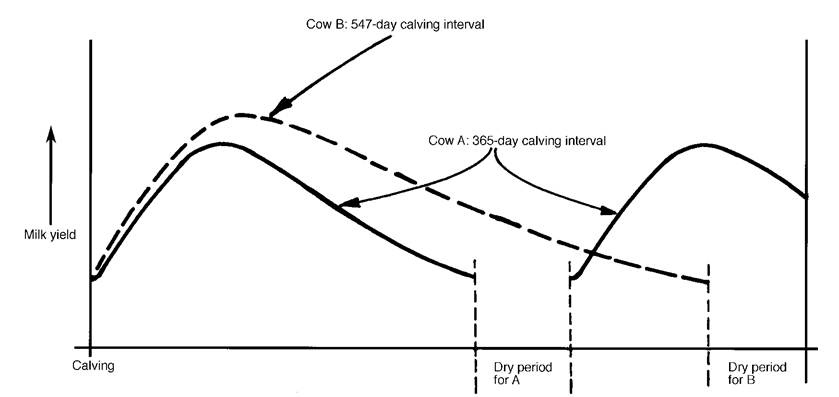
Figure 8.1. The effects of calving interval on milk yield. Cow A had a 365 day calving interval and therefore achieved two peak yields in an 18 month period. Although cow B peaked at a higher level and milked extremely well, her overall milk production was lower.
Extended Calving Intervals
If cows continued to milk, did not have extended dry periods and did not get overfat before the next calving, there would certainly be some benefits from extended calving intervals. One obvious advantage is a reduction in disease. Most of the common health problems of dairy cows - mastitis, milk fever, ketosis, calving problems, retained placenta, suboptimal fertility and even lameness - are associated with calving and the early lactation period. If the calving interval was, say, extended by 3 months, from 12 to 15 months, this could result in a potential reduction in disease costs of as much as 25% (3 months in 12 = 25%). This is only an option for all year round calving herds and would have to be carefully managed. Perhaps it could result in improvements in cow welfare, and as a result it is likely that longevity and overall lifetime production might also improve.
For a 15 month calving interval cows would need to be served at 6 months into lactation. By this stage they would be well past peak and one would expect an improvement in fertility. However, anyone reading this needs to carry out a very careful economic appraisal of their own system before embarking on any changes. If herd fertility is good and disease incidence is low, the benefits will not be so attractive and even in a herd with health problems there may well be more economic ways of improving the situation.
More on the topic COSTS OF AMISSED heat:
- HEAT INJURIES
- Heat Syncope
- HEAT DETECTION
- Heat Stroke
- Heat-Induced Illness
- Heat Exhaustion
- COSTS OF THE FINANCIAL DISTRESS
- Controlling Fees and Costs
- Fees and Costs
- WHICH COSTS COUNT?
- Costs of Injury
- Host defenses and parasite counterdefenses both have costs
- Conduct on Fees and Costs
- The Costs of Imperial Overstretch
- Article 8.7 Eurozone borrowing costs hit record low
- Transport costs and market size
- Chapter 13 Financial Distress and Bankruptcy Costs
- When individuals or firms make decisions about production, consumption and investment, they generally consider only their own costs and benefits, not the environmental or social consequences (externalities).
- Benefits and Costs of Higher Capital Requirements for Banks
- Group size may reflect a balance between the costs and benefits of group living