PREGNANCY DETECTION
It is vitally important that the herdsman knows not only if the cow is pregnant, but also when she became pregnant. Many of the management decisions throughout lactation - observation of heat, insemination, drying off date, calving pattern, fulfilment of milk quota, etc.
- are based on a knowledge of an accurate conception date and therefore calving date. Methods of pregnancy detection include:• the cow fails to return to oestrus
• milk progesterone testing
• ultrasonic scanning
• bovine pregnancy associated glycoprotein (bPAG) testing
• rectal palpation
• testing for oestrone sulphate in milk
• external abdominal palpation
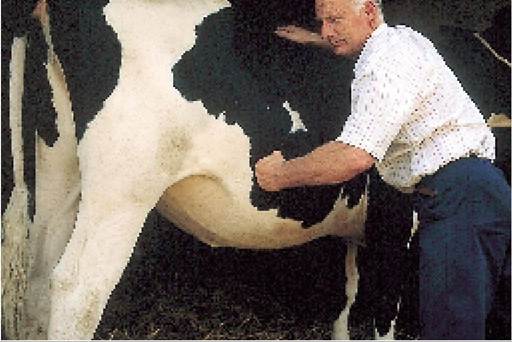
Plate 8.7. Late pregnancy can sometimes be detected by pushing your fist firmly in and out of the lower abdomen, in a swinging action. The calf is felt as a hard structure, bumping against your fist.
Failure of the cow to return to oestrus is the most common and the most important method, although it is not discussed in the following. External abdominal palpation can be used from approximately 7 months of pregnancy onwards. It should be possible to ballot the calf by gently but firmly pushing your fist in and out of the lower flank area, as in Plate 8.7.
Milk Progesterone Tests
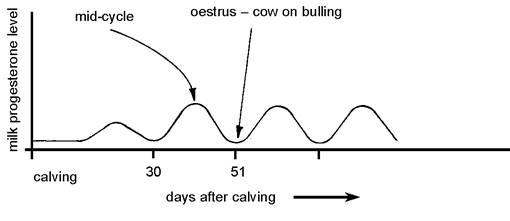
Figure 8.7. Milk progesterone in a normal cycling cow.
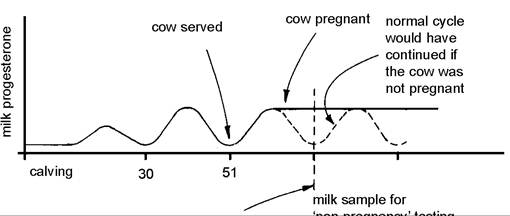
Figure 8.8. Milk progesterone levels in pregnancy.
In Figures 8.3 and 8.4 we saw how the corpus luteum is present in the ovary between one heat and the next and that it produces the hormone progesterone. Progesterone circulates in the blood and passes into the milk and measurements of milk progesterone levels can be very useful in several areas of fertility control.
Figure 8.7 shows the milk progesterone of a cow which had her first heat at 30 days after calving. When she is on heat there is no corpus luteum present in the ovary and so milk progesterone levels fall to zero. Levels rise to a peak during the middle of the next cycle and then return to zero 21 days later (now 51 days after calving) at the following oestrus. Figure 8.8 shows the same cow, but this time she was successfully inseminated at day 51. Because pregnancy was established, the corpus luteum stayed in the ovary and she did not come on heat at day 72. The dotted line shows how the cycles would have continued if the insemination had not been successful. This is the basis of the milk progesterone pregnancy test. A milk sample is taken 24 days after insemination - at 24 days because the cow could well return to service at 21-24 days and there is no point in sending a milk sample to the laboratory at day 21, only to find that the cow comes bulling 1 or 2 days later. Even if she came on heat at day 19-21 but was not observed, milk progesterone levels would still be low at day 24.A high milk progesterone level at 24 days after service suggests pregnancy whereas a low level indicates that the cow is not pregnant, and that she was on heat at 19-24 days but that oestrus was not observed. The accuracy of the test is very good for cows which are not pregnant (i.e. low progesterone levels), but only 80-85% of the cows which had high progesterone values will be pregnant when examined manually at 8 weeks after service. Because of this many prefer to call milk progesterone an indicator of non-pregnancy.
Some of the reasons for the false positive results are given in Figures 8.9, 8.10 and 8.11. The first cause is early embryonic death (Figure 8.9). The cow was pregnant when she was milk sampled at 24 days after service, but she then lost her calf and came on heat 54 days later. Irregular return intervals such as these are a good indicator that early embryonic death has occurred.
A second cause of false positive results is incorrect heat detection. In Figure 8.10 the graph shows the cow’s normal cycles. The cowman missed her heat at day 51, but mistakenly thought she was bulling at 65 days so had her served. Unfortunately he also missed her true heat at 72 days and so he took a milk sample 24 days after serving her. Of course by this stage the cow was in the middle of her next cycle, so the milk sample came back with a high progesterone level, a ‘positive’ result, but we know that the cow could not have been pregnant. Because his heat detection was poor, the cowman missed both of the true heats at days 51 and 72.
Causes of high progesterone
24 days after insemination
• pregnancy
• poor heat detection
• persistent corpus luteum
• luteal cyst
• pyometra
This type of situation is more common than you may think. Surveys have been carried out in which all cows presented for AI have been milk sampled. If they are truly on heat the progesterone levels should be zero. In fact results have shown that around 10-15% of cows presented for AI are not on heat. Clearly the conception rate of these cows will be zero and this shows how heat detection and conception rates are closely linked. Herds with a high proportion of negative milk progesterone results (viz returns at 21 days were not observed and so the cow was milk sampled at 24 days) are likely to have a poorer conception rate, as well as a larger number of false positive milk progesterone results.
The third category of false positive results covers factors other than pregnancy which hold the cow in mid cycle, that is maintain the corpus luteum in the ovary. Pregnancy is obviously the main reason for a ‘persistent’ corpus luteum, but a type of uterine infection known as a pyometra (see page 266) and a luteal cyst can have the same effect. Sometimes the cow simply stays in mid cycle for no apparent
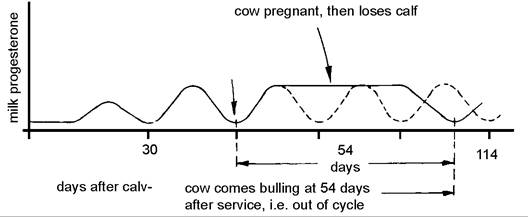
Figure 8.9.
Milk progesterone and early foetal death.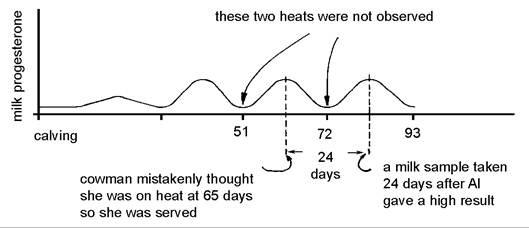
Figure 8.10. Milk progesterone and poor heat detection.
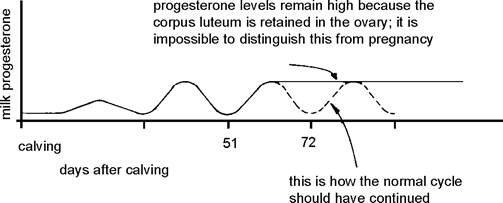
Figure 8.11. Milk progesterone and retained corpus luteum.
days after calving
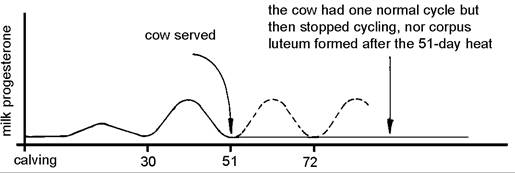
Figure 8.12. Long low progesterone or anovulatory phase.
reason (Figure 8.11), and this may be called a persistent corpus luteum, or simply prolonged luteal
activity.
On other occasions a cow may start cycling and then stop, but without any corpus luteum in the ovary. This would give the long low milk progesterone or anovulatory pattern shown in Figure 8.12. It will not confuse the milk pregnancy test, however, because the result of low progesterone, that is
‘not pregnant’, will be correct anyway. These cows are often referred to as hovering, that is they are very close to oestrus but do not ovulate (see also page 243). I find it a particularly frustrating syndrome to deal with when doing fertility work. The cow is presented as ‘not seen bulling’; on examination I diagnose ‘close to bulling’ or ‘follicle left/right ovary’, yet in 2 weeks time when she is presented again, she is at exactly the same stage of the cycle. Nothing has changed. Aprogesterone releasing device will probably be inserted for treatment and 2 weeks have been wasted. It would be very useful if hovering cows could be diagnosed at the first examination.
Numerous whole herd milk progesterone serial samplings have been carried out in the UK and the incidence of the various oestrous cycle abnormalities assessed. Approximate percentages are:
• 10% not cycling by 60 days post-partum
• 4% persistent corpus luteum (range 2-6.5%)
• 4% hovering (range 3-5%)
In one of these surveys, cows which were hovering had mean yields higher than the remainder of the group: 6627 litres versus 5203 litres, suggesting that perhaps the condition is induced by the stress of higher yields.
On-farm kits
There are now a variety of kits available for on-farm testing, the majority of which are based on colour change.
There is relatively little advantage in doing your own progesterone testing for pregnancy at 24 days, because you do not need the result until 12-15 days later, that is when the cow is due to come back on heat. There are, however, two occasions when on-farm testing is ideal. These are:• testing at 18-19 days after the previous service to see which cows are about to come on heat. Some systems have even recommended a ‘blind’ service on the basis of two low progesterone readings on alternate days
• as a method of heat detection. If a cow is at 21 days past her last heat or service and you are not sure whether she is bulling or not, a milk progesterone will help. A high progesterone says that she is not on bulling
Ultrasound Scanning
The scanner consists of a probe which is inserted into the cow’s rectum (Plate 8.8) and, by palpation,
passed over each horn of the uterus. The probe emits a beam of ultrasound which, after reflection off tissues of varying density, is collected by the same head and transformed into a picture on the screen. Soft tissues such as the walls of the rectum, uterus, blood vessels and the corpus luteum are seen as grey/white areas. Denser fluid - blood inside arteries and veins, uterine fluid, the fluid in cystic ovaries and urine within the bladder - is seen as dark areas. The screen of the ultrasound scanner therefore shows a black and white TV picture of the uterus and surrounding tissues in cross-section. The wall of the uterus is light in colour, the uter-
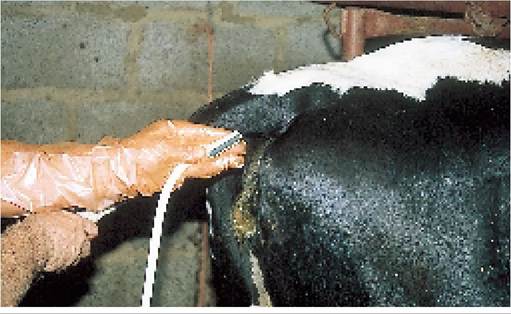
Plate 8.8. Rectal examination using an ultrasound probe can detect pregnancy from approximately 30 days post service.
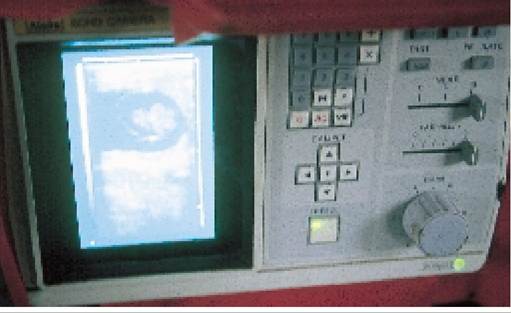
Plate 8.9. The picture produced by an ultrasound linear scanner. The wall of the uterus (light colour), uterine fluid (dark) and developing embryo (35 days old) are shown.
ine fluid dark and the developing embryo is light (Plate 8.9). It is a video and not a still photograph and so the foetal heartbeat can be seen - often as early as at 30 days of pregnancy!
Several types of scanner are available. Some have a fixed beam (linear scanners) and others a beam which waves to and fro, like a searchlight (sector scanners). Different levels of magnification are also available, depending on whether you want to see small objects (for example, early bovine pregnancy or ovarian follicles), or larger structures (such as scanning the abdomen of a dog externally for pregnancy or intestinal obstruction).
The main advantages of the scanner are:
• Pregnancy can be diagnosed at an early stage, for example from 30 days onwards.
• Ovarian structures - follicle, cyst, corpus luteum - can be more accurately visualised than by rectal palpation.
• Early embryo death can be detected, seen as white ‘snowflakes’ in the uterine fluid.
The disadvantages are:
• Cost. An average machine was priced at £8000 in 1998.
• The equipment is cumbersome. It is not always easy to find somewhere safe and convenient to position the scanner at the correct height beside a cattle handling system. Cattle, expensive equipment and electricity extension cables are not always a good mix!
• Low lighting is required. It is absolutely vital that the screen is in an area of low light intensity, preferably in a building. If in bright sunlight, accurate examination of the screen is virtually impossible.
Even the early pregnancy diagnosis has some disadvantages. Because the rate of natural embryo loss is higher in early pregnancy, a greater proportion of cows diagnosed as pregnant at 30 days will lose their embryo than if pregnancy was diagnosed later. This is particularly the case in problem herds, where embryo losses are high. However, there is still a big advantage in pregnancy checking prior to 6 weeks, because cows suspected not pregnant can be treated, or simply watched much more carefully, and then served again at 42 days.
Bovine Pregnancy Associated Glycoprotein (bPAG)
This protein is only produced by the developing embryo and unlike milk progesterone tests, cows can be sampled for pregnancy at any stage of the cycle. Blood samples are taken from 35 days of pregnancy onwards and the test is highly accurate. However, bPAG is also present in the immediately post-partum cow and ideally animals should be more than 100 days after their previous calving before testing for their next pregnancy, which somewhat limits the usefulness of the test.
Rectal Palpation
Pregnancy can be detected by rectal palpation from 6 weeks of gestation onwards and from 5 weeks in heifers with small compact uteri. Animals which are very fat are much more difficult to examine. When palpating through the rectal wall, the first step is to compare the size of the two uterine horns. The pregnant side is larger and at 6 weeks the placental membranes may be felt enclosing a bag of fluid. It is most important to distinguish this uterine enlargement from a pyometra or simply failure to return to a normal size following a previous pregnancy. At 8 weeks the calf can be felt, approximately the size of your thumb nail, and by 12 weeks cotyledons are developing.
Assessing the stage of gestation gets less accurate as the pregnancy advances. From 4 months onwards the foetus often drops down into the abdomen and can no longer be palpated, so that stage of pregnancy can only be assessed by the size of the cotyledons. This is not particularly accurate. In late pregnancy, probably from 8 months onwards, the calf becomes palpable again and the stage of gestation is assessed by calf size and position. This is also not particularly accurate. Avery small calf may be diagnosed as a 7 month pregnancy, only to be born 2 weeks later - as I know from personal embarrassment!
The advantages of a manual rectal examination are that it is accurate, that in heifers especially, pregnancy can be detected from 5 weeks onwards or even less, that an assessment of the stage of pregnancy can be made, and that if the cow is not pregnant possible reasons why can be given by examining the ovaries. The risks to the cow are minimal, and abortion will occur only if the very young calf (8 to 10 weeks pregnancy) is grasped and squeezed between the finger and thumb. This is almost impossible to achieve accidentally.
Although often discussed, to my knowledge there is absolutely no evidence that rectal palpation leads to any higher rate of embryo loss than scanning and recent research has confirmed this. There will be a low natural loss following both methods, and in both instances herds with a fertility problem will have a higher rate of loss.
Oestrone Sulphate
Oestrone sulphate is a hormone produced only by the pregnant uterus. Significant quantities can be detected in the milk from 120 days of pregnancy until calving. The test is very accurate and has the advantage over milk progesterone that milk samples do not need to be taken on a specific day. It cannot be used for early pregnancy detection, however.