CAUSES OF LOW CONCEPTION RATES
Causes of poor conception rates will be discussed under the following headings:
Poor embryo recognition
Serving too soon after calving
Poor heat detection
Timing of insemination
Endometritis
Fatty liver
Genital and other infections
Stress
Poor handling facilities
Operator technique
Semen quality
Nutrition
Poor Embryo Recognition
The cause of this high rate of early embryonic loss described in the preceding section has been the subject of much speculation and research.
It would appear that at least part of the problem is that although conception has occurred, the cow fails to realise that she is pregnant. In such a case, a cascade of hormonal changes is then put into place which starts the next cycle - and a viable embryo is eliminated. The hormonal changes are described in Figures 8.4 and 8.5, which should be used in conjunction with this section. From approximately 12 days of pregnancy onwards, before the placenta attaches to the wall of the uterus, the embryo produces a protein known as bovine trophoblastin (bTb). This acts as a signal, telling the cow she is pregnant. If, for some reason, the signal is not received by the cow, then at day 16-18 the uterus produces prostaglandin, the corpus luteum is dissolved and the next cycle begins.Possible reasons why the signal is not received include:
• a ‘weak’ signal from the embryo, caused by low bTb production
• the uterus is not in a receptive state and does not ‘hear’ the signal
Embryos which are small and underdeveloped certainly produce poorer signals. This has been clearly demonstrated by embryo transfer work: the larger the embryo (at a fixed age), the better the conception rate. Small embryos could result from a poor uterine environment, poor timing of AI (due to aging of the semen or ova before fertilisation occurred) and poor semen storage.
Some embryos are genetically non-viable. In other words, if these embryos were to develop into a full-term calf, the calf would be so badly deformed that it could not live a normal existence. Early embryonic mortality is therefore a method of eliminating such calves in the early stages and this must be an advantage to the survival of the species. Older cows have a higher rate of genetic abnormalities and embryonic mortality than heifers. It is worth comparing this with women, where there is an increased incidence of certain genetic birth defects with age, and where up to 30% of miscarriages are thought to be due to chromosomal abnormalities.
Failure of the uterus to receive or react to the signal is a more common cause of embryo loss. Once again this could be due to any one of a number of factors, some of which are discussed in more detail later in the chapter. Examples include:
• serving the cow too soon after calving, before the uterus has recovered from the previous pregnancy and therefore before it is in a receptive state
• uterine infections which can produce inflammation of the wall of the uterus, making it less receptive to the embryo signal
• stress
Stress for dairy cows is a difficult area to define. It will encompass many aspects of feeding, management, disease and housing, which are discussed in more detail on page 268. In relation to embryo recognition, stress can be compared to extraneous ‘noise’, so that the cow is unable to ‘hear’ the very faint signal produced by the embryo. A happy and contented cow, which is sitting quietly, is much more likely to be able to ‘hear’ a faint signal than an animal which is concurrently receiving many other sensory inputs from pain, hunger, fear or discomfort. Practical causes of poor conception rates are given in the following section. Some will have a direct influence on maternal embryo recognition and have been mentioned already.
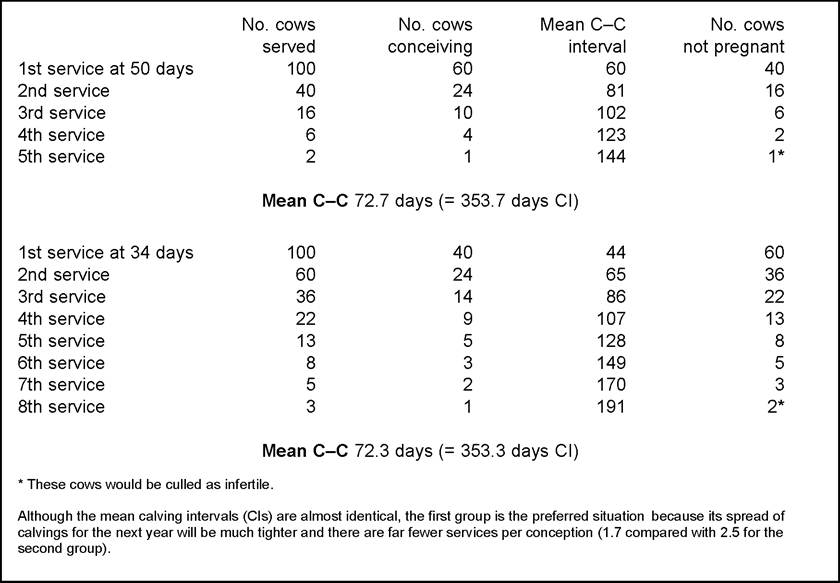
Table 8.7. Atheoretical comparison of the overall calving to conception (C-C) interval of 100 cows where serving started at 50 days after calving and achieved a 60% conception rate (top group), with another 100 cows served from 34 days onwards and achieving only a 40% conception rate.
Serving Too Soon after Calving
If cows are served too soon after calving, conception rates will be lower. This is thought to be due to the uterus not having settled down properly after the previous pregnancy and not being ready to accept the embryo for implantation. Figure 8.17 shows that you need to delay service until 70 days post calving in order to achieve the best conception rates, and if you serve at 35-40 days, conception rates may fall to 40%. As an approximate rule of thumb, the conception rate achieved is likely to be numerically equal to the number of days from calving to service. For example:
Conception rate of cows served after
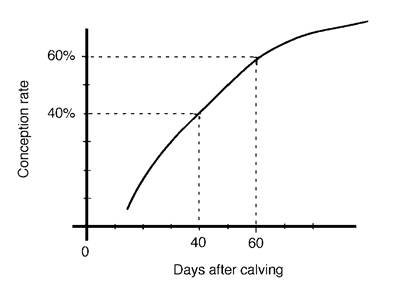
Figure 8.17. Conception rate varies with the interval from calving to first service.
20 days = 20%
30 days = 30%
40 days = 40%
50 days = 50%
60 days = 60%
It is, of course, no use waiting until 100 days and hoping for 100%!
Under average farm conditions I would recommend that cows are served after 50 days. The overall measure of fertility is the average period from calving to conception, since calving to conception plus gestation length (281 days) gives the calving interval (CI), and the gestation length is constant.
Table 8.7 shows that if you begin with 100 cows you get almost the same overall calving to conception (C-C) interval by starting the service period at 34 days and accepting only a 40% conception rate, as you do by waiting until 50 days post calving to get a 60%+ conception rate. Assuming that it takes 21 days to serve all the cows in a group, if the serving of 100 cows is started at 34 days post calving, then the average calving to first service interval (and calving to conception interval for those which hold to service) will be 44 days. Similarly, if serving is started at 50 days post calving, then the average calving to first service interval will be 60 days (viz 50 + (21 divided by 2) = 60).
Table 8.7 assumes that the conception rate remains constant throughout the service period in both groups and that heat detection efficiency is 100%. However, if the 40% conception rate is due entirely to serving too soon after calving, then by the second service the conception rate may have risen towards 60% and the figures will not be strictly accurate. The table also shows that one normal cow would need 5 services starting at 50 days post calving, whereas 3 cows would need 8 services starting at 34 days. Although the calving to conception intervals are very similar, the 50 day starting point is the preferred result, because it will give a tighter calving pattern the following year, there will be fewer culls and there will be fewer insemination fees. For example 1.7 inseminations were required for each conception in the first group, but this rose to 2.5 services per conception by starting at 34 days. If your herd already has a poor conception rate, however, you may be forced to start serving at less than 50 days, although there is then a risk that this may depress conception rates even further. Similar data is shown in Table 8.8. Although conception rates (services per conception) were poorer at 40-60 days, days open (calving to conception) were better.
There is a danger of being too concerned about conception rates. If you are doing your own AI and using inexpensive semen, then the important thing is to get the cow pregnant, so if you suspect that the cow is bulling, she is best served - even if it means that she is served again 2 days later when her true heat occurs. The exception to this rule comes when cows have been served already, since AI could then abort an existing pregnancy. This is discussed in the next section.
The submission rate is the proportion of cows eligible for service - namely those within the service period window - which are actually served. Submission rates are an important measure of fertility and often used in the analysis of data from problem herds.
Table 8.8. Influence of interval from calving to first service on reproductive traits of Holstein cows.
Days from calving to first insemination
| Reproductive trait | 120 | |||||
| Con. rate 1st serv. | 47 | 45 | 60 | 56 | 63 | 69 |
| Services/conception | 2.1 | 1.9 | 1.7 | 1.6 | 1.6 | 1.4 |
| Days open | 78 | 87 | 97 | 115 | 126 | 154 |
From Britt (1977), J. Dairy Sci. 60 1345.
Poor Heat Detection
The way in which poor heat detection affects fertility was explained in detail in the milk progesterone section on page 245.
On average, 10-15% of cows presented for AI are not on heat. It is interesting that data gives similar figures from the UK and from North America. Clearly the conception rate of these cows is zero. But even worse: if they are presented as a ‘repeat’ service, an incorrect insemination may abort an existing pregnancy. Abortion is less common if the incorrect AI is at 3 weeks and consequently some cows calve 3 weeks early, viz to the earlier service date. However, at 6 or 9 weeks or later, the larger placenta has expanded into the body of the uterus and incorrect insemination is much more likely to cause abortion.
The problem is compounded by the fact that about 5% of cows show standing heat when they are pregnant and it is impossible for the herdsman to know whether or not a bulling cow is pregnant. Unless he has already had her checked for pregnancy, he is almost certain to have her inseminated, thus running the risk of aborting an established foetus.
If you are unsure whether a cow is bulling or not, the following options are open to you:If heat detection is poor,
• many cows are not seen bulling and therefore are not served. Heat detection efficiency and submission rates are then both low
• a higher proportion of cows presented for AI will not be on heat, so heat detection accuracy influences conception rates
• Ask your vet to examine her for pregnancy.
• Carry out an on-farm milk progesterone test. A low progesterone means that the cow is in oestrus.
• Let the bull serve the cow. If she is pregnant, natural service will do no harm.
• Use AI, but inseminate into the cervix only. If she is in oestrus, there may be a 5-10% decreased chance of conception, but if she is not in oestrus, intracervical insemination will not abort an existing pregnancy.
Timing of Insemination
If you see a cow bulling this morning, should she be inseminated today or tomorrow? I would recommend that the cow is inseminated on the same day as she is seen on heat and not the following day. We have already noted that standing heat is a very variable period, lasting from 3 to 30 hours. There is a sharp rise in LH release from the pituitary gland 1-2 hours before the onset of true standing heat and ovulation seems to occur approximately 30 hours later, that is 30 hours after the LH surge, irrespective of how long heat lasts. For most cows ovulation occurs 6-18 hours after the end of standing heat. The optimum service time is towards the end of standing heat, which is 12-24 hours pre ovulation and 12-18 hours after the LH surge. To predict the timing of ovulation, it is therefore much more important to know when heat starts than when it ends. There are two other important factors to consider in the timing of insemination:
• Once shed, the egg remains viable for only 6-8 hours, whereas semen can survive in the uterus for up to 36 hours.
• Once in the uterus, semen has to undergo a process of changes known as capacitation before it is ready to fertilise the egg. This takes 4-6 hours. The semen also has to swim from the cervix along the uterus to the end of the oviduct to fertilise the egg.
For these two reasons it is better to have the sperm ready and waiting for the egg from ovulation.
When you see a cow standing to be mounted, you may not have any idea of whether she is just starting heat or just finishing, or how long heat will last. The only sure way is to have her inseminated, so that the semen is ready and waiting for ovulation to occur. This is particularly important if you are using an inseminator service which only calls once every 24 hours and you cannot specify the time of day. Also, in some areas you cannot call after 10 am for AI service on the same day.
For those doing DIY AI, the best advice would be to serve 12 hours after heat is first seen; that is the ‘am-pm’ method, whereby cows seen in the morning are inseminated in the afternoon and vice versa. On 24 hour inseminator service, if a cow served in the morning is still standing very late at night, or particularly the following morning, then she should be served again. The following gives an example of two possible scenarios. Let us assume that
• Two cows were seen bulling at 8.00 am one morning (day 1).
• One cow (ST) was just starting her heat and the other (E) just ending.
• Both cows were standing to be mounted for the average heat period of 15 hours.
• Ovulation for both cows occurred 24 hours after the onset of heat (viz approximately 26 hours after the pre ovulatory LH surge).
• They must be served by an AI inseminator at 10.00 am on either day 1 or day 2.
• The egg lasts for only 6 hours after ovulation, semen for 36 hours after insemination.
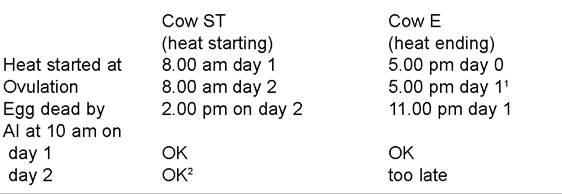
1 Cow E had been on heat for 15 hours at 8.00 am on day 1, which means that her heat started at 5.00 pm on day zero and ovulation therefore occurred 24 hours later at 5.00 pm on day 1 (i.e. 9 hours after she was first seen on heat).
2 Fertility here may not be very good because the semen will only just have time to undergo capacitation. (Insemination at 10.00 am and capacitation by 2.00 pm, just as the egg is dying.)
This example shows how many complex factors have to be considered when trying to decide a simple issue like the timing of AI. If cow E had a heat period for longer than 15 hours, then ovulation and egg death would have occurred even sooner. A further complicating factor is that you cannot specify the time of day when the inseminator will call. For both cows the timing of AI on day 1 would make no difference. However, if cow ST was inseminated at 2.00 pm on day 2 instead of 10.00 am, this would also be too late. The bull only serves a cow when she will stand to be mounted and the advice given above, namely to inseminate a cow during or soon after standing heat, is simply trying to mimic nature.
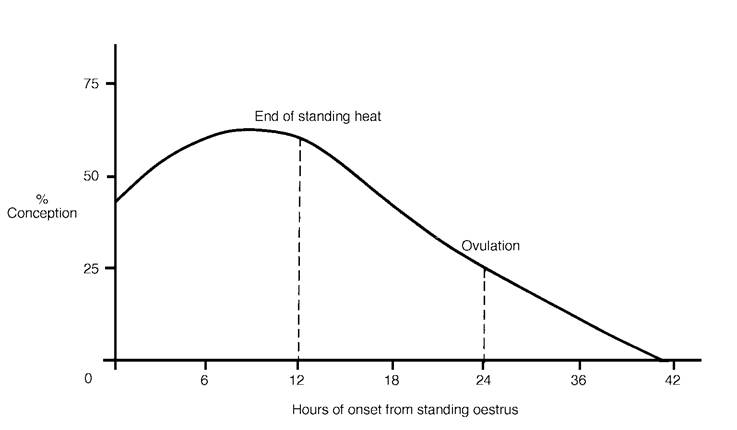
Figure 8.18. The effect of timing of insemination on conception rates. This cow was in standing oestrus for 12 hours and ovulated 12 hours later.
Figure 8.18 also shows how poor timing of insemination leads to reduced conception rates. Although cows served early or late in oestrus may conceive, their chances of doing so are much less, and the best conception rates are obtained by serving a cow when she is actually in standing heat. Figure 8.18 shows that there is a greater reduction in conception rate by serving too late rather than too early.
Endometritis
Sometimes also known as ‘the whites’ or ‘dirty’ cows, this is an infection of the inner wall of the uterus (endo- = inside; -metr- = uterus; -itis = inflammation of). When a cow is on heat the cervix opens and the uterus contracts, expelling the bulling string, so if there is any discharge present, this is the time when it is most likely to be seen. In more severe cases there may be a continual discharge, visible as white mucoid globules on the tail or at the vulva (Plate 8.20). Sometimes the uterus is full of pus but no discharge is produced. This is called a pyometra.
Prostaglandin is the treatment normally used for pyometra. It brings the cow into oestrus, thus emptying the uterus. At the same time the increased levels of circulating oestrogen associ-
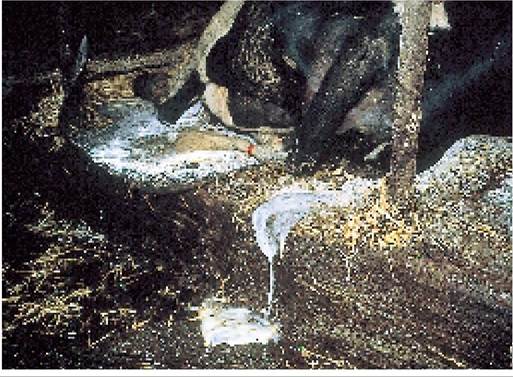
Plate 8.20. Endometritis (‘the whites') can be seen as a vaginal discharge from cows lying in the cubicles.
ated with oestrus boost the activity of the bacterial-fighting cells which are lining the uterus and this prompts a more rapid ‘cleaning up’ process. Sometimes injections of oestrogen (oestradiol) are used to produce a similar effect.
Causes of endometritis include
• retained placenta
• dirty calving boxes
• unhygienic, premature assistance with calving
• difficult calvings
• calves born dead
• overfat cows at calving (fatty liver)
• poor bodily condition at calving, or excessive weight loss post calving
One study showed that if all cows were injected with prostaglandin at about 2 weeks after calving, their subsequent conception rates would be improved. This is not often carried out as a routine in the UK, although if you had a problem it could be an option which your vet might suggest. Other options include the use of intrauterine pessaries or oxytocin injections 12-24 hours after calving. There can be no doubt that cows ‘dirty’ with endometritis subsequently have a much reduced fertility. Another survey monitored 180 endometritis cases from 24 farms and found that compared with ‘clean’ cows in the herd, ‘dirty’ cows
• had a lower first service conception rate (33% vs 53%)
• needed more services per conception (2.6 vs 1.8)
• overall took 20 days longer to get back in calf. At a cost of £3.40 per cow per day, this represents an average loss of £68.00 per cow, in addition to the cost of treatment!
It was also found that cows receiving their first treatment reasonably soon after calving had better fertility than those treated later. This is shown in Table 8.9, where early treatment of endometritis cases improved the calving to conception interval by 21 days (107 days versus 128 days), a considerable economic benefit. Prompt and effective treatment is therefore essential and I would suggest that cows are examined at between 14 and 28 days after calving. Unless they are obviously ‘dirty’, cows are best left for the first 2 weeks after calving before checking, because many early discharges will clean up spontaneously without treatment.
There is a range of factors which can lead to uterine infections and a high incidence of endometritis. One of the most common is retained placenta, particularly if it is not treated correctly. (Retained placenta, its causes and treatment are described in Chapter 5.) Not all cows with retained placenta subsequently develop endometritis, however, and it is only those cows with endometritis which are difficult to get back in calf. Retained placenta on its own may have relatively little adverse effect. Endometritis may also be associated with some of the many factors which lead to an increased incidence of retained placenta, namely overfat cows, excessive interference, twins, mineral or trace element imbalances, even though the incidence of retained placenta is normal.
Clean calving boxes are very important. During normal birth, uterine contractions push the calf’s legs and nose part way through the vulva. When the cow then relaxes, the calf falls back into the abdomen - and of course draws air back in with it. If the bedding is very dirty, then the air will be heavily contaminated with bacteria, these will pass into the uterus and endometritis may develop.
| Timing of first treatment | Number of cows | Calving to conception (days) | Services per conception |
| EARLY | 74 | 107 | 3.22 |
| (less than 28 days after calving) | |||
| LATE | 44 | 128 | 3.21 |
(more than 56 days)
From Anderson (1984).
Some authorities are so convinced of the importance of hygiene that they even recommend washing the hind quarters of a cow before calving
Table 8.9. Endometritis is known to lead to poor fertility, but the effect is even worse if treatment is delayed.
and wrapping a bandage round her tail to prevent aspiration of infection during the birth process. Similarly, if you are assisting with a calving, make sure that you are clean. Wash your arms and the cow’s vulva with soap and water before examining her, and if (or when!) faeces fall onto your arm, make sure you wash them off before going back into the uterus. Clean calving ropes are obviously essential.
Even the choice of bull has an effect. A large bull giving difficult calvings will lead to a higher incidence of endometritis. One of the greatest risk factors for endometritis is in fact a stillborn calf. Any factor leading to stillborn calves (for example, overfat cows, poor sire selection, excessive interference) increases the risk of endometritis. Causes of stillbirths are discussed later in this chapter.
Underfeeding and excessive weight loss in early lactation can lead to increased endometritis, especially in heifers. Presumably this is because the stress of underfeeding decreases their resistance to infection and, in addition, ovarian oestrous cycles which would naturally clear up the endometritis fail to start.
In summary, inadequately treated endometritis leads to poor conception rates and can be caused by a range of factors.
Fatty Liver
This is described in Chapter 6. Cows with fatty liver have low albumin and glucose levels in their blood and their conception rates will be reduced. They are also more susceptible to retained placenta, uterine infections and cystic ovaries, and this may have a secondary effect on conception rate, as shown in Table 6.2.
Genital and Other Infections
Poor conception rates caused by specific genital infections with such organisms as Brucella abortus, Trichomonasfoetus and Campylobacter (previously known as Vibrio) are fortunately less common in Britain nowadays. However, as bulls are being used more often in dairy herds, particularly as ‘sweepers’ at the end of the service period, the possibility of campylobacteriosis should not be overlooked. Your vet will need to take special samples of vaginal mucus or washings from the bull’s prepuce to check for this organism.
Leptospirosis, BVD, IBR and Neospora are all infections which can cause poor conception rates. The effects of leptospirosis and BVD are particularly pronounced and are dealt with elsewhere in this book.
Stress
Social stress in cows is an interesting condition but as it is rather difficult to define, a few examples are needed. It is quite easy for a cow introduced into a small herd of 40-50 others to come into contact with each one of them and soon establish her own position in the ‘pecking order’. The chances of getting to know 250-300 cows over a few days is much less, however, and the situation becomes almost impossible if cows are being taken in and out of the herd all the time. In this situation our cow will be continually meeting new faces and possibly having to fight to establish her superiority (or otherwise) to them. This is a clear example of stress, and it is becoming increasingly apparent that if group size goes above 100 cows or if group composition is constantly changing, then the cows will be adversely affected.
Unless food is freely available, group feeding can be a high stress situation. For example, if cows are given a mid day feed there may be a 200% variation in individual food intake, and this can be even greater if trough space is inadequate.
Heifers probably suffer most from stress. They are regularly reared in a separate group, having only to compete with animals of their own age and size. After they calve, their world almost falls apart. There will be discomfort around the perineum (vulva and vagina) from calving and perhaps soreness due to an enlarged or oedematous udder. They have been transferred into a large and strange group of much bigger and aggressive animals, namely the main dairy herd. They have often come from soft ground (pasture or straw yards) onto a hard and slippery floor (concrete). They are made to stand for long periods of time, waiting to be milked, or waiting for their turn to feed. The diet will have changed dramatically and if access to forage is poor, for example, because trough space or access to self-feed silage is inadequate, they may well develop acidosis from eating excessive concentrate in the parlour. The buildings are often overcrowded. There may be no loafing area, nowhere to get adequate exercise and so they stand almost motionless on hard concrete. They may have never seen cubicles before, so lying times are reduced and this causes intense laminitis/coriosis and later lameness. Even when they do learn to use the cubicles, the shed may have passageways with blind endings and no escape routes, so that the heifers feel too intimidated to enter. In a few instances the herdsman himself (and his dog?!) may increase their sense of alarm by rough handling, rushing them when walking on rough or slippery concrete, driving them with tractors or ATV bikes and packing them tightly into the collecting yard for milking.
The net result of all this stress is that lameness (especially), mastitis, displaced abomasum and other diseases become more common, compounding the stress further in individually affected animals.
Can we be surprised that heifers sometimes do not perform well? Yields are certainly better if they are kept in separate heifer groups for their first lactation, which must be an indication of reduced stress.
I have obviously painted the worst possible scenario in order to emphasise the point, but it serves to demonstrate the many potential areas for improvement. Stress reduces fertility by increasing endometritis, delaying the onset of ovarian cycles, increasing embryo mortality and reducing conception rates. It also increases the animal’s susceptibility to disease and reduces its milk production.
Poor Handling Facilities
A stress factor which can affect both cow and operator is poor handling facilities. If the inseminator has to chase your cow around the yard and then stand her in the front of a herringbone parlour where she can wriggle from side to side, you cannot expect him to do a perfect job. The cow should be well restrained, ready and waiting for him and preferably left with an adequate supply of food and water. It is not an easy task to pass the insemination catheter through the cervix and into the uterus. The cow needs to be on the same level as the inseminator and restrained so that she cannot move forwards or sideways. If the cow is excessively excited and stressed, this may upset her hormonal mechanisms so that ovulation or fertilisation may fail to occur anyway.
Operator Technique
It is possible that even the best trained inseminator can develop faulty techniques, leading to reduced conception rates. For this reason and for on-farm inseminators especially, it is important to consider
• regularly attending retraining sessions
• monitoring performance, especially if it is possible to compare your own performance with other inseminators working in the same herd
Semen Quality
Poor-quality semen can originate from poor semen storage (for example, a flask low in liquid nitrogen), poor thawing techniques (water too hot), poor handling (semen allowed to cool excessively prior to insemination) or a bull with suboptimal fertility. The latter could be temporary, for example, following an illness, or it may be that the bull has inherently poor fertility. Any of these factors will obviously affect conception rates.
Nutrition
Eating is probably the most important activity of the dairy cow, because without food she cannot milk or grow. Many aspects of feeding can have an effect on fertility and some have been mentioned already, for example:
• Inadequate feeding space can cause stress and lead to an increased incidence of early embryonic mortality, as well as causing difficulties with heat detection.
• General underfeeding and weight loss in early lactation may be associated with uterine infections.
• An energy deficit in overfat cows immediately after calving may lead to fatty liver syndrome.
• Excess calcium or inadequate magnesium intakes during the dry period can cause an increased incidence of milk fever and this in turn may lead to more endometritis and reduced conception rates.
• Acidosis caused by a forage:concentrate imbalance can lead to laminitis and subsequent lameness, and lame cows are more difficult to detect on heat.
Effects of nutrition on fertility
• direct: inadequate energy balance may depress conception rates
• indirect: adverse nutrition increases the incidence of disease, and the disease has an adverse effect on fertility. Examples include lameness, fatty liver and milk fever
• specific: deficiency of a single trace element or vitamin may adversely affect fertility
Earlier in this chapter we saw that the physical and hormonal changes in the ovary associated with oestrus are extremely complex. The hormonal balance needed to maintain pregnancy is equally as intricate. It is likely that minerals and trace elements affect only minute aspects of these events and so it would therefore be illogical, if not naive, to expect nutrition to have a precise and consistent effect on overall fertility. The exact relationships have yet to be established and my own approach to a herd fertility problem is to examine the diet and to correct as many of the abnormalities as possible. This may seem rather unscientific, but fertility control is a dynamic process. At any one time it is influenced by a wide variety of factors and if we can help the cow to overcome some of her nutritional imbalances, then she may well cope with the remainder and the herd can once more return to reasonable fertility. These are general comments. There are certain aspects of nutrition which are more positively correlated with conception rate, however, and which need to be discussed in a little more detail.
Energy balance
It was once well accepted that conception rates improve if cows and heifers are served on a rising plane of nutrition. This is very difficult to achieve in early lactation. Figure 8.19 shows how milk yield reaches a peak well before the cow achieves her maximum appetite capacity and so some weight loss is bound to occur. The problem is more acute with first-calved heifers which not only have to compete with older cows for food, but also need an additional allowance for growth. This occurs at a time when they are changing their front teeth (Plate 13.1), making eating even more difficult. If nutrition is adequate, weight loss may have stopped by the time the cow is ready to be served and there may even be some weight gain. This is especially true by the second or third service if the
cow repeats.
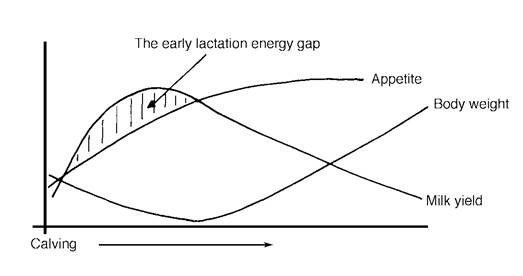
Figure 8.19. In early lactation milk yield peaks before a cow reaches her maximum dry matter intake. The energy gap leads to weight loss.
These traditional views have become modified following the introduction of flat-rate feeding and from what has become an almost classic experiment by Ducker. Using 100 heifers, he divided them into two groups which were fed high or low both before and after calving. He found that heifers which were fed at a high level in order to gain weight at the time of service had a reduced fertility, whilst those losing weight got back into calf quite well. The higher- fed heifers had higher yields and this depressed fertility. This is almost certainly why herds practising flat-rate,
lower concentrate feeding do so well. It produces a much flatter lactation curve and, as changes in bodyweight are by no means as extreme, fertility seems to be better. This is only an observation, however, and I know of no trial work producing any conclusive proof. It is likely that the most important factor is to avoid any extremes of weight change.
Energy balance can be measured in a variety of ways. Conventionally the quantity and quality of the food being eaten are compared with the cow’s requirements for milk production and a diet balance sheet is prepared. Secondary checks are always worthwhile, however, and measurements such as bodyweight loss, body condition score, the bulk milk protein content and betahydroxy butyrate and blood glucose levels in the metabolic profile test (see Chapter 6) will all help in the assessment of energy status. Energy balance may affect those cows in a herd which were being served when there was just a short-term problem.
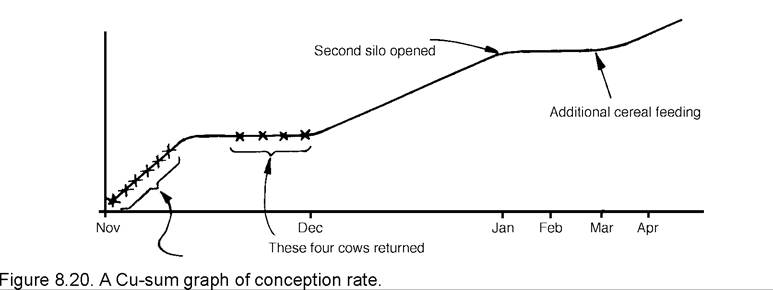
Figure 8.20 is a Cu-sum graph of conception rate. The cows are arranged in order of service date along the horizontal axis, the bottom of the graph. Starting from zero in November, if a cow conceives the plot moves up one square. If the next cow does not conceive, the plot moves along one square, but remains horizontal. In some systems Cu-sums are arranged so that conception moves up one square and failure moves down one square. A horizontal plot then denotes a 50% conception rate. In Figure 8.20 a line with a 45° slope represents a 100% conception rate. The distance for November and December is much greater than for February and March, because far more cows were served in the first 2 months. The overall graph shows a serious fall in conception rate for cows served during late January and early February. This was because when the second clamp was opened, the silage was much poorer and there was an overall fall in energy intake. Additional cereal feeding introduced in late February improved the conception rate of the cows served in March and April.
Protein balance
There is increasing evidence that high protein diets (often fed to boost yields) lead to depressed conception rates. This is particularly the case with high levels of rumen degradable protein (RDP) such as urea and lush autumn grazing, and also when there is a concurrent energy deficit. Diets high in UDP (undegradable or rumen by-pass protein) do not appear to have the same deleterious effect. As overall dietary protein intakes have increased over the past ten years, this could be one reason why conception rates have been falling.
Minerals and trace elements
Dairy farmers spend millions of pounds each year on mineral and trace element supplements, with phosphorus probably coming top of the list. Specific and consistent associations between minerals and fertility are virtually impossible to prove. We have already seen the massive range of other non-nutri- tional factors which can affect fertility and which can confuse the results of feeding trials. Deficiencies of copper, manganese, cobalt, iodine, phosphorus and selenium have all been associated with poor conception rates and the calcium-to-phosphorus ratio in the diet is also said to be important. Details of the levels required and of the effects of deficiencies and excesses are given in Chapter 12.
Deficiency of vitamin A impairs fertility, and several workers have shown a relationship between B-carotene (a vitamin A precursor) and conception rates. The position with regard to vitamin E and selenium is less clear. Deficiency in rats causes sterility, but no relationship has ever been proven in dairy cows. If your herd has an inadequate vitamin E status, however, it is most sensible to provide additional supplementation. There is some evidence that inadequate vitamin E/selenium status leads to increased placental retention and endometritis, and endometritis definitely affects subsequent fertility.