Russian Orthodoxy Colonizes America
Not all European colonization of North America was transatlantic and westward-moving. Beginning in the late 18th century, Russian Orthodox missionaries and entrepreneurs approached from northeast Asia, moving eastward across the Bering Sea and north Pacific to trap furs and convert natives in North America.
Russian exploration of North America began with the 1728 and 1741 voyages of Vitus Bering (1680–1741), but missionary activity began in 1784 when eight Orthodox monks arrived at Kodiak Island. They constructed a church there in 1794—which remains active—enjoying considerable success because they allowed converts to retain much of their religious tradition and because converting brought substantial material benefits. After establishing on the southern Alaskan coast a string of settlements named for Eastern Orthodox saints—Three Saints Harbor (1784), Fort St. George (1787), St. Paul’s Harbor (1791), St. Nicholas (1791), and St. Constantin (1793)—they expanded their missionary reach to the Aleutian Islands and the Alaskan interior.
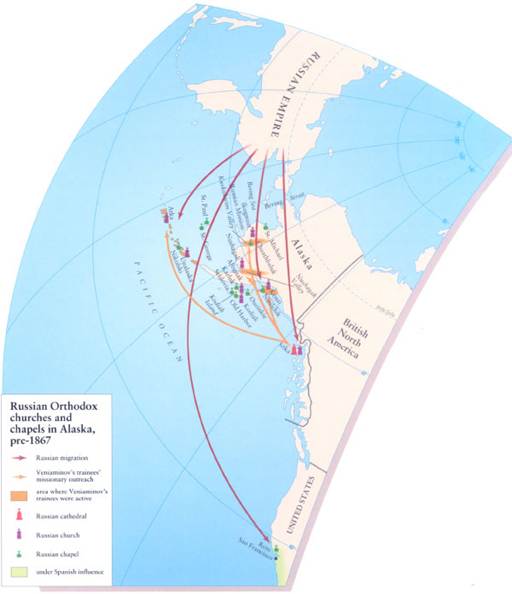
In 1799, Czar Paul I founded the Russian-American Company, required as a government agency to promote the established Orthodox church. But its relations with indigenous Alaskans was tense, for it virtually enslaved male Aleuts and other natives to work in fur trapping, pressured (later, legally required) them to convert, and founded New Archangel (Sitka)—which became an administrative center for both company and Church—on the site of an ancient Tlingit village. Sitka faced hostility from many local natives but eventually developed a multiethnic Russian-Indian population. Company relations with natives, and missionary success, improved after 1821, when the company revised its charter to ameliorate working conditions and step up its support for Orthodox evangelism.
Russian Orthodox activity in Alaska accelerated with the 1834 arrival in Sitka of Ivan Veniaminov (1797–1879), who became Bishop Innocent when Sitka became an official diocese in 1840. The first Orthodox bishop to serve in the Americas, he contributed significantly to the long-term survival of Orthodoxy in the region. During his tenure, the number of churches, chapels, and converts rose substantially—particularly at sites occupied by the company—and the first Orthodox cathedral in the Americas was constructed at Sitka (1848). He also, in 1841, established a seminary at Sitka which trained a native and creole clergy for missionary work throughout the Aleutians, the Kenai Peninsula, the Kuskokwim and Nushagak valleys, and other parts of Alaska.
Russian settlement spread southward to northern California in search of furs, trade advantages, and an agricultural base for the northern settlements. The company sent expeditions to Spanish San Francisco and environs in 1806 and in 1812, when it established Ross (from the word for “Russia”) north of the Bay area. But the colony foundered: it never numbered more than a few hundred, never secured official Church recognition of the settlement or consecration of its chapel, never held regular worship services, and was hampered in its agricultural production by coastal fogs. Spanish control, meanwhile, limited expansion into the fertile interior valleys. In 1841, the company sold Ross and its chapel to Sacramento entrepreneur John Sutter.
By 1867, American and British competition in the region had led Russia to sell Alaska to the United States and concentrate more fully on its Asian territories. The Church retained its American property, continued missionizing, and appealed to natives as a buffer against Americanization. It eventually (1905) moved its official American seat to New York to reach out to new Orthodox arrivals from eastern Europe. But Native Americans remained its largest constituency, their creolized religions and cultures permanent legacies of a once Russianized America.