French Catholicism in North America
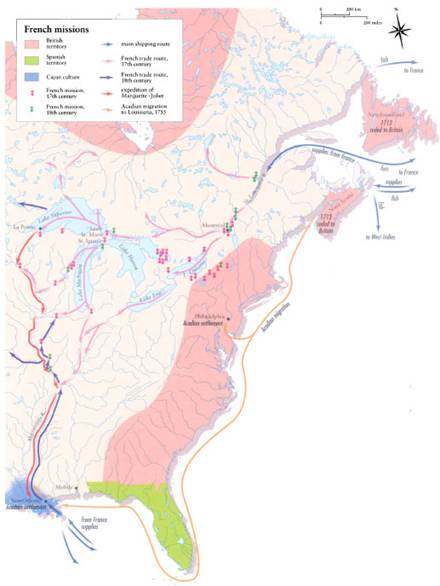
While Spanish Catholics colonized the southern rim of what is now the United States, French Catholics, likewise motivated by missionary zeal and economic opportunity, settled its northeastern and central regions.
Penetrating North America by way of the St. Lawrence River, their religious presence moved southward from present-day Canada, largely following its waterways: the St. Lawrence Valley, the Great Lakes region, and the Mississippi River Valley.The French established Quebec as a fur trading hub in 1608, and by 1625 their Jesuit missionaries were working among the Huron Indians of the Great Lakes. The missionaries adapted their message and lifestyle to indigenous religions, languages, and cultures, and while vast differences prevented them from converting more than a handful of Indians, their mild approach and the economic and military benefits they offered combined to keep the Hurons open to their activities. Iroquois attacks beginning in 1648 disrupted Jesuit activity among the Hurons, but the missionaries retained their ties to the Hurons while also establishing ties with the Iroquois. By 1668 they had established several missions to the Iroquois in upstate New York. After 1680 they began work among the Abenaki of what is now Maine. These efforts were continually challenged by rival Dutch and British traders and did not survive the large-scale English movement into the area that began in the late 17th century.
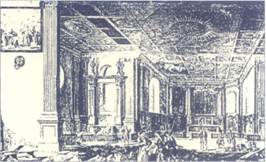
Jesuit College and Church in Quebec, as depicted in 1759 by Richard Shortt. Jesuits established a lasting French Catholic culture in the region.
French Jesuits had begun working among the Ottawa of the Illinois country by the 1630s and in subsequent decades founded several missions around the Great Lakes, including La Pointe in northern Wisconsin (1665), and Sault St. Marie (1668) and St.
Ignace (1670) in northern Michigan. Jesuit activity expanded southward into the Mississippi Valley after Father Jacques Marquette (1637–75) set out from La Pointe with Louis Joliet (1645—1700) in 1673 to journey down the Mississippi River. Missionaries and fur trappers followed, and by 1682 the French government had claimed all the territory drained by the river and its tributaries and called it Louisiana. By the early 1700s, Jesuits were missionizing among the Natchez of the lower Mississippi, had formed a parish in what became Mobile, Alabama, and made New Orleans a major colonial center from which they evangelized the Choctaw, Alibamon, Arkansas, and other peoples of the region.Just north of New Orleans, an enduring pocket of French Catholic culture began to develop later in the 17th century with the arrival of French Catholics from Acadia (Nova Scotia). Settled by the French in the early 17th century and ceded to Great Britain in 1713, Acadia remained home to several thousand French Catholics until their expulsion by Britain in 1755. They dispersed through the British colonies to the south, and a large group eventually settled in French-speaking southern Louisiana. Their Acadian culture and Catholicism thereafter developed, through periods of Spanish and then American rule, into the forms we call “Cajun.”
The vestiges of colonial French Catholicism in the United States remain most pronounced—though generally weak—in Louisiana. Outside that region, French Catholicism exerted influence not through descendants of French colonizers but by French clergy who emigrated after the French Revolution and assumed important positions in an emerging American Catholic church hierarchy.