Spanish Catholic Colonization
Spanish Catholics colonized America and its peoples—whom they considered spiritually benighted—with a religious and nationalistic zeal stemming from Spain’s 1492 unification and subsequent expulsion of Muslims and Jews.
They established a church, diocese, and bishop in Puerto Rico by 1513 and by the 1530s had begun sending Franciscan, Dominican, and Augustinian missionaries—joined later by Jesuits—to Mexico. By the early 19th century, Spain’s enormous American empire—New Spain—encompassed what is now the Latin America and, on its northern edge, the southern rim of the United States.Hampered by distance from Spain and the rest of Mexico, and in desert areas by a forbidding landscape and climate, missionary efforts in northern New Spain were initially meager but increasingly substantial. Along the Florida and Guale (Georgia) coasts, French settlement in 1564 stimulated Spain to found a line of missions from St. Augustine, Florida (1565) to Santa Elena (Port Royal, South Carolina). French activity in the lower Mississippi Valley after the 1670s likewise prompted missionaries to move northward to found missions in the Florida panhandle, and from Mexico to do likewise in eastern Texas. These missions were soon undercut by Indian uprisings in defense of native customs, tense relations with the Spanish government, and, in Texas, geographic isolation. Longer-lived missions appeared in eastern and central Texas during the early 18th century, but English colonization on the Atlantic coast prevented a resurgence in Florida.
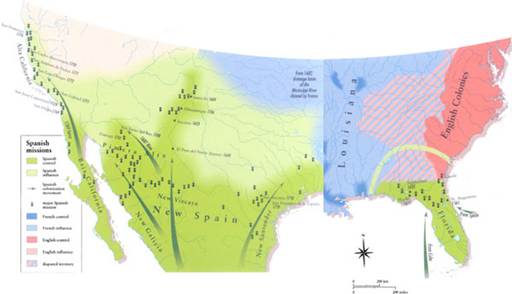
Missions in present-day New Mexico and Arizona fared little better. Between 1598 and 1630, Franciscan friars moving northward from Mexico established thirty missions in New Mexico’s Rio Grande Valley, but their aggressive methods prompted Pueblo peoples to eject them in the 1680 Pueblo Revolt. Missions reappeared in 1693, diminished in influence but contributing to an enduring creolized culture centered in Santa Fe and blending Catholicism with indigenous religion.
Meanwhile, Jesuit Eusebio Francisco Kino (1654–1711) founded several missions in Arizona after moving northward from Sonora in 1687, but these were stifled by Pima Indian revolts in 1751 and 1781 and by the eviction of the Jesuits from the empire in 1768. Franciscans replaced the Jesuits but withdrew in 1828.In California, Junipero Serra (1713–84) and other Franciscans moved northward from Baja California amid rising Spanish concerns about Russian activity along the north Pacific coast. They established twenty-one missions stretching 600 miles from San Diego to Sonoma (north of San Francisco) between 1769 and 1823. Using benevolent paternalism, a creole language, and occasional harsh punishment, they set up profitable agricultural communities and coaxed more than 21,000 Indians to a European “way of life.” But in 1833 the newly independent Mexican government dissolved the missions, sold their lands and buildings, and scattered the Indian communities. Both Spanish Catholic and Native American cultures in California were further eroded by the transfer of California to the United States in 1848 and subsequent influx of diverse American and immigrant groups.
Only with Hispanic immigration in the 20th century, much of it to the nation’s southern rim, would Spanish-derived Catholicism be revived in the United States.
More on the topic Spanish Catholic Colonization:
- Carroll Brett. The Routledge Historical Atlas of Religion in America. Routledge,2000. — 144 p., 2000
- Contents
- The Spanish kingdoms
- The Effect of Institutions on Economic Growth
- The Effect of Institutions on Economic Growth
- PART VI THE GREAT CONFLUENCE