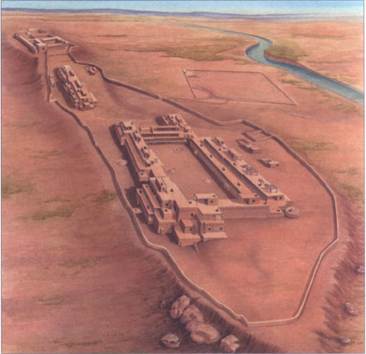
Amongst the sedentary agricultural peoples, like the Pueblo Indians, the Spanish built their missions amongst existing settlements.
In this reconstruction of Cicuye, later known as Pecos, the mission was constructed at the southern end of the fortified site.
 |
The colonization of the Americas by European peoples between the 15th and 19th centuries, approaching from across the Atlantic Ocean, Pacific Ocean, and Bering Sea, was perhaps the most important transformation in American religious history.
Steeped in Christian tradition and driven by missionary zeal, the pursuit of wealth, and geopolitical rivalry, European colonizers—Spanish and French Catholics, Russian Orthodox, and British, Dutch, and Swedish Protestants—undertook to Europeanize and Christianize the American landscape.Whether and to what extent they and their descendants Christianized America are matters of debate. But their arrival certainly intensified and redefined the dynamic intermixing of peoples, religions, and cultures that indigenous Americans had already established as a constant of American life, and they and their descendants became dominant in a culturally reconstituted America. Religious beliefs and institutions were central to both processes: they were mechanisms of cross-cultural interaction, European cultural imperialism, and what became a massive transformation of the North American continent.
The new Americans operated on very different understandings of space and time indigenous Americans. The latter considered their landscapes from those of timeless, their existence one of perpetual being, but the Europeans imagined a world moving through linear time in accordance with a divine plan discernible in terrestrial events—including their settlement of a “New World.” And whereas Amerindians sacralized the natural landscape, Europeans were inclined to separate sacred space from nature and dotted their new environment with religious structures intentionally insulated from it. They also, pursuing what they believed were God’s plans for the continent, constructed farms and factories, roads and railroads, and—on a greater scale than had the Indians—towns and cities.
Indians and Europeans also understood each other very differently. Natives tended at first to regard the Europeans in traditional terms: either as peoples like any other, suitable for alliance or rivalry, or as deities with powers that might be harnessed to enhance control of the environment. Their worldviews included little basis for discerning long-term conflicts of interest between peoples, and only as the newcomers’ patterns of behavior and settlement became clear did they develop new and racially aware religious expressions addressing the altered realities of American life. The Europeans, on the other hand, understood natives virtually from the start as racially different, and as peoples to be either converted or displaced in pursuit of their religious aspirations for the “New World.”
Colonization by Europeans and their religions changed the fundamental premises of American religious life. Their arrival intensified the process of transoceanic migration and the various west-to-east, east-to-west, south-to-north, and north-to-south movements by which the American religious landscape became peopled, developed, and diversified. They sought utterly to transform their new surroundings and understood religious pluralism as a matter of increasing and often anxious concern. Physically and spiritually, they were redefining America.
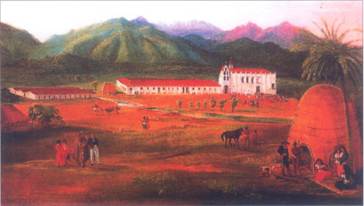
Ferdinand Deppe’s 1832 painting of the mission of San Gabriel, just north of Los Angeles, was made the year before the Mexican government dissolved the mission.