Postcontact Revitalization and Accommodation
Contact with Euro-Americans brought indigenous Americans disease, depopulation, physical dislocation, and cultural displacement, triggering among them a variety of religious responses.
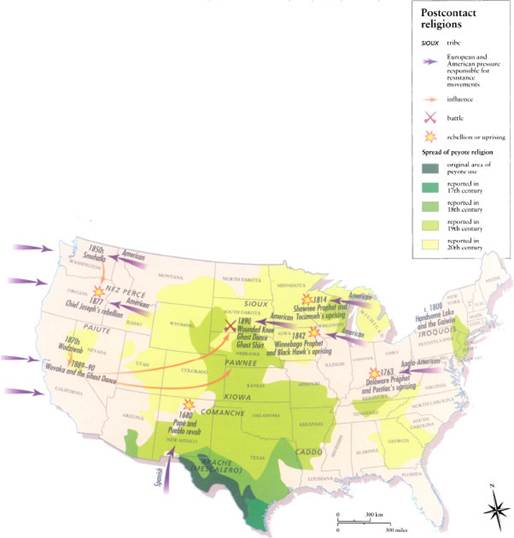
Some resisted these changes and attempted to revitalize ancestral ways, while others sought to accommodate indigenous traditions to new conditions. Both responses rested heavily on the traditional practice of vision seeking and, often drew on Christianity as well.As early as 1680, Pueblo shaman Pope urged revitalization and inspired a (temporarily) successful rebellion against Spanish colonizers in New Mexico. By the 18th and 19th centuries, religions of resistance developed in response to westward-moving Anglo-American settlement. In the Ohio Valley, the “Delaware prophet” Neolin sparked Chief Pontiac’s 1763 uprising, and “Shawnee prophet” Tenskatawa in turn inspired his brother Tecumseh to lead campaigns between 1805 and 1814. By 1832, “Winnebago prophet” White Cloud inspired Black Hawk’s armed resistance movement in the upper Mississippi Valley. These later movements were intertribal, suggesting a growing sense of shared racial and spiritual identity among Indians.
By the late 19th century, such movements became pan-Indian and interregional as continuing Euro-American expansion through the Missouri Valley and on the Pacific coast intensified pressure on Indian lands, food supplies, and cultures. In Washington in the 1850s, Catholic-educated Wanapum shaman Smohalla experienced visions in which earth’s original Indian inhabitants lived in Edenic harmony with Mother Earth until later-arriving whites wounded her with metal ploughs. In 1877, Nez Perce Chief Joseph made this ideology the basis for an unsuccessful armed rebellion. The prophet Wodziwob sparked a similar movement among the Paiute of Nevada and California around 1870, teaching in Christian apocalyptic imagery that the earth would swallow humanity but that followers of a special dance would be resurrected into a revitalized world without whites.
The dance spread among several Western tribes, then faded for a time.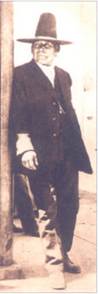
Paiute prophet Wovoka. His Ghost Dance spread among Native Americans in the late 19th century in response to expanding Euro-American settlement.
In 1889 it was revived and transformed into the “Ghost Dance” by Paiute visionary Wovoka, who combined visions, ritual dance, the reception of supernatural tokens, and Christian eschatology. His followers, much like Wodziwob’s, sought through dance to achieve reunion with dead Indians of the past in a renewed prewhite world. The Ghost Dance spread eastward, assuming local variations. The Lakota Sioux, seeking to replenish the disappearing buffalo, modified it to resemble their Sun Dance. The Oglala Sioux added “Ghost Shirts,” garments ritually empowered by the dance to repel bullets. The dance aroused misunderstanding and fear among whites, generating tensions that culminated in an 1890 massacre of Indians at Wounded Knee. Though many tribes subsequently abandoned the dance, the Pawnees retained it into the 20th century, and it has sometimes resurfaced amid late-20th-century Indian militancy.
Other movements sought accommodation to white culture. Around 1800, Seneca prophet and visionary Ganiodaio (Handsome Lake) proposed a new way of life called the Gaiwiio to an Iroquois population suffering social disintegration. His teachings blended apocalyptic prophecy with a Protestant (particularly Quaker) ethic of peace, temperance, settled agriculture, private land ownership, economic enterprise, and domesticity. Ganiodaio’s code proved attractive and continues by some estimates to shape the lives of perhaps one-quarter of reservation Iroquois.
Peyote religion has been another effective accommodation strategy. The ritual ingestion of peyote—a hallucinogenic cactus of southern Texas and northern Mexico—had characterized Mexican agricultural rituals as early as 1000 CE, but its use in the United States dates from around 1870, when the Mescalero Apache of Texas began acquiring it for their shamans.
Peyote rituals spread progressively northward, changing as they went. By 1880, the Kiowas, Comanches, and Caddos, confined to reservations in what is now Oklahoma, were using it in their dances, and among the Plains tribes it became itself the focus of ritual. After the demise of the Ghost Dance, and due to the promotional efforts of Delaware-Caddo tribe member John Wilson and Comanche chief Quannah Parker, peyote religion became a particularly appealing means of nonviolent accommodation. Parker blended Christian and indigenous traditions into the “Peyote Way,” an ethical system counseling selfdiscipline and participation in the white economy, and a combinative ritual. The ritual varies from group to group in extent of Christian content, but was loosely formalized in the 1944 establishment of the Native American Church.Peyote religion remains widely practiced, contributing substantially to pan-Indian consciousness despite its multiformity.