The Effect of Institutions on Economic Growth
We now argue that there is convincing empirical support for the hypothesis that differences in economic institutions, rather than luck, geography or culture, cause differences in incomes per-capita.
Let us start by looking at the simplest correlation between a measure of economic institutions and income per capita.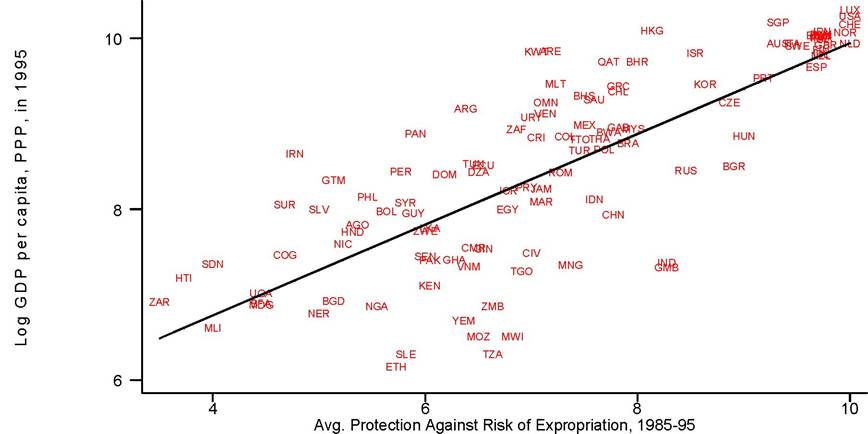
Figure 4.1. Relationship between economic institutions, as measured by average expropriation risk 1985-1995, and GDP per capita.
Figure 4.1 shows the cross-country correlation between the log of GDP per-capita in 1995 and a broad measure of property rights, “protection against expropriation risk”, averaged over the period 1985 to 1995. The data on this measure of economic institutions come from 147
Political Risk Services, a private company which assesses the risk that foreign investments will be expropriated in different countries. These data are not perfect. They reflect the subjective assessment of some analysts about how secure property rights are. Nevertheless, they are useful for our purposes. First, they emphasize the security of property rights, which is an essential aspect of economic institutions, especially in regards to their effect on economic incentives. Second, these measures are purchased by businessmen contemplating investment in these countries, thus they reflect the “market assessment” of security of property rights.
Figure 4.1 shows that countries with more secure property rights—thus better economic institutions—have higher average incomes. One should not interpret the correlation in this figure as depicting a causal relationship—that is, as establishing that secure property rights cause prosperity. First, the correlation might reflect reverse causation; it may be that only countries that are sufficiently wealthy can afford to enforce property rights.
Second and more importantly, there might be a problem of omitted variable bias. It could be something else, for example, geography or culture, that explains both why countries are poor and why they have insecure property rights. Thus if omitted factors determine institutions and incomes, we would spuriously infer the existence of a causal relationship between economic institutions and incomes when in fact no such relationship exists. This is the standard identification problem in economics resulting from simultaneity or omitted variable biases. Finally, security of property rights—or other proxy measures of economic institutions—are themselves equilibrium outcomes, presumably resulting from the underlying political institutions and political conflict. While this last point is important, a satisfactory discussion requires us to develop models of political economy of institutions, which will have to wait until Part 8 of the book.To further illustrate these potential identification problems, suppose that climate or geography matter for economic performance. In fact, a simple scatterplot shows a positive association between latitude (the absolute value of distance from the equator) and income per capita consistent with the views of Montesquieu and other proponents of the geography hypothesis. Interestingly, Montesquieu not only claimed that warm climate makes people lazy and thus unproductive, but also unfit to be governed by democracy. He argued that despotism would be the political system in warm climates. Therefore, a potential explanation for the patterns we see in Figure 4.1 is that there is an omitted factor, geography, which explains both economic institutions and economic performance. Ignoring this potential third factor would lead to mistaken conclusions.
Even if Montesquieu’s story appears both unrealistic and condescending to our modern sensibilities, the general point should be taken seriously: the correlations depicted in Figure
4.1, and for that matter that shown in Figure 4.2, do not necessarily reflect causal relationships.
As we pointed out in the context of the effect of religion or social capital on economic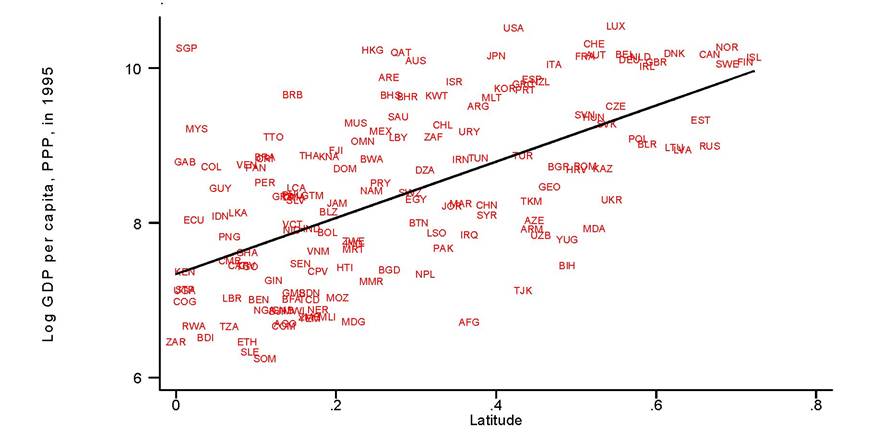
Figure 4.2. Relationship between latitude (distance of capital from the equator) and income per capita in 1995.
performance, these types of scatterplots, correlations, or their multidimensional version in ordinary least squares regressions, cannot establish causality.
How can we overcome the challenge of establishing a causal relationship between (economic) institutions and economic outcomes? The answer to this question is to specify econometric approaches based on convincing identifying restrictions. This can be done by using estimating structural econometric models or by using more reduced-form approaches, based on instrumental-variables strategies. At the moment we do not know enough about the evolution of economic institutions and their impact on economic outcomes to be able to specify and estimate fully-structural econometric models. Thus as a first step, we can look at more reduced-form evidence that might still be informative about the causal relationship between institutions and economic growth. One way of doing so is to learn from history, in particular from the “natural experiments”, which are unusual historical events where, while other fundamental causes of economic growth are held constant, institutions change because of potentially-exogenous reasons. We now discuss lessons from two such natural experiments.
4.4.1. The Korean Experiment. Until the end of World War II, Korea was under Japanese occupation. Korean independence came shortly after the war. The ma jor fear of the United States during this time period was the takeover of the entire Korean peninsula either by the Soviet Union or by communist forces under the control of the former guerrilla fighter, 149
Kim Il Sung. U.S. authorities therefore supported the influential nationalist leader Syngman Rhee, who was in favor of separation rather than a united communist Korea.
Elections in the South were held in May 1948, amidst a widespread boycott by Koreans opposed to separation. The newly elected representatives proceeded to draft a new constitution and established the Republic of Korea to the south of the 38th parallel. The North became the Democratic People’s Republic of Korea, under the control of Kim Il Sung.These two independent countries organized themselves in radically different ways and adopted completely different sets of (economic and political) institutions. The North followed the model of Soviet socialism and the Chinese Revolution in abolishing private property in land and capital. Economic decisions were not mediated by the market, but by the communist state. The South instead maintained a system of private property and capitalist economic institutions.
Before this “natural experiment” in institutional change, North and South Korea shared the same history and cultural roots. In fact, Korea exhibited an unparalleled degree of ethnic, linguistic, cultural, geographic and economic homogeneity. There are few geographic distinctions between the North and South, and both share the same disease environment. Moreover, before the separation the North and the South were at the same level of development. If anything, there was slightly more industrialization in the North. Maddison (2001) estimates that at the time of separation, North and South Korea had approximately the same income per capita.
We can therefore think of the splitting on the Koreas 50 years ago as a natural experiment that we can use to identify the causal influence of institutions on prosperity. Korea was split into two, with the two halves organized in radically different ways, and with geography, culture and many other potential determinants of economic prosperity held fixed. Thus any differences in economic performance can plausibly be attributed to differences in institutions.
Figure 4.3 uses data from Maddison (2001) and shows that the two Koreas have experienced dramatically diverging paths of economic development since separation:
By the late 1960’s South Korea was transformed into one of the Asian “miracle” economies, experiencing one of the most rapid surges of economic prosperity in history while North Korea stagnated.
By 2000 the level of income in South Korea was $16,100 while in North Korea it was only $1,000. There is only one plausible explanation for the radically different economic experiences of the two Koreas after 1950: their very different institutions led to divergent economic outcomes. In this context, it is noteworthy that the two Koreas not only shared the same geography, but also the same culture, so that neither geographic nor cultural differences could have much to do with the divergent paths of the two Koreas. Of course one can say that South Korea was lucky while the North was unlucky (even though this was not due to any kind of multiple equilibria, but a result of the imposition of different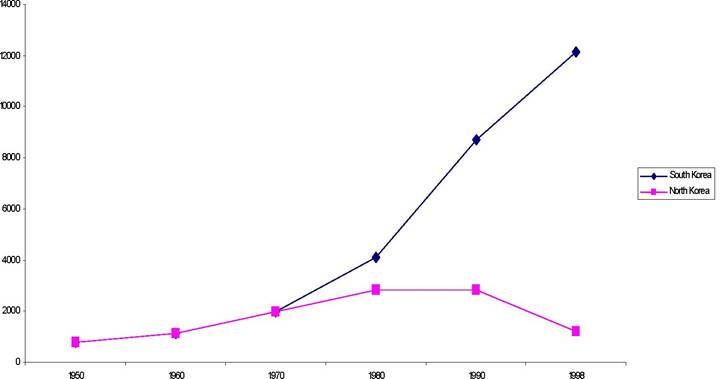
Figure 4.3. Evolution of income per capita North and South Korea after the separation. institutions). Nevertheless, the perspective of “luck” is unlikely to be particularly useful in this context, since what is remarkable is the persistence of the dysfunctional North Korean institutions. Despite convincing evidence that the North Korean system has been generating poverty and famine, the leaders of the Communist Party in North Korea have opted to use all the means available to them to maintain their regime.
However convincing on its own terms, the evidence from this natural experiment is not sufficient for the purposes of establishing the importance of economic institutions as the primary factor shaping cross-country differences in economic prosperity. First, this is only one case, and in the better-controlled experiments in the natural sciences, a relatively large sample is essential. Second, here we have an example of an extreme case, the difference between a market-oriented economy and an extreme communist one. Few social scientists today would deny that a lengthy period of totalitarian centrally-planned rule has significant economic costs. And yet, many might argue that differences in economic institutions among capitalist economies or among democracies are not the ma jor factor leading to differences in their economic tra jectories.
To establish the ma jor role of economic institutions in the prosperity and poverty of nations we need to look at a larger scale “natural experiment” in institutional divergence.4.4.2. The Colonial Experiment: The Reversal of Fortune. The colonization of much of the world by Europeans provides such a large scale natural experiment. Beginning in the early fifteenth century and especially after 1492, Europeans conquered many other 151
nations. The colonization experience transformed the institutions in many diverse lands conquered or controlled by Europeans. Most importantly, Europeans imposed very different sets of institutions in different parts of their global empire, as exemplified most sharply by the contrast of the institutional structure that developed in the Northeastern United States, based on small-holder private property and democracy, versus the institutions in the Caribbean plantation economies, based on repression and slavery. As a result, while geography was held constant, Europeans initiated very significant changes in the economic institutions of different societies.
The impact of European colonialism on economic institutions is perhaps most dramatically conveyed by a single fact—historical evidence shows that there has been a remarkable Reversal of Fortune in economic prosperity within former European colonies. Societies like the Mughals in India, and the Aztecs and the Incas in the Americas were among the richest civilizations in 1500, yet the nation-states that now coincide with the boundaries of these empires are among the poorer nations of today. In contrast, countries occupying the territories of the less-developed civilizations of North America, New Zealand and Australia are now much richer than those in the lands of the Mughals, Aztecs and Incas.
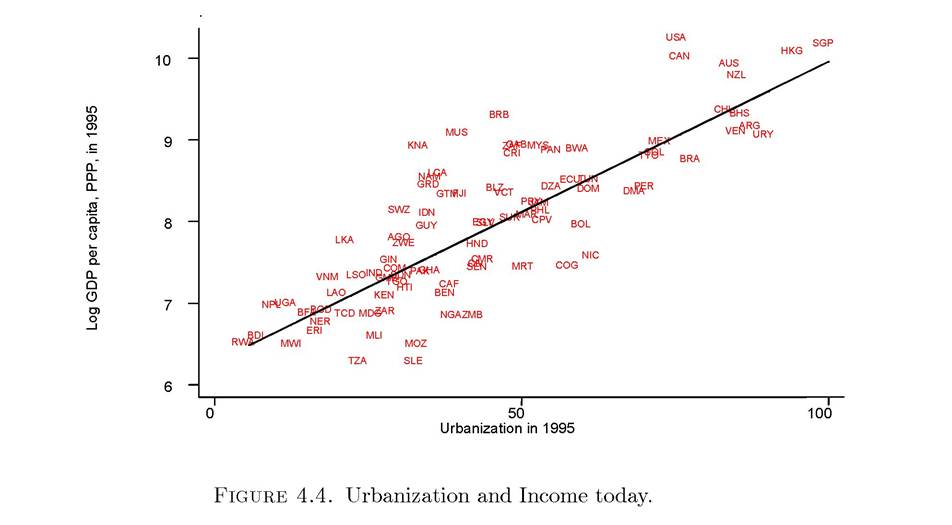
The Reversal of Fortune is not confined to such comparisons. To document the reversal more broadly, we need a proxy for prosperity 500 years ago. Fortunately, urbanization rates and population density can serve the role of such proxies. Only societies with a certain level of productivity in agriculture and a relatively developed system of transport and commerce 152
can sustain large urban centers and a dense population. Figure 4.4 shows the relationship between income per capita and urbanization (fraction of the population living in urban centers with greater than 5,000 inhabitants) today, and demonstrates that even today, long after industrialization, there is a significant relationship between urbanization and prosperity.
Naturally, high rates of urbanization do not mean that the ma jority of the population lived in prosperity. In fact, before the twentieth century urban areas were often centers of poverty and ill health. Nevertheless, urbanization is a good proxy for average prosperity and closely corresponds to the GDP per capita measures we are using to look at prosperity today. Another variable that is useful for measuring pre-industrial prosperity is the density of the population, which is closely related to urbanization.
Figures 4.5 and 4.6 show the relationship between income per capita today and urbanization rates and (log) population density in 1500 for the sample of European colonies. Let us focus on 1500 since it is before European colonization had an effect on any of these societies. A strong negative relationship, indicating a reversal in the rankings in terms of economic prosperity between 1500 and today, is clear in both figures. In fact, the figures show that in 1500 the temperate areas were generally less prosperous than the tropical areas, but this pattern too was reversed by the twentieth century.
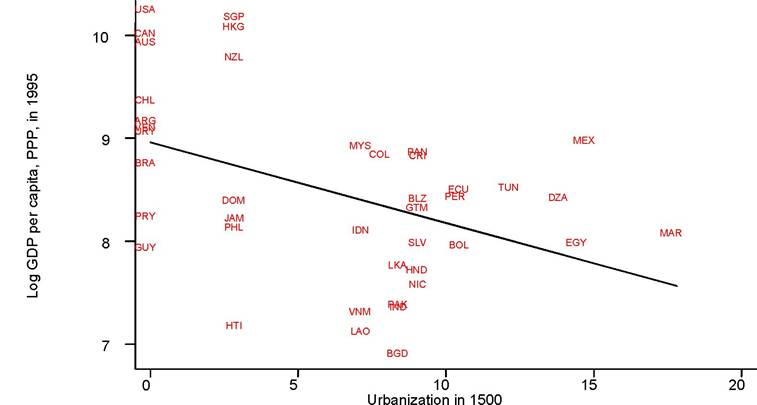
Figure 4.5. Reversal of Fortune: urbanization in 1500 versus income per capita in 1995 among the former European colonies.
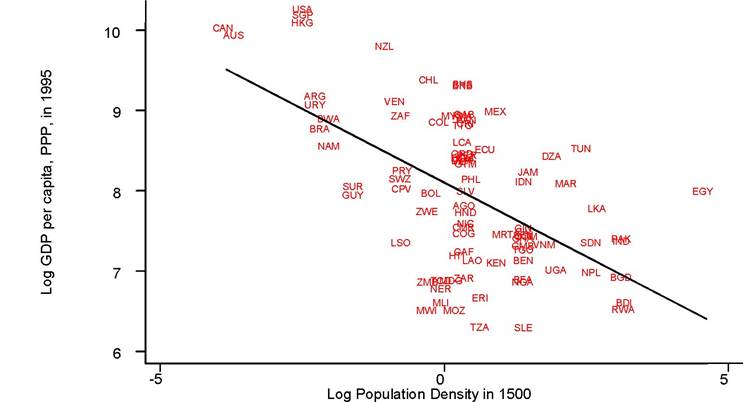
Figure 4.6. Reversal of Fortune: population density in 1500 versus income per capita in 1995 them on the former European colonies.
There is something extraordinary and unusual about this reversal. A wealth of evidence shows that after the initial spread of agriculture there was remarkable persistence in urbanization and population density for all countries, including those that were subsequently colonized by Europeans. Extending the data on urbanization to earlier periods shows that both among former European colonies and non-colonies, urbanization rates and prosperity persisted for 500 years or longer. Even though there are prominent examples of the decline and fall of empires, such as Ancient Egypt, Athens, Rome, Carthage and Venice, the overall pattern was one of persistence. It is also worth noting that reversal was not the general pattern in the world after 1500. When we look at Europe as a whole or at the entire world excluding the former European colonies, there is no evidence of a similar reversal between 1500 and 1995.
There is therefore no reason to think that what is going on in Figures 4.5 and 4.6 is some sort of natural reversion to the mean. Instead, the Reversal of Fortune among the former European colonies reflects something unusual, something related to the intervention that these countries experienced. The major intervention, of course, was related to the change in institutions. As discussed above, not only did the Europeans impose a different order in almost all countries they conquered, there were also tremendous differences between the 154
types of institutions they imposed on in the different colonies.[12] These institutional differences among the former colonies are likely at the root of the reversal in economic fortunes.
To bolster this case, let us look at the timing and the nature of the reversal a little more closely. When did the reversal occur? One possibility is that it arose shortly after the conquest of societies by Europeans but Figure 4.7 shows that the previously-poor colonies surpassed the former highly-urbanized colonies starting in the late eighteenth and early nineteenth centuries. Moreover, a wealth of qualitative and quantitative evidence suggests that this went hand in hand with industrialization (see, for example, Acemoglu, Johnson and Robinson, 2002). Figure 4.7 shows average urbanization in colonies with relatively low and high urbanization in 1500. The initially high-urbanization countries have higher levels of urbanization and prosperity until around 1800. At that time the initially low-urbanization countries start to grow much more rapidly and a prolonged period of divergence begins.
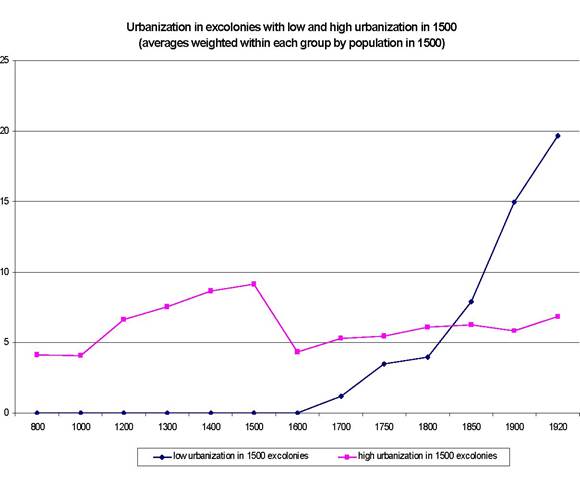
Figure 4.7. The Timing of the Reversal of Fortune: Evolution of average urbanization between initially-high and initially-low urbanization former colonies.
These patterns are clearly inconsistent with simple geography based views of relative prosperity. In 1500 it was the countries in the tropics which were relatively prosperous,
today it is the reverse. This makes it implausible to base a theory of relative prosperity on the intrinsic poverty of the tropics, climate, disease environments or other fixed characteristics.
Nevertheless, following Diamond (1997), one could propose what Acemoglu, Johnson and Robinson (2002a) call a “sophisticated geography hypothesis,” which claims that geography matters but in a time varying way. For example, Europeans created “latitude specific” technology, such as heavy metal ploughs, that only worked in temperate latitudes and not with tropical soils. Thus when Europe conquered most of the world after 1492, they introduced specific technologies that functioned in some places (the United States, Argentina, Australia) but not others (Peru, Mexico, West Africa). However, the timing of the reversal in the nineteenth century is inconsistent with the most natural types of sophisticated geography hypotheses. Europeans may have had latitude specific technologies, but the timing implies that these technologies must have been industrial, not agricultural, and it is difficult to see why industrial technologies do not function in the tropics (and in fact, they have functioned quite successfully in tropical Singapore and Hong Kong).
Similar considerations weigh against the culture hypothesis. Although culture is slow- changing the colonial experiment was sufficiently radical to have caused major changes in the cultures of many countries that fell under European rule. In addition, the destruction of many indigenous populations and immigration from Europe are likely to have created new cultures or at least modified existing cultures in major ways. Nevertheless, the culture hypothesis does not provide a natural explanation for the reversal, and has nothing to say on the timing of the reversal. Moreover, we will discuss below how econometric models that control for the effect of institutions on income do not find any evidence of an effect of religion or culture on prosperity.
The importance of luck is also limited. The different institutions imposed by the Europeans were not random. They were instead very much related to the conditions they encountered in the colonies. In other words, the types of institutions that were imposed and developed in the former colonies were endogenous outcomes, outcomes of equilibria that we need to study.
4.4.3. The Reversal and the Institutions Hypothesis. Is the Reversal of Fortune consistent with a dominant role for economic institutions in comparative development? The answer is yes. In fact, once we recognize the variation in economic institutions created by colonization, we see that the Reversal of Fortune is exactly what the institutions hypothesis predicts.
The evidence in Acemoglu, Johnson and Robinson (2002a) shows a close connection between initial population density, urbanization, and the creation of good economic institutions.
156
In particular, the evidence points out that, others things equal, the higher the initial population density or the greater initial urbanization, the worse were subsequent institutions, including both institutions right after independence and also institutions today. Figures 4.8 and 4.9 illustrate these relationships using the same measure of current economic institutions used in Figure 4.1, protection against expropriation risk today. They document that the relatively densely settled and highly urbanized colonies ended up with worse institutions, while sparsely-settled and non-urbanized areas received an influx of European migrants and developed institutions protecting the property rights of a broad cross-section of society. European colonialism therefore led to an “institutional reversal,” in the sense that the previously-richer and more-densely settled places ended up with worse institutions. The institutional reversal does not mean that institutions were better in the previously more densely-settled areas. It only implies a tendency for the relatively poorer and less densely-settled areas to end up with better institutions than previously-rich and more densely-settled areas.
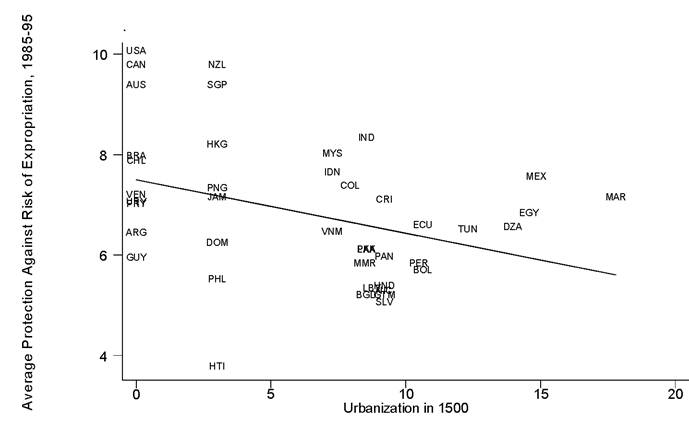
Figure 4.8. The Institutional Reversal: urbanization in 1500 and economic institutions today among the former European colonies.
As discussed in footnote 5 above, it is possible that the Europeans did not actively introduce institutions discouraging economic progress in many of these places, but inherited them from previous civilizations there. The structure of the Mughal, Aztec and Inca empires were already very hierarchical with power concentrated in the hands of narrowly based ruling elites and structured to extract resources from the majority of the population for the benefit of a minority. Often Europeans simply took over these existing institutions. What is important in any case is that in densely-settled and relatively-developed places it was in the interests of 157
Europeans to have institutions facilitating the extraction of resources, without any respect for the property rights of the majority of the populace. In contrast, in the sparsely-settled areas it was in their interests to develop institutions protecting property rights. These incentives led to an institutional reversal.
The institutional reversal, combined with the institutions hypothesis, predicts the Reversal of Fortune: relatively rich places ended up with relatively worse economic institutions, and if these institutions are important, we should see them become relatively poor over time. This is what the Reversal of Fortune shows.
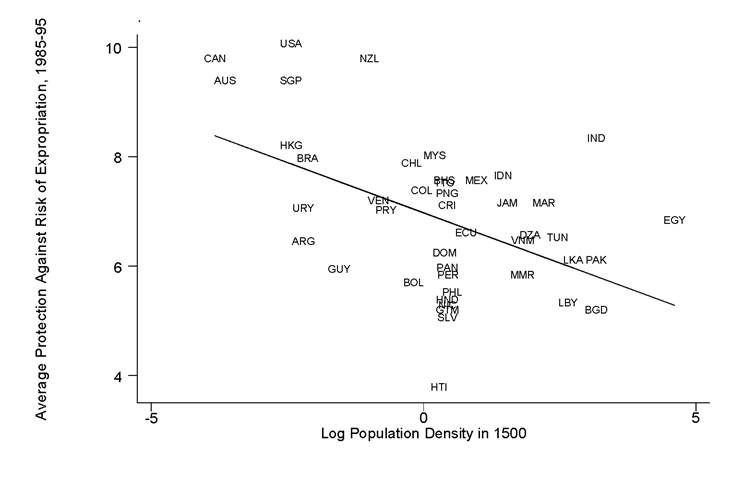
Figure 4.9. The Institutional Reversal: population density in 1500 and economic institutions today among the former European colonies.
Moreover, the institutions hypothesis is consistent with the timing of the reversal. Recall that the institutions hypothesis links incentives to invest in physical and human capital and in technology to economic institutions, and argues that economic prosperity results from these investments. Therefore, we expect economic institutions to play a more important role in shaping economic outcomes when there are major new investment opportunities— thus creating greater need for entry by new entrepreneurs and for the process of creative destruction. The opportunity to industrialize was the major investment opportunity of the 19th century. As documented in Chapter 1, countries that are rich today, both among the former European colonies and other countries, are those that industrialized successfully during this critical period.
The explanation for the reversal that emerges from the discussion so far is one in which the economic institutions in various colonies were shaped by Europeans to serve their own (economic) interests. Moreover, because conditions and endowments differed between colonies, Europeans consciously created different economic institutions, which persisted and continue to shape economic performance. Why did Europeans introduce better institutions in previously-poor and unsettled areas than in previously-rich and densely-settled areas? Without going into details, a number of obvious ideas that have emerged from the research in this area can be mentioned.
Enropeans were more likely to introduce or maintain economic institutions facilitating the extraction of resources in areas where they would benefit from the extraction of resources. This typically meant areas controlled by a small group of Europeans, as well as areas offering resources to be extracted. These resources included gold and silver, valuable agricultural commodities such as sugar, but most importantly, what is perhaps the most valuable commodity overall, human labor. In places with a large indigenous population, Europeans could exploit the population. This was achieved in various forms, using taxes, tributes or employment as forced labor in mines or plantations. This type of colonization was incompatible with institutions providing economic or civil rights to the majority of the population. Consequently, a more developed civilization and a denser population structure made it more profitable for the Europeans to introduce worse economic institutions.
In contrast, in places with little to extract, and in sparsely-settled places where the Europeans themselves became the majority of the population, it was in their interests to introduce economic institutions protecting their own property rights (and also to attract further settlers).
4.4.4. Settlements, Mortality and Development. The initial conditions of the colonies we have emphasized so far, indigenous population density and urbanization, are not the only factors affecting Europeans’ colonization strategy. In addition, the disease environments differed markedly among the colonies, with obvious consequences on the attractiveness of European settlement. Since, as we noted above, when Europeans settled, they established institutions that they themselves had to live under, whether Europeans could settle or not had a major effect on the subsequent path of institutional development. In other words, we expect the disease environment 200 or more years ago, especially the prevalence of malaria and yellow fever which crucially affected potential European mortality, to have shaped the path of institutional development in the former European colonies and via this channel, current institutions and current economic outcomes. If in addition, the disease environment of the colonial times affects economic outcomes today only through its effect on institutions, then we can use this historical disease environment as an exogenous source of variation in 159
current institutions. From an econometric point of view, this will correspond to a valid instrument to estimate the casual effect of economic institutions on prosperity. Although mortality rates of potential European settlers could be correlated with indigenous mortality, which may determine income today, in practice local populations had developed much greater immunity to malaria and yellow fever. Acemoglu, Johnson and Robinson (2001) present a variety of evidence suggesting that the major effect of European settler mortality is through institutions.
In particular, Acemoglu, Johnson and Robinson (2001) argue that:
(1) There were different types of colonization policies which created different sets of institutions. At one extreme, European powers set up “extractive states”, exemplified by the Belgian colonization of the Congo. These institutions did not introduce much protection for private property, nor did they provide checks and balances against government expropriation. At the other extreme, many Europeans migrated and settled in a number of colonies. The settlers in many areas tried to replicate European institutions, with strong emphasis on private property and checks against government power. Primary examples of this include Australia, New Zealand, Canada, and the United States.
(2) The colonization strategy was influenced by the feasibility of settlements. In places where the disease environment was not favorable to European settlement, extractive policies were more likely.
(3) The colonial state and institutions persisted to some degree and make it more likely that former European colonies that suffered extractive colonization have worse institutions today.
Summarizing schematically, the argument is:

Based on these three premises, Acemoglu, Johnson and Robinson (2001) use the mortality rates expected by the first European settlers in the colonies as an instrument for current institutions in the sample of former European colonies. Their instrumental-variables estimates show a large and robust effect of institutions on economic growth and income per capita. Figures 4.10 and 4.11 provide an overview of the evidence. Figure 4.10 shows the cross-sectional relationship between income per capita and the measure of economic institutions we encountered in Figure 4.1, protection against expropriation risk. It shows a very strong relationship between the historical mortality risk faced by Europeans and the current extent to which property rights are enforced. A bivariate regression has an R2 of 0.26. It also shows that there were very large differences in European mortality. Countries such as Australia, New Zealand and the United States were very healthy, and existing evidence suggests
that life expectancy in Australia and New Zealand was in fact greater than in Britain. In contrast, all Europeans faced extremely high mortality rates in Africa, India and South-East Asia. Differential mortality was largely due to tropical diseases such as malaria and yellow fever and at the time it was not understood how these diseases arose nor how they could be prevented or cured.
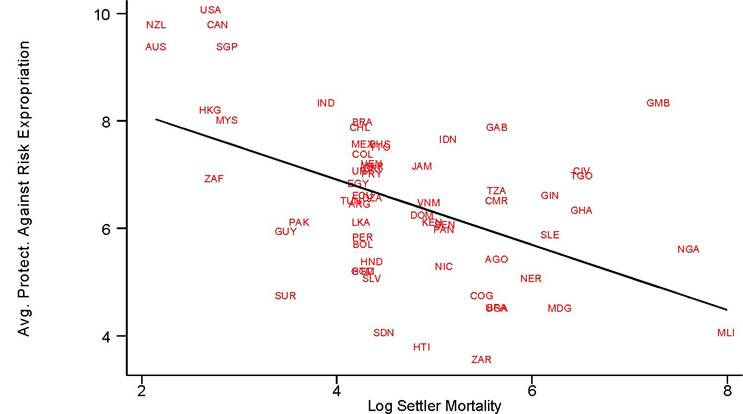
Figure 4.10. The relationship between mortality of potential European settlers and current economic institutions.
Figures 4.10 and 4.11 already show that, if we accept the exclusion restriction that the mortality rates of potential European settlers should have no effect on current economic outcomes other than through institutions, there is a large impact of economic institutions on economic performance. This is documented in detail in Acemoglu, Johnson and Robinson (2001), who present a range of robustness checks confirming this result. Their estimates suggest that most of the gap between rich and poor countries today is due to differences in economic institutions. For example, the evidence suggests that over 75% of the income gap between relatively rich and relatively poor countries can be explained by differences in their economic institutions (as proxied by security of property rights). Equally important, the evidence indicates that once the effect of institutions is estimated via this methodology, there appears to be no effect of geographical variables; neither latitude, nor whether or not a country is land-locked nor the current disease environment appear to have much effect on current economic outcomes. This evidence again suggests that institutional differences across 161
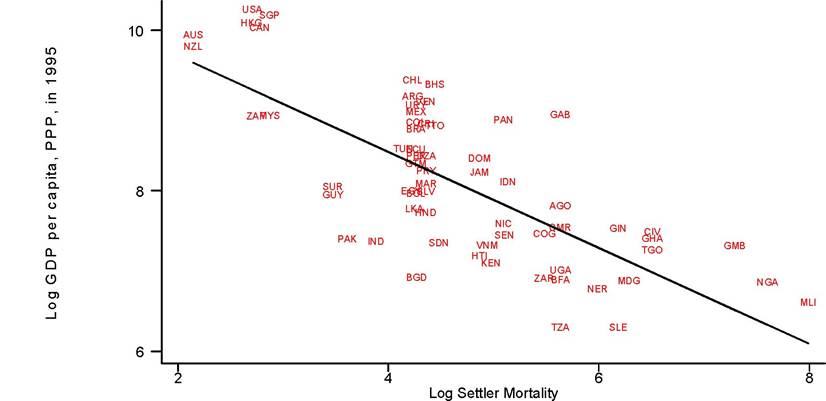
Figure 4.11. The relationship between mortality of potential European settlers and GDP per capita in 1995.
countries are a major determinant of their economic fortunes, while geographic differences are much less important.
These results also provide an interpretation for why Figure 4.2 showed a significant correlation between latitude and income per-capita. This is because of the correlation between latitude and the determinants of European colonization strategies. Europeans did not have immunity to tropical diseases during the colonial period and thus settler colonies tended, other things equal, to be created in temperate latitudes. Thus the historical creation of economic institutions was correlated with latitude. Without considering the role of economic institutions, one would find a spurious relationship between latitude and income per capita. However, once economic institutions are properly controlled for, these relationships go away and there appears to be no causal effect of geography on prosperity today (though geography may have been important historically in shaping economic institutions).
4.4.5. Culture, Colonial Identity and Economic Development. One might think that culture may have played an important role in the colonial experience, since Europeans not only brought new institutions, but also their own “cultures”. European culture might have affected the economic development of former European colonies through three different channels. First, as already mentioned above, cultures may be systematically related to the national identity of the colonizing power. For example, the British may have implanted a “good” Anglo-Saxon culture into colonies such as Australia and the United States, while 162
the Spanish may have condemned Latin America by endowing it with an Iberian culture. Second, Europeans may have had a culture, work ethic or set of beliefs that were conducive to prosperity. Finally, Europeans also brought different religions with different implications for prosperity. Many of these hypotheses have been suggested as explanations for why Latin America, with its Roman Catholic religion and Iberian culture, is poor relative to the Anglo- Saxon Protestant North America.
However, the econometric evidence in Acemoglu, Johnson and Robinson (2001) is not consistent with any of these views either. Similar to the evidence related to geographical variables, the econometric strategy discussed above suggests that, once the effect of economic institutions is taken into account, neither the identity of the colonial power, nor the contemporary fraction of Europeans in the population, nor the proportions of the populations of various religions appear to have a direct effect on economic growth and income per capita.
These econometric results are supported by historical examples. Although no Spanish colony has been as successful economically as British colonies such as the United States, many former British colonies, such as those in Africa, India and Bangladesh, are poor today. It is also clear that the British in no way simply re-created British institutions in their colonies. For example, by 1619 the North American colony of Virginia had a representative assembly with universal male suffrage, something that did not arrive in Britain itself until 1919. Another telling example is that of the Puritan colony in Providence Island in the Caribbean. While the Puritan values are often credited with the arrival of democracy and equality of opportunity in Northeastern United States, the Puritan colony in Providence Island quickly became just like any other Caribbean slave colony despite its Puritanical inheritance.
Similarly, even though the 17th century Dutch had perhaps the best domestic economic institutions in the world, their colonies in South-East Asia ended up with institutions designed for the extraction of resources, providing little economic or civil rights to the indigenous population. These colonies consequently experienced slow growth relative to other countries.
To emphasize that the culture or the religion of the colonizer was not at the root of the divergent economic performances of the colonies, Figure 4.12 shows the reversal among the British colonies (with population density in 1500 on the horizontal axis). Just as in Figure 4.6, there is a strong negative relationship between population density in 1500 and income per capita today.
With respect to the role of Europeans, Singapore and Hong Kong are now two of the richest countries in the world, despite having negligible numbers of Europeans. Moreover, Argentina and Uruguay have as high proportions of people of European descent as the United States and Canada, but are much less rich. To further document this, Figure 4.13 shows a pattern similar to the Reversal of Fortune, but now among countries where the fraction of
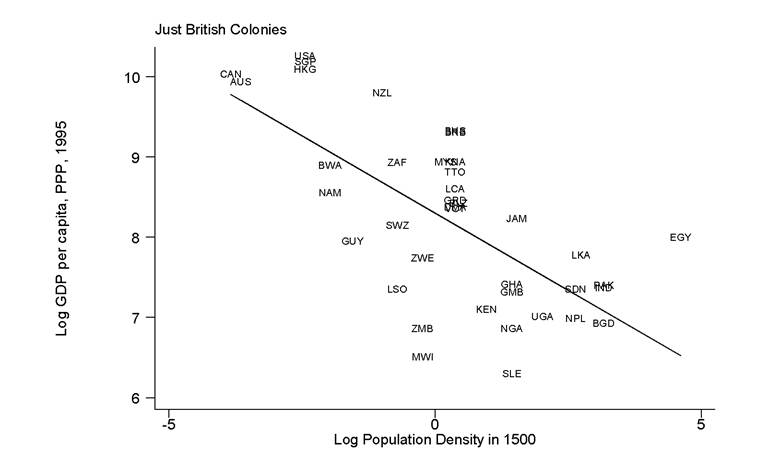
Figure 4.12. The Reversal of Fortune among British Colonies: population density in 1500 versus GDP per capita in 1995 among former British colonies.
those of European descent in 1975 is less than 5 percent of the population—thus a sample of countries in which European values or culture cannot have much direct effect today.
Overall, the evidence is not consistent with a major role of geography, religion or culture transmitted by the identity of the colonizer or the presence of Europeans. Instead, differences in economic institutions appear to be the robust causal factor underlying the differences in income per capita across countries. Institutions therefore appear to be the most important fundamental cause of income differences and long-run growth.
4.5. What Types of Institutions?
As already noted above the notion of institutions used in this chapter and in much of the literature is rather broad. It encompasses different types of social arrangements, laws, regulations, enforcement of property rights and so on. One may, perhaps rightly, complain that we are learning relatively little by emphasizing the importance of such a broad cluster of institutions. It is therefore important to try to understand what types of institutions are more important. This will not only be useful in our empirical analysis of fundamental causes, but can provide us a better sense of what types of models to develop in order to link fundamental causes to growth mechanics and to ultimate economic outcomes.
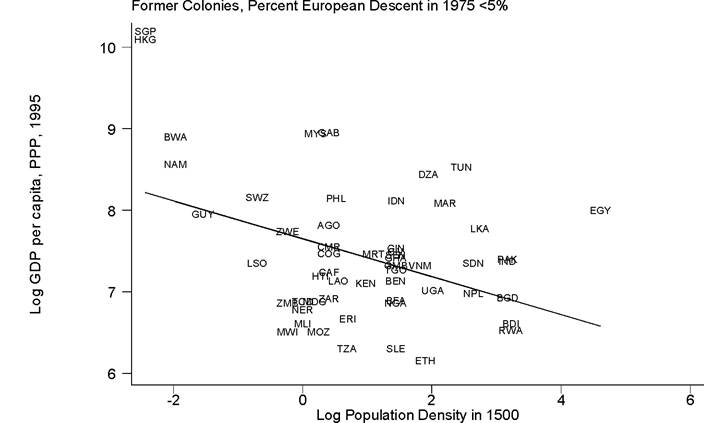
Figure 4.13. The Reversal of Fortune among former European colonies with two current European inhabitants.
There is relatively little work on “unbundling” the broad cluster of institutions in order to understand what specific types of institutions might be more important for economic outcomes. Much of this type of work remains to be done in the future. Here we can mention some existing work attempting to distinguish the impact of “contracting institutions” from the influence of “property rights institutions”. One of the important roles of institutions is to facilitate contracting between lenders and borrowers or between different firms, to facilitate the functioning of markets and the allocation of resources. Such contracting is only possible if laws, courts and regulations uphold contracts in the appropriate way. Let us refer to institutional arrangements of this sort that support private contracts as contracting institutions. The other cluster of institutions emphasized above relates to those constraining government and elite expropriation. Let us refer to these as property rights institutions. Although in many situations contracting institutions and property right institutions will be intimately linked, they are nonetheless conceptually different. While contracting institutions regulate “horizontal” relationships in society between regular citizens, property rights institutions are about the protection of citizens against the power of elites, politicians and privileged groups. These two sets of institutions are potentially distinct and can thus have distinct effects.
Acemoglu and Johnson (2005) investigate the relative roles of these two sets of institutions. Their strategy is again to make use of the natural experiment of colonial history. What helps this particular unbundling exercise is that in the sample of former European colonies, 165
the legal system imposed by colonial powers appears to have a strong effect on contracting institutions, but little impact on the available measures of property rights institutions. At the same time, both mortality rates for potential European settlers and population density in 1500, which we have seen above as important determinants of European colonization strategy, have a large effect on current property rights institutions, and no impact on contracting institutions. Using these different sources of variation in the sample of former European colonies, it is possible to estimate the separate effects of contracting institutions and property rights institutions.
Consistent with the pattern shown in Figure 4.12, which suggests that the identity of the colonizer is not a major determinant of future economic success of the colony, the empirical evidence estimating the different sources of variation in colonial history finds that property rights institutions are much more important for current economic outcomes than contracting institutions. Countries with greater constraints on politicians and elites and more protection against expropriation by these powerful groups appear to have substantially higher long- run growth rates and higher levels of current income. They also have significantly greater investment levels and generate more credit for the private sector. In contrast, the role of contracting institutions is more limited. Once the effects of property rights institutions are controlled for, contracting institutions seem to have no impact on income per capita, the investment to GDP ratio, and the private credit to GDP ratio. Contracting institutions appear to have some effect on stock market development, however.
These results suggest that contracting institutions affect the form of financial intermediation, but have less impact on economic growth and investment. It seems that economies can function in the face of weak contracting institutions without disastrous consequences, but not in the presence of a significant risk of expropriation from the government or other powerful groups. A possible interpretation is that private contracts or other reputation-based mechanisms can, at least in part, alleviate the problems originating from weak contracting institutions. For example, when it is more difficult for lenders to collect on their loans, interest rates increase, banks that can monitor effectively play a more important role, or reputation-based credit relationships may emerge. In contrast, property rights institutions relate to the relationship between the state and citizens. When there are no checks on the state, on politicians, and on elites, private citizens do not have the security of property rights necessary for investment.
Nevertheless, interpreting the evidence in Acemoglu and Johnson (2005) one should also bear in mind that the sources of variation in income per capita and investment rates identifying the different effects of contracting and property rights institutions relate to very large differences discussed in Chapter 1. It is possible that contracting institutions have relatively
small affects, so that they are hard to detect when we look at countries with thirty-fold differences in income per capita. Therefore, this evidence should be interpreted as suggesting that contracting institutions are less important in generating the large differences in economic development than the property rights institutions, not necessarily as suggesting that contracting institutions do not matter for economic outcomes.
4.6.