PART VI THE GREAT CONFLUENCE
The Culmination of Universal Empires and the Conquest of the New World:
Agrarian Consolidation and the Rise of European Commercial and Colonial Empires (1450-1750)
Peter Fibiger Bang
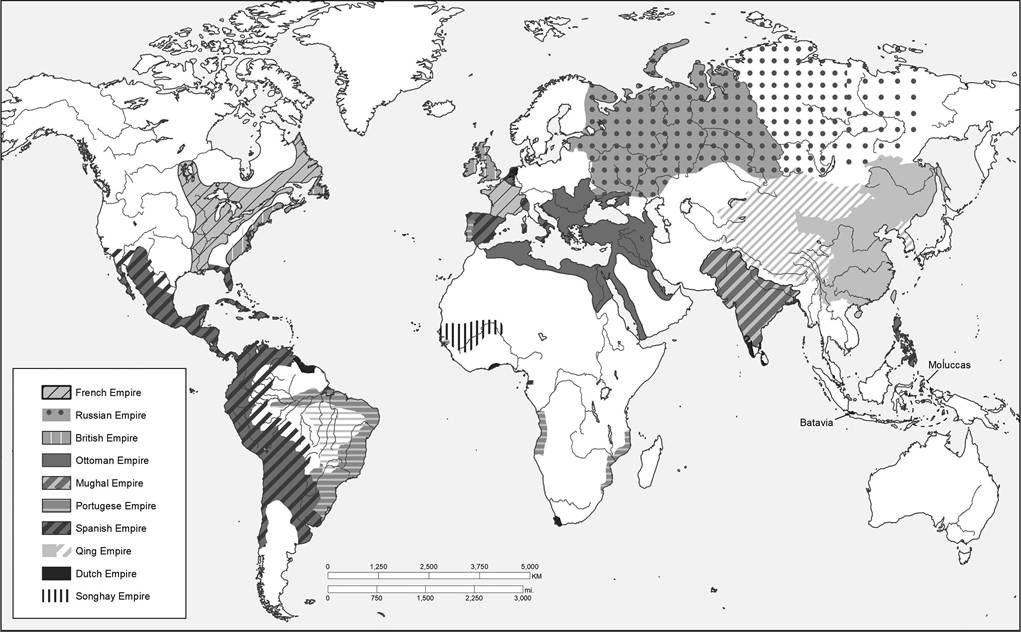
720 THE GREAT CONFLUENCE
Map VI.
The Great Confluence: The Culmination of Universal Empires and the Conquest of the New World:Agrarian Consolidation and the Rise of European Commercial and Colonial Empires (1450-1750). Copyright: Peter Fibiger Bang with Jonathan Weiland.
“There are five lofty emperors,” it is stated in a seventeenth-century Indo-Persian manual of statecraft, “whom because of their greatness people do not refer to by their names. The emperor of Hind, they call Dara, and the emperor of Rome [Rum], they hail as Kaisar, and the Emperor of Khuttun, and Chin, and Maucheen, they name Fughfoor, and the emperor of Turkestan they mention as Khaghan and they call the lord of Eran and Turan, king of kings.”1 This observation was part of a treatise written to celebrate the ancestral connection with Timur of the Great Mughals, the paramount rulers in India at the time. But the author, Abu Taleb Hosaynl, also inadvertently provides the modern historian with an alternative vision of world history for the period between 1450-1750. Looking from the middle of the Afro-Eurasian landmass, the order of the world could, perhaps more than ever, be described as dominated by a league of universal imperial monarchies, setting the standard for other rulers and with roots stretching back to antiquity.2
The Roman emperor, now in the guise of the Ottoman sultan, but still with his seat in Constantinople, reached across the Balkans, Anatolia, Mesopotamia, Egypt, the Arabian Peninsula, and the southern littoral of the Mediterranean.
Never before had the title of Caliph and Caesar been united in the same monarchy (Koiodziejczyk, Chap. 26). At the same time, the Mughals, combining Persian, Indian, and steppe models of kingship, extended empire wider and deeper across the Indian subcontinent than any other dynasty of the past (Kinra, Chap. 27). At the court of Akbar (r. 1556-1605), learned people and holy men were invited from afar to debate the character of God. The wealth of the Mughal court resonated on a global scale. Even in distant Saxony, the local ruler had one of his goldsmiths produce a lavish copy of its splendors to be included in his Wunderkammer, where it remains one of the top1 Hosayni 1783, 130 (this author's attempt at an update of the translation given on p. 131; fughfoor is the Arab term used for the emperor of China).
2 $ahin 2013 for an example of scholarship focused on the universal imperial aspect of early modern history. exhibits in the palace museums of Dresden.3 Meanwhile, the Manchu Qing rulers had ousted the Ming and embarked on a process of imposing their control over the peoples of the steppe, their only significant rival (Crossley, Chap. 29). By the early 18th century, the Manchu dynasty stood poised finally to solve a problem that had bedeviled and preoccupied sedentary imperial rule in China for centuries and thereby put an end, even to the competition of the steppe. Built northeast of Beijing and the Great Wall, the palatial complex at Chengde—with its sprawl of exquisite pavilions, elegant pagodas and serene lama temples—remains as a vivid testimony of the unprecedented success, force, and reach of Qing universalist ambitions. Here, closer to their Manchu homeland, the emperors would relocate during summers to assemble with their distant vassals from Mongolia and Tibet while engaging in archery and hunting together with the imperial elite. Steppe warriors, Tibetan Buddhism, and Confucian literati all toghether, the supremacy of the Qing lord was infinite, comprising the boundless variety of “all under heaven.”4
The vigor of the impulse to the formation of universal empire during the early modern period registers a steady underlying expansion of population and more intensive forms of peasant agriculture along both external and internal frontiers of Afro-Eurasian societies.5 Once dismissed as the quintessence of decadence and stagnation, dynasties such as the Mughal and even more so the Qing presided over growing and larger numbers of people than ever.
Adding the Ottomans to the tally, the power of these three imperial polities may well by the late seventeenth century have extended over more than 350 million people. In many respects, they represent the culmination of the slow, glacial growth that first came into its own with the Eurasian expansion of the Achaemenids. The world of state-formation, urbanization, and more intensive, sedentary agriculture had continued to increase and spread, all the while bringing the centers of population closer together; and with this, as Hostetler argues in Chap. 8 of Volume 1, empires came to preside over a slowly developing global integration of space and knowledge production.State-forming society was beginning to push against the boundaries of Afro- Eurasia. Since the height of the Roman Empire, the entity which we now understand as Europe had developed as agro-literate society had taken a decisive step beyond the Mediterranean to colonize the areas east of the Rhine and north of the Danube. Presumably, this relocation of the continent’s center of gravity explains why it acquired enough force to become a system of competing polities in its own right, rather than merely a loosely organized periphery to the Islamic world. Another reason is the enduring existence of a much-reduced Eastern Roman Empire after the rise of the Caliphate and until the rise of the Ottomans in the 15th century.
The development of Europe transpired in the continuing shadow of Rome. Byzantium, the Holy Roman Empire or Roman Christianity—medieval Europe took
3 On exhibition in the so-called Neues Grünes Gewolbe: https://gruenes-gewoelbe.skd.museum/en/ausstellungen/neues-gruenes-gewoelbe/
4 Foret 2000 (I am grateful to Pamela Crossley for guidance and Jingkun Yuan for organizing a trip to Chengde for me).
5 Richards 2003 on the expanding frontier and intensification of complex agrarian societies in this period. shape within the parameters of a divided, fractured, and contested Roman heritage.
None of these protagonists was strong enough to create a durable new unity. But expectations rose when, by the early sixteenth century, the house of Habsburg, through the deft management of matrimonial alliances, succeeded in combining the title of Holy Roman emperor, along with the possession of numerous territories scattered across Europe from Austria to the Netherlands and the kingdoms of Spain (Delgado and Fradera, Chap. 28). The powers of the Iberian Peninsula were, at the time, some of the most dynamic in Europe. Portuguese caravels had made their way down the coast of Africa, had entered the Indian Ocean, and were busy conquering a network of key commercial points (Bethencourt, Chap. 30). Parallel and in competition, the Spanish monarchies had financed the expedition of Columbus to go west in search of India, where he stumbled instead upon the Caribbean and the Americas. Barely had the emperor Charles V entered the throne than new substance was given to his slogan, “plus ultra (further beyond).” In 1521, Hernan Cortes spectacularly captured Tenochtitlan and conquered the Aztec Empire for Spain. A decade later, Pizarro would add the Inca Empire. The Age of Charles seemed destined to break the bounds of the past and surpass even the Romans. Spain, not the Ottoman rival in Eastern Europe and the Mediterranean, would be the new universal power, as Tommaso Campanella prophesied at the turn of the sixteenth century.[1814]However, by then the glory of Spain was already on the wane. There had been no shortage of brilliant victories. Battlefields from Tunis to Germany had seen the Habsburg monarch triumphantly in action. But the theaters of war had been too many. Victory in one sector was rarely consolidated because immediately the force of the empire needed to be shifted elsewhere. On the abdication of Charles, after a long life of incessant struggle, the Habsburg inheritance had to be divided between his son and his brother, constituting a Spanish and an Austrian branch, respectively.
During the decades of Charles' reign, his world had been torn asunder by the Reformation, a religious uprising rejecting the primacy of the pope and the Roman church. This cemented Habsburg failure. From now on, Europe would be split up between Protestant and Catholic powers. Instead of a resurrection of ecumenic and universal empire, the age saw a new ideology and principle of political order evolve. Based on the doctrine of sovereignty, regional powers insisted on their independence from any superior lord; and out of the councils of state sprang the principle of the “balance of power.” Under this doctrine, alliances were to be unsentimentally shifted and constantly recalibrated to prevent any one power from becoming strong enough to dominate the others.Enduring competition prevented the putative hegemon from consolidating supremacy by absorbing the most powerful neighbors and rivals. Thus, a stable situation continued to elude the leading European powers where they would be able to reap the benefits of an imperial peace and enjoy a monopolistic position in the “sale” of protection. Quite the reverse, in spite of growing income, on several occasions, the Spanish monarchy still had to default on constantly rising debt—in short, declare bankruptcy. The cost of warfare just kept spiraling upward, exhausting even the richest treasury. Widespread adoption of gunpowder produced a revolution in warfare across Eurasia. But in Europe, the combination of enduring, intense competition and the introduction of the gunpowder style of war unleashed a relentless arms race. For the next several centuries, rapidly expanding numbers of personnel and continuous technological innovation would set a tone that forced state elites to reform and increase military capacity generation by generation.
The failure or curbing of imperial aspirations in Europe is all the more remarkable since it was accompanied by extraordinary expansion overseas. While the crack imperial armies of the Habsburgs, counting in the tens of thousands, remained stuck in their tracks in the Old World, Cortes and Pizarro could capture the Aztec and Inca empires with a few hundred European soldiers and what local allies they were able to muster.
A new pattern of empire was beginning to emerge; stalemate in the center channeled conquests into less contested arenas overseas. This was the dawn of the age of European colonialism.There will probably always remain an element of mystery in explaining how the motley and unimpressive troops of the conquistadors could succeed against polities with millions of subjects. But chance it was not; the deed was accomplished twice, after all, in short succession. Better weapons technology, gunpowder, and iron against stone; the ability to exploit internal divisions; cosmologies that tended to idolize the newcomers from beyond the world known to the Amerindians—all these factors may have played a role. For the sustainability of the conquests, however, the germs and diseases brought by the invaders from the Old World were still more important. Many human diseases have originally been transferred from domesticated animals. Afro-Eurasian agriculturalists had more of these than their counterparts in the New World, and their immune systems had adjusted to enable them to live with their domesticates. This made the Europeans biological weapons of mass destruction upon arrival in the Americas. Epidemics of smallpox and probably flu swept through the unaccustomed and defenseless Amerindian populations. Vast numbers died, and the indigenous inhabitants suffered severe depletion during the sixteenth century.
Demographic collapse paved the way for the consolidation of Spanish rule, but only partially explains the initial successes. Conquerors, however, have often constituted only a relatively small group; Alexander’s capture of the Achaemenid empire is paradigmatic. The Spanish in Meso- and South America were not an exception in that regard, only an extreme case. Whether one looks to disease pathogens or weaponry, their advantages were a product of a social environment in Afro-Eurasia attuned to much harsher competition, be it from warriors or disease pathogens. It is telling that the system of rival polities dominated by the Aztecs in Mexico had not yet been joined up to form a common zone of inter-imperial rivalry with the Incas of the Andes. By contrast, when the Portuguese embarked on a program of expansion in the world of the Indian Ocean, they were confined mostly to small island communities and port towns. On the high seas their canon-armored men of war had few rivals, but on the ground they did not have to venture far inland before finding their match. On appeal from several communities in the region, the Ottomans did try to challenge the Portuguese attempt to dominate the major sea lanes of the Indian Ocean. However, they had weightier territorial matters at hand (the Safavids in Iran or the Habsburgs in Central Europe and the Mediterranean, for instance); and the effort, closely fought at times, was not sustained. The result of all this was the formation of a thin globe-spanning imperial economy with its center in Iberia.
When Philip II, heir to Charles, was able to add the Portuguese crown to his Spanish Habsburg inheritance in 1581, he became the first monarch actually to make good on the age-old claim by rulers that their possessions ran across the entire world. Silver was mined from the rich ore deposits of South America and sugar was cultivated on plantations on islands in the Caribbean and in Brazil. From East India, pepper and fine spices were complemented by an enterprise to extract protection money from merchants traveling the Indian Ocean. A Portuguese pass had now to be bought to avoid attack and plunder.
All the while, the demographic depletion of the Amerindian population had put labor in short supply in the New World. The societies of states and empires had for a long time been able to use regions on their frontiers and the less densely populated parts of the planet as a source of slave labor. The corsairs of Ottoman North Africa, for instance, found a ready supply of European captives. Cunegonde, the love of Candide in Voltaire’s famous eighteenth-century novel, ends up as a slave in Constantinople before her ardent admirer is able to buy her freedom and finally get to marry her. South of the Sahara, East Africa had supplied slaves to the societies hugging the Indian Ocean for many centuries. Among these, for instance, was the famous Malik Ambar (1548-1626) who gained his freedom and rose to high office in the Deccan where he would lead armies against the advancing Mughals.[1815] Now West Africa came to play the same role in the emerging Atlantic economy. During the early modern period, millions of enslaved Africans were sent across the Atlantic under harrowing conditions to feed the expanding cash-crop plantation economies in a ruthless effort to make the New World an economic gain (the ecology of which is treated by Beattie and Anderson, Chap. 14, Vol. 1). While the profits were rich, the toll in human suffering and death was horrifying. The unprecedented intensity of the Atlantic slave system has left a persistent legacy of disparity and institutionalised pain that has not yet been overcome by the modern successor societies to this demographic regime, born as it was out of extreme deprivation.[1816]
In forging their imperial systems, the Iberian powers both sought to rival and to draw heavily on Venetian models of empire. As mentioned in part IV, the Queen City of the Adriatic had in the preceding centuries developed an interstitial commercial empire among the great dynasties of the Mediterranean. Plantations, naval convoys, and commercial privilege were staples in a repertoire that was now employed on a bigger, more intensive scale. Where the Iberians led, soon their northwest European rivals would follow, trying to cut into the emerging global economic circuit. Conflict in Europe prompted the Dutch (Blusse, Chap. 31), the English (Canny, Chap. 32), and the French, as well as others, to attempt to take over Iberian possessions or, alternatively, to acquire some of their own. In the New World, they managed to muzzle their way into the Caribbean and initiate colonization along the east coast of the North American continent as a counterweight to the Spanish and Portuguese holdings in Central and South America. In the Indian Ocean, the Dutch in particular succeeded in capturing the richest pickings from the Portuguese network while a range of other European nations also managed to establish themselves. During the seventeenth century, the Dutch East India Company created a vast commercial system of port cities, naval stations, and trading factories along an axis from Batavia (in Indonesia) to Cape Town. With tens of thousands of employees on the books, a sizable armed navy, and an organization spanning half the globe, this was arguably the first multinational corporation. But the gravitational pull of this global economy was still fairly modest. Measured against the vast populations of Asia, it was a marginal phenomenon. The profits were easily undermined and risked being squandered in warfare, as the more aggressive corporate leaders were constantly reminded. Even more than usual, the imperial operation had to be kept lean. Neither The Company, nor the other Europeans were really strong enough to be able to benefit from a policy of extensive territorial expansion and taxation of subjects. More than previously in world history, European colonial imperialism was honed on commercial enter- prise.[1817] As yet, it was too weak decisively to up-end the world of the great universal dynasties of Afro-Eurasia.
Bibliography and Guidance
Woolf (1982) and Darwin (2007) are two unusually successful attempts to synthesize the last 500 years of global history, placing the rise of European colonial empire in the context of an Asia that remained far from stagnant. Wong (1997) and Pomeranz (2000) have made this case, perhaps better than anyone else. Chaudhuri (1986) brought together several generations of scholarship to reveal the strength of the Indian Ocean trading system, into which the Europeans were able to insert themselves, but only as one seam among several others. Crosby (1986) taught us the fundamental significance of diseases, germs, and plants for the ability of European colonists to settle outside Europe, especially in the Americas, Australia, and New Zealand while McNeill (1982) is a classic discussion of the military revolution.
European expansion was as much shaped by the character of the societies at the receiving end as it was by the aims and aspirations of the metropolis. Spanish and Portuguese overseas ventures of the fifteenth and sixteenth centuries, Gruzinsky (2012) points out, were inspired by the same motives and ideologies; their very different results were determined by variations in social organization and epidemiological resilience between human society in the Americas and in Asia, rather than by Spanish or Portuguese agency. The need for multiple global perspectives in writing the world history of this period was elegantly demonstrated by Wills (2001), while Cassale (2012) has analyzed the competing Ottoman project to match Portuguese expansion in the Indian Ocean in the sixteenth century. Subrahmanyam (e.g., 2012) draws attention to the fascinating, surprising, and unexpected cultural connections that were generated by the boundary-crossing activities of the various imperialist ventures during this period of world history. Finally, Pagden (1996) provides the best discussion of the sprawling debates about empire that colonial expansion sparked in early modern Europe.
Bibliography
Ali, O. H. 2016. Malik Ambar: Power and Slavery across the Indian Ocean. Oxford.
Berlin, I. 1998. Many Thousands Gone: The First Two Centuries of Slavery in North America. Cambridge, MA.
Campanella, T. 1640. De Monarchia Hispanica Discursus. Amsterdam.
Cassale, G. 2012. The Ottoman Age of Discovery. Oxford. Chaudhuri, K. N. 1986. The Trading World of Asia. Cambridge.
Crossby, A. 1986. Ecological Imperialism: The Biological Expansion of Europe 900-1900. Cambridge. Darwin, J. 2007. After Tamerlane: The Rise and Fall of Global Empires, 1400-2000. London. Davis, D. B. 2006. Inhuman Bondage: The Rise and Fall of Slavery in the New World. New York.
De Vries, J. 2010. “The Limits of Globalization in the Early Modern World.” Economic History Review 63, no. 3: 710-733.
Eltis, D. and S. E. Engerman eds. 2011. The Cambridge World History of Slavery, Volume 3: AD 1420 - AD 1804. Cambridge.
Eltis, D.; S. E. Engerman; S. Drescher and D. Richardson eds. 2017. The Cambridge World History of Slavery, Volume 4: AD 1804 - AD 2016. Cambridge.
Foret, P. 2000. Mapping Chengde: The QingLandscape Enterprise. Honolulu.
Gikandi, S. 2011. Slavery and the Culture of Taste. Princeton. Gruzinski, S. 2012. LAigle et le dragon. Paris.
Hosayni, Abü Täleb. 1783. Institutes Political and Military, Written Originally in the Mogul Language by the Great Timour, Improperly Called Tamerlane, First Translated into Persian by Abu Taulib Alhusseini, and thence into English, with Marginal Notes, by Major Davy. Oxford.
McNeill, W H. 1982. The Pursuit of Power: Technology, Armedforce, and Society since A.D. 1000. Chicago. Pagden, A. 1996. Lords of All the World. New Haven, CT.
Pomeranz, K. 2000. The Great Divergence. Princeton.
Richards, J. F. 2003. The Unending Frontier: An Environmental History of the Early Modern World. Berkeley.
§ahin, K. 2013. Empire and Power in the Reign of Süleyman. Narrating the Sixteenth-Century Ottoman World. Cambridge.
Subrahmanyam, S. 2012. Courtly Encounters: Translating Courtliness and Violence in Early Modern Eurasia. Cambridge, MA.
Wills, J. E., Jr. 2001. 1688: A Global History. New York.
Wolf, E. R. 1982. Europe and the People without History. Berkeley, CA.
Wong, R. Bin 1997. China Transformed. Historical Change and the Limits of European Experience. Ithaca. 0stergard, U. 1997. “The Failure of Universal Empire.” In S. Tennesson et al. eds., Between National Histories and Global History, 93-114. Helsinki.
More on the topic PART VI THE GREAT CONFLUENCE:
- In Part Two, we looked at the first part of Gaius' institutional scheme, the law of persons. It now remains to us to consider the law of things.
- The Great Patriotic War Commemorations
- The Great Kushans
- Chapter 10 The Great Revolt
- Whilst the previous part considered some of the difficulties that have dogged documentary trade finance, Part II looks to the future. Given the technological advances that have occurred since the advent of the documentary letter of credit, the former is increasingly threatening to eclipse the latter.
- The Second Great Awakening
- 28 The Great Acceleration
- Cyrus the Great
- The Great Awakening
- Volodimer the Great