28 The Great Acceleration
I
So far this book has been concerned with separate oceans. Admittedly, the western Pacific rim and the Indian Ocean enjoyed close ties through maritime trade during the Middle Ages, whether by means of Tamil and Malay or Chinese navigators; but these sailors never targeted the wide- open spaces of the island Pacific.
Links between the Indian Ocean and the Atlantic were mediated through the Red Sea and the Mediterranean, after the opening of a regular sea route from Italy to Flanders and England at the end of the thirteenth century. The 1490s, however, saw a great acceleration in contact between western Europe and what were fondly imagined to be the Indies, for in the case of two discoveries they were not the Indies at all, even if Columbus’s voyages resulted in the term ‘Indies’ being applied to the great landmass of the two American continents, whose inhabitants were classed as ‘Indians’. The three European attempts to reach the Indies were those of Christopher Columbus, whose four voyages to the New World spanned the years from 1492 to 1504;1 John Cabot, who sailed west in search of China and the Indies in 1497;2 and Vasco da Gama, whose first expedition to the real India departed the same year. Amerigo Vespucci, sailing in the wake of Columbus, wrote about the lands to the west, often tendentiously, but his name, not that of Columbus, became attached to the Americas.3 The second Portuguese expedition to India should also be added to this list, as it resulted in the accidental discovery of Brazil in 1500 - a voyage that linked four continents. This linking of the oceans was completed remarkably quickly during the sixteenth century, once the routes from the Atlantic to the Pacific had been mapped out by pioneers such as Ferdinand Magellan, the Portuguese captain in the service of Spain, Juan Rodriguez Cabrillo, the Spanish discoverer of California, and Francis Drake, sailing in the service of England. The world, as a book describing Drake’s voyages proudly proclaimed,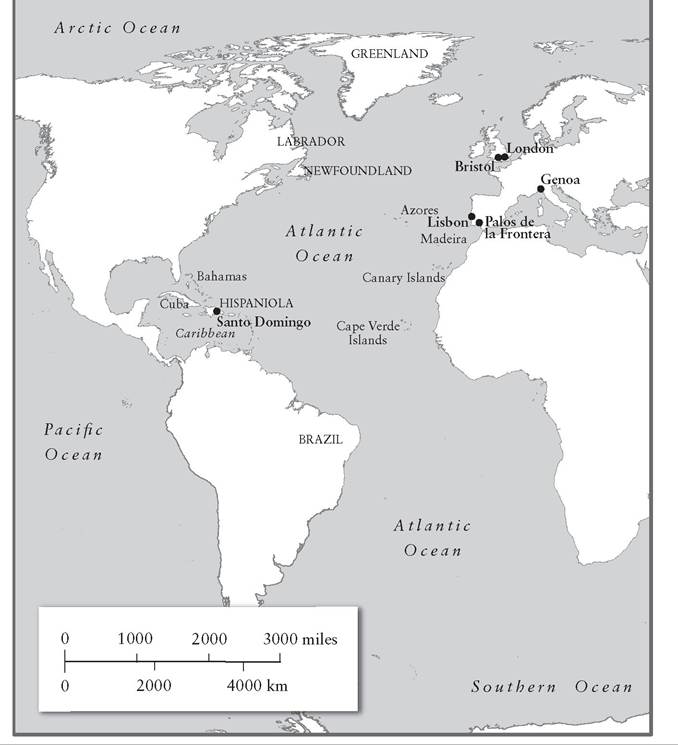
had now been ‘encompassed’.4 The linking of the oceans culminated in 1565 with the despatch of the first Manila galleon tying the western Pacific (and, beyond that, China) to Mexico and, ultimately, the Atlantic trade networks. Bearing these developments in mind, the chapters that follow will concentrate mainly on the navigators, routes and goods that passed between different oceans, rather than continuing to portray the history of three separate oceans. It may then seem odd to begin with Columbus and Cabot, whose expeditions were confined to a single ocean; but they assumed that the waters off Europe and Africa and the waters off China and Japan were part of one great ocean, in modern terms the Pacific combined with the Atlantic.
It is often pointed out that the Canary islanders, the Taino Indians of
the Caribbean, the Tupinamba Indians of Brazil and all the other peoples previously unknown to the Europeans were perfectly well known to themselves; their ‘discovery’ was a two-way process. The Arab traders who already knew the Swahili coast far down the flank of east Africa were surprised to encounter Vasco da Gama as he worked his way into the Indian Ocean in 1498; but they were aware that Christian lands existed beyond the frontiers of Islam, and da Gama even met traders who knew the Mediterranean. ‘Discovery’ was not a purely European phenomenon, but those who were carving out new routes across the oceans were Europeans.
II
So far, the history of the Atlantic has been presented as the history of the north-eastern Atlantic, and (by the end of the Middle Ages) the history of navigation all the way down the Atlantic coast of Africa. Another maritime network existed in the Atlantic, within and a little beyond the Caribbean, a ‘New World’ that would be exposed to European view by Columbus’s voyages.
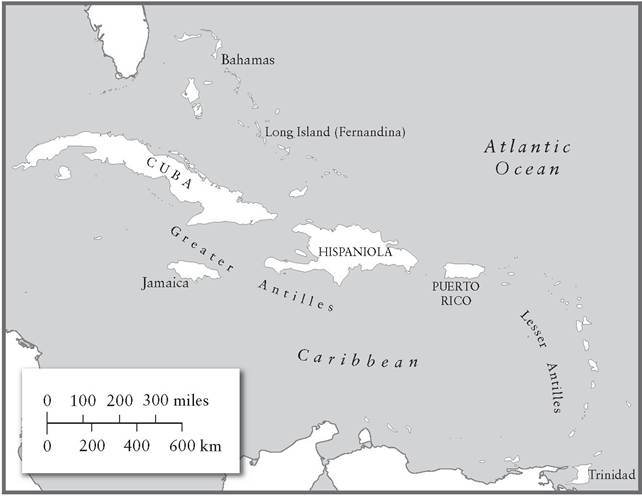
It was in reality a very old world, first settled in the fifth millennium bc, with new waves of settlers arriving periodically from South America.5 Unlike the Canaries, seven isolated islands that seem not even to have been in contact with one another, let alone the African mainland, the Caribbean and Bahama chains were lively places of interaction; the analogy, not that Columbus would have been aware of it, is with the small Pacific islands that were linked together by a constant flow of travellers bringing goods back and forth.Who these inhabitants were has been much discussed, and it has become increasingly clear that archaeologists have underestimated the ethnic complexity of the pre-Columbian Caribbean. They have generally been content to divide the population into two groups described by European observers, the warlike, cannibalistic Caribs and the more peaceful inhabitants of the large islands, especially Hispaniola and Puerto Rico, some of whom have come to be known as the ‘Tainos’, meaning ‘noble people’ in the principal language of these islands.6 The name ‘Carib’ was derived from a mythical island of Caribe said to be inhabited solely by men (another island was supposedly inhabited solely by women). The Tainos at first wondered whether Columbus and his crew had come from there. But the Spaniards seized upon the negative image of islanders from Caribe and collectively labelled all islanders who paddled their large canoes northwards to Hispaniola in the fifteenth century man-eating ‘Caribs’; that they did occasionally eat human flesh is very likely. These ‘Caribs’ represented a further wave of migrants of Arawak descent, warriors seeking to establish themselves in the lush islands of the Greater Antilles; it is likely that the Lesser Antilles, the line of islands stretching from the South American coast towards Puerto Rico, were becoming overpopulated, and they were looking for new lands to settle. The problem was that some of these lands, notably Hispaniola, were already very densely settled.
This set off violent confrontations.While it suited the Spaniards to distinguish between those who were regarded as legally free subjects of the king and queen of Castile, and hostile cannibal invaders from the south, who could legitimately be enslaved, the reality on the ground was rather different. On the largest island, Hispaniola, a variety of languages could be heard, reflecting different waves of immigration from South America.7 Jamaica was only settled in around ad 600, as also the Bahamas, at the end of a period known to archaeologists as the ‘First Repeopling’. Although there are uncertainties about the route that the very earliest settlers might have taken, evidence from pottery suggests that the main route taken during this phase was a south-to-north one, along the line of the Lesser Antilles. As in the Pacific, movement was slow, and just as ‘Melanesians’, ‘Polynesians’ and ‘Micronesians’ overlapped and intermingled, here the very earliest settlers were eventually outnumbered by a wave of migrants related to the Arawak population of northern South America, who created a particularly elaborate group of societies on Hispaniola by the time of the arrival of the first European explorers. The Taino idols, or cemis, often carved out of stone, survive as evidence of a lively culture, dependent on a reasonably nutritious food starch, cassava, and organized into small political units that jostled for power on the main islands.8
This was a well-connected world. The sea lay at the centre of their elaborate myth-making, which included strange stories about all the fish and all the water in the seas raining down from a great gourd, recorded by a puzzled friar named Ramon Pane whom Columbus had sent into the interior of Hispaniola to find out about the islanders’ religious beliefs.9 Hispaniola is a fairly large and mountainous island, and there were certainly Tainos and other groups who lived in the interior and did not have much to do with the sea.
Their aim was to achieve self-sufficiency, and this they did by and large manage to do, which led occasional admiring Europeans to speak in glowing terms of their societies: ‘theirs is a Golden Age’, an Italian scholar at the court of Ferdinand and Isabella opined, describing a society where envy and property were absent, and there was no need for laws and judges - the writer Peter Martyr never actually went to see for himself, but his words set off some fantastic ideas in the mind of Thomas More, recorded in his Utopia.10 But that is not to say that there was no trade. The inhabitants of the Bahamas, which they called the Lucayos, were familiar with the bigger islands to the south, trading goods such as coloured stones, foodstuffs, cotton thread and carved cemis : Columbus was amazed to find that glass beads and coins traded by his men on 13 October 1492, the day after he arrived in the New World, were already being taken south in a native boat he encountered off Long Island (Fernandina) on 15 October, along with some dried leaves and food. Not just European goods but reports of the coming of the strangely attired visitors in their flying boats were diffused at top speed throughout the island chain.A maritime highway ran all the way from Cuba to Trinidad and the South American mainland. Inter-island trade was conducted using the dugout canoes, propelled by paddle power, which attracted Columbus’s attention from the moment he made contact with the Lucayan Tainos. The largest of these canoes, made from a massive felled tree trunk, could seat as many as a hundred Tainos, and the chieftain’s boat might be specially painted and carry on board a canopied area. The process of making these boats was long and complex, involving a massive collaborative effort by the village. The tree trunk had to be split open and hollowed out, by burning away the wood and chopping away at the residue. The outside of the boat was trimmed and ‘marvellously carved in the native style’, to cite Columbus’s first reaction.11 The smallest, carrying a single person, were also very seaworthy, skimming back and forth between the islands.
Not for nothing was the native word canoa adopted in western European languages. In 1492 the Caribbean was not home to static cultures rooted in centuries of unchanging traditional practices; it was a little world on the move.12III
Yet this Caribbean world could only be the outer edges of the luxurious empires crowded with great cities described by Marco Polo. From the European perspective, da Gama’s voyage to India was the true success story. Columbus and Cabot were convinced that they had reached the edges of Asia, and yet Columbus’s first voyage did not reveal the silks and spices of China and Japan, as he so confidently promised Ferdinand of Aragon and Isabella of Castile. Instead, he brought back some strips of gold foil (though not a shipload of gold), some attractive feathers and some interesting but puzzling inhabitants of the Caribbean, who, he had to admit, were little more advanced in technology than the Stone Age Canary Islanders being conquered at the same time. It seemed that the islands he had reached were richer in cotton than in gold; and the mystery remained: where were the teeming cities whose harbours were crowded with massive junks, ruled over by the Great Khan, of whom Marco Polo had informed western Christendom two centuries earlier?13 Cabot’s voyage in 1497 was even less satisfactory: he was almost certainly aware that Bristol ships had strayed towards distant coasts somewhere near Newfoundland, but once he returned home he had to admit that the best chance for profit came not from rich ports and courts but from codfish - it was so plentiful that English fishing boats would no longer need to sail to Iceland.14
It is important to keep remembering that the first American voyages were conceived as voyages to Asia and as ways of opening up access to the spices of the East. They were planned according to exact expectations of finding gold and spices. The waters they reached were deemed to be part of what would now be regarded as the western Pacific. Some gold and spices were indeed found, though not by Cabot. Oddly, therefore, it makes sense to play along with the geographical assumptions of Columbus, and to assume that the routes they had found did lead to Asia, and that the goods the Spaniards acquired in the Caribbean were from the ‘Indies’. Only then can one understand how more and more Spanish efforts were pumped into the transatlantic voyages, which became quite regular within ten years of Columbus’s arrival in the Caribbean. Even the discoveries claimed by Amerigo Vespucci at the start of the sixteenth century did not definitively disprove the idea that South America was somehow connected to Asia; the idea that there might be a land bridge between the continents was only decisively rejected in the late nineteenth century. The Americas and Asia and indeed eastern Africa were all las Indias, ‘the Indies’. After he had heard of da Gama’s success in reaching Calicut, Columbus even speculated about carrying on westwards to meet the Portuguese in India. What discouraged him from an attempt to circumnavigate the globe, according to his son (and biographer) Ferdinand, was the lack of supplies on board his ships, rather than any notion that this was an impossible achievement.15
Just like the Portuguese, Columbus and Cabot were guided by the grand strategy of bypassing the Red Sea and eliminating dependence on the dhow traffic carrying spices across the Indian Ocean. The aim was not simply to make a grand profit: Columbus shared with the Portuguese the ambition of undermining the economy of the Muslim world by diverting the spices of the Indies directly to Christendom; and he shared with King Manuel (and with Ferdinand and Isabella) the messianic expectation that the discovery of a new route to the Indies would fund a massive attack on Islam that would culminate in the reconquest of Jerusalem by the greatest crusade of all time, in which, it was fervently hoped, various Christian kings of the East would also take part - Prester John was never far from the thinking of these new-style crusade strategists. Ideally, Christian navies would force open the Red Sea and clear the way to the Mediterranean - the spice route, but also the route to the Holy Sepulchre in Jerusalem. Columbus’s apocalyptic thinking dipped and soared depending on circumstances, and he was generally most obsessed by his sense of a divine mission when he found himself in a tight corner, but his combination of materialistic greed and the conviction of having been chosen by God never left him. Whatever riches he acquired in the ‘Indies’ were also to be understood as God’s gift; the material and the spiritual were intertwined like the strands in a rope.16
At no stage did Columbus express serious doubts that he had reached Asia, even if the geography of the Indies had proved far more mysterious than his reading of existing maps had led him to believe it would be. This is not to deny that Columbus had private doubts: when he made his sailors swear that Cuba was part of the Asian mainland, subject to a penalty of 10,000 maravedis and excision of the culprit’s tongue, he was unconsciously expressing his own uncertainty about where on earth he had arrived.17 But such evidence as existed for lands across the Atlantic seemed to confirm the assumption that Asia was within reach. The bodies of strange people had been cast up on the shores of Ireland, and their features were rather like those of Tartars, in other words, the ‘Orientals’ with whom westerners were reasonably familiar through political contact and through the trade in slaves from the Black Sea into the Mediterranean. Almost certainly these were the bodies of native North Americans which had been washed out to sea. If, as is possible, the young Columbus travelled to Iceland he might well have heard tales of lands to the west visited by Norse sailors in the past. In Bristol he could also have picked up rumours of lands to the west, because several Icelanders had taken up residence there, and because English expeditions had penetrated deep into the Atlantic in the 1480s. Besides, he seems to have read some mysterious papers in the possession of the Perestrello family of Porto Santo near Madeira (into which he married), which provided further evidence of land to the west.18
Building into their work the mass of rumours that circulated throughout the Middle Ages, several fifteenth-century cartographers liberally sprinkled the Atlantic with imaginary islands. One such mapmaker was Andrea Bianco, a citizen of Columbus’s own home town of Genoa, who made charts in 1436 and 1448. Still, the distances looked formidable, unless one followed the argument presented by the Florentine geographer Paolo Toscanelli, who shrank the distance between western Europe and the Far East by arguing for a narrow Atlantic that separated the continents, a judgement that also stretched the distance overland from Portugal to China, making it greater than Ptolemy had assumed.19 Columbus conveniently slotted Toscanelli’s version of the Atlantic into Marco Polo’s description of Japan to show that Cipangu, or Japan, was within relatively easy reach of Europe. Moreover, it was virtually paved with gold:
The people are white, civilized, and well-favoured. They are Idolaters, and are dependent on nobody. And I can tell you the quantity of gold they have is endless; for they find it in their own Islands, and the King does not allow it to be exported. Moreover few merchants visit the country because it is so far from the mainland, and thus it comes to pass that their gold is abundant beyond all measure [passages in italics appear only in some manuscripts].20
The emperor of Japan was said to have a palace roofed with gold, ‘just as our churches are roofed with lead’, with golden floors made of great golden slabs, ‘so that altogether the richness of this Palace is past all bounds and all belief’.21 Conceivably this description was based on Chinese whispers about the Golden Pavilion and other beautifully decorated temples in Kyoto.
The assumption that Japan lay across his line of travel was not unique to Columbus and Toscanelli. Martin Behaim, a German cartographer who had made the lucky decision not to join van Olmen’s ill-fated voyage west of the Azores in 1487, produced the first proper globe that has survived; now in the Germanisches Nationalmuseum in Nuremberg, it dates from around the time of Columbus’s first voyage, and does not include any of his discoveries. However, the globe shows Cipangu athwart the western Atlantic, about two thirds of the way across; superimposed on a modern map that would place Japan just above the Guianas, while to its south-east a scattering of smaller islands leads down to ‘Java Minor’ and ‘Seilan’, or Ceylon, the Bay of Bengal having evaporated. Even though there is no evidence Columbus and Behaim knew one another, the similarity between their view of what lay out there in the western Atlantic is very striking. In that sense, Columbus was not quite the eccentric fantasist he might at first appear.22
He was, after all, a citizen of Genoa, a port whose inhabitants had saltwater in their veins - despite many counterclaims there is no doubt about that, for the Genoese archives prove that he was the son of the weaver Domenico Colombo; he was an imposing figure, six feet tall and red-haired, capable of great charm as well as great fury.23 It is certainly striking that three of the pioneers who opened up the Atlantic on behalf of kings in Spain, Portugal and England were Italian. John Cabot appears to have been Genoese by birth, but he lived long enough in Venice to acquire Venetian citizenship, always a long process.24 Amerigo Vespucci was a well-connected Tuscan who lived in Florence and Piombino, a little maritime state on the coast. It has been seen that the Genoese were very active in the colonization of the Atlantic islands, which explains why Columbus was made so welcome when he called on the Perestrello family in Porto Santo.25 At that stage in his career, the young Columbus was interested, like many of the Genoese who sailed the Atlantic, in the sugar trade.
Wealthy Italian businessmen based in Lisbon and Seville were of crucial importance in funding both the transatlantic voyages and the Portuguese expeditions. Columbus came to depend on Florentine backers, since the king and queen insisted they had run out of money after spending all they had on the war to conquer Muslim Granada. The solution was to combine their financial support, over a million maravedis (less than it sounds, as this was a low-value coin), with backing from Italians in Seville, notably a certain Giannetto Berardi; this way Columbus was able to inject half a million more maravedis into the preparation of his tiny fleet.26 John Cabot received monetary support from the London manager of a bank operated on behalf of an ancient and illustrious Florentine family, the Bardi, with the intention of seeking out ‘the new land’ (the fact this land is preceded by the word ‘the’ rather suggests prior knowledge of its existence, but may simply refer back to knowledge of Columbus’s discoveries much further south).27 As for Amerigo Vespucci, he was for a time an agent of Berardi’s bank, which brought him into contact with Columbus, and they held one another in respect.28
Why then did these Italians not set out across the ocean on their own initiative? Political power was an important issue here. By the 1470s the Portuguese and the Spaniards were already sparring for control of Atlantic waters, so lone interlopers travelled at their own risk. And in delivering grandiloquent letters to the Great Khan, of the sort Columbus carried on his first voyage, it would surely make a difference if they were written in the name of Europe’s greatest monarchs, the king and queen of Castile and Aragon, rather than the tiny, if highly influential, republics of Genoa or Florence - even though they were addressed to the ‘dear friend’ of the king and queen, the letters Columbus carried contained blank spaces so that he could fill in the unknown name of whatever ruler he managed to visit.29 Besides, the Italians living beyond Italy were probably better placed to raise funds and take risks; the 1490s were troubled years in Italy, marked by a massive French invasion of the peninsula and by Savonarola’s revolution within Florence. Finally, there was the fact that the Italians had for hundreds of years been selling their nautical skills to the kings of Portugal and Castile.
Neither Cabot nor Vespucci shared Columbus’s apocalyptic vision. Cabot, at the court of the money-hungry King Henry VII, well understood that the king expected good financial returns from whatever lands Cabot might find. Vespucci was a cultured product of Renaissance Florence, and, though he enjoyed exaggerating his achievements, he did not boast about how his discoveries would end the Turkish threat or usher in the Last Days before the Second Coming of Christ. While Columbus fantasized about how he had discovered the source of all the world’s great rivers and was closing in on the Garden of Eden, Vespucci, even in his most extravagant moments (describing cannibal feasts, for instance), was keener to shock than to moralize. Columbus saw himself as a crusader; Vespucci did not.
IV
Columbus’s first voyage, conducted by two caravels and a slightly larger nao, the Santa Maria, set out in August 1492 from Palos de la Frontera in Andalusia, passed through the Canary Islands, and reached its first stop in the Bahamas on 12 October.30 His crew included at least one convert from Judaism, Luis de Torres, whose great virtue was that he knew both Hebrew and Arabic and would surely, therefore, be able to communicate with the peoples of the East. Oddly, there was not a single priest or friar on board, although Columbus claimed in his own logbook (which survives in a heavily re-edited edition) that one of his aims was to ‘determine what method should be undertaken for their conversion to our holy faith’; but if anything the lack of a priest made Columbus even more conscious that he himself was God’s agent on board the voyage. Also lacking were impressive trade goods that could be offered to the Great Khan; however, the native population of the Bahamas and the Caribbean was only too happy to be given beads, little red caps and other items of truck, which, as has been seen, immediately passed into the trading networks of the Tainos.
Over the next few months Columbus explored the Bahamas and the coast of Cuba, but decided that the large island he called Hispaniola (modern Haiti and the Dominican Republic) would be most suitable as a base. Although his initial relations with the Taino population of these lands were by and large friendly, and he wrote very positively about how sweet, docile, good-looking and innocent they were, he had great difficulty fitting them into his world view; they were, for one thing, naked, which was not what one expected of the subjects of the Chinese or Japanese emperor, who would surely be clad in silk. The closest parallel he could find was with the Canary islanders: they too were naked island people, ignorant of metal tools (although the Tainos were, he was glad to report, familiar with a gold and copper alloy called guanin); and they too were pagans who lived without any ‘law’, by which he meant that they were not Christians, Muslims or Jews. Some early accounts and maps show the newly discovered islands as Novas Canarias, ‘New Canaries’, reflecting the view that he had found more of the same on the same latitude, but much further away.31 He attempted to found a small settlement in the north of the island. He returned to Europe in March 1493, after a difficult voyage through the Azores that washed him up in Lisbon, where King Joao II was deeply disconcerted to learn of his discoveries, having previously ignored him as a fantasist.32
Had he really reached India? Evidently there was something out there, and after Columbus had presented himself, and the Tainos he brought back with him, to Ferdinand and Isabella at court in Barcelona he received a second commission, setting out in September with a much more impressive armada of seventeen ships; and this time there were priests on board. Much of his energy was spent trying to subdue the interior of Hispaniola, as he became sucked into rivalries between the different chieftaincies on the island. He established a new centre of operations at La Isabela in northern Hispaniola, of which more later; and the Taino Indians were subjected to harsh demands for tribute in gold. Accusations of incompetence reached the court in Spain
When the first inspector, named Juan Aguado, was sent out to Hispaniola in 1495, Columbus was deeply resentful. Normally such inspections took place when a governor demitted office, but the king and queen had appointed him ‘Admiral of the Ocean Sea’ and governor of all newly found lands for life. Columbus, an agile social climber, expected to make a fortune out of the share of the wealth of the Indies that the king and queen were willing to assign to him. His pretensions did not endear him to people back at the court of Castile. The Genoese were not popular, even though their contribution to the Castilian economy, notably in Seville, and to the creation of a Castilian navy had been crucial; some of the hostility that had been building up against the Jews, expelled as Columbus set out on his first voyage, was redirected towards the Italians. Columbus was also accused, with good reason, of attending too much to the interests of his family, promoting his brothers and his son to high office in Hispaniola and exploiting the resources of Hispaniola to enrich himself - there was a real issue as to whether he was legally entitled to one tenth of the value of goods sent back to Spain, or merely one tenth of the tax of one fifth that the Crown would receive on goods sent back to Spain, in other words one tenth or a mere fiftieth.33
The result of all this was that Columbus hurried back to Spain in 1496.34 He had a difficult time making his case to the Catholic Monarchs, but - taking into account his undoubted skill as a navigator - he was allowed to go out a third time in 1497, and now he headed further south, through the Cape Verde Islands, in the hope that he would find a route to the Far East somewhere to the south of Hispaniola. He discovered ‘a very great continent, which until today has been unknown’, the north coast of South America, but not too much should be made of this: the term ‘continent’ simply meant a large area of mainland, which could still be connected to, or lie just offshore from, Asia. Still, the mystery of what was out there deepened further. Columbus was convinced that he had reached the outskirts of the Garden of Eden, which, as the Book of Genesis explained, was guarded by angels bearing flaming swords and could not be entered. He decided that the garden stood at the top of a great protuberance ‘something like a woman’s nipple’ - the earth was not round, but pear-shaped.35 Sometimes he insisted that these were not just the Indies; he had discovered Paradise - even its Taino inhabitants, tame and beautiful, unashamedly naked, seemed to live in prelapsarian innocence.
Back in Hispaniola, reality intruded: trouble with the Tainos was compounded by trouble with his fellow Europeans, and he faced a series of rebellions by his Spanish lieutenants. These culminated in the despatch of yet another official investigation under a somewhat dubious figure, Bobadilla, and in the arrest of Columbus. In 1500 he was sent back to Spain in chains that he refused to have removed until he stood in the presence of the king and queen, whom he was still, remarkably, able to charm.36 Even so, it is surprising that he received a fourth commission, hedged about with conditions about where he could put in, since his presence in Hispaniola was rightly seen as a source of trouble. He was only able to raise funds for four ships, while the governor of Hispaniola, Nicolas de Ovando, sailed out to the Indies ahead of him with thirty.37 In June 1502 Columbus’s ships stood off Santo Domingo, the third attempt at European settlement in Hispaniola and now the island’s capital; but they had to sit out a hurricane, as he was not supposed to set foot on the island that he had discovered and ruled.
The conviction that he was called by God to make ever greater discoveries became still more powerful during his final voyage. His knowledge that he was God’s agent was confirmed even more strongly at a low point in 1503, during his fourth voyage, when his men were beaten back by the Indians of Panama, where he was hoping to found a colony. Suffering from a high fever and deeply depressed by his failures, his troubled sleep was disturbed by a voice from heaven that said:
‘O fool and slow to believe and to serve your God, the God of all! What more did He do for Moses or for his servant David? Since you were born, He has always had you in His most watchful care. When He saw you at an age with which he was content, He caused your name to sound marvellously in the land. The Indies, which are so rich a part of the world, He gave you for your own; you have divided them as it pleased you, and He enabled you to do this. Of the mighty barriers of the Ocean Sea, which were closed with such mighty chains, he gave you the keys.’38
On the coast of Panama and Costa Rica, he gathered information about a rich civilization in the interior, probably a mixture of memories of Maya glories from centuries earlier (his men found what were almost certainly some Maya buildings), and vague knowledge of the Aztec empire in Mexico. The evidence was there in solid gold ornaments worn by the local Indians, some of which must have been traded from the interior. This gold awakened yet again the greed of Columbus and his followers. He once again tried to found a settlement in lands he suspected were genuinely rich in gold; but when he was beaten off by the locals and when his ships were tossed to and fro in another hurricane, he found himself washed up on the shores of Jamaica, an island he knew vaguely but had never tried to conquer. For a whole year from June 1503 onwards he was allowed to languish there, since the Spanish governor of Hispaniola rather enjoyed leaving him to rot, but one of his companions who had already escaped from Jamaica sent him a ship, and in early November 1504 he was back in Spain, only to discover that his eager patron, Queen Isabella, was on her deathbed; her husband had other priorities, mainly in Italy (following his conquest of Naples a year earlier), so now Columbus was stranded once again, but at least it was in his adopted country; and he himself died there a year and a half later.39
As has been seen, Columbus saw the Tainos as innocent and beautiful creatures quite different from the dog-headed monsters some had predicted would be found in southern climes; in his logbook Columbus wrote: ‘on these islands until now I have not found any monstrous men, as many expected; rather, they are all people of very beautiful appearance.’ Occasionally he looked over his shoulder at what the Portuguese were doing in Africa (he had visited Elmina), and speculated that they were so docile that they would make excellent slaves or servants, but Queen Isabella was adamant that they were her free subjects and must not be enslaved.40 Attempts to convert the Tainos were half-hearted; a friar was sent into the interior of Hispaniola to learn about their ways, but evidence revealed as recently as 2006 shows that Columbus was unhelpful over conversion, to the point of being obstructive.41 These ambiguities and inconsistencies in his attitude occur again and again. He still had room in his thinking for monstrous peoples, especially when he heard tales of man-eating Car- ibs (whence the term ‘cannibal’, whose first letters echo the Latin canis, ‘dog’); these Caribs were said to be invading Taino lands from the south, coming up in their war canoes and seizing boys, whom they castrated and raised for the pot, or women, who bore them children that faced the same terrible fate.42
Whether they, or indeed the Tainos, occasionally feasted off human meat has become a controversial question. Historians and literary scholars who claim the label ‘post-colonial’ argue that cannibalism was a European invention, employed to justify the subjection of the American Indians. On the other hand, it is surely the height of colonial condescension to assume that the Caribs or indeed the Tainos must have had the same moral values as western Europeans either now or in the sixteenth century; there is no serious reason to doubt that some American Indians, whether in the Caribbean or in Brazil, did occasionally eat their captives.43 Such stories of monstrous conduct led Columbus to divide the inhabitants of the New
World into good Tainos, whom he had made into notionally free subjects of the king and queen, and evil Caribs, who were fair game for slaving expeditions: ‘when your Highnesses order me to send you slaves, I expect to bring or send the majority of them from these people.’
However, the Tainos could not produce nearly as much gold as he had hoped, and as he continued to promise to the Catholic Monarchs in Spain. He therefore put them to work sifting and mining for gold in increasingly oppressive conditions, laying the foundations for the encomienda system that effectively enslaved the Indians not just of the Caribbean but, in later generations, of Mexico and Peru as well. Rather than being actually slaves, the Tainos were understood to be legally free; but like other subjects they had to render some service to their rulers, which for Columbus meant tribute in gold dust, an amount per head sufficient to fill a hawk’s bell. The Crown did occasionally try to improve the conditions under which they lived, but European slavers made no effort to distinguish between ‘good’ Tainos and ‘evil’ Caribs. The first major legislation in favour of the Tainos, the ‘Laws of Burgos’, dates from twenty years after Columbus first reached the Caribbean; by then it was far too late to save them. Unaccustomed to heavy labour and corralled into settlements, with families often broken apart for months at a time, the Tainos began to disappear: falling birth rates, i ll-treatment by Spanish masters, even massacres, resulted in their rapid extinction. Demand for labour in the gold fields of Hispaniola led to the depopulation of outlying islands, so that the Bahamas were largely deserted by 1510. As will become clear, the disappearance of the Tainos led to the importation of cheap labour from Africa, black slaves who were not even notional subjects of the Spanish rulers and had even fewer benefits of protection. The economic viability of the West Indies was only sustained by a radical transformation in population, both African and European.
Columbus, torn between his duties as governor of the new Spanish lands and his sense of mission as bearer of God’s word, neglected the people of Hispaniola because he was still convinced that he stood on the edge of the Fabulous Orient and that he would unlock the door that would lead Christian armies and navies to Jerusalem. He had radically different views about how to reach Asia from most of his contemporaries; but that does not make him into an example of ‘Renaissance Man’. When he used the classical writer Seneca to demonstrate that Europe would overwhelm the Indies which lay not too far to the west, he read Seneca as a prophet, indeed as a Christian prophet, for it was often argued that he had been a secret Christian at the court of the Christian-hating Emperor Nero.44 His thinking was rooted in medieval ideas of crusade and
Christian redemption as much as it was rooted in the commercial outlook of medieval Genoa.
V
Columbus set out on his first voyage with three ships; John Cabot only had one, the ‘shippe of Bristowe’ named the Matthew, a medium-sized boat of around fifty tons. This was not even a new ship, but a commercial vessel that had probably traded towards Ireland and France before Cabot took charge.45 One has to say ‘probably’ because the evidence about Cabot is very fragmentary. His early career was punctuated by failure and scandal: he seems to have fled from Venice to avoid his creditors, and in both Valencia and Seville he offered his services as a harbour engineer, but his projects were never brought to a finish, raising doubts about his competence.46 A respected British historian announced that she was writing a radically revisionist life of Cabot that would, it seems, have brought to light not just his connections with Italian bankers but his attempts to explore large tracts of the North American coastline and even to settle friars and others along that coast. However, she died before her work was complete and left adamant instructions that all her notes and drafts were to be destroyed.47 So there is still plenty of speculation about his origins, his career and his impact, speculation that is further muddied by the insistence that he was the real discoverer of America, because Columbus only reached the mainland of America (South rather than North) in 1498, and felt too ill to set foot there, though he did send his men ashore. In reality, the discovery of America was a gradual process of working out that two large continents blocked the way to a further ocean which would present an even greater challenge to navigators than the Atlantic.
Cabot knew perfectly well that Columbus had found land in the west, but his voyage was designed to show that the Spaniards had been sailing too far to the south in their search for Asia, a route partly determined by the lust for the gold that the sun was believed to have generated in hot latitudes.48 The Milanese ambassador in London reported that Cabot was searching for the real Cipangu, for he was unconvinced that Cuba or any other land Columbus had found was Japan; Cabot, he said, ‘believes that all the spices in the world have their origin’ in Japan, and Cabot supposedly knew about this because he had intrepidly journeyed to Mecca as a young man and had asked where spices originated.49 If Cabot’s hunches were correct, London stood to become an even more important spice market than Alexandria. In March 1496 King Henry blithely granted John Cabot extensive rights of conquest, trade monopoly and dominion in the lands he would discover: ‘whatsoever islands, countries, regions or provinces of heathens and infidels, in whatsoever part of the world placed, which before this time were unknown to all Christians’, though King Henry left it to others to finance the expedition, and evidence collected in the last few decades shows that the Bardi of Florence provided essential backing.50 The fact that the king specified these were to be previously unknown lands avoided a direct clash with the interests of Columbus and the Crowns of Castile and Portugal.51 It was simply assumed that Christian discoverers could raise the flag of England in whatever non-Christian land they visited, without reference to the native inhabitants or to the papacy, which, as will be seen, had already divided the globe into Spanish and Portuguese hemispheres.
After a first try in 1496, when he was defeated by the weather and the pessimism of his crew, his first full voyage, in 1497, apparently took him to the ‘New-found-l and’, and possibly to Labrador.52 As has been seen, spices were not to be had; but there was an astonishing amount of cod. It was widely assumed that Cabot had found more islands, rather than a continent - the duke of Milan was told by his agents that Cabot had found the Island of the Seven Cities.53 The Englishman John Day wrote to ‘the Lord Grand Admiral’, almost certainly Columbus (then back in Spain, between his second and third voyages), with a description of Cabot’s voyage; he patriotically claimed that ‘the cape of the said land was found and discovered in the past by the men from Bristol who found “Brasil”, as your Lordship well knows’; what Columbus made of any of this is unknown, and he was never tempted to try a northerly route across the Atlantic. Day reported that Cabot reached land in late June, but there were only a few clues that any humans lived there.54 So the claim that this was Japan or China did not fit at all well.
Another, larger expedition set off under John Cabot, in 1498. This time he was more willing to take into account Columbus’s discoveries, for as far as is known he headed towards Newfoundland, with the idea that the ships would strike southwards towards the tropics, in search, perhaps, of a route to India, or at least Japan and China. John Cabot himself disappeared, though it is possible that some sailors made their way back to Europe with three Indians.55 For the Great Chronicle of London reported that in 1501 or 1502 there ‘were browgth unto the kyng iij men takyn In the Newe ffound Ile land’; ‘These were clothid In bestys skynnys and ete Rawe fflesh and spak such spech that noo man cowde undyrstand theym, and In theyr demeanure lyke to bruyt bestis.’56 John Cabot’s son Sebastian, himself an explorer of North America, warned of a ‘very sterile land’, inhabited by polar bears, moose (‘large stags like horses’), sturgeon, salmon, soles a yard long and an infinity of codfish.57 It was not, then, the semi-paradise about which Columbus enthused so poetically, in which seasons were of little importance and crops almost shot out of the soil. The ocean and the rivers, not the land, were the greatest assets of this new-found-land.
There are hints that Cabot or later visitors from Bristol travelled very far to the south. In June 1501 one of Columbus’s rivals, Alonso de Hojeda, received a commission from Ferdinand and Isabella, instructing him to ‘follow that coast which you have discovered, which runs east and west, as it appears, because it goes towards the region where it has been learned that the English were making discoveries’. He was to set up the Spanish equivalent of padroes, to make public the Castilian claim to this shoreline, ‘so that you may stop the exploration of the English in that direction’.58 This was despite the marriage alliances that bound the house of Tudor to Spain through Catherine of Aragon. These explorations were probably conducted by Bristol merchants; in 1527 Hugh Elyot and Robert Thorne were both credited with the discovery of Newfoundland some years earlier, which may have been not so much a snub towards the Cabot family as a recognition that further new-found-lands were reached around 1500, and the American Indians brought back to the court of Henry VII may have arrived on one of these later sailings, which seem to have continued until 1505 or thereabouts.59 Although a patriotic English historian has claimed that Cabot made entirely clear the fact that North America was not Asia, in reality the discombobulation continued - this was both a New World, of previously unsuspected existence, and at the same time somehow attached to the Old World. Its inhabitants lived so far from the Old World that they might even have been created separately by God; yet they were also ‘Indians’, sharing ancestry with the peoples of the Old World. None of it made much sense.
How hard it was to connect the mass of new information to existing knowledge became apparent when Greenland once again entered the consciousness of western Europeans. King Henry VII was interested to hear of the rediscovery of Greenland by Gaspar Corte Real, from the Azores, in 1500, news brought to his court by a Portuguese sailor named Joao Fernandes Lavrador (‘the Farmer’) from Terceira in the Azores. Lavrador received a privilege from the English king and set up an Anglo- Portuguese syndicate that explored the western Atlantic out of Bristol.60 The Corte Reals subsequently, at the cost of their lives, explored the coast of Labrador right down to Newfoundland - confusingly, they applied the name Labrador not to the Atlantic coast of Canada, meant here, but to Greenland.61 A map of 1502, the Cantino Map, drawn in Lisbon, attached a caption to Greenland describing it as the land ‘discovered by licence of the most excellent prince Dom Manuel king of Portugal, the which is believed to be the peninsula of Asia’.62
Enough reports filtered back to Portugal to confirm that this stretch of sea was good for fishing, but the land had little to offer beyond ice.63 It has been suggested that the real motive of these explorers was to find a North-West Passage to Asia over the top of Canada, which would become a longstanding obsession of navigators; however, it is more likely that they were curious to look further at whatever Cabot had found, and that they concurred with the general view that Greenland was a spur sticking out of Asia.