29 Other Routes to the Indies
I
It took nine long years to capitalize on Dias’s rather amazing discovery that Ptolemy was wrong, and that the Indian Ocean has an open bottom. One factor that delayed action was that the Portuguese once again became interested in campaigns in Morocco, though their meddling continued to irritate the Castilians, who sent an expedition to Morocco’s Mediterranean coast, capturing Melilla in 1497, and holding it ever since.
The Portuguese king was surrounded by doubters who pointed out that the monarchy did not have unlimited resources, even with the profits that accrued from gold, sugar and slaves; surely it made more sense to concentrate on maximizing these profits? It was easy too to insist that little was really known about political conditions in and around the Indian Ocean. Quite apart from the difficulty in keeping such elongated trade routes open, little was known about the Christian prince who was supposed to come to the aid of the Portuguese, Prester John, who had been cited again and again for four centuries.In preparation for new voyages, spies were sent into Muslim lands, in the hope that they could penetrate still further, all the way to both India and Ethiopia. Between 1487 and 1491 an agent of King Joao, Pero da Covilha, explored the land route to India and ended up in Ethiopia, where he saw out his days. His account of conditions in India was sent back to Lisbon via Portuguese Jews trading in Cairo.1 The Portuguese court also applied the knowledge of the skilled Jewish astronomer Abraham Zacuto, who had taught at Salamanca University before being exiled from Spain in 1492.2 Zacuto was a great specialist in astronomical tables, vital for long-distance sailing; for the aim in sending Covilha to India was not to create a land route, which was obviously impossible while Turks and Mamluks stood in the way, but to spy out the cities of India, find out what could be bought there, and obtain some sense of the geography of the lands bordering the Indian Ocean.
Portuguese interest in a westward route across the Atlantic was limited. Columbus had not been taken seriously when he delivered his sales pitch about a short transatlantic route to Asia, still less after Dias rounded the Cape of Good Hope and gave the Portuguese good hope of a route to the Indies; Columbus’s calculation of the size of the earth was simply not credible, and his idea that Cipangu (Japan) was within easy reach of the Canary Islands made no sense.3 The Crown had given its blessing to Ferdinand van Olmen’s expedition westwards in i486, but had invested nothing in it, and, after all, van Olmen never reappeared.4 King Joao was therefore shocked when Columbus returned from his first voyage to the Caribbean in 1493, carrying Taino Indians on board. One issue was which newly discovered lands should fall under the dominion of which kingdom; the solution agreed in the Treaty of Tordesillas, in 1494, was to divide the Atlantic, and by extension the globe, vertically down the middle of the ocean; the treaty was mediated by the pope, Alexander VI Borgia, who took the opportunity to express his own overarching authority across the entire world. Spain was granted rights to the west of the line of division, Portugal to the east. The Portuguese therefore remained confined to the eastern flank of the Atlantic during the 1490s.
Seen from a maritime perspective, this was the lull before the storm. A new king succeeded to the throne late in 1495; Manuel I was the cousin of Joao II, and he was driven as much by messianic ideas of Portugal’s role in the struggle against Islam as he was by his support for the now wealthy trading community of Lisbon; he had been educated by Franciscan friars who imbued him with his sense of a messianic mission, which was accentuated when, against the odds, he found himself heir to his cousin’s throne.5 Manuel’s decision to expel both Jews and Muslims from his kingdom in 1497 reflects his apocalyptic view of human history: Christ would return when the Jews became Christians and when the Infidel Moors were defeated at home, as far east as Jerusalem, and in Asia.
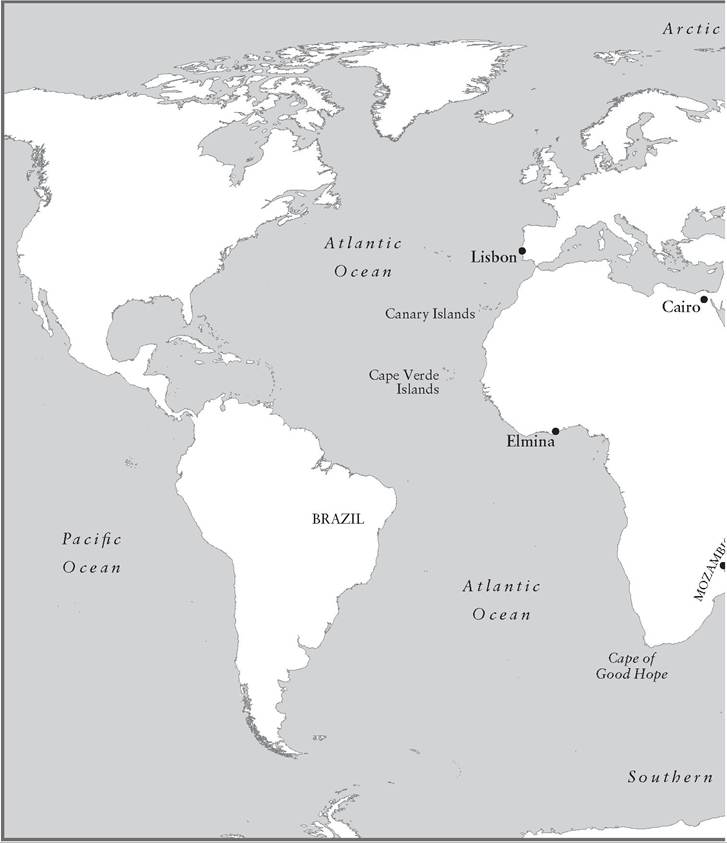
(In the event, most Jews were forced to convert to Christianity when Manuel closed the ports to prevent them leaving, with the result that a large and prosperous community of New Christians, often secretly loyal to their old religion, came into existence.) Voyages to the heart of Asia would divert the gold and spices of the East away from the Islamic heartlands, and help to undermine the power of the Mamluks in the Middle East and of the Ottomans in Turkey and the Balkans.So, amid great celebration, in July 1497 Vasco da Gama set out with four ships, at first following the classic Portuguese route along the west coast of Africa and past the Cape Verde Islands.6 Two of these ships were not caravels; much energy had gone into designing a sturdier type of ship,
with square sails, that would be better suited for the bold route Dias had identified. This route would take the ships through powerful winds across open ocean well out of sight of land, rather than the coastal route Cao had taken, which took advantage of the ability of caravels to sail a good way upriver. Dias advised on the design of the new ships, but the king mysteriously chose da Gama, a minor nobleman with no experience of command at sea, to lead the expedition; Manuel was more interested in placing someone who might be able to negotiate with foreign rulers at the
head of the expedition, rather than an old sea dog like Dias.7 Bearing in mind Dias’s advice, da Gama swung far out into the ocean once past the Cape Verde Islands, describing a route that traversed three times the distance covered by Christopher Columbus in 1492. His ships were swept along, arriving somewhere along the coasts of modern Namibia and South Africa. There they met naked, tawny-coloured Bushmen who were disappointingly ignorant of spices, gold or pearls;8 further south, Vasco da Gama’s chronicler described people who looked and acted more like the black Africans known from much further to the north.9 The Portuguese bought an ox for three bracelets from these people and dined well off it, for it was full of fat and as tasty as anything back home - a great joy after weeks of salt pork and hard biscuit.10 The good news was that, as they rounded southern Africa, the Portuguese began to realize that the inhabitants were not isolated from the world; they were ‘handsome and well-made’ and they knew iron and copper, and the Portuguese met one man who told them about his travels far up the coast, where he had seen big ships.
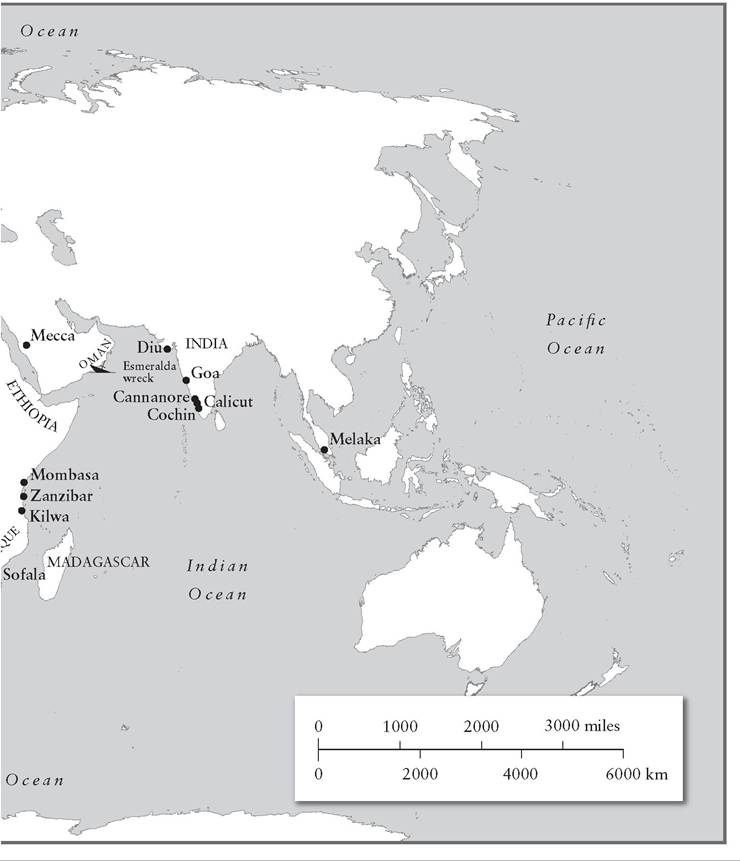
The further they coasted into the Indian Ocean the more the Portuguese were reminded not of the Christian but of the Muslim world, and this made sense because Arab merchants had been trading up and down the east African coast for centuries in their dhows.11 Many of the inhabitants spoke Arabic, whatever the colour of their skin (for there had been plenty of intermarriage between the Arabs and the Africans). These people dressed finely in linen and cotton and wore silk turbans; they were active in trade with the ‘white Moors’ to the north, and Arab vessels were in port, piled with the gold, pearls and spices about which the Portuguese had been asking everyone they encountered, including the pepper of the Indies. The merchants boasted that pearls and jewels were so abundant in the lands towards which the Portuguese were heading that one simply gathered them, without any need to offer goods in return.12 The Portuguese absorbed all the rumours they heard like sponges: there were Christian kingdoms to the north, at war with the Moors; there was the Ethiopian realm of Prester John, still busy in defence of Christendom after three centuries. It was all too good to be true. By the time he reached Mombasa in what is now southern Kenya, da Gama had entered a much more familiar world of princes and traders. He even convinced himself that he had met some Christians when two merchants of Mombasa proudly showed the Portuguese what the newcomers believed was an image of the Holy Spirit drawn on paper.13 With the help of a willing pilot, often though wrongly assumed to have been ibn Majid, the Muslim author of several tracts on navigation, da Gama was at last able to make his way to Calicut in India, where he arrived on 20 May.14
Here he was entering a world which had close links to home. He found a couple of Moors from Tunis, who spoke Spanish and Italian, and who unenthusiastically greeted the Portuguese with the words: ‘May the devil take you! What brought you here?’ The Portuguese were, nonetheless, convinced that they had reached a Christian land.
It was certainly not a land under Muslim rule. The Portuguese were mightily impressed by a building they identified as a church; it was made of stone, and was the size of a monastery, with a great bronze pillar at the entrance. Within the church there was an imposing chapel, and ‘within this sanctuary stood a small image which they said represented Our Lady’. The figure carried a child, so the identification was as certain as could be. Therefore Vasco da Gama entered the compound with some of his companions, and they said their prayers. The local priests threw holy water over the Portuguese visitors and presented them with ‘white earth’ made of cow dung, ashes and sandalwood, with which the local Christians were accustomed to anoint themselves. The local Christians were also devotees of any number of saints, whose images were painted on the walls of the church, some with several arms or with giant teeth.15It was all, of course, a great mistake. Their first encounter with the Hindu gods was transmogrified in the fertile imagination of the Portuguese into an encounter with the Virgin and Child. The panoply of gods painted on the walls was read as a cycle of Christian saints.16 The Virgin and Child was probably an image of Krishna being suckled by his mother Divaki. The Portuguese knew these people were not ‘Moors’, whose places of cult had no images and whose language and practices were easily recognizable - as has been seen, Islam was banned in Portugal only in the year when da Gama left home.17 But India was a land of kings, of scheming Moors, of undoubted wealth, in which the Portuguese were not really welcome. Da Gama’s attempts to negotiate with local rulers were frustrated at every turn, and his constant recourse to violence, which became the trademark of Portuguese conquerors, made it more difficult still to win the respect of local rulers and establish trading stations. Still, da Gama was able to leave loaded with samples of pepper and other goods, and to reach Lisbon again in September 1499.
The king of Portugal optimistically began to call himself ‘king of Portugal, lord of Guinea, lord of the conquest and navigation and commerce of Ethiopia, Arabia, Persia and India’. This title was not quite as empty as it may sound: within five years an astonishing eighty-one ships were despatched from Lisbon to India. A second fleet was put together under the command of Pedro Alvares Cabral, setting out in 1500; this fleet consisted of thirteen ships and swung so far out into the Atlantic that it made landfall in South America, in what the Portuguese called the ‘Land of the Holy [or True] Cross’, soon to be rechristened Brazil. This land happened to fall on the Portuguese side of the line of demarcation that had been established by the Treaty of Tordesillas six years earlier. Although it has often been suggested that the Portuguese already possessed secret knowledge of Brazil, and that Cabral knew where he was heading, contemporary reports indicate that this was an accidental discovery. The Portuguese took a long time to capitalize upon it.18
Cabral took care to carry along Arabic interpreters, including a certain Gaspar da Gama, named after his godfather Vasco, who was an enthusiastic and well-informed Jew of Polish descent da Gama had found wandering in India and had brought back to Portugal. Cabral’s method for convincing the Samudri, or king, of Calicut to do business was crude in the extreme: ships with hundreds of passengers aboard were sunk; the town was bombarded by cannon; no quarter was given; elephants as well as people were massacred (and the elephants were eaten); but in the end permission was given for spices to be loaded, though not enough to fill all the holds. These goods were only acquired because Cabral was able to take advantage of the intense rivalry between the ruler of Calicut, whose town he had ravaged, and the rajah of Cochin, better disposed to the interlopers because he saw them as well-armed allies.19 Seven of the ships finally returned to Lisbon, but only five carried merchandise; one ship wandered off and reached Madagascar, the first European landing there. In June 1500, along the coast of Africa Cabral’s ships encountered a fleet carrying the Italian explorer Amerigo Vespucci, a sign that this vast world was in some respects still a small one - in these enormous spaces Europeans somehow managed to find one another. Vespucci was bound for the north coast of South America; but he was fully alive to the implications of these Portuguese voyages. He sent a long letter back to Florence, recounting the achievements of Cabral’s fleet and describing the geography of maritime Asia to his patron, a member of the Medici family; he thought that the lands Cabral had visited in South America were an extension of those Columbus and others had been revealing under the Spanish flag, whereas the Portuguese view was that Brazil was a large island.20
King Manuel was so carried away by enthusiasm that even before Cabral had returned he sent out yet another fleet, in March 1501, under the Galician commander Joao de Nova. Nonetheless, de Nova managed to learn what Cabral had been doing: Cabral left a message in a shoe suspended from a tree near the southern tip of Africa; astonishingly, the message was found, and de Nova was warned that he should stay wary of the hostile Samudri of Calicut. De Nova was able to use his cannon to fight off attacks by ships from Calicut, and he captured several cargo vessels, one of which belonged to the embattled Samudri. Cochin and Cannanore proved good sources of spices, although the downside was that the Indians had only limited interest in the goods the Portuguese had brought. Still, de Nova managed to establish a ‘factory’, that is, a warehouse and office, for the Portuguese at Cannanore; this is what da Gama had aimed to achieve at Calicut, but his bloodthirsty behaviour there made the creation of a permanent base impossible. So de Nova was able to return to Portugal in September 1502 with hundreds of thousands of pounds of pepper, cinnamon and ginger. Some of the cargo was without doubt loot from captured Cochin ships. The Portuguese would long appear to many of the inhabitants of the shores of the Indian Ocean as pirates and interlopers, and it is impossible to disagree.21
In 1502 da Gama went out to India for a second time, departing just as de Nova left Indian waters. Twenty ships set out, divided into three squadrons: one squadron of ten ships to collect cargoes of spices, one to clean the sea of Arab traders hostile to the Portuguese, and one to stay in India, protecting the Portuguese who were taking up residence there. The selfconfidence of the Portuguese is impressive: they assumed that the ships that went out would - with some losses - eventually return, despite the danger of war with the ruler of Calicut and the sheer difficulty of a journey through stormy seas and past many potentially hostile towns in east Africa. The tone of the expedition was set by a visit to Kilwa, long an important port on the east coast of Africa, where the threat of unleashing his firepower on the town convinced the local ruler to declare himself a vassal of the king of Portugal and to offer a substantial tribute in gold.22 The message that Portugal would achieve its aims by force was never allowed to fade from sight. Once off India, the level of violence increased to horrific levels: the burning of a merchant ship full of men, women and children returning from Mecca was only one ghastly episode, as da Gama bombarded towns and rejoiced in Portuguese firepower, ever intent on humiliating the Samudri of Calicut and of forcing his way into the spice markets of India. Potential friends were harassed too, like the rajah of Cannanore, who was found to be in cahoots with Muslim merchants and had to be warned that in no circumstances must he interfere with the Portuguese agents based in his port.23
These actions even stirred da Gama’s enemy, the ruler of Calicut, to begin negotiations, though in the hope of trapping da Gama and destroying his fleet; early in February 1503 the Portuguese and the navy of Calicut clashed, and da Gama won a handsome victory. One reason for the defeat of Calicut was that the Samudri was unable to persuade the Arab merchants to lend him their ships, so his navy consisted of a few dozen ships provided by his Indian subjects. The Portuguese took home an extraordinarily rich cargo of over 3,000,000 pounds’ weight of spices, mainly pepper but also plenty of sweet-smelling cinnamon. Brightly coloured parrots were brought back, described as ‘marvellous things’. If this could be repeated year in, year out in more peaceful conditions, the trade routes of the world would be radically transformed.24
Even when these pioneers were able to fill their ships with pepper, the high risks of these voyages, with the loss of up to half the ships, began to raise doubts back home about their viability; the wreck of what may well be one of da Gama’s ships, the Esmeralda, which foundered off the coast of Oman, was first identified in 1998, although its location was kept secret until 2016. It is the earliest known wreck of a European ship from the age of discovery. This is one of those cases where archaeological evidence and the documents converge neatly, for the story of this shipwreck is well known, thanks to reports in contemporary chronicles and in a letter sent to King Manuel.25 The sinking of the Esmeralda and its sister-ship, the Saa Pedro, was even illustrated in a manuscript of 1568, such was the fame of these events. These vessels had been sent to hunt down Arab ships off Arabia, but unfamiliarity with the winds and waves did the Portuguese vessels far more harm than clashes with Arab dhows - the Esmeralda was torn from its anchorage close to an offshore island by a storm and hurled against the rocks. The name of its captain, Vicente Sodre, was commemorated in the inscription ‘VS’ carved on to the stone shot kept on board for use in battle; Sodre was da Gama’s uncle and was to be his substitute if da Gama died on the expedition. A bell carrying the number ‘498’, that is, 1498, and some gold cruzado coins minted in Portugal help to confirm the ship’s identity; one coin, a silver indio of King Manuel I, is only known from one other surviving example, but it was a famous coin in its day, minted for trade with the Indies.26 Among the most recent finds is a mariner’s astrolabe, of which very few other examples survive, and none this early.
Growing experience of these waters reduced these dangers, and growing profits increased their attractiveness to those trying to make their fortune. Venetian writers began to panic, fearing (wrongly) that all the pepper they had been buying through Alexandria would disappear; they were also disconcerted to learn that ‘it is impossible to procure the map of that voyage. The king has placed a death penalty on anyone who gives it out.’27 In his diary the Venetian Girolamo Priuli kept repeating his fears about the future:
Some very wise people are inclined to believe that this thing may be the beginning of the ruin of the Venetian state, because there is no doubt that the traffic of the voyage and the merchandise and the navigation which the city of Venice made each year thence, are the nutriment and milk through which the said republic sustained itself... With this new voyage by the king of Portugal, all the spices which should come from Calicut, Cochin and other places in India to Alexandria or Beirut, and later come to Venice... will be controlled by Portugal.28
Venice was quick to act, and sent its own galleys out of the Mediterranean to Flanders, dumping the spices it had obtained in the Levant and trying to head off Portuguese competition.29
Portuguese pepper was plentiful, but by the time it reached Europe it was often waterlogged, and Portugal did not gain supremacy in the spice trade overnight. The Venetians were relieved when the Portuguese king failed to make much money from the pepper brought back in 1501. It took a few years for the effects of da Gama’s breakthrough to be visible. After 1503 the price of spices in European markets fell, reflecting the presence of spices brought by the Cape route. Venice did suffer, but a sudden and catastrophic collapse did not occur, and there was even a Venetian recovery in the late sixteenth century.30 Portugal’s success depended on the strength of demand in north European markets; Antwerp was to be Portugal’s salvation, a market close to the cities and courts of northern Europe where Portugal could unload its goods and undercut the Venetian galley trade out of the Mediterranean. That said, it is important to remember that the major overseas market for Indian spices lay eastwards, not westwards, in China, which was a voracious consumer even in the face of Ming attempts to concentrate production at home; and India itself consumed far more spices than the whole of Europe - even before the Mughals brought their cuisine to the subcontinent, there was plenty of spicy food to be had in India. European demand for spices did not have much effect on the price of spices in the Indies. The opening of the route to India and beyond by Portugal was of massive importance, laying the foundation of the first of the great European maritime empires; yet it is important not to exaggerate the effect of the European spice trade on the economy of Asia.
Some Italian businessmen did, however, benefit from the new opportunities. Bartolomeo Marchionni was a very wealthy Florentine businessman who had been based in Lisbon for nearly thirty years when da Gama first set out; he traded in sugar, slaves and wheat and built up interests in both Madeira and the Guinea Coast before he became an enthusiastic backer of the India project. He was a naturalized Portuguese subject, and he believed that his family’s future lay in the booming city of Lisbon, where, by about 1490, he was the richest merchant in the city. He had a long history of supporting India ventures even before da Gama; he had provided the letters of credit that Pero da Covilha cashed as he travelled eastwards on his spying mission. Marchionni was the proud owner of the Annunciada, one of Cabral’s ships, which returned carrying gems obtained in India, and he also funded de Nova’s expedition.31
II
The Swahili coast also entered the consciousness of the Portuguese. Although the Swahili population was not much interested in taking to the sea, the Portuguese could hardly prevent Arab dhows from carrying on their trade down the east African coast; Arab, Indian and quite probably Malay ships used to visit the ports along this shore, stopping at Kilwa, Mombasa and other towns, whose faraway links extended, according to Tome Pires, the early sixteenth-century Portuguese writer, all the way to Melaka.32 The main aim of the Portuguese was to intimidate local Muslim rulers, so that they had free passage through their waters; they needed stopping points where ships could be careened and leaks could be plugged; and above all they hoped to blockade the Red Sea, cutting off the supply routes that brought the spices of the Indies to Alexandria. There was one place along this coast that really did attract them: Sofala, in modern Mozambique, which was a terminal point for the gold that was brought from the African interior towards the coast. By controlling the coast of Mozambique, the Portuguese would be able to block Arab access to Sofala, while the region was within surprisingly easy sailing distance of India, once the monsoon winds were blowing in the right direction. Otherwise, they were not enormously interested in what they could buy and sell along this coast: the aroma of Indian spices was addictive.33
Most histories of da Gama and his successors pay rather little attention to Portuguese projects in east Africa, but success there was vital if the Portuguese were to master the route to India and gain some degree of control over an ocean so far from home. There was no point in creating bases in India, at Cannanore and Cochin, and later at Goa and Diu, if the route past Africa was not protected by strong alliances and by impregnable forts that would remind local rulers how important it was not to irritate the Portuguese; much the same policy had guided them down the coast of Morocco and all the way to Elmina, so fortress-building far from home was in their bones. This understanding of how east Africa fitted into their wider plans was apparent as early as 1503, when Manuel sent Antonio de Saldanha into the Indian Ocean with three ships. Such a tiny squadron might seem laughably small, but the firepower of the Portuguese was terrifying; the cannons on board were the weapons of mass destruction of the early sixteenth century, as one of Saldanha’s captains showed when he seized some ships based at Mombasa and then blockaded Zanzibar. However, the attack on Zanzibar is a perfect example of the repeated failure of the Portuguese to think their actions through. The sultan of Zanzibar had never opposed the Portuguese. When the Portuguese bombarded the beach they killed the sultan’s son; they also captured three ships standing in Zanzibar harbour, whereupon the sultan felt obliged to make a humiliating peace agreement, consisting of a large tribute in gold and thirty sheep each year, as well as a hefty ransom payment for one of the ships that had been seized.34
Local rulers hoped that the Portuguese would go away within a few years, once they discovered how unwilling the Muslim and Hindu rulers were to host them, after which they would leave the Indian Ocean in relative peace. Yet they kept returning for more, and began to dig themselves into east Africa by constructing Portuguese forts at Sofala and Kilwa. The commander who was sent out to build these forts, Francisco de Almeida, exploited the fact that the local sheikhs had accepted the overlordship of the king of Portugal, but it was clear that they would only be permitted to stay in power so long as they continued to pay tribute and to help the Portuguese.35 This type of relationship was inspired by the surrender treaties that the Christian rulers in medieval Spain and Portugal had forged with Muslim princes: a combination of an alliance, into which the Muslims had been coerced, with loosely defined submission.
Almeida, who became the first Portuguese viceroy in the Indian Ocean, was sent to the Indian Ocean with the largest Portuguese fleet so far: there were 1,500 men aboard twenty-two or twenty-three ships, and those on board included many high-ranking Portuguese and captains with experience of these waters (such as Joao de Nova), because the aim, set out in a 30,000-word set of instructions, was to gain mastery over the western half of the Indian Ocean.36 When he found that the sheikh of Kilwa was less than welcoming - the sheikh argued that he could not meet Almeida as a black cat had crossed the road in front of him - Almeida’s willingness to compromise turned into fury at obvious delaying tactics, and Portuguese troops were unleashed on the town. Almeida’s men overran the town, the sheikh fled through a postern gate, and the next day the victorious Almeida began to build the promised fort. Still, he had to sort out the government of what could become a restive city. A compliant Muslim leader whom the Portuguese knew as Anconi was installed as king of Kilwa; conveniently, Almeida had brought along a crown that Manuel was sending to the rajah of Cochin, and this was used in Anconi’s lavish coronation ceremony, which was attended by the Portuguese commanders all dressed up to the nines.37
A similarly revolting story can be told of the attack that was now launched against Mombasa: intimidation followed by ruthless bombardment, the landing of troops, the looting and burning of the city, and the massacre of many of its inhabitants. The sultan wrote to another Arab ruler: ‘in this city the stench of death is such that I dare not enter it.’ The victors divided up loot, some of it from as far away as Persia, that included gold, silver, ivory, silk, camphor and slaves, as well as a carpet so magnificent that it was set aside as a gift to King Manuel. So much was seized that loading the ships took a fortnight.38 The Portuguese preferred to be feared rather than loved. They were particularly interested in Sofala, with its reputation as a centre of the gold trade, even though its harbour was difficult to enter, making it less suitable as a supply station. Their reputation had preceded them, and the sheikh, aged about eighty and blind, was hardly in a position to resist them, especially when they offered to defend Sofala against attacks by African raiders from the interior. They were allowed to build a fortress and commercial base, which they created from scratch in a couple of months during the autumn of 1505. This gave them charge of the gold trade out of Sofala, from which the Arab traders were now excluded.
The Portuguese also began to eye the great inland empire of Monomo- tapa, the source of much of the gold they craved; in 1506 a report by a Portuguese agent demonstrated that the gold lay in a kingdom ruled from a place called Zimbaue, which it took about three weeks to reach - the first European reference to a successor kingdom to the empire of Great Zimbabwe, whose rulers had once dominated large stretches of south-east Africa. Clearly, the more gold they could extract from this area (later the Portuguese colony of Mozambique), the more easily they could pay for the spices of the Indies, and a lively exchange network developed, linking Portuguese Sofala with India and importing into Africa Indian cloths and carpets, ranging from the finest silks to linen shirts.39
One of the most striking features of this Portuguese takeover in the Indian Ocean is that they were confidently seizing control while they still knew little about the geography and resources of the lands where they were building their forts. One of the ships in da Cunha’s fleet landed by chance in Madagascar, which had already been discovered by the Portuguese, but was still unknown territory. When they saw that young men on the island wore silver bracelets, and realized that cloves and ginger could be found there as well, the Portuguese became very excited. Maybe there was no reason to go all the way to India and fight wars against the Muslims and Hindus, when the spices and precious metals of the Indies were accessible on this massive island inhabited by generally friendly inhabitants. Joao de Nova informed King Manuel that ‘great ships’ arrived every other year in Madagascar from further east, and that it would therefore be possible both to exploit the island’s own riches and to tap into the trade between Madagascar and Melaka in the Far East; as one historian has said, ‘it would be a case of large profits, quick returns’. Manuel became very excited. In 1508 an expedition was sent out to see if these expectations were realistic. But no silver and no cloves were found; interestingly, the Portuguese came to the conclusion that the cloves they had been shown had been collected from the wreck of a Javanese junk. In the years around 1500, traffic continued to ply between the East Indies and south-east Africa, especially Madagascar, which had not lost its connection to the islands far to the east from which its own population had originated.40
The Portuguese had scored remarkable successes in east Africa and India. Yet the waters of the Indian Ocean could never be entirely theirs: not just Javanese junks but Arab dhows and Ottoman war galleys had to be taken into account, for, as will become clear, the Turks had their own ambitions in this vast arena.
More on the topic 29 Other Routes to the Indies:
- The ‘beautiful Indies'
- The politics of beautiful Indies landscapes
- The splendour of endeavour: landscape photography from the Indies
- 40 The Nordic Indies
- 6 Trade Routes in Eastern Europe in the Eighth to Tenth Centuries
- DESIGN ROUTES WITH REGARD TO ABM
- The Netherlands Indies, c. 1830-1949
- Several design routes regarding the trading agent type, market mechanisms, traded assets, time, and validation have been used in previous works on agent-based financial markets (Lebaron, 2001a).
- “The world of the Vikings was extensive. It stretched round the whole of Europe: from Scandinavia to the Mediterranean, along both easterly and westerly routes, and to the north-west to Iceland, Greenland and America. Throughout the Viking Age many sought their fortune in distant lands. Some remained there.” ―Else Roesdahl (The Vikings)
- The Four Key Elements of the British Empire
- Backdrop as foreground: environment and histories of imperialism
- The Middle World
- 46 From the Lion’s Gate to the Fragrant Harbour
- Visual perspectives on environment and empire
- 44 A Long Way to China
- 28 The Great Acceleration
- Colonies and the slave trade in the second half of the eighteenth century
- The Role of the Environment
- Grain, Coal, and Gas. Ukraine's Economy since the Eighteenth Century
- Transmission of Paratuberculosis in Cattle