30 To the Antipodes
I
It seemed that Asia could be reached in two directions. But gradually doubts began to accumulate. Amerigo Vespucci’s writings were distributed and translated even more widely in Europe than those of Columbus, thanks to ever more energetic printing presses; they suggested that there really was a New World that might not even be connected to Asia.
Vespucci’s claim to have taken part in four transatlantic voyages does not have to be taken at face value. His letters describing the New World, some of which survive in manuscript and some in print, combine the tendentious with the factual, for he had a very good eye for his market, which consisted of readers as interested in feasts of human flesh as in the geography of the world. The printed versions, which play up this theme in especially lurid detail, may well have been rewritten by his editors, and the real question is not whether Vespucci saw what he claimed, so much as how his works influenced Europeans at a time when awareness was growing that access to Asia through the Atlantic was blocked by massive continents. One of his admirers was Sir Thomas More; the fictitious narrator of his description of an ideal society somewhere out in the Atlantic was Raphael Hythloday, who ‘accompanied Amerigo Vespucci on the last three of his four voyages, accounts of which are now common reading everywhere’.1Vespucci claimed that he joined a Spanish expedition across the Atlantic in 1497, led by Alonso de Hojeda, who had been entrusted with the command of the first small fleet to break Columbus’s monopoly on exploration. 2 These ships were heading into areas which lay beyond the area opened up by Columbus’s first two voyages, and were therefore not automatically part of the massive grant of dominion and rights of exploration that had been made to him by the Catholic Monarchs.
The rival voyages gave rise to lawsuits between the Columbus family and the Crown that lasted a generation; the Columbuses saw the newcomers as interlopers in their own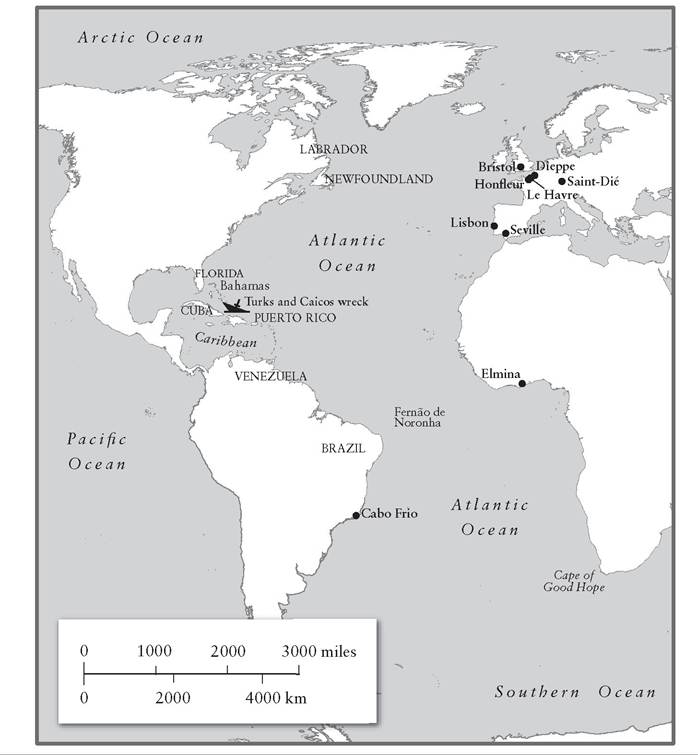
Caribbean. It is quite possible that Vespucci did not actually accompany Hojeda, and that he first crossed the Atlantic two years later; however, whether his first voyage took place in 1497 or 1499, he was drawn across the Atlantic by news that there were pearl fisheries in the southern Caribbean, and he may have fancied himself as a jewel merchant.3 But it became clear that the real source of profit was to be found not in pearls but in human bodies: the crew carried off more than 200 slaves.4
As Hojeda’s ships coasted along the southern shores of the Caribbean, they entered a land where the natives lived in villages built above the water, just like Venice; this was the origin of the name ‘Venezuela’, which means ‘little Venice’.5 Admittedly, the houses were not Venetian palazzi but huts raised on stilts and linked to one another by drawbridges which could be raised in times of danger - as on this occasion.6 When the Indians turned hostile, Vespucci blandly reported that it had been necessary to massacre them, though the explorers resisted the temptation to burn down the village, ‘since it seemed to us something that would burden our consciences’.7 The goods they found in the village were not worth much, and they pressed on.8 By and large, though, the people in this area were friendly, offering food, performing dances; ‘there we spent the night, where they offered us their women, and we were unable to fend them off’.9 These people did suffer from raids by aggressive neighbours, who also attacked the Europeans, and Hojeda decided that he had seen enough and that the time had come to return home with his cargo of slaves.
How new this New World was to Europeans became obvious when they studied the flora and fauna they saw.
For this was a fertile land, rich in wild animals such as ‘lions’ (that is, jaguars), deer and pigs, even though they were rather different in appearance to the animals of the Old World.10 Knowledge of the southern hemisphere was only acquired piecemeal during Vespucci’s seagoing career. On his second, or maybe his first, trip, in 1499, Vespucci probably still thought that the mainland was simply an extension of Asia; his sense that the New World was physically separate developed over the next few years. His third (or was it really his second?) voyage apparently took him very far down the coast of South America, giving him the chance to admire the Southern Cross hanging in the night sky. If he reached as far as he claimed, then it was with a mixed sense of achievement and disappointment. He had visited lands no one suspected were there, full of people living a simple life on the edge of what seemed to be impenetrable forests. But there were no great cities. And where was the route to China and Japan? Where was the gold that always seemed to come from over the hills and far away?Eventually Vespucci concluded that this was the southern continent. ‘We learned that the land was not an island but a continent, both because it extends over very long, straight shorelines, and because it is filled with countless inhabitants.’11 As has been seen, the term ‘continent’ did not have quite the meaning it has now, and in a general sense indicated a large area of mainland that could be part of Asia, Africa or Europe, the three known continents in the modern sense of the term. However, Vespucci concluded that this was indeed a separate landmass; he was convinced these were the ‘Antipodes’, the southern continent that had occasionally been mentioned by geographers but that were assumed to be not just uninhabited but uninhabitable, in view of the torrid heat of southern climes: ‘I have discovered a continent in those southern regions that is inhabited by more numerous peoples and animals than in our Europe, or Asia or Africa.’12 So how had the people arrived there? As the puzzle grew, later commentators would sometimes suggest that God must have created them separately, and that even if they were somehow descended from Noah, the common father of all mankind, they were not fully rational beings but were destined to serve their European masters as ‘natural slaves’.
These views were still being promoted in the seventeenth century.13 Vespucci’s descriptions of cannibal peoples reinforced the idea that the inhabitants of the southern continent were human in shape, but monsterlike in behaviour.Others came to the conclusion that these lands were not Cathay or Cipangu with the help of their mercenary instincts. The silks and spices of the East were not to be had; but slaving expeditions became more and more frequent. Vicente Yanez Pinzon had captained the Nina on Columbus’s first voyage; in 1499 he set out under royal licence for the New World. He was ordered not to bring back Caribbean natives as slaves, though Africans were acceptable if he entered eastern Atlantic waters; in fact he took thirty-six slaves from the New World.14 But the most persistent slavers were the Guerra brothers. Luis Guerra and a colleague went to Brazil in 1500-1501, taking slaves from ‘Topia’, the land inhabited by the Tupi Indians; they sold one girl named Sunbay in Spain for 6,000 maravedis, though this was an exceptionally high price, and it was not a good deal - Sunbay fell ill. The Guerras raided into Topia with impunity, because this land lay in the Portuguese sphere, and therefore the natives had no right to the protection of the Spanish monarchs.15 These captives were called indios bozales - the term bozales indicated that they were primitive, even savage, and was also used of untrained black slaves from west Africa. In 1504 the Guerra brothers were allowed to go slaving anywhere except the lands of Columbus and the king of Portugal, which concentrated their efforts on Carib territory in the southern Caribbean; the Spanish historian Oviedo wondered about this: ‘I do not know if these merchants were authorised to enslave the people of that land because they are idolaters, savages, sodomites, or because they eat human flesh.’16 Thus, a sad routine of slave-raiding developed.
Linked to the slave-raiding was the incessant search for sources of gold; one Spanish explorer, Juan de la Cosa, met people along the coast of South America who went around naked, though the men wore penis sheaths, sometimes made of gold.17 The explorers begged some gold off them, but when the natives asked for it back they wisely agreed; rumours reached the Europeans of a great temple with gold-plated idols, suggesting that the real riches lay a little further inland.
These rumours coalesced into the story of El Dorado, the kingdom awash with gold. De la Cosa had accompanied Columbus, Hojeda and Vespucci on voyages to the New World, and is best known for his remarkably well-i nformed world map of 1500, showing great stretches of the South American coast and daring also to include what looks like the coast of Texas and areas still further north. Without engaging in the argument that Hojeda or others penetrated that coastline to keep the English at bay, as defenders of Cabot’s reputation like to think, one can still see that de la Cosa had clever intuitions: he realized that Cuba was not Japan nor part of the Asian mainland, showing it as a humpbacked island looking not vastly different from its real shape.These uncertainties stimulated further expeditions that gradually mapped out parts of the North American as well as the South American coast. Inevitably, the presence of European ships on the coast of what much later became the United States of America has created a whole industry built around the nonsensical question: ‘Who discovered the USA first?’ The credit, if that is the right term, for landing on future United States soil is usually granted to Juan Ponce de Leon, one of the more attractive figures in an age of brutal Spanish conquistadores, although there is not much doubt that slave-raiders had arrived first.18 The great defender of Indian rights, the Dominican friar Bartolome de las Casas, told of the disappointment of Spanish slavers that they could not find any victims in the now-deserted Bahamas, already emptied of their population by earlier raids; so they travelled further north to the land las Casas knew as Florida, and brought back from there the first slaves captured on the North American mainland, who would have belonged to the relatively sophisticated Calusa or Timucua peoples.19
The oldest wreck found in the western hemisphere was found off the Turks and Caicos Islands, close to the Bahamas; it was very probably manned by slave-raiders.
Although its exact date is unknown, let alone the name of the ship, of which only a small part of the hull survives, the pottery and firearms found on board indicate that the ship hit a reef within the period 1510-30. The lack of personal equipment belonging to the sailors suggests that they survived and salvaged their own possessions. Life on board was evidently very simple, to judge from the coarse tableware. Tiny glass beads found in the wreck would have been used in trade with the Taino Indians. A more sinister aspect of Spanish trade is represented by a number of leg irons, used to restrain captives. The ship’s ballast, in the form of big stones placed at the bottom of the hull during construction, is especially revealing. Analysis shows that the stones originated in various places: near Bristol; from the mid-Atlantic islands; and above all from Lisbon. This does not prove that the ship visited those places, but it does show how bits and pieces of ships were recycled, and what sort of maritime connections dominated the trade of the eastern Atlantic around 1500.20 The Casa de Contratacion in Seville that took charge of trade with the New World was founded in 1503. The fact that the Crown took an intense interest in these routes does not mean that its supervision was very effective. There were plenty of interlopers, and not just Spanish ones.21Ponce de Leon represents the official side of trade with America. His career was moulded by the changing fortunes of his principal backer, King Ferdinand of Aragon, who was spending his money on Italian wars that brought him control of Naples but also deeper and deeper immersion in the quagmire of Italian politics. At the same time, he was trying to maintain his influence in the politics of Castile, which had been checked by the death of his wife, Isabella, in 1504, whereupon he had to cede control of Castile to his short-lived son-in-law, Philip of Burgundy, and his unbalanced daughter, Juana, later known as ‘the Mad’. As if these developments were not enough, he also knew that the situation in Hispaniola was deteriorating, as the governor, Ovando, struggled to keep the claims of the Columbus family at bay; every move the Spanish government made in the Caribbean seemed to be challenged by Christopher’s son Diego Colon, on the basis of the exceptionally generous grant of rights conferred on the admiral by the Catholic Monarchs way back in 1492.22
If Hispaniola was such a nightmare, the answer was to capitalize on the opportunities for finding gold in the other large Caribbean islands, beginning with Puerto Rico; Cuba was only invaded in 1511. Ponce was in Puerto Rico by 1508, if not sooner; he built a Spanish town and his stone house still survives. He tried to encourage the Taino Indians to work with their new masters, and began to collect gold, providing the king with 10,000 pesos of tribute in 1511. But the chance that he would avoid the interference of Diego Colon was slim. In a great show of its independence from Ferdinand, the Royal Council in Castile decided that Ponce was treading on the legal rights of Diego Colon, and Ponce realized that he now had little chance of carving out a dominion in Puerto Rico. He must have known of previous attempts to explore a mainland to the north of Puerto Rico, and he was aware of legends about an island called ‘Bimini’ somewhere to the north. When in 1511 Ferdinand’s commissioner based in Hispaniola invited him to sail north, this seemed the golden opportunity to break free from the tortuous political struggles dividing supporters of the Crown, supporters of the Columbus family and the Indian chieftains that were ruining Hispaniola and had spilled over into Puerto Rico.
More controversial is the idea that Ponce de Leon was sent by the ageing king of Aragon to search for the ‘Fountain of Youth’.23 This fountain would restore his virility and offer him the chance to father a child by his second wife, Germaine de Foix, giving him an heir in Aragon (though not Castile, which would pass to Juana the Mad’s son, the future Habsburg emperor Charles V) - better Aragon without Castile than a Habsburg Spain. That was the practical dimension to a fantasy about the ‘Fountain of Youth’ that drew on both Indian and European myths, and acts as a reminder that the miraculous and strange were still an important part of European ideas about the New World.
II
Meanwhile, demand for maps of the lands Vespucci described grew and grew. A small coterie of scholars interested in geography gathered in the little town of Saint-Die among the hills of Lorraine, under the patronage of their duke, Rene II, titular king of Naples. They reprinted one of Vespucci’s most popular pamphlets and added to it a massive world map by Martin Waldseemuller, published in 1507, which portrayed the New World as a separate pair of continents to the linked-up continents of Europe, Asia and Africa. A small part of the southern continent was labelled AMERICA in honour of Amerigo Vespucci.24 Although the west coast of South America was drawn as a straight line, for want of any information about it, only a fragment of North America was shown, and on the main map (though not in a miniature version in the margins) North and South America are separated by a short stretch of water close to the land Columbus had explored on his fourth voyage, without, obviously enough, finding such a channel. Vespucci’s explorations southwards had revealed plenty of large rivers but no seaway that would take one towards Asia. It was becoming more and more obvious that the transatlantic routes tried so far did not and could not reach the true Indies. Waldseemuller optimistically assumed that Japan lay close to South America; he had no conception of the vastness of the Pacific. At least his judgement was more accurate than that of the maker of the small globe now preserved in the Jagiellonian University in Krakow and thought to date from around 1510. There, a transatlantic continent resembling South America is labelled as ‘New World’, ‘Land of the Holy Cross’ and ‘Brazil’, while an irregular chunk of land in the eastern Indian Ocean becomes ‘Newly Discovered America’; here is the work of a cartographer who was thoroughly puzzled by the news that Vespucci had been exploring unknown lands in the Indies.25
Amid all this confusion about how to reach the Indies, John Cabot’s son Sebastian set off with two ships and a royal licence, in 1509, right at the start of the reign of Henry VIII, on a voyage to Labrador and, he hoped, the route to the wealth of Asia. He reasoned that Newfoundland was blocking the way to Asia, but the strait that he found north of the island, which was probably the entrance to the large sea that became known a century later as Hudson Bay, was full of ice and his crew refused to take the ships any further.26 In any case, Henry VII was not really interested in the sea, and his son Henry VIII was much more interested in building a fleet which would outrank that of France - one can imagine his annoyance when the French king built a ship with a tennis court and windmill on board, and his delight when it proved too heavy to float. In England, the American lands only came into focus in the second half of the sixteenth century, when Spain was a bitter enemy, and serious colonization only began when Jamestown was founded in 1607. By then Protestant England had no reason to accept the pope’s division of the world between Spain and Portugal.
The French also attempted to join the race to reach the spices of the Indies by choosing a westward route. The first reported journey across the Atlantic by a French ship happened, rather like Cabral’s voyage, by accident; and like Cabral its captain, Binot Paulmier de Gonneville, was not trying to reach land across the Atlantic but the ports of India. The phrase ‘reported voyage’ is important, because sceptics have argued that the surviving narrative of this voyage was cooked up in the seventeenth century to bolster French claims to authority in Madagascar, or South America, or some other land such as the massive, temperate ‘southern continent’ that was believed to encompass the bottom of the world, counterbalancing the continents of the northern hemisphere. After he published the account of Gonneville’s voyage, one of the captain’s descendants received the reward he craved and in 1666 was nominated as Papal Vicar in the southern continent.27 What follows can therefore be treated as fact or fantasy.
The Espoir, of 150 tons, is said to have set sail in 1503; its captain came from Normandy and was named Binot Paulmier de Gonneville, and before then the furthest the Espoir had ever travelled was to Hamburg. This was a private expedition, not a royal one, but Gonneville was well connected and had persuaded a group of businessmen from Honfleur to invest in his risky venture.28 Gonneville knew a certain amount about what the Portuguese had achieved in India, and he even secured the services of two Portuguese pilots, who had been out to India and who might well have been executed had they fallen into Portuguese hands.29 Nevertheless, the ship was loaded with a good supply of armaments, to fend off enemies in the Atlantic or the Indian Ocean, including cannon, harquebuses and muskets; there were enough salted fish, dried peas, local cider and water for over a year, and enough ships’ biscuit for two; and then there was the merchandise - scarlet cloths, fustians, a velvet cloth, a cloth embroidered with gold, but also simpler goods such as fifty dozen little mirrors, knives, needles and other hardware, as well as silver coins.
Claims have often been made that Norman sailors (particularly from Dieppe) knew as much about the Atlantic - or more than them - as the men of Bristol, even that they reached America a few years before Columbus in a ship commanded by a certain Jean Cousin; but like all these claims it is based on an optimistic reading of very vague evidence - in the case of Cousin the so-called evidence dates from 1785.30 More to the point - bearing in mind that Gonneville in any case was trying to round Africa - is the simple fact that the ports of Normandy were undergoing a lively revival in the late fifteenth century now that war with England was at an end, and now that the western European economy was returning to stability after a century and a half of plague and disruption.31 A school of mapmakers existed in Dieppe by 1540, though one can assume there were earlier mapmakers in the town, simply because it was home to ambitious merchants and mariners. Many of the maps seem to have been plagiarized from Portuguese models, despite the extreme reluctance of the Portuguese to permit others to peruse their charts.32
According to the surviving narrative, the Espoir set out from Honfleur on 24 June 1503; avoiding a landfall in the Spanish Canaries, the ship hugged the African coast and was fortunate to pass the Portuguese Cape Verde Islands without challenge. The crew spent ten days at Cape Verde itself, on the African coast; there, they traded some of their iron goods with the native Africans, buying chickens and couchou, ‘a sort of rice’, in other words the thick couscous still eaten there. The ship then swung out to sea, hoping to catch the Trade Winds and to be swept eastwards in the wake of da Gama. Instead, it was caught by fierce gales, and was swept westwards, as Cabral had been, though the crew were convinced that they were in the right latitude to pass the Cape of Good Hope - they saw Manche-de-velours, ‘velvet sleeves’, or penguins, which someone, no doubt the Portuguese pilots, identified as birds that lived on the southern tip of Africa. For weeks they were tossed about, and then drifted. However, on 5 January 1504 ‘they discovered a great land’, which reminded them of Normandy itself.33 The sailors felt they had gone far enough and that the ship would bear no more; they persuaded Gonneville that it was pointless to try to recover their route to India.
The inhabitants of this land were fascinated by everything they saw in the ship: ‘had the Christians been angels who had come down from heaven, they could not have been more loved by these poor Indians’. Simple items of truck like knives and mirrors meant as much to them as gold, silver or even the philosopher’s stone meant to Christians. They were particularly fascinated by the sight of written words on paper, for they could not understand how paper could be made to ‘speak’. But the spiritual dimension was not neglected by Gonneville. The Normans built a great wooden cross in time for Easter 1504, and this was carried in barefoot procession by Gonneville and his senior crew, joyously accompanied by the Indian king, Arosca, and his sons, one of whom would later join Gonneville’s ship, be taken back to Europe and marry Gonneville’s daughter. Gon- neville inscribed his cross with the names of King Louis XII of France and of the pope, thereby staking some sort of French claim to these lands.34
The Espoir had no better fortune on its return journey than on its outward journey. Foul weather forced the ship to put in twice on the coast of Brazil before it was able to cross the Atlantic. They found Indians whom they regarded as more primitive than Arosca’s followers. They were cruel eaters of human flesh: au reste, cruels mangeurs d’hommes. This accusation was not levelled against Arosca’s people. No less extraordinary was evidence that these man-eaters had had some contact with Christians in recent times; they possessed some trinkets that must have come from Europe, and they were not very surprised to see the ship, though they were well aware of the threat posed by European artillery. Gonneville had probably arrived in the areas visited by the slave-raiders in the last few years. The Normans were desperate to leave, and sailed off as soon as they could; the voyage home past the Azores was slow, but it was easy enough until they came within sight of home. For as they entered the waters off Jersey and Guernsey the ship fell prey to two pirates, Edward Blunth of Plymouth and Mouris Fortin, a Breton corsair. After such a long voyage the Espoir was in no condition to escape. The pirates caught up with, pillaged and sank the ship; many of the sailors were massacred. Only twenty-eight men reached Honfleur alive; but among them were Gonneville and his future son-in-law, Essomericq, who aroused considerable wonder, ‘since there had never been anyone in France from such a distant land’.35 However, the logbook went down with the ship, and only in the nineteenth century was a detailed narrative of the voyage discovered in the archives. Gonneville had promised King Arosca that he would return after ‘twenty moons’, but he never did so, and Arosca was left wondering what had happened to his long-vanished son.
Without the backing of the French king, who was more interested in laying claim to Milan and Naples, Gonneville was unable to set in train a French bid for whatever parts of Brazil he had reached. For the time being, Portugal’s priorities remained in Africa and India and colonization was slow. Nevertheless, a small series of commercial ventures was aimed at Brazil. An expedition in 1501 reported that, frankly, there was little to be loaded apart from brazilwood. But this was a prized dyestuff that produced a rich reddish colour, so the next year a royal licence was granted to Fernao de Noronha or Loronha, a wealthy New Christian merchant, who agreed to send six ships each year to Brazil to collect brazilwood; in 1504 he brought back some parrots as well, and we also hear of monkeys being sent back to Lisbon. Noronha already knew the eastern Atlantic, trading in gold and slaves through Sao Tome and Elmina, and he was thus a pioneer in joining together the three continents of Africa, Europe and South America. On his first journey to Brazil, Noronha discovered a beautiful offshore island that still carries his name.
King Manuel also wanted to know more about what had been discovered. It had become obvious that the assumption made by Cabral that the ‘Land of the Holy Cross’ was just a fairly large island did not match the news that was filtering back by way of Vespucci and others. The shoreline went on and on. So Vespucci was commanded to explore 300 leagues of the coast each year, and the Portuguese decided to set up a small fort, subject to a sliding scale of royal taxation, from zero in the first year to one quarter in the third year. In 1503-4 just such a fort and factory were built at Cabo Frio close to modern Rio de Janeiro, which already lay to the south of the areas Cabral is thought to have visited. It was staffed by twenty-four men.36 These ships were soon bringing back about 30,000 logs (about 750 tons) each year. The ships often carried black slaves and other labourers, whose task was to trim and cut the brazilwood. Brazil’s African connection therefore can be traced back to the very origins of Brazil itself. Here Noronha, with his interest in the African slave trade, played a crucial role. It turned out that the Tupi Indians were willing helpers too. In exchange for small items of truck, such as little mirrors, combs and scissors, they were happy to load logs on the Portuguese ships.37 A small-scale trade in Brazilian slaves also developed, war captives of the Tupis for whom the expected fate was that they would be ceremoniously killed and eaten at a cannibal feast. What they thought about escaping the cooking pot, or rather griddle, for a life of captivity is not recorded.38
In February 1511 a ship named the Bertoa set out for the factory at Cabo Frio in Brazil, where it spent two months before heading back home, reaching Lisbon in October of the same year. By good fortune a manifest listing what was on board still survives. Everything in the account of the voyage suggests that trips to South America were becoming routine: the Bertoa set out via the Canaries and returned via the Guinea coast and the Azores, making the best use of the prevailing winds. By now it will be no surprise that the principal investors included, among the Portuguese, Fernao de Noronha, and, among the Italians based in Lisbon, Bartolomeo Marchionni, although they did not travel out with the ship. One of Mar- chionni’s servants was aboard, however, as was one of his black slaves. The Crown also took a strong interest in the voyage, which was being conducted under royal licence, and this meant - as with the contemporary voyages to Elmina - that every stage of the journey was tightly managed and recorded. The instructions were very clear: every inch of available space was to be filled with logs of brazilwood, which seems to have left little room for the slaves, wild cats and parrots that were also to be brought back. In the end 5,008 logs were loaded, as well as thirty-six slaves, one of whom was acquired by Marchionni’s servant, who also brought back cats, monkeys, parrots and parakeets. The Bertoa was ordered not to dally in the islands or along the coasts that lay on its route back home, but to head straight for Lisbon. No harm was to be done to the natives of Brazil. Indians who insisted they wanted to come to Portugal were under no circumstances to be allowed on board; were they to die in Europe the Tupis would assume they had been eaten by the Portuguese, ‘just as they have the custom of doing among themselves’. Sailors who blasphemed were to be carried off to prison in chains when they returned to Lisbon, until they paid a hefty fine.39
Brazil was, then, a sideline, valued up to a point but not able to compare with Elmina or the India trade as a source of profit. Still, the arrival of loggers in Brazil was the first stage in the binding together of this corner of the Portuguese Empire with lands in Europe, Africa and Asia; after 1500 Portugal had a stake in four continents and two oceans.
III
It has been seen that French interlopers planned to reach the Indian Ocean but arrived in Brazil instead. By 1500 the reach of Dieppe extended as far as Seville in one direction and the Danish Sound in the other; among the products that reached Dieppe in this period was Madeiran sugar, brought from Portugal, while Norman ships even edged their way into the trade out of Morocco and Guinea, which the Portuguese were unable to seal off hermetically. Gonneville’s expedition, if it really took place, was an exceptionally ambitious example of this constant attempt to break the Portuguese monopoly on movement across the ocean. The Normans were as adept at piracy as they were at trade, exploiting the rivalry between the French king and the duke of Burgundy in the 1470s to prey on ships trading with Burgundian Flanders. The Portuguese often thought of the Normans as ‘thieves’, accusing them of greed and jealousy towards the ever-growing wealth of Portugal.40 Meanwhile the Bretons established a reputation as hardy fishermen, leaving open the possibility that they, like the Bristolians, occasionally crossed to the Newfoundland Grand Banks in search of cod even before Cabot’s first voyage; and they were certainly there by 1514, when the monks of Beauport were levying a tax on cod brought back to Brittany from Newfoundland. In 1508 a Norman, Jean Aubert, sailing out of Dieppe, reached as far as Newfoundland and brought back seven Mic-Mac Indians, the first north Americans to be seen in France.41
One family, the Angos of Dieppe, played a particularly prominent role in the creation of the French merchant marine. Jean Ango the Elder was a fairly typical merchant, dealing in herrings, barley and other humdrum products (though also some sugar) during the 1470s and 1480s. However, his son, also Jean, greatly enlarged the family business; his interest in the sea was intellectual as well as commercial, for he seems to have received a rich education in geography, hydrography, mathematics and literature. His trade in England and Flanders brought him great wealth - he was still alive in 1541, when a report on his activities was sent to no less a person than the Holy Roman Emperor, describing Ango as ‘a most rich person’, and noting that ‘because of his trading affairs, people call him the Viscount of Dieppe’. This also made his ships obvious targets for attack by the Portuguese: he lost boats to them off Guinea, but it is hard to see how he could complain, as his way of tapping into Portuguese trade with the Indies, or the sugar trade out of Madeira, was to launch pirate attacks on ships returning from those parts loaded with precious cargoes. The booty included Chinese silk and jewels that originated in Bengal and China. At least a million ducats’ worth of loot was seized by Ango’s pirates between 1520 and 1540.42 Ango was presented to the king and became a favourite of the king’s sister, Marguerite of Navarre, the famous author of the Heptameron.
The king took an increasing interest in the possibilities for trade in Asiatic spices by way of the western Atlantic. By the 1520s Francis I was determined to receive a cut of transatlantic trade and gave his backing to the plans of Giovanni da Verrazano, a Florentine navigator who also had the support of Jean Ango and - not surprisingly - of Italian merchants, though from Lyons rather than Dieppe; and he made use of the new and successful Norman port of Le Havre as departure point.43 Verrazano’s name is now commemorated in a bridge linking Brooklyn to Staten Island, although the aim of his expedition was not to explore the coast of North America but to find a way to Asia: ‘my intention on this voyage was to reach Cathay and the extreme eastern coast of Asia, but I did not expect to find such an obstacle of new land as I have found.’44 He concluded that the continent he reached in 1524 was bigger than Europe or Africa, and maybe even Asia. He had hoped that he could find a route round the top of the newly discovered continent, the North-West Passage; he may well have known that Magellan had recently explored the southern tip of the Americas, which did not seem to offer a promising route to the Indies; a big ocean west of America had already been spied out by the Spanish commander Balboa standing on his ‘peak in Darien’ in 1513.45 But if one could go round the bottom, maybe one could go round the top, an idea which shows that the assumption that the Americas were a gigantic isthmus sticking out of Asia was beginning to lose its power. Verrazano was chapitano dell’Armata per I’India, ‘captain of the India Fleet’, engaged on a voyage to the espiceryes des Indes, ‘the spice-lands of the Indies’, and as far as can be seen the idea of taking this route was his own.46
Verrazano has divided historians. In 1875 Henry Murphy looked closely at the documents and concluded that Verrazano’s description of his voyage was a fiction built out of earlier descriptions of the coasts and peoples of the New World.47 For a time that seemed to be the end of the matter, and Verrazano dropped out of history. That his systematic demolition of the story Verrazano told was rather too enthusiastic was proved when a new manuscript came to light in 1909; it is now impossible to doubt that the voyage of 1524 took place. But that is not to say that his letter contains accurate information; he may well have inflated his account, rather as Vespucci did, in order to impress his audience, especially if the audience included the vain King Francis. Murphy may not have been completely wrong. What is clear is that Verrazano sailed out on a second voyage in 1526. His fleet of four ships was scattered, and he reached Brazil, where he loaded brazilwood; but one of his ships entered the Indian Ocean, apparently trying to reach Madagascar. Instead it was blown towards Sumatra and then made its way back past the Maldives to Mozambique, where the Portuguese governor took charge of the crew and reported back to Lisbon in alarm.48 Verrazano had apparently abandoned his idea of looking for a North-West Passage, and the obvious alternative was to break the Portuguese monopoly on the spice trade linking the Indian Ocean to the Atlantic. But the voyage can hardly be called a success. On his third voyage, in 1528, Verrazano is said to have been eaten by cannibals, though this did not deter his brother from making another remarkable voyage the next year, from Le Havre to Brazil, then through the Mediterranean to Alexandria and back to Le Havre.49 Long and ambitious voyages in search of spices had become the trademark of the Verrazanos.
The story of the Verrazanos takes one well into the sixteenth century. However, they built cleverly on the information acquired by an earlier generation, that of Jean Ango the Elder, which was also the generation of Columbus and Cabot. They shared with Columbus and Cabot the backing of Florentine businessmen who were willing to chance several thousand ducats on the possibility - and, increasingly, the likelihood - that these voyages would produce valuable returns. In the three decades after Columbus first arrived in the Bahamas, roving explorers were increasingly outnumbered by fleets of merchant ships that knew exactly where they were going and had a good enough understanding of the seasons (vital in the hurricane-ridden Caribbean) to reach their destination safely. Although it has been suggested that in these decades roughly one fifth of the ships on the India route eventually foundered, this figure does not mean that one in five voyages ended in disaster, as ships were reused, repaired and given new life. Many ended their days being broken up so their timbers could be recirculated. The transatlantic crossing had become a trade route.