31 The Binding of the Oceans
I
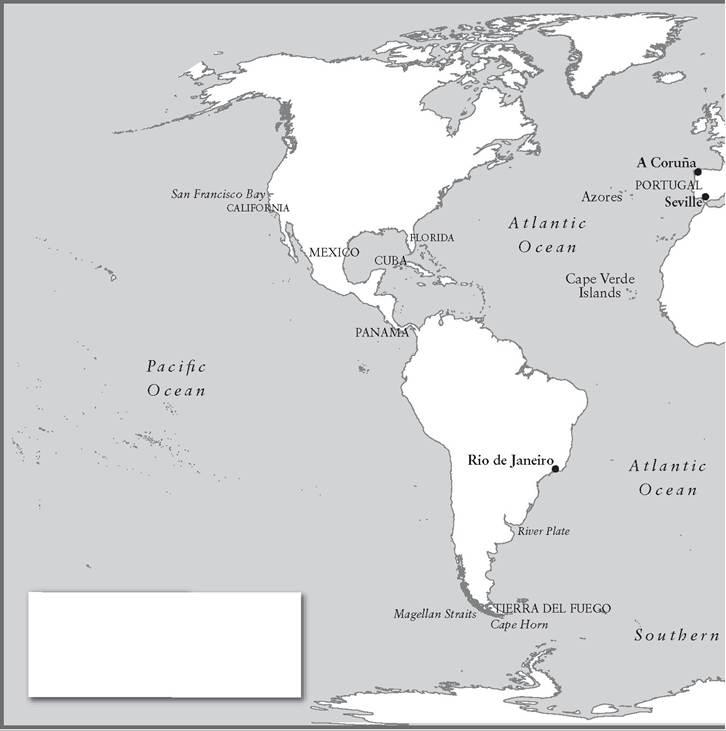
And then there was the third great ocean. The first person to set eyes on it and to realize that another expanse of water separated the newly discovered continents from Cipangu and Cathay was Juan Nunez de Balboa, a Spanish conquistador who in 1513 was trying to create a Spanish settlement on the coast of Panama.
His discovery was commemorated, under the wrong name, by John Keats:Or like stout Cortez when with eagle eyes He star’d at the Pacific - and all his men Look’d at each other with a wild surmise - Silent, upon a peak in Darien.1
Advised that Balboa, not Cortes, had stood upon that peak, Keats retained the name of Cortes, so that the scansion would not be ruined. Yet Cortes, conqueror of Mexico, also enters the story: at this point he was secretary to the governor of Cuba, which the Spaniards had invaded in 1511, and, as voyages to the coast of Central America became more frequent, news of a civilization rich in gold somewhere in the interior began to spread.2 Moreover, Ponce de Leon’s discovery of Florida suggested that the big continent to the north was probably connected by land to the big continent to the south.
If there was no route across Central America, there were three options. An icy North-West Passage over the top of America might be accessible if Asia and North America were not joined together, as they were often thought to be. This was an idea that motivated Sebastian Cabot as he tried to follow up his father’s discoveries, and it was still alive in 1845, when Sir John Franklin led his ill-fated expedition into the ice floes of northern Canada.3 Another Arctic route entered the calculations of mid-sixteenthcentury English explorers, who wondered whether a North-East Passage
| 0 I | 1000 | 2000 miles 1. |
| 1 0 | 1 2000 | 1 4000 km |
over the top of Russia all the way to China was feasible.4 Both of these ideas, or rather fantasies, will be examined in another chapter.
But there was a third possibility, based on Vespucci’s observations, accurate and otherwise, about the extended coastline of South America. Just as Catalan and Portuguese explorers of the fourteenth and fifteenth centuries had imagined that a channel or river might cut right across Africa, Spanish explorers now held out hope for a more direct route to the Spice Islands rather than the long haul around south Africa through hostile waters in which, as will be seen, Ottoman navies contested control with the sparse and scattered fleets of Portugal. A route round South America might offer Spain its chance to dominate the spice trade, by taking the spices eastwards out of the Indies towards America and then Europe.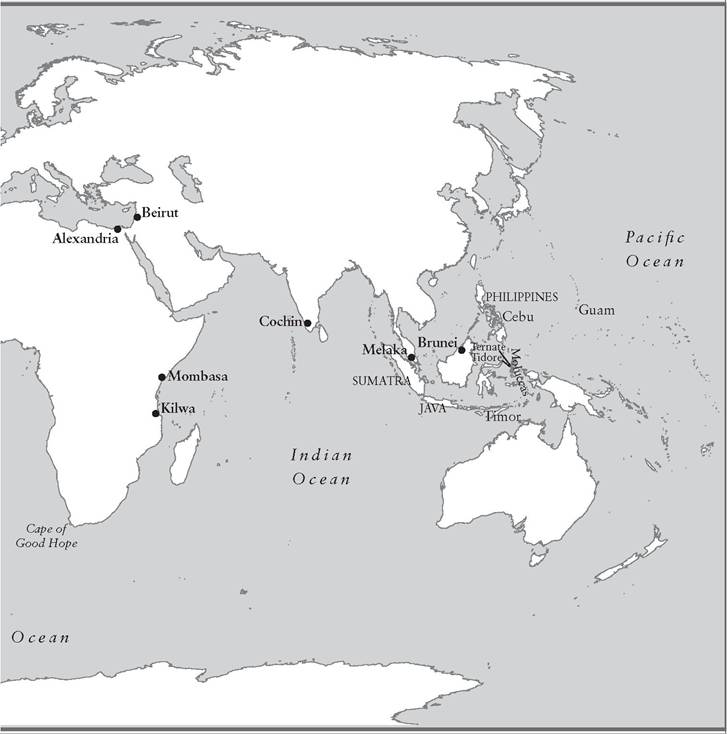
At the end of his life King Ferdinand of Aragon was playing with several ideas about how he might challenge Portugal’s dominance of the oceanic trade in spices. It makes sense to use the adjective ‘oceanic’ because there were still spices to be had in the eastern Mediterranean, though the conquest of Egypt and Syria by the Ottoman Turks had only increased the risks of going to Alexandria and Beirut to buy them. In 1512 Ferdinand gave his support to a plan to send ships round the Cape of Good Hope, in the wake of Portuguese ships; the target was to be Maluco, the Moluccas, ‘which lie within our demarcation’, and ultimately China, but the challenge to the Portuguese in the Indian Ocean was too obvious, and the scheme never materialized. Three years later he commissioned the same commander, Juan de Solis, to lead a voyage westwards that would find a way round the bottom of, or through the middle of, South America. Solis discovered the River Plate in 1516, and thought it was a freshwater sea that would take him to the Spice Islands. However, Solis fell out with the Indians and was killed, so the survivors turned back to Spain.5
II
The same idea motivated Ferdinand Magellan when he approached the Spanish court with a proposal to reach the Spice Islands by way of a SouthWest Passage.
He was born as Fernao de Magalhaes in Portugal and was a member of the minor nobility; he also had close experience of Indian Ocean waters, for he sailed out to India in 1505 under the Portuguese commander Francisco de Almeida, visiting Mombasa, where the local ruler was summarily deposed; Kilwa, which was sacked; and Cochin, where he saw the spices of the East being loaded on board. He went out again in 1507, and apparently stayed in the Indian Ocean for several years. The fleet on which he was serving visited Melaka, which Portugal seized in 1511. He acquired a Sumatran servant, whom he baptized under the name ‘Enrique’, and whom he brought back to Europe in around 1512.6 One of his companions was Francisco Serrao, a Portuguese officer, who made quite a reputation for himself in engagements with hostile forces on the ground.Lured eastwards by his wish to penetrate deep into the Spice Islands, Serrao reached the Molucca chain, finding islands almost unbelievably rich in nutmeg. The Moluccas lie at the eastern end of the Spice Islands, to the west of New Guinea, north-east of the eastern tip of Java and south of the Philippines; even by the standards of the ancient trade routes of the East Indies they were remote. But remoteness did not erode their fame - rather the opposite; these were seen as the most desirable of all the Spice Islands. After a number of adventures, during which he lost his ship and took over a pirate vessel that had been chasing him, Serrao sorted out a bitter dispute between the rival Moluccan sultans of Ternate and Tidore, both of whom were Muslim. The sultan of Ternate was so impressed that he appointed this Portuguese Christian as his vizier. Serrao sent letters to Magellan in Melaka in which he told of his luxurious life at the court of the sultan of Ternate, and described the lush lands full of precious spices in which he now lived: ‘I have found here a New World richer and greater than that of Vasco da Gama.’7 India was already an extraordinary distance by sea from Portugal, Melaka another great leap, but reaching the Moluccas meant making a half-circle around the world.
Serrao was very possibly the first European to find his way to the Moluccas, and it is one of those constant ironies of the age of exploration that his extraordinary career has received so little attention. (A rival case can be made for the Italian traveller Ludovico di Varthema, who travelled extensively in Asia between 1503 and 1508 and claimed to have seen cloves growing in a place he called Monoch, which may be one of the Moluccas.)8 Serrao showed that it was all very well to control Melaka, but Melaka was itself the main point of trans-shipment for the spices that came from still further to the east; and, while the pepper of south India was a great prize, the cloves, cinnamon and camphor of the Spice Islands might be accessible at their point of origin. This would be the culmination of all those schemes to reach the source of spices, for the Portuguese still relied on middlemen to obtain the spices they bought in Melaka.Magellan therefore knew a great deal about the lands he was trying to reach from personal experience and from his friend’s enthusiastic letter; and Varthema’s book of travels had been published in 1510. However, despite his rich experience, Magellan was not made welcome at the Portuguese court, where he was accused of trading illicitly with the Moors in north Africa; and King Manuel was determined to press on with what had already been achieved by breaking into the Indian Ocean.9 The Portuguese capture of Melaka in 1511 seemed to guarantee access to the Spice Islands through the traditional routes followed by Indian Ocean navigators over many centuries. There was no obvious reason to look for a westward route, especially because this would dissipate precious resources that needed to be spent on keeping open the supply lines through Guinea, south Africa and the Indian ports where Portuguese factories had been established.10
Selling the scheme to the new king of Castile, Charles of Ghent, was therefore somewhat easier than selling it to King Manuel.
It is important to realize that Magellan never had it in mind to circumnavigate the globe, for all his extraordinary achievements.11 The purpose of his expedition was to reach the East Indies, to load his ships with spices, and to return the way he had come; the fundamental error, which he shared with Columbus, was to assume that the distance between Europe and Asia, sailing westwards, was much smaller than it actually is. Moreover, Magellan was killed in the Philippines at a point i24°E, and did not enter the Indian Ocean. (He had, however, sailed as far east as i28oE earlier in his career, so that he went round the world in separate journeys.)12 The captain who did leave from and return to Seville was the Basque Juan Sebastian Elcano, who took command of the expedition after Magellan was killed and managed to steer one leaky, rotten hull back to Spain through the Indian Ocean and the Atlantic, travelling through four oceans, since he sailed through the Atlantic twice. Nor did Magellan open a regular route linking Spain to its Pacific Ocean possessions in the Philippines; as will be seen, the solution to the question of how to reach those islands was quite different. None of these reservations undermines the claim of the Magellan-Elcano voyage of 1519-22 to be the most ambitious and impressive act of seamanship in the age of discovery. But, as with Columbus, what was planned and what was achieved were very different.The basis for Magellan’s expedition had to be the past agreements between the kings of Castile and Portugal, mediated by the pope. But one can also see the influence of past agreements at a lower level: as in the case of Columbus, Magellan and a cartographer named Faleiro were to enjoy a monopoly on trade to the lands they found, but the Crown had learned a little from its mistakes, and this monopoly was limited to ten years, to avoid the endless lawsuits that were still being pressed by Columbus’s heirs. They also received handsome tax privileges, 20 per cent of the profits from the first voyage, and the hereditary office of governor of the lands they brought under Spanish rule, always bearing in mind the need to avoid interfering in lands that lay under Portuguese rule.
This, however, was the real complication: Magellan and Faleiro had managed to persuade King Charles that the Moluccas lay within the Spanish half of the world, assuming one could extend the Tordesillas line through the North and South Poles and wrap it round the world, but there was no chance the Portuguese court would accept that. Faleiro has been described as ‘something of a madman’, ‘a brilliant but deranged man’, who encouraged Magellan to underestimate the breadth of the Pacific, rather as Columbus had underestimated the distance to Cipangu and Cathay.13III
Charles agreed to send five ships under Magellan’s command in search of the passage to Asia. When they set out from Seville in 1519 they carried a motley crew of 260 men that included forty Basque sailors, among them the future commander, Elcano, although there were also Portuguese, black Africans, Germans, Frenchmen, Flemings, Irishmen, Italians and Greeks, as well as a single Englishman, Andrew of Bristol, who was chief gunner, plus Magellan’s Sumatran servant, Enrique.14 The identity of the crew serves as a reminder that the voyages of discovery were not simply the work of Portuguese, Castilians and the occasional Italian. But aboard Magellan’s ships was one of those occasional Italians: a patrician from Vicenza, Antonio Pigafetta, signed up as a passenger, adding his name to the list of curious Italians who were prepared to risk their lives to see unknown parts of the world, a successor to Vespucci and Varthema. He wrote an account of the entire voyage, which remains the principal source of knowledge about what happened.15 He was a great admirer of Magellan, which skews his account in one direction; but he survived the entire voyage, carrying on westwards under the command of Elcano, whom he disliked so much that he never even mentioned him by name in his narrative.
The challenge Magellan faced was not simply that of keeping a hostile crew (Pigafetta apart) under control; nor was it simply that of finding an unknown passage to India. He also needed to sail clear of his own compatriots, for Portuguese patrols were looking out for Spanish and other interlopers, and news of his plans had infuriated the Portuguese court, even if King Manuel had never believed in Magellan’s scheme. The journey across the Atlantic followed a peculiar route, staying close to the Guinea shore in worryingly calm waters before the ships were tossed about in November storms as they attempted to reach South America. Magellan’s unorthodox route down the African coast irritated his Spanish officers, who had expected to strike out for the New World from Spanish-controlled Tenerife. The lack of trust between them and Magellan was a constant problem, fed by the traditional dislike of Castilians for their Portuguese neighbours. There was some comfort in the safe arrival of the little fleet off Rio de Janeiro in December 1519, which was high summer in the southern hemisphere, but lack of faith in Magellan’s abilities revived when the estuary of the River Plate was decisively shown not to offer a route through South America to Asia. Travelling south from there in February 1520 the ships met late summer storms, and the slower they progressed the greater became the danger that food supplies would be exhausted. The crew were put on short rations. The officers demanded that Magellan should keep them properly informed about what route he planned to take. The frustration of blindly following orders without knowing the why and the wherefore of Magellan’s decisions undermined still further their belief in his abilities.
All this led to mutiny, with Elcano among those condemned to death, though in due course he was pardoned and even promoted.16 Magellan was perfectly well aware that he could not execute forty of his own crew as mutineers. The main punishment was symbolic; the mutinous captain of the ship Victoria had already been killed in fighting between Magellan’s supporters and the mutineers. His body was hung upside down from the yardarm as a warning to all who dreamed of opposing the admiral. The rebellion gave Magellan the excuse to appoint Portuguese officers to the command of his ships - one of them, Joao Serrao, was the brother or cousin of his old friend Francisco Serrao, who had ended up as vizier of the sultan of Ternate, and whom Magellan was determined to meet when he reached the Spice Islands. Pigafetta, meanwhile, was fascinated by the Patagonian ‘giants’ whom the sailors met as they penetrated further and further south. Their ability to live almost naked in such a cold climate was only one of their remarkable features; tall and thin, the Patagonians had adapted well to the cold, since their body surface was actually smaller than that of the more compact but relatively tubby population further north. Their willingness to eat rats found on board ship, unskinned, surprised and rather disgusted the explorers.17
The greatest challenge of all, however, came when Magellan’s fleet reached the strait that he correctly identified as a passage through the southern tip of South America, later known as the Strait of Magellan. Pigafetta claimed that Magellan knew all about the strait already because he had seen a chart in the treasury of the king of Portugal made by ‘Martin of Bohemia’, who must be Martin Behaim, the creator of the globe made in around 1492 that still survives in Nuremberg and does not show any part of America. Behaim died in Lisbon in 1507, so Magellan may well have met him. However, a German globe of 1515 did speculatively include a channel between South America and a great southern continent. This globe was created by Johannes Schoner, who, like Behaim, hailed from Nuremberg; it also included a channel between North and South America and placed Japan only a few degrees west of America.18 It was not obvious to Magellan that the land on his southern quarter, which became known as Tierra del Fuego (owing to the fires he saw there, possibly lit by Patagonian inhabitants), was simply a medium-sized island that ended at a great cape, Cape Horn. To him it seemed to be another vast landmass. This idea persisted, so that the first world map of the famous cartographer Mercator, of 1538, marked the Magellan Strait as the channel between two continents, one of which, the Terra Australis, covered the entire southern tip of the world, like a great enlarged Antarctica.19
Navigating these stormy waters, through channels that led in different directions, and that were constantly buffeted by the so-called williwaw winds, cold blasts that seemed to explode from nowhere, depended on a combination of intuition and luck, and one of his captains decided to turn back to Spain. The desertion of the San Antonio reduced his fleet to three ships, as one had already been wrecked while exploring the South American coast. By the end of November 1520 he had entered a new ocean. Pigafetta remarked: ‘during these three months and twenty days, we sailed in a gulf where we made a good four thousand leagues across the Pacific sea, which was rightly so named. For during this time we had no storm.’20 The experiences of later navigators would give the lie to the name ‘Pacific’, but at last the greatest of all oceans had a European name and - more importantly - it became obvious how gigantic this sea is: leaving Tierra del Fuego on 28 November 1520, Magellan only reached Guam on 6 March 1521. This was the first proper landfall, for, oddly, the three ships did not encounter the islands and peoples of Polynesia and Micronesia as they headed for what they hoped were the Moluccas. Nor, apparently, did they meet any Pacific islanders in their splendid outrigger boats until they arrived at Guam. This is testimony to the sheer vastness of the Pacific Ocean, but it also shows that the land-sighting skills of European navigators accustomed to the very different waters of the Atlantic Ocean were quite different to those of the Polynesians, who could find needles in the Pacific haystack without great difficulty.
The real difficulty that Magellan’s crew faced as they crossed the Pacific was not the weather but the lack of supplies of fresh food that left the sailors trading in rat meat and chewing rehydrated oxhides for their dinner, so long as they could chew anything. The scourge of scurvy made these long voyages a deathtrap, not just because of the dramatic effects of this disease on skin, bones and blood vessels, which to all intents fall apart, but also because of its side effects: it was impossible to eat what food there was with massively swollen gums. Thirty-one men died of scurvy or other illnesses during the Pacific crossing, including a Patagonian giant and a Brazilian Indian. When the ships at last reached land, islanders swarmed aboard, robbed the ships and were fought off; the sick sailors asked for the entrails of the islanders who had been killed in this engagement, in the belief that by eating them ‘immediately they would be healed’. The true solution was there to be seen: when the crew started to eat fresh fruit and vegetables, the swelling shrank away. Moreover, the officers on board, with a more luxurious diet, by and large escaped from the disease, so that Pigafetta, for one, ‘being always in good health’, observed scurvy without suffering from it: ‘yet by the grace of our Lord I had no illness’, which was still the case when he returned to Spain.21 The discovery that lemons or limes kept scurvy at bay was the result of trial and error between 1746 and 1795, when the Royal Navy began to include lemons or limes in the diet of British sailors, and only the identification of ascorbic acid (vitamin C) in the early twentieth century explained how and why limes worked so well.22
IV
When Magellan reached the islands of the western Pacific, he encountered lands very different in culture and social structure to those he had left behind in Patagonia. Admittedly, the first islands he reached, around Guam, revealed societies that made no use of metal and where people walked around almost naked; because the islanders had run amok on board the Spanish ships, seizing everything they could carry away, Magellan’s men called this place the ‘Island of Thieves’. Pigafetta thought that the islanders believed that they were the only people in the world, but he was relying, as he admitted, on sign language, and what they were no doubt expressing was their disbelief that the shaggy-looking sailors on their vast wooden ships were of the same genus as themselves. They were people of the sea, whose boats decorated with palm leaf sails and outriggers ‘are like dolphins jumping from wave to wave’.23
Gradually, though, the ships navigated their way through islands blessed with an abundance of chickens, palm wine, coconuts and sweet oranges (a novelty, as the oranges known in the west were the bitter Seville oranges introduced to Spain by the Arabs). There was even some gold, which was used to decorate the islanders’ daggers. As the ships penetrated deeper into the Philippine chain in March and April 1521, they found new friends among the local rajahs; it was a great help that Magellan’s Sumatran servant, Enrique, was able to speak with one of these rajahs in Malay and make himself understood. The rajah presented Magellan with porcelain jars filled with rice, and offered presents of gold and ginger; Magellan gave the king a red-and-yellow robe, ‘made in the Turkish fashion’. The rajah organized a reception for the officers, and Pigafetta found himself eating meat on Good Friday, ‘being unable to do otherwise’; on the other hand, it was a relief to discover that the rulers of these islands were ‘heathens’ and not ‘Moors’. An even greater luxury than dinner with the rajah was the chance to sleep in a soft bed made out of a mat of reeds, with cushions and pillows.
In the spirit of previous explorers under the Spanish flag, Pigafetta noted that this rajah had a brother who ruled over a neighbouring island that contained ‘mines of gold, which is found by digging from the earth large pieces as large as walnuts and eggs’, with the result that the king dined off gold plates as a matter of course.24 The sight of Chinese porcelain here, and on islands they visited later, was a sure sign that they were not far from the luxurious empire that a generation of explorers had been trying to reach: ‘porcelain is a kind of very white earthenware, and is fifty years underground before being worked, for otherwise it would not be fine. And the father buries it for the son. And if poison or venom is put into a fine porcelain jar, it will immediately break.’25 This was evidence for trade between the Chinese ports and the Spice Islands, but Magellan preferred to find a route to the clove-scented Moluccas; after all, his fleet was the Armada de Molucca.
All this promised good results; yet the deeper Magellan’s ships penetrated into this island world, the more the captain-general became aware of the difficulties he still faced in winning the confidence of the rajahs. The rajah of Cebu expected to receive tribute or taxes, which he levied on all boats that called at his shores. A iunco, or junk, had come in from ‘Ciama’, either Vietnam or Java, four days before Magellan arrived; the rajah introduced one of Magellan’s officers to a Muslim merchant who had reached Cebu aboard the junk, and the merchant not very helpfully warned the rajah:
‘Have good care, O king, what you do, for these men are of those who have conquered Calicut, Malacca, and all India the Greater. If you give them good reception and treat them well, it will be well for you, but if you treat them ill, so much the worse it will be for you, as they have done at Calicut and at Malacca.’26
Fortunately Enrique, the Sumatran interpreter, understood what was being said, and ‘told them that his master’s king was even more powerful in ships and by land than the king of Portugal, and he declared that he was the king of Spain and emperor of all Christendom’, a fair point since Charles had already been elected to the throne of the Holy Roman Empire. This riposte was combined with threats of a Spanish invasion which cannot have made Charles of Spain sound a better friend than Manuel of Portugal.
These threats did not destroy increasingly warm relations between Magellan and the rajah. If Pigafetta is to be believed, he swore fealty to the king of Spain and joined in the mass baptism of hundreds of islanders, as well as the querulous Moorish merchant. It hardly needs to be said that this did not result in the Christianization of Cebu, and that the inhabitants slipped back to their ‘heathen’ ways when the ships departed, just as loyalty to King Charles was easily forgotten. However, the insistence on conversion is something that can easily be lost to sight when looking at the voyages of discovery. There was a genuine desire to spread the faith; at the same time, the conversion of the rajahs of these islands would help bond them closer to the Spanish masters to whom they were nominally subject.27
Cebu brought disaster upon the little fleet. A number of outlying islands refused to accept Magellan’s demand that they should place themselves under the control of the rajah of Cebu, who was henceforth to be the Spanish king’s representative. In other words, the real issue was not the authority of the king of Spain, about which the islanders cannot have cared, but the authority of an overweening rajah whom Magellan was enthusiastically supporting. In April 1521 Magellan, against the advice of Joao Serrao, insisted on joining an armed attack on one of these islands, Mactan. There, the invaders faced stiff resistance, and Magellan was killed.28 Soon after, the rajah of Cebu turned against the Spaniards and massacred twenty-seven men whom he had invited to a feast; they included Joao Serrao. This was a world of which the Spaniards knew very little indeed, apart from the existence of spices, and it had been a foolish mistake to become embroiled in local rivalries; after all, Magellan did not think of Cebu as his destination; he was still searching for the fabled Moluccas. Clearly it was time to move on, and in July 1521 the ships visited Brunei in Borneo, with their captains still determined to find a route to the Moluccas. Then as now Brunei had a wealthy court, and Elcano, soon to be the leader of the remnant who returned to Europe, found himself riding an elephant and being instructed in the elaborate protocol required when one entered the presence of the rajah. One was not allowed to address the ruler directly; instead one told a courtier, who told a brother of the ruler, who whispered the message to the rajah through a speaking tube, which cannot always have resulted in very accurate messages reaching his ear. The Spaniards were not at all awestruck by the solemnity of their interview and found these rules quite comic.29
They set sail for the marvellous Moluccas, and reached the islands in November 1521. The sultan of Tidore, Rajah Sultan Mansur, told his visitors that he had had a strange dream a long time ago which foretold the arrival of ships sailing to the Moluccas from far-off lands. He was friendly, to the point where he proposed renaming Tidore ‘Castile’ out of love for the Spanish king. Pigafetta took great delight in the clove trees and learned how the spices were harvested, and was interested to see how the inhabitants made bread out of sago, a starchy food extracted from palm stems that was the staple crop in the Moluccas and remains a firm favourite in south-east Asia. But there was bad news about Francisco Serrao. He had become the commander of the troops of the rival ruler of Ternate, and during a struggle between the two sultanates he had carried off many of the chief men of Tidore as hostages. After peace was made, he visited Tidore to buy cloves. But he was deeply resented; he was given poisoned betel leaves to chew and died within a few days. This had happened only eight months earlier; Serrao had still been alive when Magellan set out from Spain.30
The Armada de Molucca had now reached waters that were also being probed by Portuguese based in Melaka, even if their appearances were spasmodic and their expeditions unofficial. The Spaniards met a Portuguese merchant named Pedro Afonso de Lorosa in Tidore; he arrived in a local boat, or prao, and he, like the late Serrao, lived in Ternate. He claimed to have spent sixteen years in India and ten years in the Moluccas. He knew of a ‘great ship of Malacca’ that had reached the Moluccas just under a year ago, commanded by a Portuguese captain, Tristao de Meneses, who had already heard that the Spanish king had sent a fleet out of Seville towards the Molucca Islands. Pedro Afonso was delightfully garrulous and quite incapable of keeping a secret. He told the Spaniards that the king of Portugal had reacted furiously to reports of Magellan’s voyage. He sent ships to the River Plate and to the Cape of Good Hope to block Magellan’s armada, since he did not know which route it would actually take. He also encouraged one of his captains in the Indian Ocean to sail to the Moluccas in search of Magellan with six heavily armed ships; however, when this commander heard that the Ottoman Turks were planning an expedition against Melaka he headed westwards instead, towards the coast of Arabia, sending a smaller convoy, which was forced back by contrary winds. Pedro Afonso claimed that the Moluccas were already loyal to Portugal, and that the ever-secretive court in Lisbon had simply not wanted anyone to know of its success out there.31
Maybe he imagined that all this would deter Elcano; far from it. He loaded one ship, the Victoria, with cloves and set out for Spain by way of the Indian Ocean, carrying a crew of forty-seven sailors who had endured the voyage so far, but sixty in all as they had taken on board some native inhabitants during their travels. A handful of sailors were left in Tidore so that they could set up a Spanish base there. The other seaworthy ship, the Trinidad, would take the trans-Pacific route home with a crew of fifty- three men and nearly fifty tons of cloves, but not by way of the Strait of Magellan; the idea was to send it to Panama and then trans-ship its cargo across Central America and into the Caribbean, always assuming it could find its way and that there was anyone in Panama waiting to greet its arrival. The Trinidad struggled to find a route, ending up in the latitude of Japan and then turning back to Tidore. Alas for her, Tidore had already been visited by a Portuguese squadron which was searching for the Spanish flotilla; the Portuguese closed down the Spanish station, set up their own on Ternate, and found the Trinidad, from which they seized the cargo. Just as importantly, they seized the charts they found on board; the Portuguese were quite determined to keep knowledge of these waters a secret. If anything, the Spanish expedition had drawn the Portuguese deeper into the Spice Islands. Eventually one survivor escaped and three were sent back to Lisbon, where prison awaited them - one found that his wife had remarried, assuming he had died at sea.32 Yet the idea that the only way for Spain to maintain contact with the East Indies across the Pacific was by way of Central America, rather than through the Magellan Strait, was a sound one, as later events would show.
Elcano also faced a Portuguese threat. His route home would take him right through the waters that the heirs of da Gama were now trying to dominate. He could expect to pass Portuguese patrols, and calling in at coastal stations to take on water and food was beyond consideration. His voyage did start well, though, with a useful visit to Timor, where excellent sandalwood was to be had. Between early February and early May he was at sea between Timor and the southern tip of Africa, sailing far to the south, avoiding Java and Sumatra, where the Portuguese were known to trade; meat taken on board turned rotten, and a landfall in south Africa took them to sterile land where no food was found: as Elcano wrote to the king of Spain after his return, ‘when we had left the last island behind, we subsisted for five months on nothing but corn, rice and water’. Fifteen Europeans and ten inhabitants of the Spice Islands died on this stretch. Worse was to come, as the Victoria still had to wend its way past the Portuguese bases in west Africa. The only solution to the lack of supplies was to put in at Ribeira Grande, the capital of the Cape Verde Islands. The crew told the Portuguese customs officials that they had got lost on their return from the Caribbean, but when an attempt was made to pay with cloves for food and slaves (needed as extra hands), it became obvious that the ship had been poaching on what the Portuguese regarded as their part of the world. Elcano was alert enough to realize that he must set sail at once, but he still had to cope with the prevailing winds, which demanded he should take a convoluted route past the Azores to reach Iberia. On 4 September his lookout spied Cape St Vincent and by 8 September the worm-eaten hulk of the Victoria was tied up on the quayside at Seville. Eighteen Europeans had survived the trip.33
Elcano had brought specimens of the crops he had found in the Moluccas and Philippines as well as descriptions of crops he had seen and their location; the emperor was impressed enough to write to his aunt, Margaret of Austria, that ‘one of our ships has returned laden with cloves and with specimens of all the other spices, such as pepper, cinnamon, ginger, nutmeg, and also sandalwood. Further, I have received tokens of submission from the rulers of four of the islands.’34 Elcano also brought home something much more valuable than a large cargo - i ntelligence about what could be found in the eastern extremities of the Spice Islands. The actual weight of the cargo he brought has been estimated at about 20,800 kg, of which more than a twentieth belonged to Elcano. This meant that the costs of the expedition were met, with a small profit - very roughly the same amount as Elcano’s share. A return of 5-6 per cent was rather feeble, but it was also obvious that the profit would be very much higher if this could made into a regular sea route.35
V
How to create such a sea route was the problem. The Portuguese would continue to stand in the way, denying that the large western Pacific islands fell within the Spanish half of the world. Discussions with Portugal about where the lines between the Spanish and the Portuguese hemisphere should be drawn achieved nothing, because it was impossible even to agree on where the line sliced through the Atlantic; for a start there were conflicting views about which of the scattered Cape Verde Islands should be used as marker.36 In addition, not everyone was happy about Elcano’s conduct as captain, and still less about Magellan’s, so that commissions of enquiry delayed plans for a second expedition along the same route round South America. Elcano’s fears for his life, which led Charles V to assign a bodyguard to him, were mainly prompted by the knowledge that the Portuguese would happily kill to reserve their monopoly.37 A new expedition set out in July 1525 under the leadership of Garcia Jofre de Loaisa, who was no sailor and who would therefore depend on his pilotmajor - Elcano. The fleet consisted of seven ships, carrying 450 men, including four gluttons for punishment who had served with Magellan. But these men had seen what the Far East had to offer and were eager bounty hunters. Moreover, the great Augsburg banking house of the Fuggers, the wealthiest bank in Europe, was willing to invest in the expedition. No doubt this was an opportunistic throw of the dice; the Fuggers can have had few illusions about the dangers involved, whether from natural hazards or enemy attacks, but they were rich enough to be able to take a chance and threw 10,000 gold ducats into the pot. The Spanish dream was to make A Coruna in Galicia the new Lisbon, the base from which the spices of the East Indies would be shipped on to Antwerp and from there into the wider European market.38
Though much was gained from past experience, only four ships out of seven actually reached the Strait of Magellan, and Loaisa himself died, with the result that Elcano once again found himself in charge - for a week. For he too did not survive the journey across the Pacific, and three of his brothers also died on the voyage. He had been hoping to achieve the great ambition of Christopher Columbus: to find the route to Japan. The plan was to head for Japan and then to turn southwards towards the Moluccas. The crew of the ship on which Loaisa and Elcano had been sailing did reach Tidore, only to find that the Portuguese were now installed nearby in rival Ternate, and had recently sacked Tidore. Disaster struck another ship, which struggled to reach Mexico and made contact with the conquistador Hernan Cortes. Finding Cortes was the salvation not just of these Spanish castaways but of Loaisa’s ship, which had ended up in Tidore, where the survivors spent their time fending off the Portuguese; little did they realize that they would end up spending more than a decade in these islands before being sent home.
Cortes had already been corresponding with the Spanish court about routes to the Indies, and the court was keen for him to find out what had happened to Loaisa’s ships. With an eye on the profits he could make as an intermediary in the spice trade, he saw that a route from Mexico to the Spice Islands made much more sense than the elongated route around the bottom of South America, which risked capture in Portuguese waters off Brazil. What the Spaniards really wanted was to carry off some clove bushes and replant them in Mexico, which would render the Portuguese spice route around Africa redundant. Somehow Cortes launched three ships on the Pacific, under the command of his cousin Saavedra, who then set off for Tidore with the aim of carrying off the survivors from Loaisa’s ships (about 120 people in all). Two ships went down near Hawai’i. But in an all too typical act of the time, the crew of the third ship, the Florida, reached Tidore, looked at what was going on, decided there were too many people to take off the island, and filled its empty spaces with a cargo of cloves instead. Trying to beat its way back to Mexico, the Florida made no progress and was forced to return to Tidore. Several attempts to sail away were frustrated by the winds, and all these Spaniards languished in the East Indies for years as unwilling guests of the Portuguese, who were not clear what to do with them; eventually, in 1534, most of them were sent back to Lisbon. Andres de Urdaneta, who was on board keeping the ship’s accounts, did not reach Spain until 1536, and will be met again in a later chapter.39
The Spaniards were keen to find out much more about the ocean Magellan had entered, with an emphasis on the Pacific shores of their growing American empire that now embraced not just Mexico but Peru. Cortes and the viceroy of New Spain, Mendoza, were eager patrons of voyages up and down the American coastlines as well, leading to the mapping of the coast of Lower and parts of Upper California between 1539 and 1542. The name most closely associated with the opening up of Upper California to Spanish shipping is that of Juan Rodriguez Cabrillo (although the Chumash Indians around Santa Barbara are still there to object that they knew about the coast all along). Cabrillo set out with three ships, the largest of which was a small galleon named the San Salvador, of about 200 tons’ displacement. In many ways his most impressive achievement was the construction of these ships, as well as ships for other explorers, in an inhospitable river mouth on the Pacific coast of America. He brought in Spanish artisans and used native labour, and African slaves for the most unpleasant work: hauling objects as heavy as anchors from the Atlantic coast across to the shipyard in Guatemala. The great advantage of this site was that there was plenty of good, hard wood to be had.
Cabrillo tested the San Salvador, and the quality of his crew, by taking the galleon on a trading voyage to Peru, where he sold horses at the highly inflated prices they then fetched in a land where they had been unknown until the arrival of Pizarro’s conquering armies a little more than a decade earlier.40 Traffic continued to grow along the stretch of coast linking Central America to Peru, so that even before the Spaniards had mastered the art of sailing right across the Pacific, they were adept at navigation along the eastern shores of the ocean. Cabrillo’s Californian voyage reached as far north as San Francisco Bay, without discovering what they had hoped to find: a channel that would enable ships to pass through the North American continent, which had a name, the Strait of Anian, but no existence. Even if they did not find the strait, there was the lure of a mythical kingdom, that of Queen Calafia, who ruled over a population of black Amazons. It was rich in gold, and man-eating griffins were used to carry heavy goods around.41
Elcano and the Victoria had crossed three oceans. A few Portuguese had already passed all the way through the Atlantic, had crossed the Indian Ocean and had penetrated the Pacific as far as the eastern Spice Islands. But the sheer stamina, determination and fortitude involved in bringing one ship the whole way around the world continues to astonish. It might seem odd, then, to finish this chapter on a negative note, not just because Magellan, Elcano and Loaisa were not thinking of circumnavigating the world when they planned their expeditions, but because the route taken by the Victoria was proved not really to work. More thought was needed about how to extend Spanish dominion across the Pacific, and about how to use a route from Mexico to the Spice Islands in order to ferry silks, spices and porcelain from the Far East to America and Europe.