32 A New Atlantic
I
Even though Columbus took a long while to set foot on the American mainland and even though he soon became persona non grata in Hispaniola, his voyages completely transformed Atlantic navigation.
Spanish sailors seized the opportunity to look for profit in the New World with enthusiasm. The constant warnings from Queen Isabella that they must take care not to enslave the native population, at least on those islands that were claimed by the Spanish Crown, provides clear evidence that this did happen on an increasing scale by 1500, as does the complete depopulation of the Bahamas by about 1520, after their inhabitants were carried off to work in the gold mines and sugar plantations that were the main attraction of Hispaniola, or were captured by slavers. The history of European relations with the Tainos of Hispaniola and neighbouring islands offers a devastating indictment of Spanish policy in the New World, even if no one could have predicted that the arrival of European diseases such as smallpox would wipe out tens, and maybe hundreds, of thousands of Tainos before these diseases wreaked even worse havoc on the American mainland. The increasing demands laid upon the Tainos by Columbus and his successors also destroyed their communities: backbreaking work in the gold fields demanded more energy than their simple diet of cassava bread could supply; the separation of males from their families meant that the birth rate fell - these and other changes wiped out the Tainos within thirty years of Columbus’s arrival in the New World. The persistent pleas of the Dominican friars Montesinos and Las Casas, enriched by terrifying stories of the mistreatment of the Indians (treated like ‘excrement’ according to Las Casas), fell on deaf ears in the Caribbean. Eventually, it is true, Las Casas gained an audience among conscience-stricken courtiers back in Spain. By then it was too late. Isabella’s great-grandson Philip II sat on the Spanish throne. The Tainos had long ago disappeared.1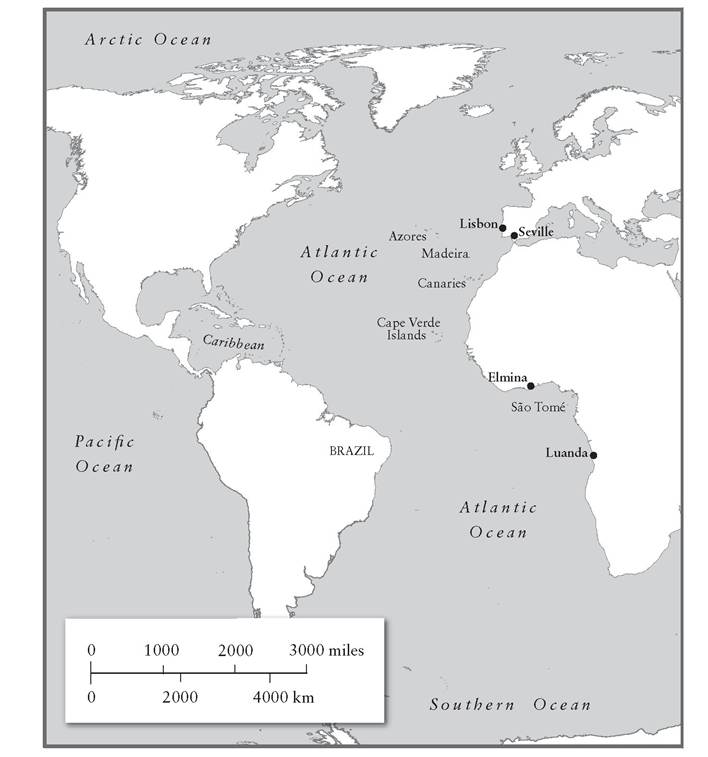
Today, the genetic profile of the inhabitants of the Dominican Republic, constituting the greater part of Hispaniola, reveals how massive this collapse in population actually was: taken as a whole, modern Dominicans are 29 per cent southern European in ancestry (including 0.5 per cent Neanderthal), and only 3.6 per cent Taino. The largest single element in Dominican DNA is west African, accounting for nearly 45 per cent, with a further scattering of DNA from central and southern Africa.2 Denuded of native workers, the Spanish lords of the Caribbean began to import thousands of west Africans, easily available by way of the Portuguese trading stations on the other side of the Atlantic. The Spaniards were already perfectly familiar with slaves from sub-Saharan Africa, many of whom could be found on the streets of Seville around 1500; indeed, if there was one city where black slaves abounded, it was this great port with its ready access to both the Atlantic and the Mediterranean trade routes.3 Still, the Africans of Seville were by and large domestic slaves, in a longstanding Mediterranean tradition.
After 1500 the purchase of slaves for hard work in mines and plantations became ever more widespread. Those slaves who survived the ‘Middle Passage’, the journey across the Atlantic, were likely to be robust and resilient, and the constant flow of African labour into the Caribbean, and, once the Portuguese decided to capitalize on its resources, into Brazil, meant that high mortality among the African workers was not seen as a problem: they could be replaced, since the source of labour seemed to be bottomless: African war captives and other victims of internecine conflict in west Africa. For much of his career, Las Casas was so obsessed (with good reason) by the fate of the American Indians that he failed to register the appalling realities of the slave trade out of Africa.
He was aware that the Indians were, legally, free subjects of the Crown, and had less sympathy for those who arrived as slaves in the New World, people who had never been subjects of the Spanish kings but had already lost their freedom before they were passed along the trade routes by the Portuguese.The infrastructure for this shameful trade was in place now that the Portuguese had established their bases in west Africa. Elmina in Ghana became a centre for the trade in gold and slaves ten years before Columbus reached the New World. War captives were sent down to Elmina and trading stations on the west coast of Africa by the African allies of the Portuguese - noble prisoners of war, peasant farmers, women and children. Elmina itself had only limited holding facilities; but the Cape Verde Islands were the perfect base for a transatlantic slave trade, a collection point that lay astride one of the obvious routes to the Caribbean. Thus there was no need to go to the slave market in Lisbon or Seville to buy slaves. The economy of the Cape Verde Islands was transformed by the growing demand for African slaves. Originally, many of them had been kept on the islands in the hope that they could conjure life out of the poor soil of the islands. This was not a success. The transit trade to the Americas began in earnest in 1510. After that, the islands’ slaves fell into three categories: ‘trade slaves’, destined for the slave market in Portugal or, increasingly, America; ‘work slaves’, for sugar and other plantations on the Cape Verde Islands; and domestic slaves, bought to serve in settler households, who were certainly the most fortunate. In recognition of its growing importance, Ribeira Grande - which was not at all grande - was granted city status in 1533, when it became the seat of the Portuguese bishop responsible for west Africa. Even so, most of those who slept in the little city were merchants and slaves who were passing through the islands. Even towards the end of the century there were probably only about 1,700 settlers in the whole archipelago, and about six times as many slaves.4
The towns of Hispaniola had a different character.
For the moment, until Cortes and his successors conquered vast tracts of the American mainland, this was the end of the line. Columbus had not had much luck with his town foundations. The inhabitants of La Navidad, constructed out of the timbers of the Santa Maria on Christmas Day, 1492, had met with disaster - all the Spanish settlers were dead, turned on by the Taino chief and his men, by the time Columbus returned to Hispaniola. The next settlement on the north of the island, named after Queen Isabella, was founded a year later, but the site was unhealthy and the settlers quarrelled among themselves. La Isabela had slightly better fortune than La Navidad: it lasted four years. Columbus did not see the town as the capital of a new Spanish province, so much as think of it as a trading station, or feitoria, modelled on Elmina in west Africa. Just as Elmina functioned as a funnel through which great quantities of gold from the interior were channelled to Portugal, so La Isabela would be the collection point for the gold and spices of the Indies.5The settlers needed to eat as well as to trade, and their numbers were much larger than the small team who kept Elmina in business. Excavations at La Isabela show that it was built with defence in mind, as one might expect after the experiences at La Navidad; it was constructed mainly of packed earth, but the builders used a limited amount of stone as well, and what was probably Columbus’s own house had a stone doorway. Many colonists had to make do with thatched huts not totally dissimilar to the houses of the Tainos. But the Spaniards tried to be as self-reliant as possible: there was a sizeable community of artisans, not just masons but workers in wood and metal, makers of tiles and bricks and boat-builders. Some people lived on a second, satellite, site at Las Coles, on the opposite side of the river, which, it was hoped, would help feed the new town, for the main business there was agriculture, along with pottery-making.
The Spaniards were none too happy with the Taino diet of cassava bread, along with the occasional iguana, manatee, conch and large rodents. Las Casas thought the Spaniards ate in a day what the Tainos would eat in a month, adding, ‘just think what 400 of them would consume!’ The Indians marvelled at the voraciousness of the settlers, and wondered whether they were so hungry because they had run out of food at home.6The Spaniards within La Isabela and the Indians outside its stockade kept apart; yet children of mixed origins must have been common, because there were so few Spanish women in early Hispaniola. For the moment, though, sharp lines were maintained between the communities. The Spaniards had little interest in Taino products, and made only limited use of Taino pottery. The proportion of Spanish pottery found on the site of La Isabela is actually higher than one would expect to find on a contemporary archaeological site in Spain, where plenty of Italian and other foreign goods normally appear. The style of Spanish goods found on the site is typical of the arabized culture of southern Spain, and includes plenty of glazed maiolica that was brought from Seville and its sister ports during the brief life of the town.7 Columbus attempted to place all trade with the Indians under his own control, acting in the name of the Crown. No gold objects have been found; any golden artefacts or nuggets of gold passed quickly through the colony to the Old World. On the other hand, over a hundred Spanish coins have been found, mainly low-value coins made of the heavily debased silver alloy known as billon; real silver coins were a rarity. The coins themselves were not just from Spain but from Genoa, Sicily, Portugal and elsewhere, palely reflecting the trading world of late medieval Seville.8 So it is clear that the residents did business among themselves, operating a modest money-based economy, but mixing little with the Tainos.
II
In 1498, as it became more and more obvious that La Isabela was never going to flourish, Bartholomew Columbus, Christopher’s brother, made the fateful decision to move the centre of Spanish operations right across the island to the shores of the Caribbean.
In deference to his brother he at first called his new capital Nueva Isabela, but Santo Domingo was the name that stuck until 1936, when the ruthless Dominican dictator Trujillo modestly renamed it Ciudad Trujillo - it has been Santo Domingo again since his fall. Even then the Columbuses did not get it quite right. The city lies on the River Ozama, in those days a broad passageway offering a reasonable harbour for ships arriving from Seville; but Bartholomew’s town was blown to smithereens by a hurricane, and within a few years the town was moved across the river to what was thought a better- protected site.9 There, Nicolas de Ovando, who had replaced Christopher Columbus as governor of the Indies in 1502, decided to build a true Spanish city, so Spanish that he and his successors brought stonemasons and carpenters from northern Spain to construct monumental palaces and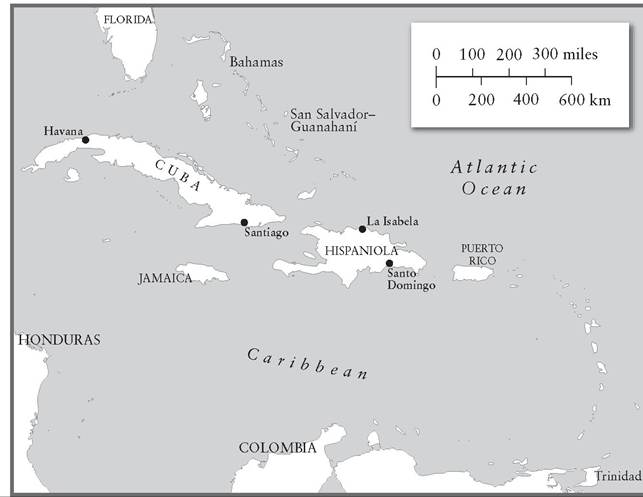
churches in the latest Iberian styles. A longstanding rival of Columbus, Ovando had arrived in the New World accompanied by the largest number of sailors, soldiers and settlers yet seen there, well over 2,ooo.10
Ovando’s aim became the creation not just of a Portuguese-style feito- ria, but a city with broad streets, stone houses and, above all, a permanent population. The Zona Colonial of Santo Domingo is the oldest, largest and best-preserved colonial quarter anywhere in the Americas. Ovando’s palace, now a luxury hotel, still survives as testimony to his sense of grandeur, and he built at least fourteen more substantial stone houses. His immediate successor, Diego Colon, son of Christopher Columbus, who took up office in 1509, constructed a particularly imposing residence with an excellent view over the harbour and out to sea. These governors of the Indies, later graced with the title of viceroy, were keen to place their capital at the centre of the New World. At first they could only see as far as Spain; but as new explorations and conquests opened up first Cuba, in 1511, and then Mexico, whose capital fell to Cortes (an old Santo Domingo hand) in 1520, Ovando’s city seemed poised to become the nerve centre of an entire western Atlantic trading network.
Making Santo Domingo work would present many challenges. In the early days food supplies were scarce; the Spanish settlers came to rely on imported grain brought all the way from Spain, though this was good news for Spanish businessmen, since they needed to fill the outbound ships with something saleable. Wheat was the food of the rich, maize the food of the relatively poor, and cassava was left for those at the bottom of the social pile, who, by definition, were not Spaniards.11 Royal officials were set in place in Santo Domingo, where an imposing headquarters was built; their function was to record what passed through the port, especially the gold brought from the mines, while keeping an eye out to make sure that the Crown received its fair share of the profits. Columbus had pointed out that the areas poor in gold were very rich in cotton; but no one in Europe was terribly interested in New World cotton, since there were plentiful supplies that arrived from the Mediterranean. Even Columbus realized this and began to argue that the inhabitants of Cathay and Cipangu, China and Japan, would surely snap up the cotton of the Indies - a good example of the fantasies that often wandered across his brain.12 Rather later, salt would become a prized asset of northern Hispaniola, picked up by Dutch ships that were not really supposed to visit Spanish territory; but for now gold, gold and more gold was what people sought.
By 1508 forty-five ships were coming each year to the island, and Santo Domingo was firmly established as the prime port of call in the Spanish Indies. Some of its settlers came from well-connected families, such as the Davila of Segovia, and it is no coincidence that many of the stone buildings recall those of Segovia itself.13 Santo Domingo attracted the attention of the two busiest men of affairs in Seville, who were of Genoese origin, Juan Francisco de Grimaldo and Gaspar Centurion. In 1513 and 1517 their loans to merchants and ship’s masters sailing to the new port mounted higher and higher, one loan being worth 214,000 maravedis. Admittedly, the sort of product the settlers required was at first relatively modest, as had been the case when the Canaries or the Cape Verde Islands had first been settled: chickpeas, vinegar, paper, coarse cloth. But there was every hope of bringing back gold by return. By the middle of the sixteenth century, demand for luxury goods in the new colonies had begun to rise, including fine cloths from all over Europe, and increasing numbers of African slaves, all of which (or whom) helped to make the fortune of yet more Genoese families. One not very popular imposition by King Ferdinand was a tax of 7% per cent on imported European goods, which included silk shirts, velvet hats and other luxuries for the Spanish elite. If one compares the excavated remains of La Isabela with the grandeur of Ovando’s city of Santo Domingo, one can see how the standard of living of the colonial elite was beginning to soar.
In the early days, the Taino Indians had simply panned for gold in river beds, but the point came when the large lumps had, by and large, been collected, while other lands across the Caribbean began to look much more promising as sources of gold - on his final expedition Columbus had uncovered evidence of gold-rich peoples some way inside Central America. The Spaniards now resolved to transform the island economy in new ways, always with an eye on demand from Europe: just as Madeira, the Canaries and Sao Tome had become major sources of sugar, there seemed to be no reason why the same should not happen in Hispaniola.14 The tropical climate guaranteed heavy rainfall, and water was essential in sugar production. The newly arrived African slaves were thought to be better suited than the vanishing Tainos to the exceptionally harsh conditions within a sugar mill: punishingly high temperatures as the sugar was boiled, not to mention very demanding work in the fields cutting the thick and fibrous stalks of the sugar cane with knives or machetes. Even so, the history of sugar production in Hispaniola is a story of mixed success. In 1493 Columbus apparently took sugar cane from La Gomera in the Canaries to Hispaniola, though several attempts were necessary before the Caribbean sugar industry took off.
The first serious attempts to start sugar production in Hispaniola began in 1503, and the first proper mill was only built in 1514, on the initiative of a Spanish landowner named Velloso; growth was slow, depending as it did on securing experts who could advise on the machinery needed in the mills, some of whom Velloso brought over from the Canaries.15 An even more important problem was lack of capital, in short supply before the Genoese and the Welsers became involved. A state-of-the-art mill could cost as much as 15,000 gold ducats, way beyond Velloso’s modest means; however, he did enter into a partnership with wealthy local officials, and his project was soon under way. More money was pumped into this industry by the Jeronymite friars, who had become a major influence in the government of Hispaniola by 1518 and who petitioned the Crown for investment in what they advertised as a golden opportunity. Royal loans enabled dozens of settlers to build sugar mills in the years around 1520, and they made little effort to pay the money back; the whole sugar industry was littered with debt to the Crown, to Genoese investors and to merchants in Seville.16 Thereafter sugar mills spread across the island and the income from sugar was, for a while, handsome: over half a million pesos each year in the 1580s, from about 1,000 tons of exported sugar. Labour supply remained a problem because the African slaves rarely lived much longer than seven years before overwork and disease took their toll. The answer was to increase the number of imported slaves; some of the largest estates had a workforce of 500 slaves, and many had 200.17
Among the pioneers of the Caribbean sugar industry were pioneers of the sugar industry in the Canaries, such as the Genoese businessman Riberol (a victim of local xenophobia), and the Welsers, a German banking family from Augsburg that was keen to profit from the new discoveries across the Atlantic, and that would eventually send expeditions deep into Venezuela in search of the gold-rich kingdom the Spaniards called ‘El Dorado’. For the moment, in 1526, the Welsers were content to set up a branch of their bank in Santo Domingo managed by two Germans, one of whom would go on to become governor of Venezuela. They valued Santo Domingo not just as a source of goods such as sugar, but as the capital of the Spanish Indies, the place where they would be able to work side by side with the viceroy and the king’s other agents.18
European participation went much further, thanks to the presence on the Spanish throne of a king who was also ruler of the Holy Roman Empire, Charles V; he was in hock first to German bankers and later to the Genoese. The Welsers of Augsburg responded with enthusiasm, even though this stretched their existing resources to and beyond wise limits. In the seventeen-year period beginning in 1518, 1,044 ships sailed from Seville to Santo Domingo, an average of sixty-one each year, and of these ninety- three were owned by the Welsers - a number were then put to use in intra-Caribbean trade towards Venezuela.19 They overextended themselves both in Venezuela and in Hispaniola, and when it became obvious that they would never find El Dorado and be able to use its fabulous wealth to pay off their mounting debts they closed up shop in both places in 1536.20
Then the conquest of Mexico and Peru pulled the centre of gravity of the Spanish Indies much further westwards, so that by mid-century Santo Domingo had become a seat of government but had lost its pre-eminence in trade - not just to Mexico but, as will be seen, to newly subdued Cuba. Santo Domingo was no longer the focal point of the Spanish Empire in the Indies; its governors were looking for new ways to maintain the status and wealth of Hispaniola, and another option was to import cattle and to try to make a profit from ranching.21 The sale of hides from Hispaniola on the other side of the Atlantic became big business, but turning the land over to cattle also spelled the end of the old intensive cultivation practised by the Indians (of whom, in any case, there were now very few), and generated increasing dependence on food supplies, other than meat, from outside the island. Had the Spaniards been willing to change their diet things might have turned out differently; but, rather like British colonial officials in India who expected to be served English food, the Spaniards were slow to adapt to Caribbean tastes. Once the ranches were in place, meat and more meat became the daily diet of the entire white population - it has been suggested that in Hispaniola a plate of beef cost one hundredth of what one would have paid in Spain. Before long there were forty cattle for every person on the island. Since Spain required leather, not fresh meat, which would hardly survive an Atlantic crossing (although some was taken on board to feed the sailors), there was a glut of beef in Hispaniola. Nearly 50,000 hides were exported in 1584, though that was about a quarter of the number of hides exported from the Caribbean islands, for the passion for ranching went far beyond Hispaniola.22
The city of Santo Domingo stood frozen in time. Its magnificent Gothic cathedral was completed just as the downturn was beginning. The remarkable survival of its buildings is testimony to decline, not to success. Other ports were seizing the lead: Veracruz in Mexico and Nombre de Dios in Panama.23 So long as Santo Domingo was the redistribution point for the goods being sent to Europe, it had some role to play, but a powerful rival emerged that was better placed to handle the wealth of Mexico: the new capital of Cuba, Havana.
III
The pre-eminence of Havana within the Spanish Indies was clear by 1571, when an English observer wrote:
Havana is the principal and most important port of all the king of Spain has in the Indies: because all the ships coming from Peru, Honduras, Puerto Rico, Santo Domingo, Jamaica, and other parts of the Indies, touch there upon their return to Spain, this being the port in which they take food and water, as well as the largest part of their cargo.24
This was not the result of any great resources that Cuba could offer; indeed, it was slow to develop the sugar industry for which it eventually became so famous, and was generally a tardy developer within the Spanish world, for it had only been conquered twenty years after its discovery by Columbus - if Las Casas is to be believed, the conquest was accompanied by hideous acts of violence. Even so, the conquistador Diego Velazquez seems to have been an urbane man who made some attempts to treat the native population with consideration; after all, it was by now obvious that the treatment of their cousins in Hispaniola had led to utter disaster and population collapse. Realizing that the island had little gold to offer, Velazquez tried to introduce cattle and pigs, in the hope of re-creating Mother Spain on its soil. The production and export of hides exceeded even that of Hispaniola, but the price that had been paid was the same: nothing could protect the Taino Indians from disease, and they too disappeared within a few decades.25
Havana was founded in 1519. Its real strength lay in its position astride the Gulf Stream, which made it the ideal transit point between the two American continents and Europe.26 Settlers were attracted by the excellent natural harbour and by the quality of fresh water in the nearby river. Havana was able to supplant the original capital of Cuba, at Santiago, which lay well within range of Santo Domingo but shrank rapidly in the face of competition.27 This was the point where fleets coming from all over the Caribbean, including those bringing the silver of Mexico and Peru, converged, which also made it a very attractive target for pirates. As early as 1538 a French pirate had a go at Havana, and in 1555 another one managed to sack the town; old Havana had been built by Taino labour, but new Havana was built by African slaves, for lack of native manpower.28 And then it flourished: it was the great centre of inter-colonial shipping, that is, trade within the Spanish Indies, with ships arriving from the Yucatan peninsula, Florida, Honduras, Colombia, Trinidad and Hispaniola; but it also received goods (some in human form) from Africa, the Canaries, Spain and Portugal, and the i nter-colonial trade fed and was fed by the transatlantic connections - literally in the case of the Canaries, which in those days were celebrated for their wines, and which were also the home base of some of the liveliest merchants trading through Havana. In the last fifteen years of the sixteenth century, the volume of trade conducted by Francisco Diaz Pimienta of La Palma in the Canaries reached 1,800,000 reales. He was mainly a wine merchant but he did not scorn the slave trade out of Angola.
Mexico was Havana’s second most important trading partner, after Seville; in a later chapter it will be seen how Chinese goods reached Mexico all the way from Macau and Manila, and some of these found their way to Havana, from where they could be passed on to Spain. Sometimes they were just plain ceramics used as much as ballast as they were used as sale goods, but sometimes they were fine silks or delicate porcelains. Havana was a centre of shipbuilding too.29
Havana, then, was a city that lived from servicing international trade; it was more closely integrated into the commercial world of the Spanish Atlantic than it was into the narrower and poorer world of early colonial Cuba. A local elite of Spanish landowners, office-holders and merchants emerged, tightly bound together through marriage and common financial interests. All stoutly denied any Jewish or Moorish ancestry; if you wanted to heap the worst possible insult on someone you called him a puto judio toledano, ‘a fucking Toledan Jew’. But there were Portuguese businessmen who were strongly suspected of being secret Jews, settlers who chose Havana in order to escape as far away as practicable from the Inquisition. Still, the total population was much smaller than one might expect in a town of considerable strategic and economic importance: sixty citizens in 1570, 1,200 in 1620. And then there were high-status slaves, for not all slaves toiled in the sugar plantations or in construction projects: as in ancient Rome, some were sent abroad on business by masters who trusted them and recognized their talent.30 In 1583 royal slaves, many of whom were set to work on the city’s fortifications, numbered 125. They were mostly brought, via holding stations in the Cape Verde Islands, from Upper Guinea, which supplied the great majority of slaves before 1600. Other royal slaves reached Santo Domingo and Havana from Luanda in Angola, so that the slave trade out of south-western Africa towards the Caribbean had the dual effect of strengthening Portugal’s grip on Angola and reinforcing Spain’s control of the Caribbean, particularly after 1580, when the king of Spain held the throne of Portugal as well. Not all the Africans were kept in permanent slavery: a free black population gradually came into existence in the islands, among whom there were black ranchers who possessed their own slaves.31
All told, the Caribbean was quite unlike the world Columbus had so confidently expected to find. A new series of relationships emerged within the Atlantic. The sugar islands of the eastern Atlantic, notably Madeira and the Canaries, taught the sugar islands of the western Atlantic the necessary skills. There was constant to-i ng and fro-i ng between these groups of islands. The Caribbean towns, notably Santo Domingo and then Havana, functioned as supply stations for shipping bound from one great continent to another, just as the Cape Verde Islands and the Azores kept ships stocked with meat and dairy goods. In that sense, the claim that Columbus had discovered ‘New Canaries’ in the Caribbean was not totally mistaken. The slave trade and slave labour kept these islands afloat, not just under Spanish rule but in later centuries when the English, the Dutch, the French and the Danes staked out their own claims in the Caribbean. This New Atlantic was constructed out of the resources of the Old Atlantic.