The splendour of endeavour: landscape photography from the Indies
Colonial photography illustrated both the tropical uniqueness of the Indies and the splendour of imperial endeavour in taming and transforming the landscape. It did so in ways that attached a claim of truth to the images created—a value that some scholars have referred to as ‘indexicality’, the notion that what is pictured in a photograph corresponds exactly to a stable, external reality.49 Yet photography is no more likely than any other medium, visual or otherwise, to provide an objective image of the world, and this was certainly true of colonial photography.
From its first use in the Indies in the early 1840s (to document an archaeological expedition) photographers often functioned in similar ways to the draftspeople whom they succeeded: as specialised, technically trained adjuncts to scholarly, scientific and military expeditions.50 Photography began to eclipse painting and other hand-drawn modes of representation as a means of visual reportage soon after its invention in the mid-nineteenth century, in Europe as well as its colonies. This was particularly the case in the latter half of the nineteenth century, when technological advances ensured cheaper, more readily duplicated photographs and printed reproductions.Unlike painters, colonial photographers in the Indies recorded a broad range of contemporary landscapes in ways that not only revealed but frequently celebrated their modern, industrial nature and their significance to the Dutch colonial economy. Collectors of postcards and audiences at colonial exhibitions saw photographic images that resonated with painterly mooi Indie scenes. Views of colonial holiday resorts in mountain regions like Buitenzorg (now Bogor)—the Dutch forerunner to the better known ‘hill stations’ of British India and Malaya51—were particularly prone to representation in the mooi Indie style.
Photographs of river valleys and mountain mists in the Buitenzorg region found their way into souvenir albums as early as the 1860s, at precisely the same time that mooi Indie paintings were becoming popular. The same conventions for depicting colonial notions of tropical beauty were thus deployed in both painting and photography.The key distinction between these media was that the landscapes depicted in photography included but were not limited to mooi Indie scenes. Where painters tended to focus almost exclusively on images of stasis, photographers regularly depicted the transformations that colonial rule wrought upon Indies landscapes. Such images were cornerstones of the triumphant, positivist strands of political discourse that supported colonial exploitation and expansion.
Commercial photographers in the Indies often celebrated features that painters shunned, such as the order and efficiency of modern estates and the presence of industrial infrastructure. Photographers diligently recorded each stage of major crops’ life-cycles, venturing into Javanese coffee estates, Sumatran rubber fields and Ambonese spice gardens to capture in meticulous detail the procedures required for producing each harvest. On Javanese sugar plantations, photographers even recorded the mechanical paraphernalia (motorised tractors, processing machinery) associated with one of the most modern, industrialised agricultural sectors in the world leading up to the Second World War.52 A wide audience of late colonial viewers saw these images. Lavish commemorative albums filled with photographs of prosperous estates were regularly issued to retiring managers, and well-known commercial studios produced souvenir albums and postcards that documented the stages of growing, harvesting and processing tea, and other cultivars.53 Indies photographers also advertised sources of colonial wealth at international venues including world fairs and colonial exhibitions, which attracted millions of visitors both in Europe and in the colonies.54 Agricultural societies in the Indies staged similar displays using photographs, dioramas and live plants to promote advances in the plantation industry.55 Photography in and of the Indies thus generally presented edifying, entertaining and educational views of the colonial plantation economy to European audiences.
Photographers’ images not only revealed the regimentation of the late colonial plantation landscape, but also the hierarchical social structures, differentiated by employment status and race, that characterised estate life. At the lowest end of the plantation order were the manual workers: free or indentured Indonesian men, women and children. Their Asian supervisors occupied the next rung on the ladder. These people were distinguishable by costume (they tended to wear more clothing than ‘coolies’), and were usually not
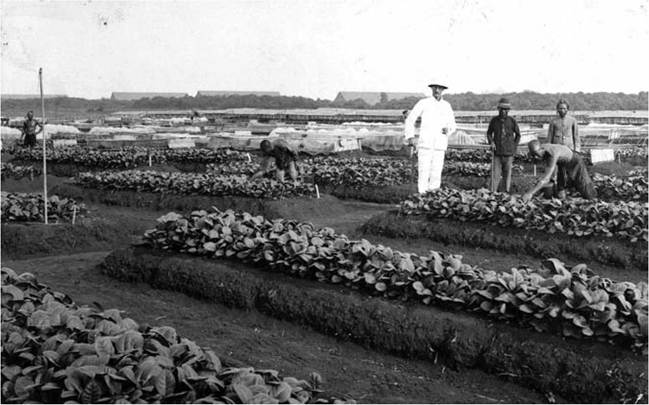
Figure 25.2 Photographer unknown, Tobacco plantation in Deli (c. 1920), 9 cm x 13.5 cm. Source: Koninklijk Instituut voor Taal-, Land- en Volkenkunde, Leiden, inv. no. 18407.
engaged in heavy labour. The European overseers who formed the apex of the hierarchy were almost always pictured striking imperious poses in white suits and topis (Figure 25.2).
Ordered landscapes mirrored the strict discipline governing the life and work of Indonesian labourers, a system enforced by sanctioned as well as illegal modes of coercion and brutality. The violence that frequently erupted on Deli plantations in the late colonial period, and the stiff penalties exacted against non-compliant coolies, are well documented.56 Although images of such events remained rare and, when extant, were certainly not intended for public circulation, some estates did occasionally keep photographs of executions as part of their records.57 In such a context, the camera trained a documentary eye on recalcitrance and the enforcement of order. Just as photographs showed monocultures in the fields, so they sometimes also revealed how behaviours that erred from the expectations of colonial overseers were weeded out.