40 The Nordic Indies
I
The history of western European contact with the Americas and with the Indies has been written largely from the perspective of the Portuguese, the Spaniards, the Dutch, the English and the French, and with good reason: their imprint can still be felt in ports as diverse as Melaka, Macau, Santo Domingo and Curasao.
By the late seventeenth century, other European powers also wanted their share of the products and profits that could be drawn from l ong-distance maritime trade. The Danes and the Swedes created global networks of their own, although their importance does not lie in the scale of their trade, for the Danish slave trade at the end of the eighteenth century accounted for not more than 3 per cent of the European total, while their trade with China accounted for just over 5 per cent of the European and American total - the figures for the fledgling USA are closely comparable, while Great Britain stood highest, with well over one third of Canton trade, followed by France.1 Nonetheless, looking at the maritime achievements of the Danes and Swedes offers a valuable, oblique slant on the activities of the Portuguese, the Spaniards, the Dutch and the English, with whom, neutral or not, the Danes found that their affairs were closely intertwined.The Danes and the Swedes bore witness to significant changes in maritime commerce, notably the explosion in the consumption of tobacco, tea and coffee in the seventeenth and eighteenth centuries. They did not stand on the sidelines but participated in the transformation of the maritime world in those centuries. Their involvement in the tea trade was particularly important: Great Britain consumed about three quarters of the tea imported into Europe from China in the late eighteenth century, and around one third of that tea was handled by Swedish merchants based in Gothenburg or by their Danish rivals.
The tea trade is not just interesting because it was massive and a good source of profit. It also says much, if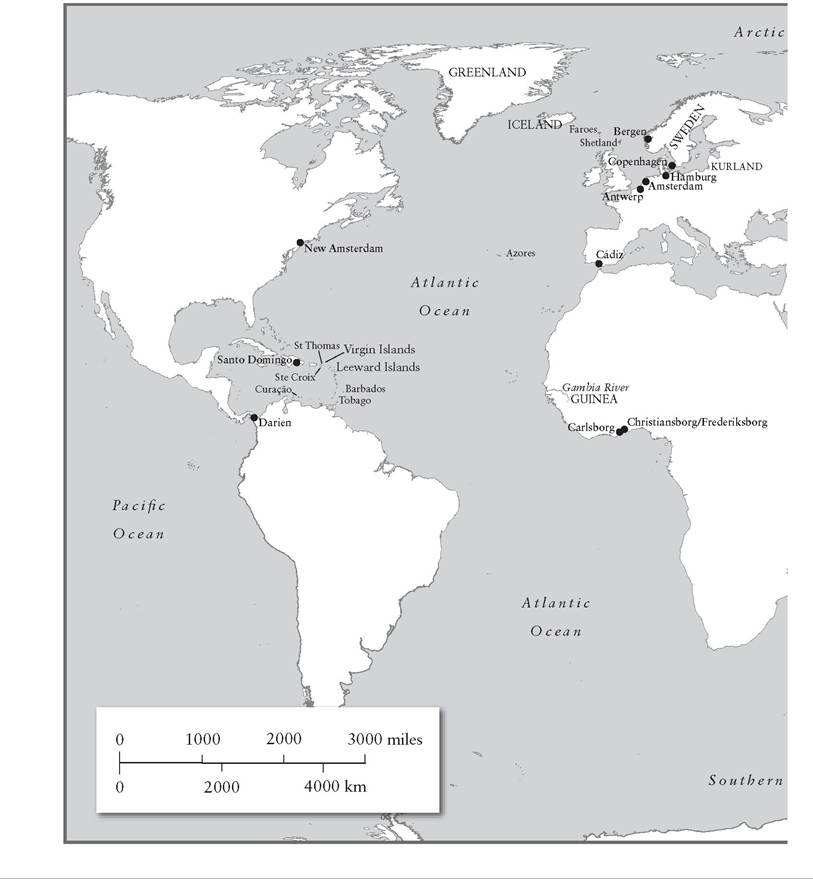
the pun can be excused, about taste and the revolution in consumption that was taking place in eighteenth-century Europe, amply revealing the imprint of maritime trade: the passion for chinoiserie; the attempts to develop porcelain or its substitutes in Europe; attempts to replicate Chinese silks and their much-admired colours in Europe, whether by natural or by artificial means. Just as medieval spice-handlers in France or Italy had adulterated and fabricated eastern condiments, fake tea became all too common in Britain, Holland and other centres of consumption. The
inclusion of such tasty ingredients as sheep’s dung did nothing, of course, to satisfy the craving for caffeine that the tea, and also the coffee, trade had brought into being.2
Scandinavia was the centre of interconnected global operations.3 By looking at the maritime ambitions of the Nordic peoples in these centuries, one can see how what happened in the West Indies was entangled with what happened as far away as Guangzhou and southern India - how, for instance, many of the cloths carried on Danish ships to the West Indies had arrived in Danish ports from India and even China before being passed on down the Danish maritime trade routes. In the case of the Danes, their insistence that they were a neutral power enabled them to act as intermediaries for other Europeans who were officially in competition with, even at war with, one another, so that Danes could be found supplying goods on behalf of English merchants to the French inhabitants of Mauritius during the Napoleonic Wars.4 From the very earliest days of Danish operations, intimate ties to other nations came into being: among the founders of the Danish East India Company were Dutch businessmen with past links to the VOC; and later on Copenhagen attracted Portuguese New Christians, who were allowed to set up a small Jewish community there, as they had done in Hamburg and the Danish town of Gluckstadt.5
Denmark became home to a great many trading companies, eighteen of which were founded between 1656 and 1782, which is something of a European record: an Africa Company based in Gluckstadt, close to Hamburg, in 1651; a Morocco Company in 1755; companies trading to and beyond Iceland; the United East India Company of 1616, which evolved into the Danish Asiatic Company, under direct royal control, in 1732.6 The West Indies and the Guinea coast were also the focus of attention, and Denmark won control of three Caribbean islands, to which its companies exported African slaves.7 Denmark lost its slice of what is now Sweden, the region of Scania, in 1658, although attempts to recover it continued for many decades; but Denmark was not the small north European state that it became following the loss of Norway and Schleswig-Holstein in the nineteenth century.
One should really write not of Danish merchants but of Danish-Norwegian ones, since the Norwegians took part in the enterprises of the Danish trading companies. As overlord of those territories, which in the case of Norway gave access to fishing grounds, furs and other Arctic products, as well as the Faroes, Iceland and (at least in theory) Greenland, Denmark was a significant maritime power even before it acquired colonies and trading stations in the Caribbean, in Guinea and in India.The Danes made full use of the north Atlantic when sending their ships out to India and China, generally sailing round the top of Scotland, between Shetland and the Faroes, to reach the open ocean - i ndeed the Atlantic leg was the most dangerous part of a journey out east that could take seven months, for ships set out around December, not the best time to face Atlantic storms. Even so, the Danes lost few ships once they had mastered the routes through the Atlantic and the Indian Ocean - sixty- three ships were sent to China after 1772, and all survived the voyage.8 Maritime trade was the foundation of the Danish kingdom’s prosperity.
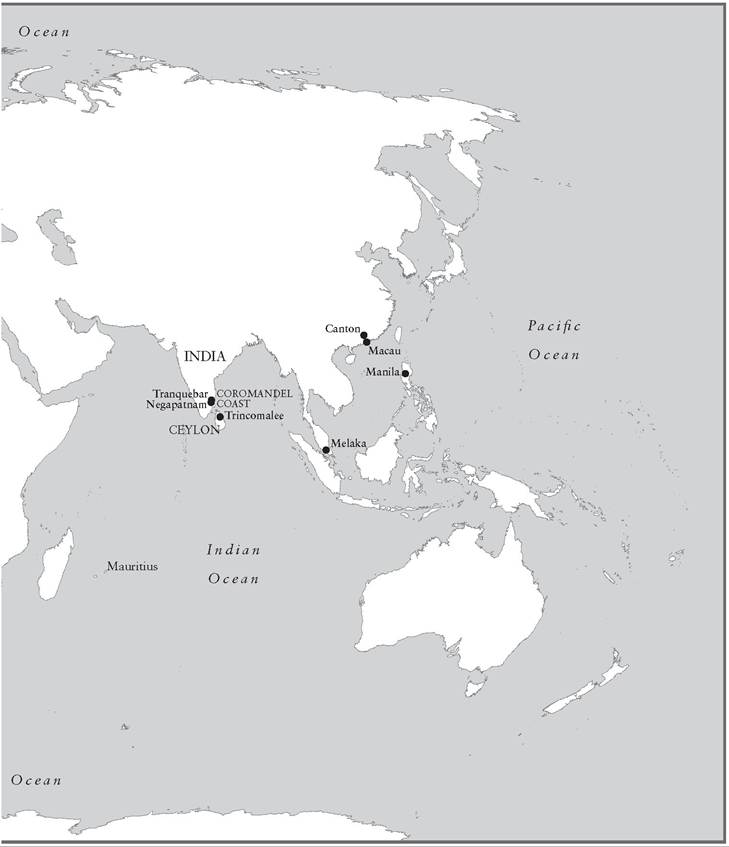
The royal castle at Helsingor was world-famous as the gateway to the Baltic even before Shakespeare put ‘Elsinore’ on the stage, for it was a magnificent source of revenue from ships passing through the narrow opening of the Sound.9 Within the Baltic, the Danes enjoyed close links to the inhabitants of Brandenburg-Prussia, who muscled in on their West Indies trade. Finally, one of the distinguishing features of Danish trade in India was its strong emphasis on local networks, so-called country trade, reducing dependence on European supplies of silver to pay for goods purchased in India and also in China, which became an increasingly important focus of interest. The main Danish possession in India, Tran- quebar in the south-east, was able to carry on its business independently of Europe, inserting itself into the maritime networks of the Indian Ocean peoples and therefore enabling one to glimpse what is often invisible, the magnitude and profitability of maritime trade outside the monopolistic spheres of the Dutch and the Portuguese.
There was a twenty-nine-year period when no ships reached Tranquebar from Copenhagen; even so, business carried on, because the colony simply did not depend on metropolitan Denmark for its survival.10II
In 1616 King Christian IV issued the first licence for Danish voyages to the East, which were to be led by the Dutch entrepreneurs Jan de Wilem, from Amsterdam, and Herman Rosenkrantz, from Rotterdam. The king wanted to make full use of Dutch experience. They set out at the very end of December 1618 en route to Ceylon, cheered by the offer of exemption from customs dues on the voyage. These two provided around 12 per cent of the initial capital of the Danish East India Company, whose organization was quite closely modelled on that of the VOC; this was more than the king put up.11 Jan Pieterszoon Coen, the bloodthirsty governor-general of the Dutch Indies, issued a ban on French and Danish traders even before the ships had left Copenhagen, and this hostility continued for several years, as the Dutch watched the success of the Danes with growing alarm. They were irritated that local rulers seemed to have taken to the Danes. The less aggressive stance of the Danes towards the native peoples of the Indian Ocean, compared to the Dutch, made them not just easier to deal with but genuinely more popular. A VOC agent in Trincomalee, an important port on the east coast of Ceylon, reported with alarm on the willingness of one ruler to assign the Danes a fort at Tranquebar, only twelve miles from the well-known trading station of Negapatnam.12
Well might he feel alarm: the Dutch had still not seen off the English, and here was a new threat; besides, the Danish voyages to Ceylon were proving profitable: news spread, and a Latin chronicle from the German- Danish borderland concisely stated that ‘in the same year [1622] the king of Denmark received two ships from the island of Ceylon in the Indies, loaded with ebony and spices’. After buying a great deal of pepper, the Danes set their sights on cloves, and an expedition of 1624 managed to obtain 9,600 kg of cloves, trumping the English, who just at this point were suffering humiliation at Amboyna and on Run.13 If the Danes could make their own capital city into a redistribution centre sending the luxuries of the East across northern Germany and beyond, the Dutch might have cause to worry.
The Danes were well aware that their core possessions of Denmark, Schleswig and Norway could not absorb all that they brought. By the end of the eighteenth century 80 per cent of what they brought from India and 90 per cent of what they brought from China was re-exported from Copenhagen, often deep into the Baltic.14The English began to worry about their own access to southern India. An English captain named John Bickley was already complaining in 1 624 that the Danes ‘had formed [farmed] all the seaports of the Kinges between Napagapatan and Pullacatt for use and benefit of the Kinge of Denmarke; therefore willed us agayne to bee gone, or else they would send us awaye in haste’. For when it came to relations with the other Europeans, the Danes proved rather less charming than they were towards Indian kings: ‘moste of all Danes were our deadly and most cruell enimyes.’ The value of their trade along the Coromandel coast in the late 1620s was the same as that of the English East India Company, roughly 30,000 rikstalers in the best years.15
In the event, there were interruptions, as Denmark became sucked, like its neighbours, into the Thirty Years War that devastated Germany. Investors were not, in any case, impressed by the returns, since only seven ships came back from the East between 1622 and 1637, so about one every two years.16 Trying to help with making ends meet, the king pumped more and more money into the Danish company; by 1624 he was already owed over 300,000 rikstalers. This was unsustainable, and the first East India Company was wound up in 1650, but a new one was up and running from 1670. This did not mean the end of the Tranquebar colony, for, as has been seen, there were excellent opportunities to pick up Indian calico cloths and carry them from Tranquebar as far as the Moluccas - this was already happening in 1625. There was a very lively spice trade within as well as beyond the Indian Ocean, notably in cloves, nutmeg and other products that could only be produced in a restricted area - only Indian cuisine cleverly combines spices from all over the Indian Ocean and South China Sea.
The Danes were as good at shifting different spices around as they were at moving cloth.17 However, they worked a standard set of routes and, after gaining Tranquebar, they did not manage to break into new markets. An attempt by the Danish ‘President’ in Asia, Pessart (who was in fact Dutch), to follow his former compatriots into Japan in the 1640s ended in disaster when the Dutch dissuaded him; he travelled instead to the Philippines, and was killed there.18Paying for eastern goods, as everyone knew, used up silver. Those who followed the mercantilist doctrines popular in contemporary Europe argued that the conservation of silver was vital to national prosperity but that national prosperity would be fostered by vigorous foreign trade. New opportunities offered themselves, now that vast amounts of silver were pouring out of the Peruvian mines, some of it destined for Macau and Canton in payment for the Chinese silks that came via Manila. The pause in trade between Copenhagen and Tranquebar actually did the Danes a favour, because it stimulated the country trade in India, and at the same time the Danes became less interested in obtaining their pepper and spices from their own factory out in India, and began to see that Indian cotton cloths were a better source of profit, whether they were sold in China or taken back to Europe. By the start of the eighteenth century, Danish trade with the East diversified further: increasing demand for Chinese porcelain was accompanied by a passion for tea and coffee. The Danish tea trade became very big business by 1800. A landing document of 1745 from Canton lists seven different types of tea, including Pecco, Pekoe tea, as well as sugar, sago, rhubarb and 274,791 teacups with saucers (who counted them so precisely?, one might ask), tens of thousands of coffee cups, and thousands of butter dishes and chocolate cups, plus more than 1,000 teapots.19 The Danes were not the only Europeans to find this happening. Chinoiserie was now in vogue throughout northern Europe, and the presence of the European trading companies was barely able to satisfy demand for porcelain and other exotic goods - so much so that attempts were being made to imitate Chinese and Japanese pottery in English and continental kilns.
III
The trade to India and China was only part of wider Danish ambitions. By working closely with colleagues in Brandenburg-Prussia and in Kurland, roughly corresponding to modern Latvia, the Danes hoped to become masters of the Baltic trade in exotic goods. For the Danish presence was far from insignificant. The Danes occupied parts of the Guinea coast for longer than the Portuguese, and for a time it appeared that their control would extend some way beyond their main trading stations into the hinterland of what is now Ghana. In the seventeenth century the Danes operated fourteen trading stations in Guinea, the English seven, the Brandenburgers three and the Swedes three, though the Swedish ones were all taken by the Danes; by 1837, thirteen years before the Guinea forts were sold to Great Britain, the Danes ruled over an African population of about 40,000 people.20 Danish entrepreneurs were involved in the sordid slave trade, though to a lesser degree than the Dutch or the English, as their main aim was to provide labour for their three West Indian islands rather than to supply the plantations of Virginia, the wider Caribbean or Brazil; and Denmark was the first nation in Europe to abolish the slave trade. Even so, in 1696 the governor of St Thomas, one of their Caribbean islands, boasted that ‘all other trade is nothing compared with this slave trade’.21
Their ability to obtain slaves depended on the willingness of local African kings to supply them; many were the subjects of rival kings and had been captured in war, while others were enslaved for debt. The cruelty began well before the slaves had even reached the Danish or other forts where they were sold to Europeans and packed away in the hold of a ship for transport to the New World, for many died during the arduous trek across country to the coast - by definition the slaves were not inhabitants of the areas closest to the European forts, whose rulers would not normally sell their own subjects to the slave-traders. Most captains, with an eye on profit rather than humane treatment, wanted to deliver as large and healthy a human cargo as possible. Therefore they did not make the conditions so absolutely dreadful that their captives died en masse; some time was allowed on deck and the slaves were generally fed well enough to keep them alive; if the conditions below deck were intolerable, disease would spread, infecting the crew as well. Yet some practices such as throwing live slaves overboard when the ship had been so long becalmed that food and water was running out only deepen the sense of horror the modern reader feels.22
The foundations of the Danish network in west Africa were in fact laid by the Swedes, their rivals, during the Thirty Years War. At this time the hyper-ambitious Swedish king, Gustavus Adolphus, imagined that, in addition to conquering vast tracts of Germany, he could draw income from a ‘General Commercial Company for Asia, Africa, America and Magel- lanica\ the last term signifying a supposed southern continent below Cape Horn. This company was the brainchild of a Flemish entrepreneur from Antwerp named Willem Usselinx who had traded out to Iberia and the Azores, and had been involved with the VOC since its early days but had been dismissed. He looked first to King Christian IV of Denmark, but did not find approval, so he approached the Swedish king instead. The company was chartered in 1626. It operated out of Gothenburg, which had only been founded in 1621, as a Swedish base on the North Sea; Gustavus Adolphus welcomed Dutch and German merchants to the city, and relied on Dutch architects to lay out its network of canals and streets.23 Usselinx’s company set up a colony in the Delaware River which kept going for seventeen years from 1638 onwards, until the Dutch overran it; it was acquired by England, along with New Amsterdam, in 1667.24 Aware no doubt of what Gustavus Adolphus was up to, Christian of Denmark did issue a charter to Danish merchants in 1625, but then and again a few years later the projects did not get off the ground.
This left the Swedes in pole position. Louis De Geer, a merchant of Liege, trading under the Swedish flag, brought an assortment of goods back to Sweden from a voyage to Guinea in 1648: tobacco, sugar, indigo, ivory, calico cloths and some gold - all very promising, except that some of the goods had been bought not in Africa but in Lisbon.25 De Geer relied very heavily on the Dutch for both ships and sailors, and he had family in Amsterdam who helped him run his business. The advantage for the Dutch shipowners in this case was that they were able to carry on business overseas under a foreign flag, free from the monopolistic policies of the VOC and its West Indian equivalent. Under the terms of the Swedish king’s charter, De Geer was able to run his own business with very little interference, though he did set up a fort named Carlsborg for the Swedish government, on the Guinea coast - oddly, the cornerstone was laid by a Swiss merchant, something of a rarity along these maritime trade routes. The site had been used in the past by the Portuguese, the Dutch and the English, but they had left it empty: there was no proper harbour and ships had to stand out at sea while goods were laboriously brought to and fro from the shore on lighters or in African canoes.
The Danes riposted in several ways. They too had a port which had been founded as an outlet into the North Sea. This was Gluckstadt, which lay in Holstein, so it is now part of Germany, and it was founded in 1615. Among its most important settlers were Dutch and Portuguese Jewish merchants. One of the Portuguese Jews even helped to negotiate a trade treaty between Denmark and Spain, and the Crown welcomed Sephardic Jews from both Iberia and the Mediterranean, ‘but no German Jews’, for the fundamental principle was not toleration but profit, and the Sephardim were seen as better businessmen. In the 1640s and 1650s a group of sea captains from Gluckstadt set up their own company to trade in Africa, while two Portuguese Jews opened up a route across the ocean to Barbados, so business out of Gluckstadt began to take off. Plans were laid for a company that would embrace all the lands, including Magellanica that the Swedes had already shown they hoped to penetrate, added to which was the Terra Australis, or ‘Southern Land’ - both being blanket terms for that vast southern continent that was assumed to reach almost as far as South America, and perhaps included Tierra del Fuego. Some of these activities did produce a return, and when a large cargo of sugar arrived in Copenhagen in 1658 a sugar refinery was built in the expectation that this was the beginning of something big. However, the most satisfying success was the capture of the Swedish forts on the Guinea coast, beginning with Carlsborg, even though it was ceded to the Dutch; they had offered their help to the Danes, more in the hope of expelling the Swedes than in the hope of creating a Danish network of forts.26
The Danes did, however, want to create their own bases, and the Gluckstadt Company that now ran Danish operations across the sea established a fort at Frederiksborg in what is now Ghana at the end of 1659, with the assent of the local king of the Fetu people. It is no surprise that the Dutch were soon at the throats of the Danes, claiming that they had once controlled that patch of territory - so much for past friendship.27 But the Danes by and large managed to placate both the Dutch and the English, and their ability to do so reflected the fact that they were seen as only minor rivals. The history of Frederiksborg is a story of constant skirmishes for control, mainly with the Dutch, the effect of which was to soak up funds that would more profitably have been spent on commerce. It is also a history of disease, early death, and mismanagement by governors who were thought by observers to be far too fond of drink and of parties. When the money ran out the fort was pawned to the English, who had no great interest in it and let it decay. Reaching Guinea also meant running the gauntlet of the Sale Rovers and other Barbary corsairs off the coast of Morocco, as well as English pirates who considered that the Danes were fair game, even though they increasingly tried to present themselves as politically neutral.
A similar history can be written of what became the major Danish fort, Christiansborg, founded in 1661 in the region of Accra. One of its commandants held office for eleven days, which were given over to a spectacular feast during which he married a part-African woman; but the Fetu king was disgusted and had him removed from office (this is less surprising than it sounds, as the forts were not sovereign territory, but were at least in theory rented from local kings against a small tribute payment). The Portuguese were deeply irritated by these northern interlopers in what they still liked to think was their Gold Coast, even though fellow Portuguese were active among the Danish merchants - Moses Josua Henriques traded between Guinea and the West Indies around 1675 and became royal factor for trade between Gluckstadt and Guinea. Meanwhile the Danish West India Company, like the African kings, expected its share of the proceeds from the Guinea trade. A ‘recognition’ had to be paid, taking the form of a percentage of profits. For instance, Portuguese Jews based in Holland were permitted to pay a 2 per cent ‘recognition’ if they sailed under the flag of Denmark to the Danish bases in Africa.28
IV
The great scramble for Africa took place in the nineteenth century; but the seventeenth century also saw a scramble, this time for Guinea and the West Indies. Part of the impetus to develop colonies in the West Indies came from an unexpected quarter, soon after the Thirty Years War came to an end with the Peace of Westphalia in 1648. This was Kurland, where Jakob Kettler was duke, and he was determined to promote the economy of his small but strategically important territory. He had spent some time in Amsterdam and had been inspired by the maritime glories of what was, after all, still a small nation. The Swedish king once described Jakob as ‘too poor for a king, too rich for a duke’. Kurland was rich in wood and other naval supplies, and Jakob could not be ignored; but his schemes proved overambitious. He could afford to build a fleet of forty-four men- of-war and sixty merchant ships, and from 1650 onwards he began to plant settlements across the Atlantic: in 1651 he established a fort in the Gambia River, and three years later he completed the purchase of Tobago, off the coast of South America, from its impoverished owner, the Englishman Lord Warwick. In one of the most curious episodes in the colonial history of the Caribbean, he sent Latvian peasants, as well as German and other settlers, to this island. This almost inevitably set the Dutch against him, while the English, then under the rule of Oliver Cromwell, proved to be better disposed and entered into a treaty that recognized Gambia as a Kurlander possession. In the end, the Kurlanders were unable to hold back their Dutch and French enemies, who were determined to flush them out of Tobago, setting up their own colonies on the island. First the Dutch seized the Kurlander fort, and then the Kurlanders managed to recover it; but their hold was precarious, and Tobago became a battleground between the Dutch and the English, putting to an end the dreams of this Baltic duke, who died not long afterwards.29
Meanwhile the Danes were having only limited success as they attempted to create colonies further north, just to the east of Puerto Rico, in what became the American Virgin Islands after the Danish possessions were sold to the United States in 1917.30 The Danish West India Company had been revived in 1670 and received its royal charter in 1672, and an unoccupied island in the Caribbean suitable for settlement had already been identified, St Thomas, which the English had briefly held but had abandoned only a few weeks before a Danish-Norwegian ship arrived from Bergen in May 1672. The English were quite co-operative, letting the Danes (or rather their slaves) cut sugar cane on one of their own small islands nearby, a free gift that proved to be the foundation of St Thomas’s prosperity, such as it was.31 The truth was that there were plenty of small islands, at most inhabited by a few Caribs, and (so long as they ignored the native peoples) the Europeans could pick and choose - Jakob Kettler had perhaps been overambitious in setting his heart on Tobago rather than a smaller territory. St Thomas, true to the style of Danish colonization, became home not just to Danes but to Dutch, German, English and Portuguese settlers, the last being mainly of New Christian origin. There were so many Dutch that the islanders mainly used their language.
Inevitably, the arrival of the Danes set off tensions with other colonists in the Caribbean. The English had been hospitable at the start, but gradually became troublesome, though King Charles II, anxious to maintain good relations with the Danish court, sacked the English governor of the Leeward Islands after he laid claim to Danish St Thomas. The French were more dangerous, for when Denmark went to war against Louis XIV in 1675 (in support of the Dutch) St Thomas was seen as a fair prize, and the island was raided; the fortifications were still unfinished, but the French did no more than capture some free and enslaved Africans, and if anything their raid acted as a spur to the completion of the fort.32 Yet there were also deep internal rivalries, accentuated by the failure of the West India Company to make much money out of its miniature West Indian empire. In 1684 the king deposed the quarrelsome governor of St Thomas and sent out Gabriel Milan as his replacement; he was of Portuguese Jewish descent, an experienced soldier who had served under the French minister Cardinal Mazarin, and had then traded through Amsterdam, becoming Danish factor there. By the 1680s he insisted that he was a loyal Lutheran, but his sixteen-month career in the Caribbean showed little evidence of piety. He arrived with a large entourage, including six or seven dogs, and carrying 6,000 rikstalers given to him by the king of Denmark to cover his expenses. However, he regarded St Thomas as a private kingdom, treating the African slaves especially harshly: one runaway was impaled, another had his foot cut off. The Danish settlers complained to the government in Copenhagen, and he was arrested and sent back to Denmark for trial. Condemned to death for abuse of power, he received the good news that the king had agreed to mitigate his sentence: instead of having his hand cut off before being beheaded, whereupon his head would be impaled on a stick, he would simply be beheaded, and this duly happened in March 1689.
Just as Denmark’s Asiatic trade had been restructured time and again because of its relatively limited success, none of these activities in Africa or the Americas proved to be as lucrative as the companies or indeed the Danish kings hoped, and in the 1750s the affairs of the West India Company reached the point where the Crown felt obliged to take over the company’s assets, as well as the forts of Christiansborg and Frederiksborg (which had been back in Danish hands for quite a while). Admittedly, there were some notable successes: in the late seventeenth century several successful trading expeditions were despatched from Bergen by a wealthy merchant; the acquisition of the island of Sainte-Croix from France in 1733 gave the Danes a stronger base in the West Indies close to the two islands they already held. On the other hand, Danish and Norwegian cargoes sent directly across the Atlantic (thereby excluding the slave traffic out of Guinea) were made up of basic necessities rather than costly goods: tallow from Iceland, Baltic pitch and tar, whale oil from the Faroes and Greenland, base metals and, importantly, all the equipment needed for the manufacture of sugar, such as copper boilers. This does show how Copenhagen, Bergen and Gluckstadt were functioning as centres for the redistribution of goods from right across the Danish colonial empire. Guinea, on the other hand, mainly received textiles, foodstuffs and weapons such as muskets; half of the textiles were not European at all, but had been brought all the way from India or even China. The Danes had put together a maritime trading network that tied together their Indian Ocean operations with their Atlantic ones.33 What came back from the West Indies was, in the first place, sugar, the colonial product par excellence, though a few other products gradually made inroads, notably tobacco, coffee and cocoa.34
There were several attempts to reinvigorate West Indian and African trade by forming new companies, such as the ‘Royal Danish Baltic and Guinea Trading Company’ at the end of the eighteenth century, which was supposed to tie together the Baltic trade of Copenhagen and its trade in the Atlantic, including even the Greenland Trade Office. It was an ambitious project: this company operated thirty-seven ships and did very well in the years around 1780 as a result of the American Revolution, which left a neutral trading power in a strong position while the British battled against the Thirteen Colonies. However, when the Danish government banned the slave trade in 1792 (admittedly with a ten-year delay before implementation) the Baltic-Guinea Company declared that it could see no point in maintaining the overseas settlements. As a result, trade was opened up as never before to all Danes and to foreigners.35 But the BalticGuinea Company pointed to a special characteristic of Scandinavian worldwide trade. Well managed, the Scandinavian ports could serve as distribution centres for large swathes of northern Europe. The Danes never quite succeeded in that ambition; however, the Swedes, making intensive use of Gothenburg, had a very slow start but in the long run proved more successful.
V
Others came up with schemes that would, they hoped, transform the fortune of small, marginal states; from 1715 onwards, the newly created Ostend Company took advantage of the transfer of the southern Netherlands from Spanish to Austrian Habsburg rule, and had grand ambitions in both west and east Africa; but it crashed in 1727 partly thanks to the hostility of the Dutch - they hated the idea of an economic renaissance in Flanders when their own world trade had passed its peak. The Austrians agreed to wind up the Ostend Company as a condition for British and Dutch recognition of the claims of Maria Theresa as heir to the Habsburg throne.36 The Scottish Company of the Indies was chartered in 1695; in its reincarnation as the ‘Darien Company’ it was responsible for the disastrous Darien Scheme that pumped its funds into a failed colony on the Panama isthmus. Panama was not an absurd place to choose, since Pacific goods coming up from Chile and Peru, and potentially from the East Indies, were trans-shipped into the Caribbean at that point; but the architect of the scheme, Paterson, had not taken the trouble to find out what sort of place it was; in the words of Lord Macaulay:
Let but that precious neck of land be occupied by an intelligent, an enterprising, a thrifty race; and, in a few years, the whole trade between India and Europe must be drawn to that point... It was true that the region which Paterson described as a paradise had been found by the first Castilian settlers to be a land of misery and death.37
It is the most famous, and in many ways the most important, of these minor companies, because the catastrophic financial collapse that then
723 followed led Scotland into full union with England, and the Darien Scheme still features in debates about whether an independent Scotland is viable.38 These and other schemes were based on the assumption, which was by no means stupid, that there was always room for companies that were willing to carry the goods of nationals of other countries while those countries forced merchants to trade through monopolistic enterprises such as the VOC and the English East India Company. The Flemish and Scottish companies just mentioned are, however, important in other ways: the Ostend capitalists helped create the Swedish East India Company; and the Swedish company depended heavily on the expertise of Scottish entrepreneurs whose imprint on eighteenth-century Gothenburg was at least as heavy as that of the Dutch on seventeenth-century Gothenburg. Many of the Scottish settlers in Gothenburg were Jacobites, sympathetic to the rebellions of the Old Pretender, son of James II of England, and his own son, Bonnie Prince Charlie. This did not mean that they were Catholics: Colin Campbell, a Scot, founded a Reformed Church in Gothenburg. And there were also English investors; the British presence was strong enough to earn Gothenburg the title ‘Little London’.39
The Ostend Company left its imprint on what became the Swedish East India Company in several ways. Between them, the English and the Ostenders commanded 80 per cent of tea imports into Europe. In 1731 the king of Sweden granted the newly formed Swedish East India Company a monopoly on trade beyond the Cape of Good Hope; this charter was valid for fifteen years, and it was renewed four times, the last time in 1806. Gothenburg was to be the centre of operations. The Swedes had one advantage over the English that both reflected and compensated for the fact that they were newcomers: they had no Indian Ocean factories whose support ate up a significant part of their income and that would have propelled them into rivalry with the Dutch, the French, the English and the Danes, all well installed on the coast of India by the early eighteenth century.40 It was touch and go around 1730 whether the Ostend traders would switch their attention to Copenhagen or to Gothenburg, but one or two of them, notably Colin Campbell and his fellow Scot Charles Irvine, built up their interests in Gothenburg, and helped to set the Swedish Company on its remarkably successful course. They focused on the trade route to Guangzhou, knowing that the Swedes would be only one of several nations trading there, but knowing too that the Chinese operated strict controls on access, and that they could count on the protection of the Chinese authorities once they reached the Pearl River.
Campbell took passage on the first Swedish voyage out East, as ‘first supercargo’, an important position, second only to the captain (whom he
detested), with rights of supervision over the cargo on board. He also carried a letter announcing that he was the Swedish king’s ambassador to the emperor of China; however, on the return voyage his ship encountered seven Dutch vessels in Indonesia, and the Dutch were unimpressed by the claim to diplomatic immunity. Only his persistence convinced them that it would be wiser to let him, his ship and his crew continue their journey, and in due course the Dutch governor-general in Batavia handsomely apologized.41 One factor that may have made the Dutch very suspicious was that the other supercargoes were British, and there was every reason to suppose that, as had often happened in the Danish merchant fleet, the Swedes were acting as cover for more serious rivals. The second company ship to leave Gothenburg, which left even before the first one had returned, was built in England and carried four British supercargoes. This ship brought back a profitable cargo, including pepper, silk and cotton cloth, but made the mistake of attempting to trade in India and Ceylon, and, if anything, this voyage made clear the advantages of heading straight to Macau and avoiding waters that teemed with more powerful European merchants. For when the Swedish ship reached Ceylon the Dutch denied the Swedes fresh water for the long haul back to the Cape of Good Hope. Fortunately they had a more humane welcome from the French in Mauritius, when they arrived there panting with thirst in June 1734.42
It became more and more obvious that tea, not pepper, was the commodity Europeans wanted to buy, in all sorts of different types and qualities, and by concentrating on that the Swedish companies kept afloat financially. Gothenburg was much less important than Copenhagen, a much larger city serving a whole Danish empire that stretched from Greenland into the Baltic, plus the West Indies and west Africa. And yet the more modest status of Gothenburg, and the less advanced economy of Sweden as a whole, brought advantages: the domestic market was small, but there was an incentive to serve the lands around the North Sea, and, as has been seen, Great Britain was a marvellous target, with its thirst for China tea.
One apparent problem was the lack of interesting products that Sweden could offer the world, particularly the Chinese. But this too could be resolved. Swedish raw materials - Finnish timber, Swedish iron, and the l ike - were in heavy demand in the shipyards of southern Spain. Cadiz became the preferred port of call on the way out to China, for its streets were paved with the silver of Peru. By selling Swedish goods in Spain, the Swedes acquired the American silver that the Chinese craved.43 The silver of the Swedes had been carried up the Pacific coast of South America, had passed through Panama or Mexico, across the Atlantic, and would then
725 be taken down the eastern Atlantic, through the Indian Ocean (generally bypassing India entirely), to reach Macau and Guangzhou in the western Pacific. At the end of the eighteenth century, the proportion of silver in the cargo of Swedish ships bound for China reached as high as 96 per cent (figures for Danish trade in China are not very different). If one arrived with cash in hand, no time was wasted trying to sell European goods in the hold of one’s ships. Scandinavian businessmen could go straight to the tea and silk markets and snap up the best teas, such as the variety known as Bohea, before their rivals had a chance to do so. The Dutch often ended up mixing this tea with inferior teas to fill their tea chests.44 Importing this tea into Britain was not straightforward: taxes on tea often exceeded 100 per cent, as the British government tried to take full advantage of demand. Inevitably, this created an unofficial tea trade - the word ‘smuggling’ conjures up a dramatic, even romantic, image, but the Swedes certainly knew how to dump their tea on the English.
A similar story can be told for silks and ceramics. In the eighteenth century 30,000,000-50,000,000 pieces of Chinese porcelain passed through Gothenburg. Admittedly, one reason for carrying so much of it in the cargo of European ships was that it provided ballast, but it was not all needed in Sweden. A Swedish expert who has also thought about rival sources of Chinese ceramics in Europe has pointed out that ‘the company brought home the largest quantity of Chinese porcelain not only in relative but even in absolute terms’.45 Even the very first voyage to China, which set out in 1732, brought back 430,000 pieces of porcelain, including over 21,000 plates and six chamber pots, which were put up for auction in Gothenburg; the ship also carried 165 tons of green and black tea and over 23,000 silk cloths.46 On each voyage, much of the return cargo took the form of teacups and other paraphernalia for the tea and coffee consumers of Europe, who now encompassed not just crowned princes but city-dwellers of quite modest means - a consumer revolution was taking place in eighteenth-century Britain and elsewhere, and Chinese blue-and- white pottery was a universal obsession.47 Attempts to imitate Chinese ceramics were matched by attempts to imitate Chinese silks, and a village called Kanton was built outside Stockholm in the hope that the Swedes could develop their own silk industry. This was influenced by a set of attitudes known as ‘cameralism’, which argued for the creation of selfsufficient national economies. Maybe, indeed, tea could be planted in Sweden; the great Swedish naturalist Carl Linnaeus, who died in 1778, tried various experiments over a period of twenty years, but there was no substitute for the teas of the Far East, as the tea bush could not be persuaded to grow in a cold climate.48
During this period 132 ships were sent east, all but a few to China; most returned, for the Swedes had a very good safety record compared to other European nations. Accidents were much more likely to occur in the North Sea on the way out from Gothenburg, in winter, or on the way back, than in warmer ocean waters. One ship foundered on rocks in the Gothenburg archipelago in 1745 when it was almost within sight of home; it is quite possible that this was a deliberate insurance scam.49 What brought the Swedish expeditions to an end was a combination of factors: a reduction in the heavy tax on tea imposed by the British government, which created a free-for-all in the tea trade; competition from new rivals, the Americans; bad financial management around 1800; the accumulation of vast amounts of unsold tea. But the Swedish East India Company had been, until the start of the nineteenth century, a remarkable success story; more than that, it had helped shape not just Swedish but European culture and society, with its massive imports of tea and tea services.
More on the topic 40 The Nordic Indies:
- The ‘beautiful Indies'
- The politics of beautiful Indies landscapes
- The splendour of endeavour: landscape photography from the Indies
- Mythological aspects of Nordic Bronze Age religion
- 29 Other Routes to the Indies
- THE NORDIC BRONZE AGE MYTH OF THE ETERNAL JOURNEY OF THE SUN
- The Netherlands Indies, c. 1830-1949
- There are many items testifying to religious or ritual activity in the rich archaeological material of the Nordic Bronze Age (1700-500 BCE).
- Backdrop as foreground: environment and histories of imperialism
- 46 From the Lion’s Gate to the Fragrant Harbour
- Visual perspectives on environment and empire