The ‘beautiful Indies'
Images of the Indies’ natural environment most succinctly signalled the tropicality of the Netherlands’ oldest and most important overseas possession. Topographical views of the Indonesian archipelago offered an alluring contrast to the horizontal, cool and watery landscapes of the Low Countries.
Tall palms and towering volcanic mountain ranges, lush valleys and rice fields shimmering under a glaring sun gave texture and colour to Dutch imaginings of a colonial possession totally different from Europe. Images of Indies landscapes also gave form to a concept and a claim: a Dutch colony in the tropics where the seeds of imperial power were first planted in the late sixteenth century, and which seemed to open an endless series of new harbours and hinterlands to Dutch expansion until well into the twentieth century.In the nineteenth century especially, most painters in the Indies were career colonists— planters, civil servants, merchants, military men—and thus personal stakeholders in the profitability of Indies landscapes.23 A significant proportion of European society in the Indies derived its livelihood, either directly or indirectly, from the plantation economy. This was certainly true of the European social elite, a growing number of whom after 1870 were planters and technocrats rather than civil servants.24 The colonial bureaucracy had little cause for existence without property and fiscal matters to administer, or disputes between planters, lessors and peasants to arbitrate. The role of the military—the largest proportion of Dutch migrants to the Indies in the nineteenth century25—was to participate in opening new lands for expansion, and to police plantations and other colonial settlements. Planters and traders earned their salaries from sugar, tea, coffee and other lucrative crops that flourished in the tropics.
All these men (Dutch migrants to the Indies were overwhelmingly male until the late nineteenth century26) and their dependents thus had a strong interest in seeing the plantation economy expand and prosper. One might therefore expect their artworks to celebrate commercial estates, the landscapes nearest to their interests. Throughout the entire colonial period, however, very few paintings made a prominent subject of plantations in the Indies.27Instead, a genre that came to be known as mooi Indie (beautiful Indies) paintings dominated the Indies art world. The style of such paintings was inevitably natural-realist, for modernist and abstract art floundered in the Indies.28 The subject matter was rice fields, palm trees, mountains or smoking volcanoes, all contained within a sweeping field of vision that minimised details and created a generic impression of ‘the tropics’. Such paintings were widely seen in the Indies, the Netherlands and Europe from the second half of the nineteenth century onwards, shown in art clubs and academies as well as world fairs and international colonial exhibitions.29 Further, as lithography and other printing processes became cheaper and more advanced in the second half of the nineteenth century, reproductions of Indies paintings moved from expensive, low-circulation folios for collectors to illustrations in books that reached a wider audience.30
The panoramic perspectives typical of mooi Indie images elegantly captured the strategic and commercial value of colonised land while conveniently eliding the practical details of its conquest, which frequently involved violence, exploitation and destruction of forests to make way for plantations. War and conflict were easily avoided in hand-drawn pictures in which imagination shaped topography. So too were landscapes in which the adverse impact of colonisation—industrialisation, exploitation (of nature and of labour) and coercion—was evident.
The emphasis of painters was thus not on the contours and details of the landscapes that employed Europeans in the Indies and enriched the Dutch treasury, European companies and investors. Rather, they focussed on the promise inherent in vast, fertile, and empty or thinly populated lands that invited the viewer to reflect on two related ideals: the image of a rural world fast receding in an industrialising, urbanising Europe and the appearance of a sweeping frontier in which colonists could pursue their own endeavours free from impediment.In this regard, European painting from the Indies shared much in common with art showing landscapes from very different parts of the colonised world, including British settler outposts in mostly temperate regions of the globe like Australia and North America.31 Indeed, the tendency of colonial landscape art to clear a conceptual space for European endeavours is perhaps one of the key similarities that unites settler and non-settler patterns of European colonialism, one born of a way of seeing that focussed on clearing imaginative space for territorial expansion and vacating colonised lands of opposition to European rule.
Views of subsistence farming, apparently unaffected by the progress of time and the impact of colonial commerce, often provide the only evidence of productive landscapes in colonial painting. Indigenous farmers, when they are visible, are typecast as contented peasants whose lives are ordered by the rhythm of the seasons rather than by the contracts and industrial time that increasingly prevailed on commercial estates. An oil painting by Leo Eland (1884-1952) titled Rice Field in West Java (Figure 25.1), probably painted in the 1930s, serves as a representative example. The painting includes the usual ingredients of mooi Indie landscapes—majestic mountains, palm trees, a rural settlement—and adds to these an agricultural scene. The painting reduces the farmers in the picture to diminutive figures glimpsed from afar, a favourite device of colonial painters.
Distant workers often appeared as little more than rustic staffage whose specific tasks—sowing, weeding, searching for pests and transplanting seedlings—are indiscernible from one another, and whose perspiration, tired muscles and strained faces are obscure. When visible at all, peasants’ work frequently appears lethargic. The result of the panoramic perspective adopted in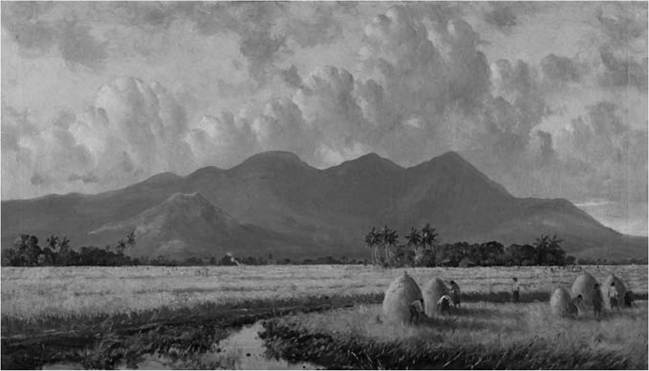
Figure 25.1 Leo Eland, Rice Field in West Java, oil on canvas, 78.5 cm x 140 cm. Source: KIT Tropenmuseum Amsterdam, inv. no. 1352-1.
most colonial paintings of rice farming thus dissociated the image of the Indonesian peasant from the graft of agricultural work.
Indies paintings of rice fields and peasant farmers promoted an historically and culturally specific georgic aesthetic in the visual culture of the Indies. ‘Georgics’ typically refers to the cultural heritage of Virgil’s didactic poem of the same title, which extolled the moral virtues of country living and the beauty of nature. Art historians have had much to say about the influence of The Georgics on early modern European visual culture, particularly the celebration of labour (and thus, the triumph of culture over nature) implicit in seventeenth-century Dutch still-life paintings and rural scenes.32 Georgic discourses are also evident in a diverse body of European colonial art from the modern era. Recent analyses of British colonial painting in Australia reveal the transformative symbolism of European labour in forging productive landscapes that supported white settlement.33 By contrast, colonial paintings of rice farming in the Netherlands Indies differ qualitatively from georgic conventions elsewhere. For one thing, Indies paintings of subsistence agriculture idealised an Asian sphere of labour rather than European ventures. More importantly, Dutch colonial views of rice farming were devoid of the transformative element that defines georgic aesthetics in other imperial contexts.34 The subsistence work that Dutch colonial paintings celebrated fell outside those fields of production (notably, plantation agriculture) where the environmental and social impact of colonialism proved most evident. It was therefore the absence of transformation—the imperceptibility of European intervention, and the ostensible continuity of traditional modes of land use among the Indonesian peasantry—that characterised colonial georgics in Indies painting.