46 From the Lion’s Gate to the Fragrant Harbour
1
Competition for access to the markets of the Far East did not wane in the early nineteenth century, even though the nations that had created the first links to China and the East Indies no longer dominated the trade of the East.
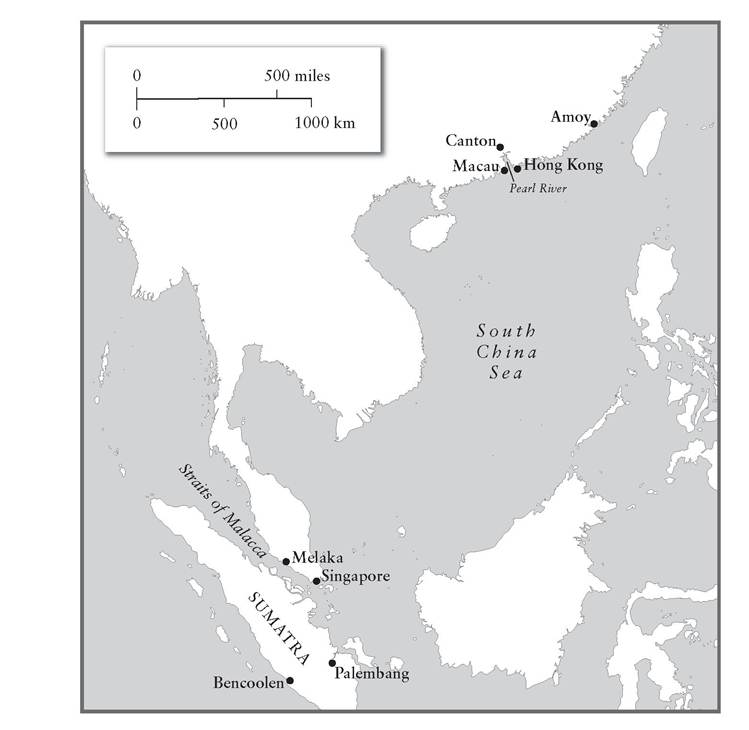
Having won Melaka from the Portuguese in 1641, after a series of attempts, the Dutch had to cede the city to Great Britain in 1795, and Britain took advantage of its war with Napoleon, and the incorporation of the Netherlands into the Bonaparte empire, to keep hold of the place for a while, without quite knowing what to do with it.1 The Dutch had never based their government of the East Indies there, preferring Batavia (modern Jakarta), which lies on Java and was therefore closer to the Spice Islands. And yet the idea of creating a base on the Strait of Malacca made good sense for any European power keen to trade through the South China Sea: it was the best place to watch for the switching of the winds as one monsoon season gave way to another, and a safe route back west opened up to shipping.2Melaka had been founded, at least according to legend, by a refugee prince from Temasek, or Singapura, generally translated as ‘the Lion’s Gate’. Fragments of sixteenth-century blue-and-white porcelain recovered from the Kallang River in Singapore reveal that the foundation of Melaka did not spell the end of Singapore; indeed, the sultan of Johor, the southernmost kingdom in Malaya, established a shahbandar, or overseer, of customs at Singapore, who was in his post by 1574. A few years later, in 1611, the Singapore settlement was burned to the ground; the entire region had become sucked into wars between the Portuguese and competing Malay and Indonesian rulers, into which the Dutch eventually inserted themselves as well. Probably there was not much to show on Singapore Island in 1703 when the sultan of Johor, who approved of the English, offered the site of the old settlement to a Scottish captain named Alexander
Hamilton.
Even when it was offered for free, Singapore was beyond Hamilton’s means, as he was expected to develop the site from his own limited resources. However, the East India Company began to recognize that Singapore lay in a perfect position overlooking the entrance to the main passageway between the Indian Ocean and the South China Sea; the islands opposite Singapore, which are now part of Indonesia, were the haunt of the Bugi pirates, who needed to be kept quiet - the surprise is that it took so long for Great Britain to create a base at Singapore.3That Great Britain did so was the result of the vision and endeavours of two employees of the East India Company, Thomas Stamford Raffles and Major William Farquhar. Farquhar administered Melaka for a while before it was returned to the Dutch at the end of the Napoleonic Wars, and had a talent for winning the trust of local rulers, which was crucial in the foundation of British Singapore. Raffles, however, is much better documented; he is one of the most extraordinary figures in British imperial history, and is generally seen as a more attractive personality than the great majority of empire-builders.4 He was born in 1781, and his origins were quite modest; he spent his early career in the gloomy offices of the East India Company on Leadenhall Street in London, joining as a clerk when he was only fourteen years old. But he was an exceedingly quick learner, and he won the attention of his superiors, so that he was sent off full of enthusiasm to Penang on the Indian Ocean coast of Malaya in 1805, as Assistant Secretary in the British administration of what, it was hoped, would become a British base to rival Calcutta and Bombay. Raffles took the trouble, unusually, to learn basic Malay; he also took a serious interest in the history and culture of the lands where he had been sent, and realized that new opportunities now existed for the British in the Far East, which would take the East India Company some way beyond its current obsession with relations with Indian princes, and might even bring the Company control of the spice trade through the East Indies, if the Dutch and their French allies could be dislodged.
When Britain succeeded in gaining control of Dutch Java, Raffles found himself appointed lieutenantgovernor, in 1811, but his attempts to introduce land reform failed to work, partly through lack of support. An important clue to his thinking is Raffles’s insistence that ‘Government should consider the inhabitants without reference to bare mercantile profits and to connect the sources of revenue with the general prosperity of the Colony.’5 This was a man who deeply deplored slavery, and who insisted that ‘all kinds of servitude should be abolished’. But social reform so far away was of no interest to the EIC in London. He was summoned back to London, and was disillusioned by the return of the East Indies to the Dutch in 1816, following the fall of Napoleon. Raffles redeemed his reputation back home - his scholarly interests were acknowledged when he became a Fellow of the Royal Society and received a knighthood, thanks to the support of Queen Charlotte. He used his time after his recall to London well, writing a History of Java in two volumes, which was as much a compendium of geography, natural history, ethnography and archaeology as a somewhat higgledy-piggledy history in the traditional sense. Dedicated, with his permission, to the Prince Regent, it was nonetheless an extraordinary work of scholarship, based on almost obsessive research and limitless curiosity.6Still, there was work to be done out East, and Great Britain still retained a small and rather neglected post at Bencoolen in Sumatra, which the Dutch had tolerated for many years. Sent there in 1818, Sir Stamford Raffles, as he now liked to be known, was disappointed to find that the Dutch were vigorously rebuilding their network in the East Indies, while Great Britain had paltry resources east of India:
The Dutch possess the only passes through which ships must sail into the Archipelago, the Straits of Sunda and Malacca; and the British have now not an inch of ground to stand upon between the Cape of Good Hope and China, nor a single friendly port at which they can water and obtain refreshment.7
To be sure, this was an overstatement (Penang was still in British hands), but Raffles managed to convince the governor-general of India, Lord Hastings, that some sort of base was needed close to the Malacca Strait.
However, the only way to achieve this was by delicate negotiation with the Malay princes; and the view in Britain was that it was important not to offend the government of the Netherlands, which was now an ally, meaning that Raffles found himself treading on eggshells. The Dutch noted how Raffles was trying to extend British influence beyond Bencoolen to the other, more valuable, side of Sumatra - Raffles had Palembang, the old capital of Èri Vijaya in his sights; they complained to the EIC in Calcutta, and Raffles was warned off. Lord Hastings insisted that Raffles should only try to obtain a patch of land for a trading base, ‘not the extension of any territorial influence’; should the Dutch have established themselves nearby, he was to go elsewhere.8 In fact, the Dutch did establish themselves a very short distance away, in the Riau archipelago, but this did not deter Raffles and his close companion, Major Farquhar (who was to become governor of the new settlement). Fascinated by the evidence that Singapore had a distinguished history many centuries earlier, Raffles retained the traditional name of the site, when standard British practice was to choose a royal name or something recalling the past history of Great Britain.9 This interest in the past only in part explains his choice of location. It was quite simply an ideal spot at which to park an EIC garrison; and the harbour, in the mouth of the Singapore River, was as good as or better than that of Melaka.Farquhar was already on good terms with the sultan of Johor, Hussein, and in 1819 a first treaty allowed the British to create a base on a small piece of land they had leased at Singapore. The event was celebrated with great pomp and ceremony as the officers and soldiers of the EIC, with Sir Stamford Raffles in charge, received the sultan of Johor in a magnificently decorated tent, its floor covered with scarlet cloth. British observers were unimpressed by the sultan: he was half-naked, and his bulging stomach and sweaty face were sharply criticized, even though it is hard to imagine that there was anyone, Malay or British, who was not perspiring heavily in that humid environment.
This agreement brought the sultan a handsome rent of $5,000 a year, in Spanish coin; it was followed a few years later, in 1824, by another treaty, by which the sultan ceded the sovereignty of Singapore entirely to Great Britain. For the sultan’s claim to rule was contested by his half-brother, and Hussein needed the British. Finally, the same year, the Dutch and the British agreed to divide and rule, with Britain taking Malaya (the ‘Straits Settlements’) and the Netherlands keeping the East Indies, though they had long been one world, culturally, economically and politically, and still use variants of the same Malay-Indonesian language.10It was a challenge to make the new settlement flourish. While the Dutch enthusiastically quoted their compatriot Grotius to assert the freedom of the seas, that generally meant their freedom of the seas. Raffles saw that the future of Singapore would depend on its role as a free port: ‘one free port in the seas must eventually destroy the spell of Dutch monopoly.’ Having instructed Farquhar that ‘it is not necessary at present to subject the trade of the port to any duties’, Raffles sailed off to Bencoolen without any suggestion about how to make the new settlement pay its way. He would need to find the means to keep the Dutch away; they blockaded Singapore harbour. But none of this prevented a remarkable community from coming into being.11 The trademark of Singapore has always been the mixture of peoples who live there, and by the time of the second treaty with Hussein the population had already reached around 5,000, many of whom had moved down from Melaka, thereby reversing the original migration over 400 years earlier that had brought people from medieval Singapore to newly founded Melaka.
Raffles came on a visit in 1822 and exclaimed: ‘here all is life and activity; and it would be difficult to name a place on the face of the globe with brighter prospects or more pleasant satisfaction.’ Taking charge of the town plan, he assigned quarters to the Chinese, Indians and other ethnic groups and mapped out where government buildings should be built.
Raffles divided his town between a government area on the right side of the harbour, still the seat of power, that stretched towards Fort Canning Hill, on which his own villa was built; while on the left side the ‘godowns’, or warehouses, of the traders were put up, with a view to attracting Chinese, Indian and Malay traffic. He thus had a vision for the future of the city - an exaggerated one, for when he died in London in 1826 Singapore still had many difficulties to overcome.12The colony continued to attract a great mix of people, but early on Singapore became a largely Chinese city, and by the 1830s it had already become the hub of the Chinese trade networks in the South China Sea and beyond, to the consternation of the Dutch in Batavia, which had been the main centre until then. In 1822, 1,776 ships visited Singapore, most of which were Asian.13 Home to only 1,000 people in 1819, it grew massively from 1824 onwards and was home to over 97,000 people in 1871. In 1867, before the town had existed for half a century, it was already host to 55,000 Chinese, mainly from the south of China, and they accounted for 65 per cent of the population. To this must be added the Chinese in transit through Singapore, many of whom became coolies in other parts of south-east Asia, or in the case of women became domestic slaves or prostitutes - a human traffic that Raffles would not have wished to see develop.14 At the other end of the social scale were the wealthy, multilingual ‘Baba’, or Peranakan, families, of mainly Chinese descent but long exposed to Malay culture - the term ‘Peranakan’ means ‘local-born’. This placed them securely in the position of middlemen, often able to make a great fortune and to live in considerable style. Baba Tan Tock Seng was born in Melaka but arrived in Singapore with the stream of Melakan Chinese who had arrived during Farquhar’s governorship. Originally a trader in chickens and greengrocery, he became the business partner of British traders, which brought him to the top of the ladder of wealth by the 1840s. Well-placed marriage alliances with mainland Chinese further enhanced his wealth and influence. He was as happy to spend money on worthy projects as to make it: in 1844 he founded the Tan Tock Seng Hospital, still in existence, at a cost of $7,000; he gave vigorous support to one of the main Chinese temples (helping to pay for the installation of a statue of the sea goddess Mazu after a lavish public ceremony); and he was appointed Justice of the Peace by the British authorities, the first Asian to hold this role not just in Singapore but in Malaya.15 Tan and his peers, partly through their philanthropy and partly through their trade, did much to create the thriving city that Singapore gradually became.
The contribution of other ethnic groups was also very substantial. Malay sailors criss-crossed the waters around Singapore, linking the new colony to the islands on the other side of the Malacca Strait and to the Malayan mainland, and helped keep the city supplied with the necessities of life, because from its own resources it could offer little apart from fish.16 One particular group of Malays, the piratical Bugis, based in the Riau islands just a short boat ride away from Singapore, upped sticks in 1820 after a quarrel with the Dutch masters of Riau, and 500 of them settled in British Singapore instead.17 During the nineteenth century Singapore attracted Tamil Indians, Armenians (whose little church is a notable monument in the modern city), oriental Jews such as the Sassoon family of Bombay, and Arab settlers such as the Alkaff family, who arrived from southern Arabia in the middle of the century and owned a good number of the warehouses along the Singapore River. These Arab traders were already active in the waters off Melaka and Java, and the fact that some of them chose Singapore as their centre of operations is proof that the idea of creating a free-trade zone there was the key to success. By the 1880s there were already about 800 Arabs living in the city.18 For Raffles understood that the prosperity of Singapore would depend on its role as an entrepot through which goods flowed and where they were exchanged; and in the longer term, as steamships came into use, it became a resupply station, offering coal as well as food, for the early steamships were extremely voracious consumers of fuel. In the long term too Singapore would flourish as a centre for the redistribution beyond Malaya of Malay goods, most famously the rubber produced on the plantations introduced by British colonists.
II
The ‘Lion’s Gate’ was indeed a gateway to the East, but it still lay a good distance from the source of the goods that Britain wanted to acquire out there. A base much closer to Canton was surely needed, so that Great Britain - or rather the East India Company - would be able to steal a lead over the old rivals, the Portuguese in Macau, the Dutch and the French. Moreover, British businessmen were looking for an easier way to pay for Chinese goods than the silver China craved and that the EIC was finding it increasingly difficult to supply. The EIC had reason to be worried about its future: it had lost its monopoly on the trade of the East in 1833, since Parliament decided that the key to Britain’s prosperity lay in free trade; and in any case the EIC had become so embroiled in the internal affairs of India that it was no longer simply a great trading cartel.
With the cancellation of the EIC monopoly, the factory premises in Canton it had occupied were filled instead by private merchants. Several of the private merchants would later dominate the business affairs of Hong Kong: William Jardine, in conjunction with James Matheson; Thomas Dent; Framjee Cowasjee, a Parsee from India who dealt in opium. Jardine was a perfect example of the enterprising British businessman in search of opportunities. He was a Scot and a graduate in medicine from Edinburgh University, but when he took passage out East as surgeon’s mate on an East Indiaman he began to realize how easy it would be to make his fortune out of the spice trade; he became active in the country trade between Bombay and Canton.19 This enthusiasm for free trade had already spurred Raffles on to the refoundation of Singapore; and it was rooted in the thinking of the British pioneers of economics, the Scot Adam Smith and the Sephardic Jew David Ricardo. Among the readers of both these authors was James Matheson, who had their books sent to him in China and became an apostle for free trade, a philosophy that he and his colleague William Jardine took to an extreme. Jardine carried his Calvinist principles to the furthest limit, so that his office contained a single chair, and anyone who came to see him had to remain standing, which meant that business was conducted rapidly.20
Facing these difficulties, the EIC turned to the trade in opium. The source of opium was, to start off with, southern Arabia, but the poppy fields of Bengal were much closer and lay under the control of the East India Company, which was happy to send out the goods through Calcutta. Thus the ‘country trade’ that had enabled Europeans to maintain their commercial empires in the Indian Ocean reached a new level of intensity. While 5,000 chests of opium, containing up to forty balls of the drug, were exported in 1820, eleven years later the EIC was handling nearly four times as many. At that point, 5,000 chests were worth somewhere around $8,000,000. William Jardine believed that opium was far preferable to alcohol; but what had been treated at first as an exotic recreational drug spread down through society as prices fell (partly in response to competition from poppy fields in western India). The result was the creation of opium dens frequented by all sorts of Chinese. The image of the Chinese at this period as semi-conscious addicts living in a haze of opium smoke was a European image that was completely at variance with Chinese official policy; but it was an image that fitted the condescending attitude of the British to another, far older, imperial power. From a British perspective what really mattered was the access opium offered to all the products of an empire that had been (in their view) far too isolated from trade with the rest of the world. This led to the paradox with which the Dutch had lived quite comfortably for a couple of centuries: free trade was conducted most easily when one’s nation possessed its own port and did not have to depend on the favours of local rulers or European rivals. This had become an especially acute problem in Canton, where customs officials interfered with merchants and their cargoes, though no doubt with good reason, in view of imperial displeasure at the opium traffic.21
This trade continued to boom despite the insistence of the Chinese authorities that they did not want it and that it had a potentially devastating effect on those who used it: ‘its obnoxious odour ascends, irritating heaven and frightening the spirits.’ These were the brave words of the Chinese imperial commissioner in Canton, Lin Zexu, who was stirred to send a complaint all the way to Queen Victoria, and who confiscated 20,000 cases of opium as well as imprisoning the foreign merchants in their factories. His actions, regarded in London as outrageously highhanded, set off a conflict with Great Britain, the First Opium War, which saw British troops capture port after port along the coast of China - Amoy, Ningbo, even Shanghai. British naval power proved unstoppable. This was a navy equipped with ironclad steamships, carrying thousands of troops, and determined to show that Great Britain would never ever suffer humiliation at the hands of a Chinese official. The short but sharp conflict was ended by the Treaty of Nanking in 1842, overwhelmingly favourable to Great Britain, in which perpetual British rule over a brand new settlement on Victoria Island was recognized.22
The British were convinced that they needed a permanent base at the mouth of the Pearl River where they would be entirely free from Chinese interference. Victoria Harbour was well sheltered; the island, with its steep mountain known as the Peak, offered little space for building compared to flat Singapore, but what was planned was a commercial station, not the teeming city that did emerge. Sir Henry Pottinger, who negotiated the Treaty of Nanking, declared that he ‘had no predilection in raising a colony at Hong Kong’, but simply wanted to gain ‘an emporium for our trade and a place from which Her Majesty’s subjects in China may alike be protected and controlled’.23 British ships were already poking into the creeks and islands that lay on the opposite side of the estuary to Macau in 1 829, when the EIC sent at least half a dozen vessels into what would become Victoria Harbour. The legal status of Macau had never been fixed; Hong Kong was to be different - a perpetual possession, with the advantage that its native population was small, maybe 7,500 people, mainly engaged in fishing, and with no sign of interest by the Chinese authorities.
Charles Elliot, the captain who planted the British flag there in January 1841, was another enthusiast for free trade. He had been entrusted with finding a suitable island or other perch along the coast of China, and, as a naval man, he was attracted primarily by the harbour, though back in London there were many doubts; Lord Palmerston was nonplussed, for it was ‘a barren island with hardly a house on it’, and ‘it seems obvious that Hong Kong will not be a Mart of Trade’, but simply a pleasure resort for British merchants who would still be tied to Canton. Queen Victoria was no more impressed, even though her name was attached to the territory. And yet had they seen Hong Kong they might have reacted differently: early visitors were also enthusiasts for the place itself, for - despite its humidity in summer - they were impressed by its lush natural beauty, its mountains and its waterways, which several writers compared to the Scottish highlands.24 In keeping with this, the name Hong Kong means ‘fragrant harbour’ in Cantonese, although the origin of the name is uncertain.
Just as at Singapore, land was earmarked for godowns, though strict conditions were attached to anyone who bought land: leases were limited to seventy-five years, and within six months the leaseholder had to spend £1,000 on construction, which guaranteed the mushroom growth of the new settlement. Sharp protests led to a change in policy: leases were extended to 999 years in 1847, but the only freehold property remains the Anglican cathedral. Jardine, Matheson & Co. were particularly active, building godowns for trade and houses for the settlers; they owned a godown ‘so extensive, as to form almost a town’. The Chinese bazaar was said to be bigger than that of Macau within a year of the colony’s foundation. Something of the tone of the colony can be gathered from the fact that one of the first buildings was that of the exclusive Hong Kong Club, at that time reserved for white British settlers, among whom Jardine and Matheson were the most prominent businessmen. Frederick Sassoon, who sat on the Legislative Council of the colony, was so worried that he would be excluded as a Jew that he did not apply for membership.25
From 1843 onwards Chinese settlers were also encouraged to come and live under the British flag, and there were at least 30,000 of them by the middle of the century, which was seventy-five times the number of Europeans, Indians and Americans. As in Singapore, the richest Chinese were often also the most generous philanthropists. All this resulted in a pleasing flow of trade: in 1844, only three years after the colony was established, it was visited by 538 recorded ships. Although the Treaty of Nanking had brought much-valued access to Shanghai and other ‘Treaty Ports’, Hong Kong rapidly seized the role of centre of operations, benefiting from its special status as a Crown Colony in which, unlike the concessionary areas of the Treaty Ports, Chinese officialdom had no influence at all. Moreover, having won the Opium War, Great Britain did not need to worry about its involvement in the opium trade, which completely dominated the trade of early Hong Kong, so much so that people used cakes of opium as currency and Macau lost its own opium business to Hong Kong. So firm was British ascendancy along the coast of China that the opium-traders had no difficulty in distributing the drug to buyers on the mainland.26 This ascendancy was consolidated by the Second Opium War, which broke out in 1856 after Chinese troops mugged the captain of a British schooner out of Hong Kong. Canton was occupied (with French collaboration), Beijing was raided, and the Chinese were forced once again to make a humiliating peace. This gave the British access to yet more Treaty Ports, as well as the right to trade inland; and it brought part of Kowloon under British rule, the beginning of a gradual extension of British rule over the southern tip of the Chinese mainland.
Hong Kong and Singapore became essential links along the chain extending all the way from London and Liverpool to the Far East. The idealism of Raffles and Farquhar stands at some distance from the materialism and cynicism of those who promoted the opium trade through Hong Kong. Their continuing role as major international centres of trade and their transformation from cities marked by both extreme affluence and extreme poverty into two of the wealthiest cities in the world are excellent examples of the way in which maritime trade has fundamentally altered the world.