47 Muscateers and Mogadorians
I
Historians have rightly insisted that a strongly Eurocentric view of the world’s history distorts reality; we are prisoners of our sources, but it is sometimes possible to break free and say something about less well- documented activities among non-European peoples.
Even there, though, the shadow of Europe often hangs over what at first sight appear to be autonomous networks of maritime trade. An important example is provided by the history of the sultans of Oman, whose political and commercial power extended at its peak from points south and west of Zanzibar in east Africa, past their old capital at Muscat in Oman, and along the shores of what are now Pakistan and India, including the trading station at Gwadar, which the rulers of Oman only ceded to Pakistan in 1958, for a handsome fee of 5,500,000,000 rupees. The Omani ‘empire’ largely consisted of a string of pearls stretched across a vast expanse of the western Indian Ocean. By the middle of the nineteenth century the most valuable of these pearls was the small island of Zanzibar, previously a place of no great importance. This, then, was another of the newly successful trading towns of the era and, despite the involvement of the British and the French in its emergence, the real initiative came from the sultans themselves. Their success was based on three commodities: cloves, ivory and slaves, and their slave trade boomed just as the slave trade in other parts of the world was being vigorously suppressed by the British Navy.Oman was already a lively centre of naval activity in the seventeenth century. By the middle of the century the Omanis had recovered Muscat from the Portuguese, and, once free from foreign shackles, the Omanis established a reputation for themselves as fearsome pirates. They raided the Portuguese bases along the coast of east Africa, as far south as Mozambique, beginning with an attack on Zanzibar in 1652, on Mombasa in 1661 and culminating in the capture of Mombasa in 1698.
They also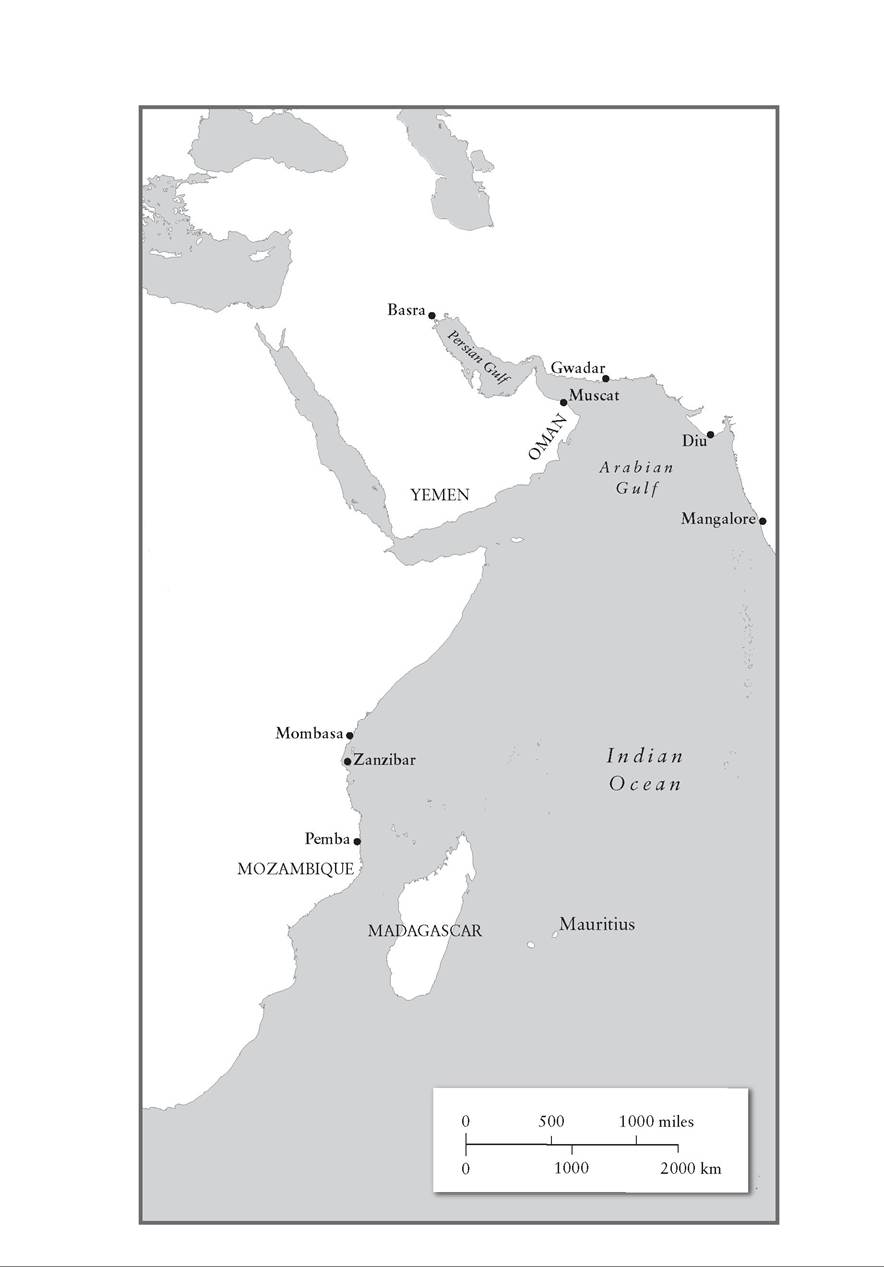
looked eastwards, sacking the Portuguese trading station at Diu in India in 1668.1 The rise of Oman was not all plain sailing, though, as there were endless civil wars and contests for the throne; this left Mombasa for a long time under a different ruler, but the Omanis compensated by acquiring Zanzibar and its neighbour Pemba during the next century, thereafter extending their control over much of the Swahili coast and building commercial links through Arab merchants some way into the African interior. From there they acquired not just the ivory for which demand in western Europe was constantly growing but the slaves whom the French were using as a labour force in their sugar plantations on Mauritius and Reunion.2
Meanwhile Oman flourished as its ships inserted themselves successfully in the trade in coffee out of Yemen. By 1774, according to a British witness, most of the Mocca coffee carried up the Persian Gulf to Basra arrived on board Omani ships based in Muscat. The British were never far away: there was a British ‘resident’ in Basra who was entitled to a share of the import duties on coffee, by agreement with the Ottoman government of Iraq. The British praised ‘the friendship which subsisted betwixt us and the Muscateers’. As their involvement with the European trade networks deepened around 1780, the ‘Muscateers’ penetrated markets in India as well, as far south as Mangalore, bringing the produce of Arabia - pearls, incense, dates, sold in exchange for sugar and spices which they bought from the Dutch, including products of the East Indies. As they became more involved with India, the Omanis attracted Indians, or ‘Banyans’, to their own shores, and communities of Indian merchants began to form in Muscat and, in due course, all the way down the coast of east Africa in the Omani-ruled ports. Around 1800 an Indian named Mowjee was customs farmer in Muscat: ‘a fat cunning Man and the richest Subject in the Place’, according to an English witness.3 In 1762 the British in Bombay decided they needed plenty of slaves, who were to be sent to the new East India Company base that was being set up in Sumatra.
The EIC turned to an Indian merchant in Muscat, and he provided a batch of African slaves for 10,000 rupees. Muscat began to acquire a reputation for its safety and its sheer convenience, particularly compared to ports within the Gulf that the Europeans had been using in the past; thieves suffered the Koranic penalty of losing their hand, so that ‘merchandise lye constantly in the Streets, without the least fear of Pilferage’.4The Omanis did not simply rely on traditional dhows, large and small, in all their variety. By the end of the eighteenth century the sultan was commissioning square-rigged ships of European design in India; in 1786 he is said to have possessed eight men-of-war, for alongside peaceful trade the sultan engaged in naval wars with his rebellious subjects, and the size of the fleet doubled in the last quarter of the eighteenth century, as did the volume of coffee handled by the Muscateers.5 Before 1800, then, the Omanis had established themselves as valuable middlemen between the European colonies in India and Indonesia and lands ruled by the Ottomans, the Persians, African rulers and themselves. Their range extended as far as Calcutta, the new British base in India, even though this meant they had to sail their ships right round the subcontinent; but there they could mix with merchants and sailors from almost every maritime nation under the sun.6 They could also take advantage of the steady reduction in importance of the Portuguese, in the Indian Ocean, both politically and commercially, and exploit the rivalry between other Europeans to insert themselves successfully into the maritime trade of the Indian Ocean.7
The rise of Muscat is only part of the remarkable story of the Omani maritime empire. Like the commercial empire of the ancient Phoenicians, it was built around ports, islands and trading counters; and like the Phoenician trading empire its centre of gravity shifted from its place of origin to a far-off base: Zanzibar was the new Carthage.
Around 1800 Zanzibar was still ‘composed of some few houses, and the rest are huts of straw mat’, in the eyes of a British visitor. Yet it had already become the main meeting point in the western Indian Ocean for Europeans, Arabs, Indians and Africans, famous for its supplies of ivory.8 By 1744 an Omani governor operated from Zanzibar, and by 1822, when the sultan signed a treaty with Captain Fairfax Moresby, representing Great Britain, in Muscat, the Omani ascendancy was clear. Under the terms of this agreement the Omanis promised to cease selling slaves to the western Europeans or in India, as part of the great British crusade against slave-trading across the world.9This had the unexpected result of stimulating the Omani trade in east African slaves, as other sources of supply dried up, for there were still swathes of territory where slaves could be bought and sold, in their tens of thousands, including the islands of Zanzibar and Pemba. The worst form this already horrible trade took was the callous, indeed murderous, treatment of African boys in a Coptic monastery on Mount Jebel-Eter in Sudan that specialized in castration. Clamped to a table, the victims had their penis and scrotum removed in one quick swipe, leaving ‘a large, gaping sore that does not heal kindly’, all the more so since there was little attempt to staunch the flow of blood. The boys were then buried in packed sand to keep them immobile; ‘it is estimated 35,000 little Africans are annually sacrificed to produce the Soudanese average quota of its 3,800 eunuchs.’10 Even if the assumption that mortality approached 90 per cent is an exaggeration (and it is impossible to say), demand for eunuchs in princely courts around the Indian Ocean did not slacken.
The attractions of Zanzibar became more and more obvious to the sultans. One practical advantage was the quality of its well-protected deep-water harbours, and another was the excellent supply of fresh water, while the fact that it was a small island close to the African shore provided natural defences.11 Sayyid Said bin Sultan made the decision to transfer his centre of government from Muscat to Zanzibar.
He was a great traveller, visiting Zanzibar in 1802, aged only eleven, and again in 1828, while the Omanis were once again trying to conquer Mombasa. At this point he seems to have laid plans for the move, building a new palace and finally settling there in 1832; according to tradition he set sail on a ship owned by one of his favourite Banyan, or Indian, merchants. He lived another twenty-four years, so he had plenty of time to consolidate his interests in east Africa, as well as presiding over the growth of Zanzibar City. That became his preferred residence, but he continued to travel back and forth between his domains, dying while en route to Zanzibar on what would have been his ninth trip. Thus he took care not to neglect his ancestral lands just because his main base was now far away in east Africa.12By now the Moresby Treaty was beginning to bite; but that did not prevent the sultan from devising a new way to make a fortune. The great transformation that now took place was the development of clove plantations in Zanzibar and Pemba, the most successful attempt so far to create a major source of this spice outside the Moluccas; it is said that he ordered his subjects to plant three clove trees for every one coconut palm on their land, subject to a penalty of confiscation of their farm if they failed to comply.13 Transplanting cloves to soil closer to Europe had been the dream of colonists in Madagascar, Mauritius and elsewhere. In addition, vast numbers of elephants were slaughtered in the African hinterland to supply European demand for high-quality ivory; Arab and Swahili merchants penetrated deep into the interior, as far as Lake Nyasa, in their search for African goods. A very active market for ivory emerged in the United States, as elephants were sacrificed to manufacture piano keys, combs and billiard balls, while Zanzibaris hungered for American cotton cloths. In 1828, while Sayyid Said was in Zanzibar, he received an American merchant named Edmund Roberts and encouraged him to ask the US government to enter into a trade treaty.
This was duly signed, and the benefits for the Omanis went beyond simple sales of raw materials: in 1840 an Omani ship, the Sultanah, sailed all the way to America, with the sultan’s ambassador on board. Ivory prices continued to rise, and at the same time the cost of manufactured goods sent from Europe and America continued to fall. This placed Zanzibar in a very advantageous position. Indeed, Sultan Said was receiving more than 500,000 Maria Theresa silver dollars (MT$) from customs dues and taxes levied in east Africa and Oman by the time of his death in 1856. By 1890 revenues from Muscat were in steep decline, but for Zanzibar this was only the beginning as revenues soared to reach MT$8oo,ooo.14II
The patronage Sultan Said and his successors extended to Indian merchants, in many cases Hindu or Parsee, has intriguing parallels on the other side of Africa. Religious outsiders might suffer discrimination, but they could also build especially strong bonds to a ruler who cared for them. In the far north-west of the continent another dynasty of Muslim rulers anxious to make big profits out of trade extended its protection to Jewish merchants, and there too the result was the flowering of a new city.15 Today Essaouira in south-western Morocco makes its money from tourism (the strong winds attract plenty of surfers) and from argan oil, of which it is the world’s only source. However, before the First World War it was Morocco’s window on the world, a place where merchants from England, France and Spain, along with Sephardic merchants from Morocco itself, and the sultan’s watchful government, collaborated in a largely successful attempt to make it the richest port in Atlantic Morocco. Generally known, until Morocco recovered its independence in the 195os, as Mogador, it will be called by that name in this chapter.
Like Hong Kong, Singapore and Zanzibar, Mogador was to all intents a new town, although the Phoenicians had traded from the rocky offshore island of Mogador, and the Portuguese and other foreign powers briefly occupied the site. Mogador’s advantage was that there was a straight run across country to Marrakesh, which vied with Fez for the role of capital of Morocco, and which was the gateway through which much of the transSahara caravan traffic passed. While it never rivalled in size Alexandria or Beirut, the intermediary role of Mogador gave it an importance out of all proportion to its physical size and population - up to 2o,ooo inhabitants towards the end of the nineteenth century, of whom at some points as many as half were Jews. The growth of this trading centre transformed the society and economy of the entire region, resulting in the creation of a ‘capitalist’ class of landowners and merchants, as well as increasing dependence on foreign rather than locally produced goods; and the ripples were felt as far away as sub-Saharan Africa, England and even China.16
Sidi Muhammad ibn Abdallah, the sultan of Morocco, founded Moga- dor in 1764 with the specific intention of making it into the prime centre
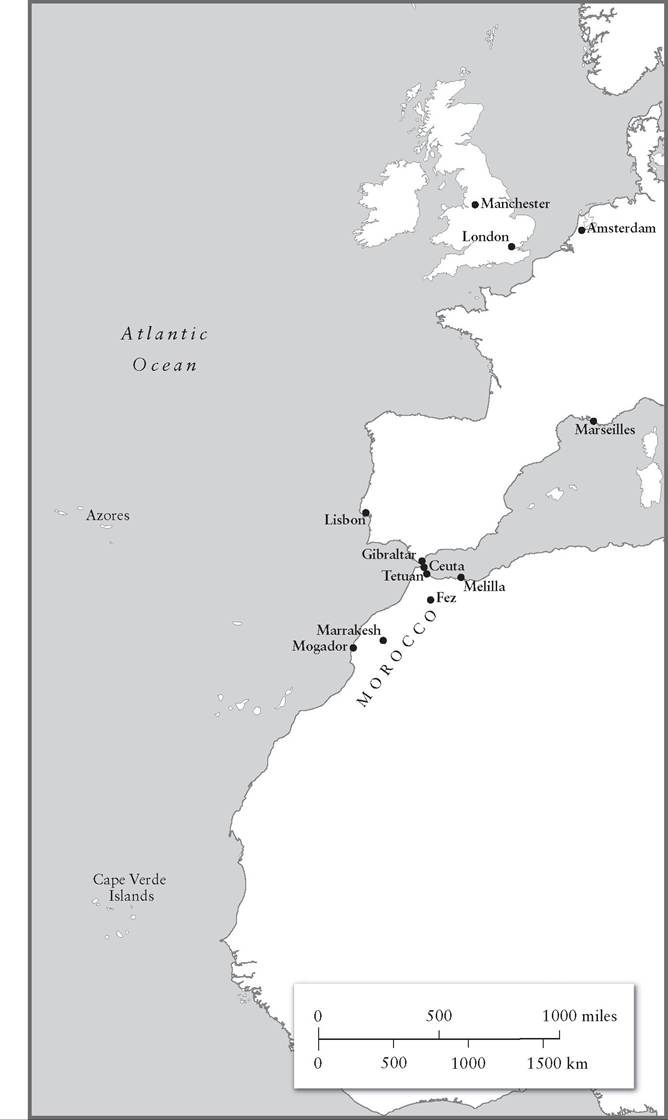
of trade with Europe, which also meant that it could tap into Europe’s trade across the oceans. The Danes had received generous concessions all along the Atlantic coast of Morocco in 1751, giving them a monopoly on foreign trade, and the sultan now realized that it was more in his interests to take charge of foreign trade himself: he wanted control of the revenues, and he wanted to increase his authority in southern Morocco. Despite the strong winds, the harbour was thought promising, better than others along an otherwise rather desolate coastline. Sidi Muhammad was happy to invest heavily in this port, commissioning buildings by foreign architects, who laid out the streets, squares and major buildings of the town on a square plan similar to that of new European cities - its elegant ‘Portuguese’ fort supposedly of the sixteenth century was in fact built by the Genoese in the eighteenth century.17 But Sidi Muhammad also needed to populate Mogador, and the local Berbers could not provide the experienced mercantile class he was seeking. So, on the advice of a Jewish adviser at his court, Samuel Sumbal, he nominated members of ten wealthy Jewish families from across his realms, several from his own capital at Marrakesh - families such as Corcos, Macnin and Sebag, who would play a vital role in the success of nineteenth-century Mogador, while several of these names became well known in business circles in London and Paris, as the families set up trading houses in Europe. Many of them were drawn from families that had arrived from Spain and Portugal at the end of the fifteenth century, for Moroccan Jewish society was sharply divided between a closed group of wealthy families claiming Spanish origins and a large mass of poorer Jews, living in their towns and villages since time immemorial, and sometimes descended from ancient Berber converts to Judaism.18
A crucial aspect of the sultan’s relationship with the Jews was that they were, to use his own phrase, his Jews. This did not mean that they were his property, any more than the use of similar phrases in medieval Europe had meant that Jews were the slaves of Christian kings. But Islam prescribed a particular relationship between Muslim governments and Jews (or Christians - but native Christians were absent from Morocco). They were accepted as part of the fabric of society, ‘second-class citizens - but citizens’ in Bernard Lewis’s concise formulation. They were dhimmis, meaning ‘protected persons’, but they were not to exercise direct authority over Muslims. When fully applied, the restrictions imposed on the main mass of Moroccan Jews were often humiliating and severe: if a Muslim struck a Jew, the Jew had no right to reply in kind; they were ordered to wear dull black clothes; and so on.19 However, they were free to practise their religion; and the leading families found ways to avoid or claim exemption from the disabilities. Precisely because they stood outside the political jungle of tribal and factional politics, rulers saw them as neutral but dependent and dependable agents, and nowhere more so than in the world of trade, where their knowledge of languages and family connections across wide spaces qualified them extremely well for the sultan’s patronage.
So it was that families such as the Corcos, descended from Spanish refugees who had arrived in Marrakesh by way of Portugal and Fez, found themselves the intimates of the Moroccan sultans, advising the royal palace on political developments in the countryside, which their agents observed as they travelled between Mogador and their markets in the interior.20 They and a few other leading families became the ‘merchants of the sultan’, tujjar as-Sultan; but this was more than a title, for they actually traded on the sultan’s account, theoretically at least with his rather than their money; ‘the sultan was in effect the pre-eminent merchant of the country.’21 The underlying reality was that the sultan’s own resources depended significantly on loans, taxes and gifts from the tujjar. All this was arranged carefully, since Islamic law forbids the direct payment of interest, with the result that the merchants paid a share of their profits to the sultan, rather than paying him interest on the sums that the government had entrusted to them for trade. When the father of Abraham Corcos died in 1853, the sultan sent letters to Corcos stating that ‘your father was our friend and was one of us - his death has greatly distressed us’. A few years later, a letter arrived from the sultan’s palace, reminding Abraham’s brother Jacob that the sultan had ordered American linen cloth for his army, and asking for still more to be supplied to make covers for army horses. The supply of uniforms for his army depended heavily on the Corcos family’s links to the outside world.22
With the sultan’s blessing, then, the Jewish merchants dominated and looked outwards from Mogador. They were permitted to live in the fortified casbah, the royal quarter, while poorer Jews were ordered to live in the Jewish quarter, or mellah, established in Mogador in 1806.23 At the end of the nineteenth century the right to live in the casbah was a special mercy, as immigration from the countryside by poor Jews led to severe overcrowding in the mellah, which became notorious for disease. The casbah, at the other end of town, contained handsome town houses built around shady courtyards in the traditional Moroccan style, several of which have now been converted into riyad hotels for tourists.24 From the houses overlooking the royal square the sultan’s merchants were able to look down on the harbour, barely five minutes’ walk away, and see their goods being unloaded. Their own partnerships mirrored those of the Cairo Genizah a millennium earlier: they entered into written contracts where a sleeping partner put up funds and sent a travelling partner off on business, looking forward to a division of the profits on his return. These partnerships also took another form, as the leading business families married among themselves, or occasionally made marriage alliances with Sephardic families with whom they traded in London, Livorno or Lisbon, in Gibraltar, Marseilles or Amsterdam.25 It was a tightly knit community and yet it was also a widespread one.
Foreign contacts took another form too. Abraham Corcos became viceconsul for the United States in Mogador in 1862. He extended US consular protection to his agents trading across Morocco; this unsettled the Moroccan authorities, because placing Jews under foreign protection undermined the claim of the sultan to be their protector. Corcos’s initiative was followed by other honorary consuls in Mogador, as also happened in Alexandria, Salonika and Smyrna. It is not clear that Corcos’s English was at all good, but what the foreign powers wanted was someone who could communicate on the ground. A photograph of him from 1880 shows an elderly bald figure in a frock coat, which increasingly became the uniform of the Mogador Jewish merchants.26 This was part of a wider process of acculturation not to Moroccan but to European habits. Although the merchant houses were splendid examples of traditional Moroccan domestic architecture, the life lived within their walls took on an increasingly western European character, for the Mogador elite, like the Sephardic elite in Salonika or Alexandria, became fluent in French and English, and even established an English-speaking school.
The Sephardic diaspora, out of which early generations of Portuguese merchants trading in Italy, Turkey, the Atlantic islands, the Caribbean and even India had emerged, continued to hold together as Mogador came into existence. There were also some wealthy Muslim merchants in Mogador, with whom relations seem to have been perfectly cordial, but the significant business community other than the Jews consisted of the foreign merchants from England, Holland, Denmark, Spain and elsewhere. They were particularly important before 1800 - there was a Franciscan church to cater for the needs of the Spanish merchants. For more than forty years, from 1845 to 1886, a British consul, John Drummond Hay, exercised great influence in Mogador.27 Great Britain was the biggest trade partner of Morocco by 1800. This meant that the Jews of Mogador and other Moroccan towns, who possessed close ties with the Spanish and Portuguese Synagogue in London, and who often had relatives in Gibraltar, were ideally placed to serve his needs.28 A series of trade agreements between Morocco and Great Britain culminated in a treaty signed in 1856 that abolished or lowered many taxes and set a standard for future British
trade agreements elsewhere in the world. The treaty acted as a spur to the vigorous development of trade through Mogador, in tea, sugar and Western manufactures.29
It has been seen that the sultan was keen to buy American cloth, but English cloth was in greater demand, woven in Manchester, where the Jewish families of Mogador often had agents, relatives and investments. Aaron Afriat set himself up in business in England in 1867, and specialized in tea and cloth. Indeed, at-Tay Afriat, ‘Afriat Tea’, was the Moroccan equivalent of Twinings or Tetley, available all over Morocco by way of Mogador, while Afriat’s linen cloth was sold right across the Sahara.30 Tea was the greatest contribution of the Mogador Jewish traders to Morocco - indeed to Moroccan civilization. Here was a product of India and China that had been carried from the Pacific, or at least the Indian Ocean, all the way to England, before being re-exported to north Africa. Although it was brewed and drunk in different ways to England (no milk but several sprigs of fresh mint), tea captured the markets of the Maghrib as successfully as it had already captured the markets of England, Sweden or the United States. Linked to the tea trade was the sugar trade out of the West Indies, since the Moroccans preferred their tea very sweet, generally placing a large lump of sugar in the mouth of the teapot, over which they poured hot water. The use of boiled water improved health across the north African population. As the tea craze gripped Morocco, demand for Chinese and Japanese porcelain grew in wealthy households, and it was brought in by way of London or Amsterdam.31
Morocco had much less to offer to the outside world. When Meir Mac- nin, who dubiously claimed to be the sultan’s ambassador to the Court of St James, sailed to London in July 1799 aboard the Aurora there was nothing very exotic about its cargo of goatskins, calf hides, almonds and gum arabic. Morocco leather was the most famous product, and reached markets as far afield as Russia, by way of English or other intermediaries. Mules were sent to the West Indies. The sultan occasionally banned the export of potentially lucrative products such as olive oil and honey. There was, though, active demand for Moroccan cattle in Gibraltar, primarily to feed the British garrison, and the sultan had a consul there from 1796 or earlier. This trade, largely out of Tetuan rather than Mogador, netted the sultan a nice income.32 However, the sultan’s interest in Gibraltar was not simply economic: there were times when Sidi Muhammad imagined he could earn the trust of Great Britain and win support for his attempts to gain control of the Spanish presidios of Ceuta and Melilla. Moreover, the trade with Gibraltar had a military dimension: he obtained gunpowder and naval stores through the Rock.33 Signs that Morocco might have more to offer were visible in 1784, just after the Great Siege of Gibraltar, when some merchants based on the Rock mentioned in a report that gold dust, ivory and ostrich feathers were now arriving. Later, by way of Mogador, the trade in ostrich feathers to England, France and elsewhere was to develop into a very lively business during the nineteenth and early twentieth centuries, driven by changing fashions in Europe. Yet what is also significant about these three products is that they were drawn from subSaharan Africa, carried on camel caravans all the way to the Atlantic coast for trans-shipment to western Europe. Just as Zanzibar was the gateway to the produce of south-eastern Africa, Mogador was the gateway to the produce of large tracts of west Africa.
III
Further proof that the Sephardic trading network had not lost its vitality within the Atlantic is provided by the way Moroccan Jews seized new trading opportunities across the Portuguese island world. Lisbon, already home to New Christians who practised their old religion out of sight, attracted settlers from Mogador and other Moroccan towns, and in 1816 the Portuguese government agreed to readmit those living openly as Jews.34 Jews from Portugal and Morocco struck out across the Atlantic. Important economic initiatives were begun in the Portuguese Azores during the nineteenth century, thanks to the Bensaude family, one of whom became a leading figure in Portuguese academic life (and an expert, among other things, on the voyages of discovery), while their company still dominates the economy of the archipelago. They arrived in 1818, and they exploited business contacts with England to tap into the shipping lines linking the Azores not just to Portugal, Great Britain and Morocco, but to Newfoundland and Brazil. One particularly prominent Jewish businessman was Elias Bensaude, who possessed an enormous variety of interests, including a tobacco factory and i nter-i sland trade. He had a penchant for oranges, which he sent in all directions, thanks to his close collaboration with partners in London, Manchester and beyond, from where he obtained ironmongery and other essentials that he sold in the islands. Although his family did much to transform the Azores from a sleepy outpost of Portugal into an Atlantic hub, the Bensaudes were by no means alone, and there was a steady stream of Jewish immigrants from Morocco, so that in mid-century fifteen out of 167 members of the Commercial Chamber in Ponta Delgada, the capital of the Azores, were Jewish immigrants.35
Looking even deeper into the Atlantic, Moroccan Jews settled in the Cape Verde Islands, which had once been the haunt of New Christians. As Great Britain placed increasing pressure on its ‘oldest ally’, Portugal, to abolish its all-too-active slave trade, from 1818 onwards the Cape Verde Islands came under increasing scrutiny, as Portugal’s main holding station for African slaves despatched to the West Indies. Looking for a source of income other than slaving, the Portuguese colonial regime installed coal depots in the islands, notably at Mindelo on Sao Vicente in 1838; the rise of the steamship created new opportunities for anyone prepared to maintain massive stocks of coal. But that meant importing coal; these are volcanic islands totally lacking in coal mines. In 1890, 156 ships are said to have unloaded more than 657,000,000 metric tons of coal, in a year when 2,264 ships visited Mindelo. It is hard to believe this figure, but even if it is exaggerated the fact remains that these ships carried nearly 344,000 people and that their cargo (other than coal) amounted to well over 4,000,000 tons.36 Whatever the correct figures may have been, Mindelo attracted Jewish merchants from Tangier anxious to service this trade alongside coal merchants from England.37
The two examples of Zanzibar and Mogador are of special interest as success stories in which non-European rulers took important economic initiatives, making full use of the non-Muslim communities in and beyond their borders. That said, the European and American connections were vital to the success of these ports, and in both cases their rulers understood the importance of trade treaties with European powers. Similar stories of success can also be told about other marginal groups whose members took advantage of the expansion of commerce across the oceans to set up trading counters in improbable places: Armenians, Syrian Christians, Greeks (some of whom penetrated deep into central Africa), Indians (in South Africa). Sailors too came from many backgrounds. The Indian Ocean had provided manpower on board European ships since the sixteenth century; the ‘Lascars’ who helped sail European ships originated in lands as diverse as Somaliland, Yemen, India, Ceylon, Malaya and the Philippines, though in their case ill-treatment sometimes gave rise to mutiny against European captains. Still, without them it is hard to see how the routes across not just the Indian Ocean but all the oceans could have been maintained.38 Another group of Jews, not Sephardim of Spanish and Portuguese descent but Mizrahi (‘eastern’) Jews from Baghdad, played a prominent role in the economic development of Hong Kong. In the age of the steamship the opportunities were endless and distances somehow seemed more manageable. Maybe, indeed, they could become more manageable still if ways through Suez and Panama could be created.