48 Continents Divided, Oceans Conjoined
I
The search for more direct routes from Europe to the Far East had continued without interruption since the days of Columbus and Cabot. The possibility of an Arctic route was still being mooted when Sir John Franklin led his disastrous and long-lamented expedition to the icy wastes north of Canada in 1845.1 The increasing role in international trade of the eastcoast ports of the United States also stimulated thinking about new routes to the riches of the Orient, since the voyage around Cape Horn and the voyage past the Cape of Good Hope were long and sometimes dangerous.
In addition to the Pacific fur trade, the Americans were heavily involved in whaling, sending ships out from Nantucket and into the Pacific by way of the Indian Ocean. Ships suitable for whaling began to be constructed in Nantucket in 1694, and other New England towns followed suit: New Bedford had eighty large whalers by 1775. At first these ships hunted whales in cold northern waters or (when searching for sperm whales) in the warmer waters of the central Atlantic, but they began to penetrate the Pacific as well, by way of Cape Horn; in 1850 the whaler Hannibal sailed all the way to the still impenetrable north-west coast of Japan, three years before Commander Perry’s famous attempt to break into Japanese trade.2 Herman Melville enthused about the Pacific in his tale of American whalers, Moby-Dick:To any meditative Magian rover, this serene Pacific, once beheld, must ever after be the sea of his adoption. It rolls the midmost waters of the world, the Indian ocean and Atlantic being but its arms. The same waves wash the moles of the new-built California towns but yesterday planted by the recentest race of men, and lave the faded but still gorgeous skirts of Asiatic lands, older than Abraham; while all between float milky-ways of coral isles, and low-lying, endless, unknown Archipelagoes, and impenetrable Japans.
Thus this mysterious, divine Pacific zones the world’s whole bulk about; makes all coasts one bay to it; seems the tide-beating heart of earth.3After the United States acquired California from Mexico in 1848, American interest in the Pacific grew further; but a transcontinental railway was still a dream, and it was far easier to send Asian goods to New York by way of Mexico or the isthmus of Panama than across the Rocky Mountains and through the large expanses inhabited by native Americans. On the other hand, rumour had it that Japan was rich in coal, and naval strategists could see that it was vital to create coaling stations around the globe now that the steamship was coming into its own, as Great Britain had managed to do in Mindelo and elsewhere. Coal rather than silk brought the Americans to Japan. The Japanese were startled by Commander Perry’s ‘black ships’, belching smoke, when the Americans reached Edo Bay in 1853, in an episode that is, rather exaggeratedly, seen as the moment Japan opened up to the wider world after centuries of near seclusion.
Like Ishmael in Moby-Dick, Perry had set out from the east coast of America, not from California. Perry travelled most of the way on a steam- powered paddleboat that took him around the bottom of Africa to Macau, Shanghai and the Ryukyu Islands, before he brazenly forced his way into Edo Bay (now known as Tokyo Bay), parading his ironclad steamboats and his firepower and flatly refusing to follow Japanese instructions: as far as the Japanese were concerned, there was a single place, Nagasaki, where foreigners could trade. Although he managed to secure a treaty on a second visit, in 1854, the agreement focused on consular representation for stranded sailors rather than trade, and powerful interests at court remained very hostile to the idea of opening up the imperial ports. In the short term, the main effect of Commander Perry’s visit was that the Dutch argued for more generous terms of trade through their base at Deshima, and the Russians and the British obtained similar rights to the Americans.
It was not much; but the door to Japan was open a crack, and a commercial treaty was signed in 1858, permitting the Americans to trade through Yokohama, near Edo. From the American perspective the advantages of trading directly with Japan remained limited while the route to Japan was so arduous. From the Japanese perspective, trade with the outside world was at best a mixed blessing. The Americans might not yet account for much, but taken together foreign trade had a massive impact on the economy of Japan. Foreign goods began to compete with domestic products; powerful foreign demand for silk, tea and copper forced up prices for Japanese consumers; the low price of gold in relation to silver within Japan created strong foreign demand for its gold, which flowed out relentlessly and was replaced by foreign silver. These changes were not easy to absorb: they happened fast, and on an alarming scale; between 1854 and 1865 the price of raw silk trebled, and the price of tea doubled; even the price of the staple foodstuff, rice, shot up.4 Not surprisingly, then, the arrival of the ‘barbarians’ opened up new controversies within Japan: should the intruders be welcomed, as one party more loyal to the shoguns insisted, or should they all be expelled, as the first stage in a return to traditional values, including proper reverence for the emperor rather than the shogun - to cite the much-read author Kamo Mabuchi (d. 1769), ‘the Way of the gods is superior to the Ways of foreign lands’? The debate about the ‘barbarians’ and other arguments about the reform of government in Japan culminated in the abolition of the shogunate in 1868 and the creation of the emperor-centred Meiji regime, dedicated to modernization on Japanese terms. As Macpherson noted, ‘Perry’s black ships symbolize the challenge of possible western colonization. The response was not to withdraw further into an isolationist posture but to emulate and catch up with the West.’ The encounter with Perry and with other foreign ships helped create a curious amalgam combining Japanese civilization with European technology.
Vigorous and imaginative reforms attempted, with varying success, to adapt Japanese society to its new outward-facing existence, notably the creation of a Ministry of Commerce which made government loans available to producers.5The foreigners were not expelled and the Americans became keen to capitalize on their new opportunities. Reaching Asia would become much less difficult if transit through the narrow neck of Central America could be made easier. Panama had long been a transfer point for goods brought from China and the Philippines. The name Panama meant ‘the place where many fish are taken’. It was originally applied to a little town on the Pacific that was wrecked by Henry Morgan in 1671, whereupon a new settlement was created on the site of modern-day Panama City. Both gave access to a ‘royal road’ that was barely a mule track, across which goods were humped to Nombre de Dios, a very modest little port on the Caribbean, founded as far back as 1510. It failed to flourish since the larger town of Veracruz, in Mexico, was adopted instead as the main departure point for the ships carrying Asian goods, as well as Central American ones, towards Europe. But, in the eyes of nineteenth-century observers, the location looked just right for a railway linking the two oceans, or even - maybe an impossible dream - a canal cutting right through Central America.6
II
Although, after many frustrating decades, the Panama Canal was eventually built by the United States, the pioneers of this great project, the largest engineering project in human history, before the late twentieth century, were not American but French. Their enthusiasm for a canal through Central America was generated in part by their success in promoting what, on the surface, seemed a similar scheme, the Suez Canal.7 Ambitious canal projects across large areas of land were in vogue in the middle of the nineteenth century: other examples of massive, and very successful, canal projects included the Erie Canal linking the Great Lakes in North America to the Hudson River and the sixty-mile Caledonian Canal across Scotland.8 Actually, the digging of a canal between Africa and Asia was a lesser challenge than the building of the Panama Canal: the land was fairly flat; it was not crossed by powerful rivers; heavy rains did not interfere with the project; there were saltwater lakes through which a route could be dredged; there were traces of much older canals that proved such a route was possible; a labour supply was available among the Egyptian fellahin.
There was, it is true, some anxiety about the lower level of the Mediterranean compared to the Indian Ocean; and, as at Panama, there were political and financial challenges that had to be met in addition to the technical problem of actually digging the canal.The building of a canal through Suez excited romantic ideas of the ‘conjoining of East and West’ in ways that the building of a canal through Panama did not. In the 1830s Barthelemy-Prosper Enfantin became the self-appointed apostle of a new world order in which East and West would join in a single ‘nuptial bed’, consummating their marriage ‘by the piercing of a canal through the isthmus of Suez’.9 Enfantin was by any standards a colourful eccentric, with his sky-blue cloak and his exaggeratedly pseudo-oriental costume; but the Parisians took him to their heart, and his insistence (guided by the thinking of Saint-Simon) on the urgent need for both material and moral improvement appealed not just to the French but to the rulers of Egypt, beginning with the redoutable Muhammad Ali. But Ali was less impressed by the argument for a canal than he was by the arguments for modernizing, even attempting to industrialize, Egypt: trade through Alexandria and other ports produced much-needed revenue for the treasury; and Ali was, nominally at least, only the viceroy of the Ottoman sultan in Constantinople, who was opposed to the plan, as, initially, were the British, who valued the existing link between Alexandria and England - a steam packet set out from Falmouth in Cornwall every month, bound for Malta and Alexandria. The last thing Great Britain wanted was France fishing in its own waters within the Indian Ocean, which would become much easier if a canal carried French shipping from Marseilles to India.10
Once Muhammad Ali had died, French attempts to convince the viceroy of the financial benefits Egypt, or rather the rulers of Egypt, could draw from a canal began to succeed. Its great proponent, Ferdinand de Lesseps, turned his charm on the new viceroy, Said, whose passion for macaroni had made him thoroughly obese; but he was a clever enough political operator, and he fell in with de Lesseps’s attempts to sell shares in the scheme.
This did not work out well for Said: when the shares offer was undersold, Said had to pick up the remaining shares, but at least the pro- j ect was well under way by the time that Said died in 1863, and the viceroy received a special bonus: the new port at the northern end of the canal, where work had begun, was named Port Said in his honour. Said raised a labour force through a corvee imposed on Egyptian peasants, which was deeply unpopular with his subjects. His successor, Ismail, had never much liked the use of corvee labour, and its abolition left de Lesseps in a dilemma. The solution was to use machines rather than men, and a French machine-tool factory jumped at the opportunity to design a whole range of diggers and dredgers suitable for different soils, so that, by the time work was completed late in 1869, most of the hard work had been done by machine.The financial situation was less satisfactory. Ismail spent 240,000,000 francs on the canal, and the political price was high: the Suez Canal Company assumed ever greater powers over the project and over the affairs of the Europeans living in the canal zone, to Ismail’s consternation. The viceroys were promised 15 per cent of the profits, but by the time the canal was open Ismail had run out of money, and was paying hefty rates of interest on loans that de Lesseps had secured in Paris. Looking back, what is astonishing in the case of this canal and the Panama Canal is the willingness of investors to place money in projects which would, at best, produce returns far in the future, assuming the project proved viable. This reveals deep-rooted optimism about the desirability, even inevitability, of progress, and of man’s mastery over nature. Traffic took time to pick up: although just under 500 ships passed through Suez in the first full year of operations, 1870, they accounted for less than 10 per cent of the cargo Ismail had expected to see; and the financial outlook was grim enough for the Suez Canal Company in Paris to declare no dividend.11 Nor is this surprising: shipping companies had to adapt to the novelty of a route out East that was almost entirely different to the Cape route. Sadly, Ismail did
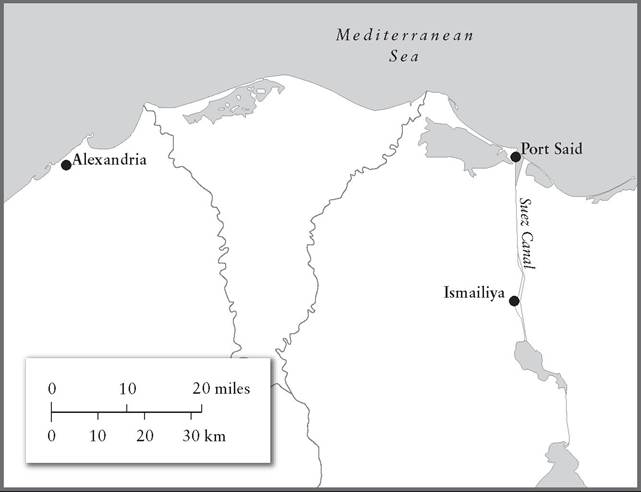
not reap the rewards he had been promised. Ever deeper in debt, spending more on servicing his debts (roughly £5,000,000 per annum) than he was receiving from the canal, the khedive, to give him the grand title conferred by the Ottoman sultan, made the reluctant decision to sell his shares, upon which Benjamin Disraeli stole a march on his French rivals and bought up 44 per cent of the canal for £4,000,000 in 1875. He understood perfectly the importance of the canal in assuring quick access to British India, and assured Queen Victoria that ‘it is vital to Your Majesty’s authority and power at this critical moment, that the Canal should belong to England’.12 Ten years later the number of ships peaked, with, on average, ten a day passing through the waterway, and the tonnage easily exceeded the 5,000,000 Ismail had been told to expect.
The Suez Canal was, then, much more than a link between the Mediterranean and the Red Sea - it was a new and shorter route from the Atlantic to the Indian Ocean and Pacific. The route from Britain to the Far East became more than 3,000 miles shorter in distance and ten or twelve days shorter in time.13 The principal beneficiary was Great Britain, not just politically but commercially: in 1889 more than 70 per cent of the goods sent through the canal were carried in British bottoms, while the French accounted for roughly 5 per cent. In London, the Board of Trade reported that ‘the trade between Europe and the East flows more and more through the Canal, and the British flag covers an ever increasing proportion of this trade’.14 Whether the cities around the Mediterranean benefited much from the canal is a moot point: Trieste, then under Austrian rule, did send ships through the canal, but the number was tiny by comparison with British numbers; and Alexandria lost its importance as a bridge between the Indian Ocean and the Mediterranean now that it could be bypassed through Port Said. Britain expanded its power and influence in the Mediterranean, but always with an eye on its route to India, along which its colonies of Gibraltar, Malta and eventually Cyprus became stepping stones. For British, German and other northern European ships, the Mediterranean became a passageway between two oceans, rather than a sea of interest in its own right.
III
The Panama Canal too was not created to service the needs of the local sea, the Caribbean, that lay on its Atlantic side, but to meet the interests of trading companies in Atlantic North America and Europe with ambitions in the Far East. Travelling by way of Cape Horn, the journey from New York to San Francisco would cover 13,000 miles, and it could take several months. By way of Panama, the journey covered only 5,000 miles.15 However, war between Spain and Britain rendered Panama unsafe, even less safe than the Cape Horn route that Spanish treasure ships began to use from 1748 onwards, in the hope of avoiding British predators in the Caribbean. Meanwhile the French had been thinking that it might be possible to carve a waterway through Central America ever since 1735, when an astronomer was sent out in the hope that he could identify a suitable route. What he suggested, after five years of exploration, was a passage upriver through Nicaragua, then across Lake Nicaragua itself. This would have minimized the need to cut through difficult terrain, but it was a long way to go, assuming the river could carry ships all the way; and as the British built up their interests along the Mosquito Coast of Nicaragua, in competition with Spain, political sensitivities made this plan unworkable. A British alliance with the Indians who lived around the mouth of the river killed the project. The future Lord Nelson was given command of a small squadron whose task, he wrote, was ‘to possess the Lake of Nicaragua which, for the present, may be looked upon as the inland Gibraltar of Spanish America’. Not for the first time, tropical diseases rather than a human enemy frustrated British attempts to hold on to Nicaragua.16 Still, it was generally agreed that the best route across Central America lay through Nicaragua, and this opinion was confirmed when, in 1811, the great German geographer Alexander von Humboldt declared that there was no suitable alternative. He was taken seriously because he knew South America so intimately, but the truth was that he had never visited either of the two sites.17
Political conditions proved to be crucial in solving the problem of where to place a route between the oceans. In the years around 1820 Spain lost control of its colonies in northern South America, resulting in the creation of ‘Gran Colombia’, known for a time as New Granada, which included the narrow neck of Panama as well as modern-day Colombia and several of its neighbours. Its inhabitants, and the government of New Granada, were keen to see a canal built through the isthmus. Licences to explore were put up for sale. Among the bidders were the Americans, encouraged by Andrew Jackson, the president, even though Jackson preferred them to bid for a Nicaragua route. And, while a canal would obviously take a good many years to plan and build, a railway across Central America could be constructed much more quickly.
Here the French, the British and the Americans jostled for position. The United States was keen to keep the British, the French and the Dutch out of Central America, and made a treaty with New Granada in 1848 that granted the Americans the right to send troops to Panama if other foreign forces began to interfere. The Americans avoided all foreign entanglements, and the decision, uniquely, to go ahead with the New Granadan treaty showed how greatly the United States valued the potential of Central America as a strategic route into the Pacific. Finally, in 1849, Lord Palmerston, as Foreign Secretary, accepted that tension with the United States had risen to a dangerous point and negotiated a deal with the USA under which neither side would try to gain exclusive rights over a canal across Central America. But the effect of this agreement was that neither side was really able to move ahead with its own project. That did not prevent an American businessman, William Aspinwall of New York, from buying the right to build a railway (and possibly a canal) between Panama City and the Caribbean. His plan was to meet the needs of passengers aboard his new shipping service from San Francisco to Panama, which would connect to shipping bound for New England.18
Events rushed ahead of Aspinwall. In 1848 news reached the eastern United States that gold had been discovered in California, which had only just been acquired from Mexico. By the end of the year a steamboat, the Falcon, was heading south by way of Louisiana, bound for the isthmus of Panama, where a couple of hundred passengers were to be transported across land in dreadful conditions that they had not stopped to consider
before sailing. This was only the first wave of a flood of people who imagined that they could enrich themselves at a stroke in the goldfields of California. Even the sailors who had manned the boats that took gullible Americans from Panama to San Francisco often abandoned ship when they reached California, which left a great many rotting ships in San Francisco Bay, and fewer and fewer ships ready for boarding in Panama. Meanwhile Panama City mushroomed much faster than its very limited infrastructure could manage. It became a shanty town of brothels and bars, with plenty of violence on the streets. One of its good-natured pioneers was the British widow Mary Seacole, partly of West Indian extraction, who set up the ‘British Hotel’ and tried to offer acceptable food while also ministering to victims of shootings and stabbings, not to mention the many victims of yellow fever and malaria.19 Yet all this greed and gore showed ever more clearly that a manageable route across Central America was badly needed if the United States were to make full use of the opportunities created by the acquisition of a western seaboard.
So the railway did come into being, after a route was hacked through the jungle by thousands of navvies, very many of whom had arrived from Jamaica, where jobs were few and pay was low. Physical conditions in the isthmus were far worse than back home, but the West Indians had more natural immunity to yellow fever and were generally regarded as good workers, even though they were treated less well than whites. The railway was opened in February 1855. One historian of the Panama Canal has observed: ‘Panama was the railway.’ European governments, especially Great Britain, wondered if the United States had become too powerful in the isthmus, not just because of the heavy capital investment in the railway but because an American elite had installed itself there, and the new town of Colon, long to remain the principal American base there, was to all intents an American settlement, even if it had an extreme Wild West flavour. The cutting of the railway proved that Humboldt had been wrong: the mountains were not impassable, even if building a waterway was vastly more complicated than building a railway track that could handle reasonably steep gradients.20 And, although the line had been laid mainly by sheer human muscle power, the railway, like the shipping routes from New England to Colon and from Panama City to San Francisco, made use of steam power, which was transforming communications in these decades.
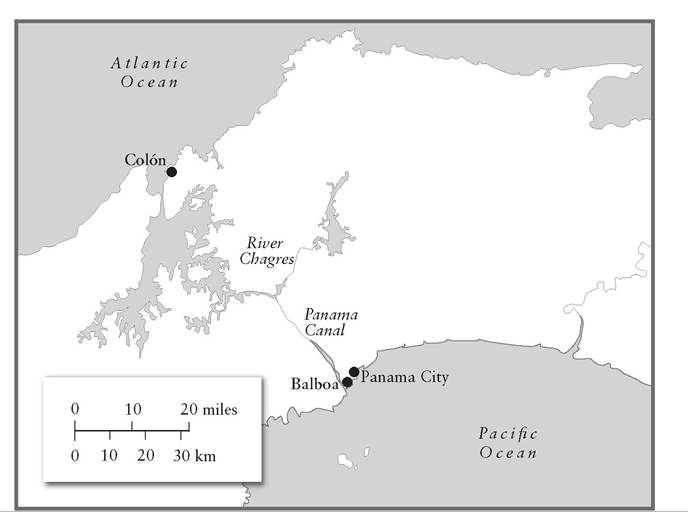
The fact that a well-functioning railway now existed through Panama did not dent enthusiasm for a canal taking a completely different route. Nicaragua did seem to make good sense, and on the decision to go for Panama turns not just the future history of Central America but that of the United States as a world power. The wealthy American Cornelius Vanderbilt had it in mind to build a Nicaraguan canal in 1851, but he could not raise sufficient capital. A quarter of a century later the US government received a report that insisted Nicaragua was the only suitable route, and Nicaragua, not Panama, became the agreed way forward.21 This left the Panama route available to interlopers, with the French at the head of the queue, inspired by de Lesseps’s rhetoric and his sense that anything was possible - he even thought it should be possible to flood the Sahara by creating a channel through Tunisia.22 With the Americans still talking of Nicaragua but not actually doing anything, the French were able to send their own explorers into Panama in 1876, led by the youthful Lucien Napoleon Bonaparte Wyse, a relative of the French emperors. Wyse’s first discovery was how awful the conditions were in the isthmus jungle, where malaria was rampant and constant downpours meant that it was very hard to survey the land; much of his report was guesswork. Yet Wyse managed to win over the Colombian president, whose republic at this point still included the i sthmus - not that it would if the French plan went ahead, as France was to be granted a 99-year lease on the canal, while Colombia would reap a 5 per cent profit on gross revenue from the canal. His clear preference was for a sea level canal, which would mean cutting right through the mountains, and one idea was to run the ships through a massive tunnel. Then there would be the literally overwhelming problem of the rush of water as the canal met the River Chagres, which flowed into the Caribbean close to Colon, and in full flood would sweep away anything that stood in its way.23 But the superhuman nineteenthcentury engineers of the generation of Brunel assumed they could achieve anything.
That is why the story of the French attempt to build a canal across the isthmus, mainly alongside the railway, is so tragic. No account was taken, even after Europeans had been poking around the area for several decades, of the threat of disease, particularly yellow fever, with its 50 per cent mortality. Enthusiasm for the scheme ensured that capital could be raised, reaching 700,000,000 francs by 1883, by which time 10,000 workers needed to be paid, a figure that doubled within fifteen months. Jamaicans still dominated the work force, attracted by good pay; ships reached Colon every four days carrying Jamaican labourers; back home in Kingston they fought to get a place on board.24 Meanwhile the engineers faced a terrible fate as they saw their families die of yellow fever, like the wife, daughter, son and would-be son-in-law of the director-general of operations, Jules Dingler. Dingler expressed his despair by ordering the execution of his beloved horses.25 French officials often brought their own coffin to Panama so that their remains could be repatriated if they caught one of the rampant diseases of Central America.26 Observers increasingly wondered whether the plan for a canal was viable. In Paris, the mood was made darker still by the vicious anti-Semitic attacks launched by the publicist Drumont against Baron Jacques de Reinach, a wealthy Jewish banker who had been advising the Canal Company. As much as the Dreyfus Affair, the Panama Affair fuelled French anti-Semitism. Reinach died just as he was coming under investigation following accusations of bribery and corruption; he may well have committed suicide.27 But by 1890 it was obvious that the project had failed, despite the considerable amount of investment and sheer physical work that had gone into it. The collapse of the Canal Company was the largest financial crash in the entire century.28
IV
The financial disaster in France brought the canal project to an end, even though channels had been dug, machinery had been sent to Panama and a great many labourers were now left without work or wages. An American journalist visited the remains of the canal in 1896 and described the all-but-abandoned machinery, which was still, oddly, oiled and maintained in otherwise deserted yards.29 Yet the disaster did not kill the idea of building a waterway between the oceans. The French had no appetite left for the project; but the Americans were keenly examining their own strategic interests in the Caribbean and the Pacific, and the argument for a direct link through Panama or Nicaragua now became overwhelmingly attractive. At the end of the nineteenth century American naval power grew prodigiously. The United States went to war with Spain in 1898 in defence of Cuban revolutionaries seeking independence. The casus belli was an explosion that destroyed the American battleship the USS Maine while it stood in Havana harbour. Nearly 300 sailors were killed, and, even though the reason for the explosion remains a mystery, this was enough to energize President McKinley. The outcome of the short conflict, which Spain was bound to lose, was that the United States occupied Cuba for several years and then imposed a treaty that seriously limited the new republic’s sovereign powers. Another acquisition, one that remains in American hands, was Puerto Rico.30
Just as significant were gains in the Pacific. The United States occupied the Philippines following the defeat of the Spanish navy in Manila Bay in May 1898, during the same war. Hawai’i and Guam were also acquired. These, along with the Caribbean acquisitions, marked a significant change in American foreign policy, the beginning of a process of empire-building that would culminate in the acquisition of the Panama canal zone. Of course, the Americans denied that this was empire-building, but it is hard to see it as anything else. Theodore Roosevelt, a rising star, governor of New York, announced: ‘I wish to see the United States the dominant power on the shores of the Pacific Ocean.’ At the same time, he emphatically denied that his views smacked of imperialism. As one American historian has pithily explained: ‘expansion was different; it was growth, it was progress, it was in the American grain.’31 Roosevelt cannot be accused of ignorance about naval affairs: he was the author of a book on the war of 1812 between Great Britain and the United States, and a great admirer of the prophet of a new naval policy, Alfred Thayer Mahan.
Captain, later Admiral, Mahan’s The Influence of Sea-Power upon History, 1660-1783, a work first published in Boston in 1890, had a powerful influence on strategic thinking in London, Berlin and Washington on the eve of the First World War; it was required reading in naval academies both in the United States and in Europe. Mahan’s aim was to reveal the importance for the United States of an active naval policy at a time when isolationism had long been the order of the day, and when even American merchant fleets were, he said, playing only a modest role in world trade. He pointed to the three maritime frontiers of the greatly expanded United States of his day: the Pacific, the Atlantic, and the vast area of the Gulf of Mexico and the Caribbean.32 Yet one of his most revealing comments about the future direction of policy appears at first sight to concern the Mediterranean rather than the oceans:
Circumstances have caused the Mediterranean Sea to play a greater part in the history of the world, both in a commercial and a military point of view, than any other sheet of water of the same size. Nation after nation has striven to control it, and the strife still goes on. Therefore a study of the conditions upon which preponderance in its waters has rested, and now rests, and of the relative military values of different points upon its coasts, will be more instructive than the amount of effort expended in another field. Furthermore, it has at the present time a very marked analogy in many respects to the Caribbean Sea, - an analogy which will be still closer if a Panama canal-route ever be completed.33
He had a good understanding of the strategic importance of the chokepoints at the edges of the Mediterranean: the Strait of Gibraltar, the Dardanelles and now the Suez Canal as well. All this pointed to the obvious conclusion that America needed its own canal through Panama. Mahan’s approach was founded upon a particular view of international relations as a great game in which nations competed for power and influence, expressing their power through control of the sea routes and using their power to promote trade. Rivalry was the fundamental concept. His book was a call to the United States administration to wake up to global realities, after a century of slumber.
Mahan’s arguments were backed up by events. The USS Oregon had been sent from San Francisco to join the fray in the Atlantic when news arrived of the destruction of the Maine in Havana. The painfully slow voyage round Cape Horn to Palm Beach, Florida, took sixty-seven days. What more needed to be said in defence of a canal through Central America? On the other hand, Roosevelt, now Assistant Secretary of the Navy, wrote to Mahan in 1897 saying that he believed in the Nicaragua route. Congress was still enthusiastically discussing this option when VicePresident Roosevelt suddenly became president in 1901 following the assassination of McKinley. But new reports on the feasibility of different routes, along with the chance to buy out the property of the rump company in France that had taken over the now dormant Panama Canal project, led to a sudden change of policy in Washington. The Colombian government was also well disposed to the idea. The cost would be up to $40,000,000, but the big prize was to be the concession of permanent control over a canal zone either side of the waterway all the way across Panama.34 Here was an opportunity to make real Mahan’s insistence that the United States needed to assert its dominance within its maritime backyard, the Caribbean, while creating an express route to its new possessions in the Pacific, and to markets in the Far East. And yet, while we may read this as proof of the will to create an American overseas empire, the canal project was not seen in those terms; rather it was proof that the United States, an inherently virtuous nation, was acting on behalf of all mankind, ‘something bigger and better than empire’, for how could the perfect republic be imperialist?35
This was the beginning, not the end, of over a decade of high drama, during which the USA gave its support to a revolutionary regime in Panama and the isthmus broke away from Colombia, still leaving the Americans with full authority over the canal zone, expressed before long in the despatch of American ships and the landing of American troops in order to secure the railway line across the isthmus. It was also a period of continued argument about the best route, as it became obvious that the French had made too many mistakes: the taming of the River Chagres was one of the most important and difficult issues, but it was managed by the building of a great dam and the creation of the Gatun Lake, spread across a large area of the canal zone, while a series of locks brought ships over the Panamanian ridges through which earlier excavators had somehow imagined they could slice their way. Meanwhile the U S government constructed the all-American towns of Balboa and Colon to service their needs in the canal zone. The zone required and was provided with schools, hospitals, post offices, churches, prisons, public restaurants, laundries, bakeries, street lamps, roads, bridges. Much of the female labour was employed within the newly built hospitals.36
The implantation of the Americans in Panama is sometimes seen as the crucial moment when the United States became committed to a world role, although there were earlier imperial acquisitions in both the Caribbean and the Pacific, and the acquisition of the canal zone was in many ways the consequence of these new responsibilities and ambitions. Roosevelt’s view that the building of the canal was a dramatic step forward in the progress of humanity proved to be true in an important respect: hard work on the ground identified malaria and yellow fever as insect-borne diseases, and a massive effort to eradicate mosquitoes and other carriers of disease by thorough fumigation and by the removal of tainted water had impressive results; simple acts like removing ornamental trees that were growing in water-filled pots destroyed the breeding ground of the insects.37 The building of the canal was a key moment in the medical history of mankind.
Roosevelt saw the acquisition of the canal zone as the greatest achievement of his first administration, a decade before the canal itself was even completed. In November 1906 he became the first US president to leave the country while in office, when he sailed down to Panama aboard the grandest American battleship, the USS Louisiana. It was a remarkable visit for other reasons. He chose to come when conditions would be bad, during the rainy season, so he could witness the difficulties the engineers and labourers were facing. He visited the sick, unannounced. He was able to report optimistically to Congress, while greatly enjoying the positive publicity his visit had generated.38 All this work was being carried out at the expense of the American government, at a cost of $352,000,000, four times the cost of the Suez Canal.39 The American government invested hugely in massive new machinery able to run on newly constructed rails, as well as a vast labour force, in which this time not Jamaica but Barbados provided many of the best workers. The labour force was divided into ‘gold’ and ‘silver’ categories, American citizens counting as ‘gold’, although Americans of colour often found themselves demoted, at least unofficially, and the many Barbadians were relegated to ‘silver’. ‘Silver’ was clearly a euphemism, but conditions did improve with time.40 The fearful mortality of the days when the French were trying to build the link was a distant memory by the time the canal opened on the eve of the First World War. The outbreak of war limited its takings, with only four or five ships a day making the crossing, but after the war ended the boom began, catching up with Suez and eventually taking the annual figure to over 7,000 ships on the eve of the next world war.41
As with the Suez Canal, there had been last-minute blockages, and the new lake had to be filled with a massive Atlantic i n-flow; but by April 1914 light cargo traffic was being towed through, beginning with a consignment of tinned pineapples from Hawai’i, another important if outwardly modest symbol of the new technology of the industrial era. The opening ceremony was quite muted, not nearly as grand as the opening of the Suez Canal, which had been attended by Empress Eugenie of France and Emperor Franz Joseph of Austria. Nonetheless, the ceremony featured not merely the president of the United States but the USS Oregon, which was recognized, justly enough, as the ship whose voyage from California to Florida by way of Cape Horn in 1898 had done most to demonstrate that a canal was urgently needed.42 With the building of the two canals, Asia and Africa had been divided by a waterway, and North and South America were also physically divided; but the oceans were now joined together.
More on the topic 48 Continents Divided, Oceans Conjoined:
- 48 Continents Divided, Oceans Conjoined
- Contents
- Proximity to oceans influences regional climates
- Oceanic circulation and the distribution and topography of continents influence global temperatures
- Rome Divided in Two
- Abulafia David. The Boundless Sea: A Human History of the Oceans. Oxford University Press,2019. — 1088 p., 2019
- 51 The Oceans in a Box
- 35 The Black Ships of Macau