49 Steaming to Asia, Paddling to America
I
The building of first the Suez Canal and then the Panama Canal, along with the increasing use of steamships, did not bring to an end more traditional ways of crossing the oceans.
Clippers and windjammers continued to sail vast distances carrying tea, grain and other basic goods. The wind was free, but coal had to be bought. Nonetheless, by the late nineteenth century massive changes in the use of ships had become visible. Passenger traffic across the Atlantic, increasingly carried on large ocean liners, grew prodigiously as migrants, fleeing famine in Ireland, poverty in Italy or persecution in Russia queued to be allowed past the newly dedicated Statue of Liberty into New York with its welcoming inscription by Emma Lazarus. The statue itself was cast in France, not America, and was carried in pieces to New York in 1885, aboard a French steamship. It goes without saying that the scale of this migration far exceeded the earlier trickle of Europeans across the Atlantic. Accompanying the stream of migrants, though generally in much more comfortable parts of the ship, could be found businessmen, along with more leisured visitors to the USA, willing to spend a week or so aboard a vessel that would adhere to a reasonably reliable timetable, and that would have a high standard of comfort and safety. Standards of safety proved less good than the public had been led to believe when the ‘unsinkable’ RMS Titanic foundered in 1912; but the inevitable response to the disaster was to look more closely at those standards, particularly lifeboat provision.Early steamships ran risks: in 1840 Samuel Cunard was granted a contract for transatlantic shipping thanks to his insistence on ‘safety first, profit second’; a shipping company lost two steamships because (so it seemed) their captains had tried to prove how fast they could cross the ocean.1 In 1866 the steamship the London went down not far out of Plymouth, with the loss of 270 people, at the start of a long run to Melbourne As well as sixty-nine crew, the ship carried 220 passengers who were looking forward to a new life in Australia.
It also carried far too much heavy cargo, maybe as much as 1,200 tons of iron and 500 tons of coal, so that her deck stood only three and a half feet above the surface of the water - in calm conditions.2 This was just one scandalous example of a much wider problem: one in six ships carrying passengers from Europe to America around this time eventually sank (which is not the same as saying that one in six voyages ended in shipwreck), and over 400 ships are said to have foundered off Great Britain in 1873-4.3 As twenty-first- century migration across the Mediterranean shows, people are only too willing to entrust their life to unseaworthy vessels; and this applied just as much to the migrants of the late nineteenth and early twentieth century. The enormous growth of maritime traffic during the nineteenth century, particularly across the Atlantic, resulted in more and more maritime disasters; rapid industrialization brought both new benefits and new dangers. Critics insisted that unscrupulous shipowners were only too happy to claim on their insurance policy with Lloyd’s: ‘the wealthy merchant thrives, but what about the priceless freight of precious human lives?’4Britain, set fair to become the greatest naval power on earth, mistress of an empire across the three great oceans, and heavily dependent on maritime trade, could not tolerate this state of affairs. It became obvious that Parliament needed to look closely at maritime safety, and the leader of the campaign was Samuel Plimsoll, who had started life as a coal merchant and had no naval background at all. He managed to win a seat in the House of Commons for the Liberal Party, and campaigned long and furiously for improvements in sailors’ safety. He gained a huge popular following: a wool clipper had been named after him in 1873, and songs and poems were composed in his honour:
A British Cheer for Plimsoll
The sailor’s honest friend
In spite of opposition Their rights he dares defend Tho’ wealth and pow’r united To put him down have sought His valour has defeated The forces ’gainst him brought.5
Benjamin Disraeli, accused of bending to the will of shipping magnates, was at first hostile to Plimsoll’s demands for legislation, while Plimsoll’s unrestrained and vigorous attacks on a shipowner named Bates, whose
boats had a dismal safety record, almost landed him in court.6 But of course Plimsoll was right.
Finally, in 1876, the British government acknowledged the need for change, ten years after the wreck of the London. Clause 26 of the Merchant Shipping Act passed that year demanded that (with a few exemptions for small vessels and yachts):The owner of every British ship... shall, before entering his ship outwards from any port in the United Kingdom upon any voyage for which he is required to enter her, or, if that is not practicable, as soon after as may be, mark upon each of her sides amidships or as near thereto as is practicable, in white or yellow on a dark ground, or in black on a light ground, a circular disk twelve inches in diameter with a horizontal line drawn through its
centre. The centre of this disk shall indicate the maximum load-line in salt water to which the owner intends to load the ship for that voyage.7
Even so, it was another thirty years before foreign shipping visiting British ports was obliged to follow suit, and the Plimsoll line, as it came to be known, was only adopted as an international standard in 1930. In the USA, Congress was hesitant, and the Plimsoll standard was applied only in 1929 for international shipping and in 1935 for domestic shipping - not a unique example of the United States going its own way for a good while. Plimsoll Days were long celebrated in a number of British towns, in gratitude for what Samuel Plimsoll achieved for British sailors.8 He deserves to be remembered as a great national and indeed international hero.
Meanwhile, new technology was transforming the world, and its effect on the oceans was felt in another way too: the first transatlantic cable was laid in 1858, although it soon broke, and only in the 1860s were cables laid that worked reasonably well (using in part Isambard Kingdom Brunel’s magnificent steamship the Great Eastern, which was twice the size of the already impressive Great Britain now preserved at Bristol).
Even so, contact was painfully slow by later standards, since Morse code was the only practicable way to send pulses down the cable. The manufacture of thousands of miles of coiled cable was an achievement in itself, and the sense that England and America were now linked in a new way was marked by an exchange of messages between Queen Victoria and the American president on the first day of operation. Other cables were laid in the Mediterranean and the Red Sea, while London remained the global centre of operations: this was a means to communicate with the Empire, as well as with the United States, and the days when messages to viceroys were out of date before they arrived were coming to an end. Later, when Marconi demonstrated that contact could be made by radio waves rather than by cable, contact across the oceans became even more rapid and communications could reach just about anywhere.II
It has been seen that the Suez route from northern Europe to the Far East was shorter and quicker than the route around the Cape of Good Hope, and the chance to make the journey even quicker arose with the development of sturdier types of steamship just as the Suez Canal opened. A pioneer of these new steamship routes was Alfred Holt, whose Ocean Steamship Company operated out of his native city, Liverpool. As he built up his fleet of trading ships he studied iron hulls, steam boilers and screw propellers, convinced that he could push down the cost of long-distance transport aboard steamships below that of sailing vessels. Perfecting the steamship had to be achieved by trial and error, sometimes at great cost - ships went down, taking goods and men with them. His idea that steam pressure could be raised to 60 lb per square inch took the technology of the time to its limits. His decision to build longer iron ships promised to increase cargo capacity, ‘as it is the middle that carries and pays’.9 Iron was certainly much stronger than wood, but making sure the rivets held the ship together was a problem.
In the early days, iron steamships sometimes split in two. Holt therefore took the trouble to send the ship he had fitted with an experimental high-pressure engine as far as Brazil and Archangel.10Holt’s Liverpool was a city that had transformed itself from being a major base of the slave trade and sugar trade, in the eighteenth century, into the export hub of northern England, taking full advantage of the rapid industrialization taking place in Lancashire. Railways connected its wharves to Manchester, Chester and beyond. Its harbour was large and well situated. Its often infamous trade of earlier years had created a capital base for diversification into shipping business other than the trade in human beings. The links to slavery did not vanish after Parliament forbade the slave trade in 1807: the city continued to trade intensively with west Africa, and a mainstay of the city’s business was the import of American cotton, produced on the slave plantations of the Deep South.11 Like other port cities, Liverpool became home to a mixed population that included plenty of Irish, Welsh and Scots, but also Africans and Chinese, many of whom had arrived on the ships of Alfred Holt.12 Liverpool did face local challenges: Manchester became a rival with the construction of the Manchester Ship Canal in 1894, but the main brokers dealing in imported cotton remained in Liverpool.13 By the start of the twentieth century Liverpool businessmen were confident enough of the city’s primacy to build the imposing Edwardian office buildings that are the city’s great architectural glory.
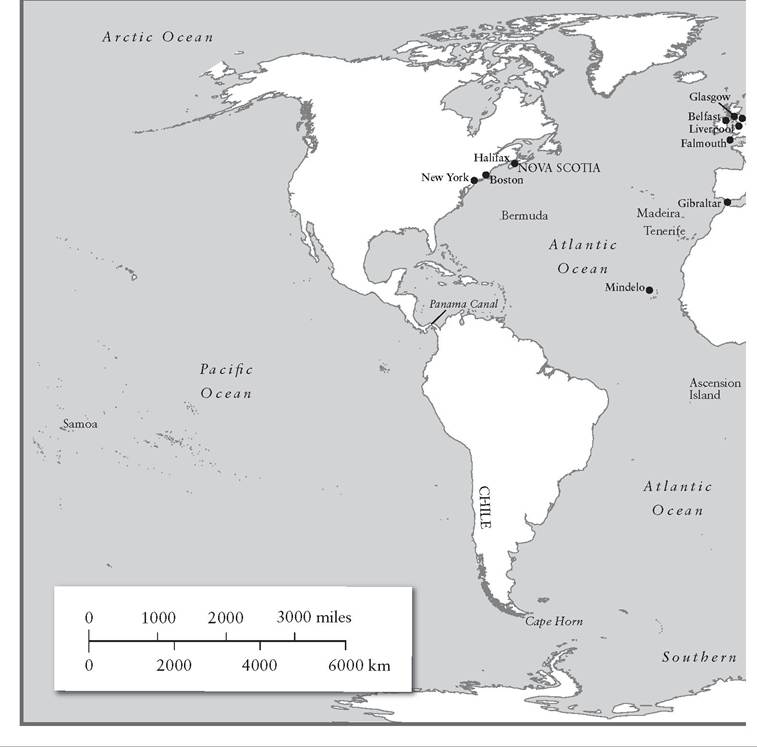
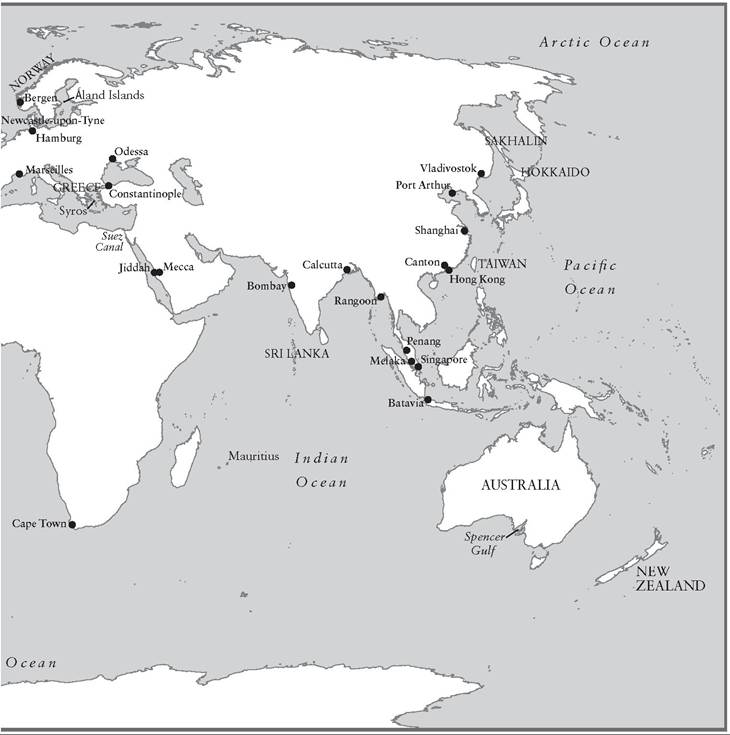
In 1866 Alfred Holt announced the launch of his steamship company, with three sister ships, the Agamemnon, the Ajax and the Achilles, each over 2,000 tons. In April the Agamemnon set out for Shanghai, by way of the Cape, Mauritius, Penang in Malaya, Singapore and Hong Kong. Holt’s first published timetable estimated the length of the outward voyage at seventyseven days, with a slightly longer return schedule of ninety days, as the ships were to stop in south-eastern China to load the most important part of their cargo - tea.
But this was still much better than the four months a sailing ship would require. Subtract from this the ten days or so that would be saved once the Suez Canal was in operation, and Holt’s company seemed bound to succeed. On the other hand, Holt had to charge higher freight rates to cover his costs, for steamships cost more to build and to operate; and there were still doubts about their reliability, since they could be stopped in their tracks if coal supply stations were not created and maintained, though in the early days they did carry large amounts of sail, just in case.14 But a long sea voyage by steamship was, at least before permanent coaling stations were created, complicated. When the rival Peninsular and Oriental Steam Navigation Company (P&O) sent the Hindostan to Calcutta in 1842, coal supply ships awaited her at Gibraltar, Mindelo in the Cape Verde Islands, Ascension Island, Cape Town, Mauritius and Sri Lanka.15 In the eyes of many traders, the traditional sailing ship was familiar as well as beautiful. This became even clearer when the tea clippers, of which the Cutty Sark, still preserved at Greenwich, is the most famous, came into operation; by the 1850s sailing ships crept back into fashion. As early as 1828 the First Lord of the Admiralty had expressed himself decisively: ‘the introduction of steam is calculated to strike a fatal blow at the supremacy of the Empire.’ But the Royal Navy, unlike the Merchant Navy, was not interested in creating timetables and schedules for passengers and freight.16The canal made all the difference, therefore, and it also opened up the route East to smaller ships that could not have coped with the Cape route. Holt charged ahead, smashing competition by building steamships at a furious rate. This paid off: by 1875 his managers insisted that they had run out of space for cargoes yet again, so that they needed three more ships; these cargoes were dominated by Lancashire cotton and woollen cloths (the cotton cloth being made largely out of imported Indian fibres, now re-exported as finished goods). Passengers were also carried: on the return leg, Muslim pilgrims were picked up and conveyed to Jiddah, from where they could reach Mecca for the haj, and this became big business for several British shipping companies; well over 13,000 Muslim pilgrims sailed on Blue Funnel ships in 1914, setting out from Singapore and Penang.17 Journey times were slashed, falling as low as fifty-five, even forty- two, days out from England. The advantages of steam navigation became most obvious when Holt’s ships joined the annual tea race, bringing the fresh crop as fast as possible to London. They not merely outpaced the tea clippers, which was to be expected, but they beat the steamships of rival companies. In 1869 his ships carried nearly 9,000,000 lb of tea to England, and, having beaten all competitors, Holt was able to take advantage of a seller’s market and dispose of his tea at 2d per pound more than his late coming rivals.18 In 1914 the Blue Funnel Line, as Holt’s company came to be known, used more berths in Liverpool docks than any other cargo line and was the most frequent user of the Suez Canal, dominating the export of British textiles to east Asia.19
Holt’s operations in China were boosted by his decision to work alongside a British merchant company based in China, Butterfield and Swire, which set up an office in Shanghai on 1 January 1867, and specialized not just in tea but in raw American cotton, which formed the bulk of the cargo of the Achilles when it left Shanghai a couple of weeks later.20 The relationship with John Swire enabled the Blue Funnel line to draw goods from deeper inside China, as Swire’s steamboats penetrated down the Yangtze River, bringing Chinese goods to Shanghai for trans-shipment. Swire was a great advocate of the Conference System, an agreement among competing shipping firms that they would set the same freight rate on outward cargoes, which left Holt uneasy, as there were pluses and minuses to this, especially after competition from faster ships than his own became a problem. After their pioneering start, the managers of the Blue Funnel Line sometimes displayed the conservatism that had delayed the introduction of steam power to other shipping companies: they were slow to follow the move over to steel from iron, and new types of engine were ignored.21 Although the Blue Funnel Line is long gone, the Swire family remains a powerful force in the trade of China, Taiwan and Hong Kong to this day, though its best-known fleet now consists not of ships but of the aeroplanes of Cathay Pacific.
Holt was unnerved by competition from P&O. The company had come into being to serve routes towards Spain, Gibraltar and the eastern Mediterranean, and began to deploy its paddle-driven steamships either side of Suez even before the canal was built. This enabled the shipping line to gain the contract to run a mail service from Great Britain to India and Ceylon. A pride of the fleet was the Hindostan (mentioned above), which was sent out to the Indian Ocean in 1842 to service the route between Suez and British India. She even offered showers, hot or cold, for the passengers, which was a marvellous innovation. And she could cope with monsoon showers as well, blithely sailing from Calcutta to Suez through the thick of the monsoon in 1845, in just twenty-five days. The building of the Suez Canal should have made it still easier to send mail to and from India, but the mail contract insisted that letters had to be sent overland from the Mediterranean to the Red Sea: the mail was unloaded at Alexandria, sent overland to Suez, and reloaded there, or vice versa. Despite the objections of P&O, this bizarre comedy was maintained for several years until the bureaucrats realized how pointless it was.22
One major difference between P&O and Cunard was the quality of food. In January 1862 the menu aboard the P&O Simla bound from Suez to Ceylon included almost every variety of meat one can imagine - turkey, suckling pigs, mutton, geese, beef, chicken - all prepared, with the exception of curry, in a stalwart British fashion, but oddly no fish. Live animals were kept on board so that fresh meat could be served. The range of clarets brought a glow of pride to the cheeks of P&O officials.23 P&O understood the need to diversify, in the face of competition. Ancillary short-distance routes were developed: the Canton ferried goods up and down the Pearl River between Hong Kong and Canton itself, though it was also put to good use in 1849 fighting Chinese pirates who attacked European ships from their j unks - the waters around Hong Kong, and the new town on Victoria Island too, were notoriously unsafe at this period, and pirate raids on shipping slowed the growth of Hong Kong.24
Another side to P&O’s activities that produced handsome revenue in its early days was cruising. The company’s historians have claimed that P&O invented deep-sea cruising in 1844. These included trips from the Atlantic into the Mediterranean, as far as the coast of Ottoman Palestine, though this came to an end with the Crimean War. Then, towards the end of the century, a number of shipping lines took cruise passengers on trips as far away from England as the West Indies: the Orient Company advertised a Caribbean ‘Pleasure Cruise’, departing in January 1898, and spending sixty days afloat while the ship called in at Madeira, Tenerife and Bermuda; and it also ran cruises to the Norwegian fjords. Once again the use of steamers meant that one could keep, or try to keep, to a timetable, and this made cruises viable.25
The ironclad steamship transformed business in other parts of the Far East than China. Penang, under British encouragement, emerged as the new port of call in the approaches to the Malacca Strait. As it drew in ships that, in the days of sail, might have rounded Sumatra and entered the South China Sea through the Sunda Strait, business was diverted from the Dutch East Indies back to the traditional route past a now sleepy Melaka to the flourishing port of Singapore. In 1870 a ship reached Singapore from Marseilles by way of Suez in t wenty-nine days. This is not simply a history of express voyages from Europe to the Far East, for within the Indian Ocean the British India Steam Navigation Company linked Singapore to Batavia in Java, and linked India to the Persian Gulf; steamships now ploughed their way along the route that 4,000 years earlier had tied Mesopotamia to the Indus cities.26 To all this can be added the business that Holt conducted in Malaya, which was emerging as the great centre of rubber production, following the introduction of rubber trees by the British, as well as being a valuable source of tin.
III
Looking westwards, Liverpool was also the base of Samuel Cunard’s British and North American Royal Mail Steam Packet Company, established in 1840, with four ships linking England to New York, Boston and Halifax. However, Cunard began in the days of wooden-hulled paddle boats, and tried to improve their performance, before finally accepting the inevitable and moving over to screw-driven ironclad steamships from 1852 onwards. Like Holt’s, Cunard’s company fell prey to a Conference System, designed to standardize transatlantic fares and freight rates. Here the issue was not so much cargo as passengers. Steerage fares were cheap, but they were good business, given the numbers wishing to set sail for New York. In the early days, Cunard ships were the Ryanair option for travel: the assumption was that passengers would always choose the cheapest fare, but facilities were basic, even for those travelling in cabin (or first) class. Food was provided, but in first class it was nothing special, and in steerage it was especially dire. But no modern airline could get away with Cunard’s failure to implement Board of Trade standards that even the shareholders felt were being shamefully ignored. At the start of the new century an effort was at last made to improve the third-class accommodation, which became notorious for overcrowding and lack of hygiene. Cunard just about balanced the books on its voyages to America, while the cost of commissioning new ships was always a drain on company funds. In 1886 one of the faster ships, the Etruria, made a profit of over £7,000, but that was exceptional, and on some of the less prestigious ships only the profit from carrying freight kept the voyage financially above water.27
This issue became more and more significant as the volume of traffic increased at the end of the nineteenth century: Poles, Swedes, Russian Jews, Irish, Italians. The evil human traffic of past times had been replaced by a humane traffic of refugees escaping persecution and migrants looking for a better condition of life. With the rise in migration out of eastern Europe, speeded further by pogroms and economic misery, Cunard was faced with energetic rivals, the German shipping firms. In 1891 the Hamburg-Amerika Line carried nearly 76,000 steerage passengers across the Atlantic, 17 per cent of total numbers, and Cunard carried 6 per cent, over 27,000 people.28 The scale of migration to North America dwarfed the scale of passenger traffic out of Europe in other directions, such as Australia and New Zealand, all the more so as it came by 1900 to embrace just about every European nationality. This formed part of a wider development, as passenger traffic became more important, whether migrants, businessmen or tourists, and freight (even if it made all the difference to the Cunard profits) was less often the motive for setting up a new route. In the age of the steamship, these routes were serviced by ‘liners’, a term that expressly meant that they followed a regular line according to a timetable; and in time this term would become attached to the big ocean-going steamships of the great international shipping lines.
In the British Isles, the boom in shipbuilding that followed the development of metal-hulled steamships transformed the economy of regions such as Clydeside, downriver from Glasgow, which became a major shipbuilding centre, as did Tyneside, in north-eastern England. But the most remarkable success story was Belfast, already established as the linen capital of the world and the only industrial boom town in Ireland. But one cannot construct ships out of linen, and old Belfast could only offer mediocre shipbuilding facilities until the 1840s. Its shipbuilders understood that their craft was turning into a major industry, as shipbuilders made more use of iron and steel and added steam engines to their vessels. This advanced thinking gave Belfast a lead, despite the lack of local supplies of either iron or coal, and despite the lack, at the start, of the skilled labour force that the new shipbuilding techniques required.29 One company was dominant. Edward Harland had acquired his first Belfast shipyard in 1858, and three years later combined forces with his deputy, Gustav Wolff, who was of German Jewish origin. They established a company whose massive gantries have become the symbol of Belfast. The great trio of RMS Titanic, RMS Olympic and RMS Britannic were the largest ships ever built, and required brand new dockyards. Even when disaster struck the Titanic, this did not hamper business at Harland and Wolff, any more than the political troubles that were tearing Ireland apart, though the company did set up additional dockyards in Great Britain as Ireland became more unstable. The introduction of new safety standards meant that there was plenty of work to be done in Belfast bringing existing ships up to scratch, and the dockyard was busier than ever on the eve of the First World War, producing nearly 10 per cent of British merchant shipping, while commissions from the Royal Navy kept it very active during the next war as well - and made Belfast a target for German air attacks.30
IV
One of the interesting features of the history of shipping and maritime trade is that apparently small players sometimes prove to have been rather more important actors than is easily assumed. Lack of resources at home sent Norwegians and Greeks far from their homeland, and led to the creation of merchant fleets out of all proportion to the size and political or economic importance of their home nation. Population outstripped home resources, so labour costs were low, while both Norway and Greece had age-old connections with the sea, generated by the geography of their countries: the jagged, mountainous coasts of Norway and the scattered islands of Greece, which in each case made the inhabitants heavily dependent on travel by sea.31 One way of measuring which are the largest maritime nations is to calculate deadweight tonnage (dwt) for every thousand inhabitants. In 2000 Norway and Greece were at the top of the scale, with a figure of over 12,000 dwt; the world average was a mere 121 dwt. But in
1890 Norway could already boast a figure of 1,100 dwt, twice the next largest figure, for the much more heavily populated United Kingdom, and seven times the figure for the country next door, which, at the end of the nineteenth century, was Norway’s overlord, Sweden.
It has been seen how the Swedes became very active in the international tea trade by the nineteenth century. The Norwegian subjects of the kings of Sweden benefited especially from the presence of Swedish consuls out in Asian ports, and slowly and without ostentation built their own impressive network of shipping routes. Ancient links with Great Britain continued - the standard route followed by Scandinavian migrants to America brought them across the North Sea to Hull before being packed on to trains bound for Liverpool.32 But the secret of Norway’s success lay in the fact that it was a global operation. Following the opening of the Suez Canal, Norwegian ships began to appear in the Far East. By 1882 their ports of call included Java, Singapore and Rangoon; within twenty years their ships were appearing in the Philippines and Shanghai, as the axis shifted from Malaya and Indonesia towards China. The domestic market back home did not count for a great deal, so they inserted themselves in the carrying trade, ferrying rice from Vietnam to Hong Kong and along the coast of China. Their role in this trade has been described as nothing less than a ‘stranglehold’; by 1902 this i ntra-Asian business accounted for more than 50 per cent of Norwegian trade in Asia.33 Their ability to achieve this depended on their quick understanding of the radically new conditions under which maritime trade was now being conducted, following the opening of the Suez Canal and the introduction of l ong- distance steamer services.
By the end of the nineteenth century Norwegian ships were a familiar sight in the Indian Ocean and the Pacific, and the re-creation of the Norwegian kingdom in 1905 accelerated this development. The achievements of Amundsen and Nansen in polar exploration further strengthened the special reputation of the Norwegians. As profits grew, a new business elite back in Norway commissioned brand new boats and gained the confidence of the western Pacific powers, Russia, Japan and China, all jostling for position in the western Pacific, and all anxious to find different commercial partners to the traditional, and often menacing, European intruders led by Great Britain. Norway was neutral, but it was not exactly unimportant: by the start of the twentieth century it ranked third in the world in tonnage.34 There was an enormous spike in business at the very start of the new century, stimulated by the brief Russian-Japanese War of 1904-5, which was a disaster for Russia. Instead of gaining a year- round port on the Pacific, as the Russians had intended at the start of the campaign, the Russians lost much of their fleet, as well as control of Port Arthur, and they even lost half the island of Sakhalin, to the north of Hokkaido. Such conflicts provided the perfect conditions under which a neutral body of traders could insert themselves into the region.35
One of those who took advantage of the new opportunities was Haakon Wallem, a giant Norwegian born in Bergen who arrived in the Russian port of Vladivostok in 1896, made his way to China, and then established himself in Shanghai, buying his first ship, the Oscar II, in 1905. Wallem hit the jackpot during the Russian-Japanese War, because freight rates shot upwards, and also because the Japanese were so grateful for the unspecified and mysterious help he had given them that they awarded him a prize of ¥100,000 or, if he preferred, a grand decoration; but, businessman that he was, he took the money rather than the medal. He showed extraordinary resilience, keeping his company afloat in what were increasingly difficult times: he survived revolution in China and the loss of his first ship, becoming not just a prominent shipowner but a leading shipbroker, buying vessels for clients, and managing to carry on business during the First World War, during which Norway remained neutral.36 His business career had many ups and downs, but its main characteristic was his constant determination to get back on his feet whenever there was a setback (notably during the post-war depression). He was, as his biographer concisely states, ‘a survivor’, but so was the entire Norwegian shipping industry.37
Another remarkable example of vigorous participation in maritime trade is provided by the Greeks. In the nineteenth century the term ‘Greek’ is best used as an ethnic label, or rather as the ethnic descriptor of groups of families from quite restricted areas within what would now be called Greece, since some regions, such as the Ionian Islands, did not belong to the emerging Greek state, and Greeks were active in ports far beyond Greece itself, notably Odessa in the Black Sea. This is part of a longer and very remarkable story: in 1894, 1 per cent of world shipping was owned by Greeks, and by the end of the twentieth century that figure had reached 16 per cent (3,251 ships), making the Greek-owned merchant fleet the largest in the world, bearing in mind that the great majority of ships sail under flags of convenience - Liberia, Panama, and so on - rather than the Greek or Cypriot flag.38
In the early nineteenth century, as Greek merchant shipping grew in scale, its focus was very much upon the Mediterranean, including Marseilles, Alexandria, Trieste and Livorno, and the leading families came from Chios, whose position in the eastern Aegean helps explain why the trade in Black Sea grain out of Odessa and other ports became a major interest. London was certainly on their radar, and the Chiot trading families had agents there, often bringing goods such as currants to Liverpool first of all, and taking Manchester cotton cloth out of the country for distribution across the world. But that is not to say that these goods travelled on Greek-owned ships; the most powerful Chiot business family, the Rallis, with agents in New York, Bombay and Calcutta, in Odessa, Trebizond and Constantinople, were dealers rather than shippers, and to move goods around they would often charter ships from outside their circle - indeed, they often took Austrian or French or British citizenship and played the role of consuls for various nations, just like the Jewish merchants of Mogador. Their business partners were as likely to be Odessan Jews or Lebanese Armenians as other Greeks.
The Rallis, who claimed descent from Raoul, an eleventh-century Norman knight in Byzantine service, operated out of Syros, a small and nowadays rather dull Aegean island whose modern claim to fame is its sticky nougat, but which once (as its opulent nineteenth-century town hall suggests) lay at the very heart of the Greek trading world. In the years after 1870 power and influence shifted to shipowners based in the Ionian Islands, and they looked further beyond the Mediterranean and the Black Sea. In the years up to the First World War the tonnage of Greek-owned ships overall grew quite gradually, but the number of steamships grew more rapidly - from just four back in 1864 to 191 in 1900 and 407 in 1914. Moreover, tonnage grew prodigiously in the first years of the twentieth century, from 327,000 tons in 1900 to 592,500 in 1914; in 1910 the Greek fleet was already the ninth largest in Europe, measured in tonnage, with Great Britain enjoying a massive l ead - 45 per cent of world ton- nage.39 After recovery from the chaos of the First World War, in which Greece was only lightly involved, there was sufficient infrastructure and knowhow in place to enable the Greek shipowners to spread their wings, and become a global phenomenon, while other merchant fleets, such as the British one, had a much harder time trying to recover. This left a vacuum that Greek shipowners, along with the Norwegians and to some extent the Japanese, were very content to fill.40 At the root of Greek success lay a willingness to act as a tramp fleet, picking up miscellaneous cargoes here and dropping them there, as they moved across the sea.
V
In some corners of Europe even more old-fashioned types of shipping than Cunard’s paddle boats still flourished in the late nineteenth century and beyond. The best example of this is the Aland Islands, lying between Sweden and Finland, and, since 1921, an autonomous territory under Finnish sovereignty. The capital of these islands, Mariehamn, was founded in 1861, while the territory lay under Russian rule - a quiet place for most of its history, but blessed with a deep port, and good supplies of wood for shipbuilding in the interior. Between 1850 and 1920 nearly 300 ships were built in the islands, and sixty more were bought from shipyards in Finland. The largest of these were tall sailing ships: in 1865 the Alanders sent their first ship to America, and in 1882 an Aland ship circumnavigated the world, loading goods in Samoa. Meanwhile the islanders seized the opportunity to buy sailing ships cheaply on the international market, taking advantage of the shift away from wind power towards steam power, which meant that there were plenty of cheap sailing vessels (with modern iron or steel hulls) to be had at ship-breaker’s prices, all the more so once the opening of the Suez Canal created a new and fast route from Europe to the Indies; these ships had been built in as varied places as Glasgow, Bremerhaven, Liverpool and Nova Scotia.41 The result was the creation of a remarkable network of shipping routes managed by i sland-based companies, trading under the Finnish flag in timber, grain and other basic commodities as far afield as Chile, Canada, Australia and South Africa.
These companies were not created by big-time capitalists. By far the most successful was Gustaf Erikson. He was born in 1872, had started his career at the age of ten as a cabin boy, then cook, eventually bo’sun, second mate and master, and he shared ownership of the first ship he operated, the barque Aland - this sank after striking a coral reef in the Pacific, because the captain did not realize that a lighthouse nearby was not functioning. Erikson bounced back from this disaster, and never actually believed in insuring his ships: ‘with so many ships it will be cheaper losing one a year than paying insurance premiums for all of them.’42 During his career he owned twenty-nine ships, and was operating twenty of them around 1930. He knew his ships intimately and kept control of every aspect of the voyage from his office in the Aland Islands, specializing in grain shipments. He had no interest in being liked, paid the lowest wages he could, and was dedicated to making his business succeed; but for a couple of decades he was the respected head of a remarkable, worldwide, operation linking the Baltic to the Atlantic, the Indian Ocean, the Pacific and the Southern or Antarctic Ocean.
Shipping grain from the opposite side of the world on sailing vessels might not seem to be sound business, especially since many ships sailed out on ballast, for lack of goods to sell in Australia. But the prevailing winds enabled sailing ships to cover the distance to Australia at a comparable speed to steamboats, wafted straight through the oceans without the need to refuel that the steamships faced. These journeys are especially impressive because they were voyages right round the world with just one major stop, in Australia: the normal route took the windjammers round the top of Scotland and out across the Atlantic, past the Cape Verde Islands and towards the coast of Brazil, from where, in classic mode, they sought out the winds that would carry them past the Cape of Good Hope and across the wide expanse of the southern Indian Ocean to Spencer Gulf in South Australia. This stretch of water is separated from Adelaide Bay by a neck of land, and port facilities were very basic, a far cry from the bustle of Melbourne, Sydney or even Adelaide. On the other hand, Spencer Bay lay much closer to the sources of grain, and using sailing vessels, which comfortably negotiated the winds and currents of the bay, avoided the nuisance of having to hump the grain a hundred miles or so to Adelaide for collection by steamers. Loading their grain there, they then headed south of New Zealand towards Cape Horn, which was generally much more manageable when travelling eastwards out of the Pacific than in the other direction: Eric Newby reported rain and snow as he rounded the cape aboard Erikson’s fast windjammer the Moshulu in 1939, but he also says that ‘the sea was not rough but there was a tremendous see-saw motion of the water’, and it was ‘bitterly cold’. After that the windjammers wended their way along a twisting route north through the Atlantic to Falmouth in Cornwall or Cobh (Queenstown) in southern Ireland. These were the ‘ports of orders’, where the captain would receive instructions about who had bought the grain (for it was sold in advance, and sometimes resold and re-resold) and where he should take the ship for unloading. This could be Bristol, Liverpool, Glasgow, Dublin or another British or Irish port. On final arrival they unloaded their cargo of grain, which was a slow process as the grain was loaded in bags - as many as 50,000 on one windjammer.43
The Alanders took great pride in these voyages: during the 1930s the windjammers raced one another from Australia to the British Isles, the record being eighty-three days in 1933, with the wooden spoon going to another ship which took almost twice as long.44 There was also a practical side to these races: late arrival would mean that there was no time to return to the Aland Islands and see one’s family before the ship had to set out yet again for Australia. Ships in Erikson’s fleet were known for the relatively good quality of food aboard, and even attracted a small number of passengers.45 Although there were competitors, including German and Swedish windjammers, the success of Erikson’s trading fleet marks it out as something special.
These operations came to an end with the outbreak of war in 1939, and only revived briefly after the war ended. Overall, what is impressive about the Alander shipping network is the way the islanders were able to insert themselves in the grain trade of Britain and Ireland, coming in as complete outsiders with old-fashioned technology that proved its true worth. Little remains today: one impressive and lovingly preserved windjammer, the Pommern, forms part of the Aland Maritime Museum in Mariehamn, while the German-built Passat, acquired by Erikson in 1932 and kept in use until 1949, is now used as a training ship for young people, standing immobilized in the river mouth that leads from Travemünde to Lübeck.
More on the topic 49 Steaming to Asia, Paddling to America:
- The years around 1850 represented a watershed in American religious history, for they marked the onset of a series of waves of immigration from Asia, Africa, Latin America, Europe, and the Middle East
- From the first permanent English settlement in North America to 1800, the character and causes of violence in Anglo-America revealed both continuities and changes.
- Buddhism in America
- America's conundrums: hyperpower humbled
- Wilsonianism: Making the World Safe for America
- Hinduism and Sikhism in America
- Russian Orthodoxy Colonizes America
- Greater India in Asia
- Batavia, the Headquarters in Asia
- North America
- Level of Injury-ASIA Impairment Scale