50 War and Peace, and More War
I
Historians only began to write about ‘globalization’ from the 1990s onwards, and they by no means agree about its meaning and applicability. It is hard to dissent from those economic historians who see the concept as a red herring: if it can mean so many things, it is hardly likely that a debate about ‘when did globalization begin?’ will produce satisfactory results.1 Was the Greco-Roman trade route that linked Egypt to south India and beyond a sign that some form of globalization could be found as early as the first century ad? It makes most sense to apply the term when one can see how the economy of regions very far apart physically became interdependent, as, for instance, when potters in central China went out of their way to meet the requests made by purchasers of their goods in Holland or Denmark for specific designs.
Even then, some trades were more ‘global’ than others: the vast scale and reach of the Roman pepper trade, the Chinese porcelain trade, the sugar trade or the tea trade are good examples of how trading connections were all-encompassing, affecting not just elites but people of modest station, including artisans and slaves. This might be described, then, as a process of economic integration across large spaces. And yet, whatever claims are made for the centuries before the Industrial Revolution of the late eighteenth and nineteenth centuries, the global integration of the nineteenth and twentieth centuries is an altogether more complex phenomenon. Early in the twentieth century observers insisted that ‘the railway, the steamship and the telegraph are rapidly mobilizing the peoples of the earth’.2 The revolution in communications took place not just at sea, but in ways of reaching the seaports from which the steamships set out; and it was accompanied by other ways of communicating across the sea, beginning with the intercontinental cables that have already been mentioned.For the economic historian Kevin O’Rourke, ‘one indication that
markets are integrated is when they have prices that are correlated with each other.’ Looking at the transatlantic wheat trade around 1900, and analysing the gap in prices between wheat put on sale in Britain and wheat put on sale in North America, he has concluded that a remarkable degree of globalization can be observed at the start of the twentieth century. Partly, this was the result of the use of steamships to transport goods, and a fall in overall shipping costs. British demand for American wheat ‘exploded’ (he says) at the time of the First World War. The war, however, marked the end of a period of worldwide economic convergence, and only after the next world war did the process of integration resume successfully, as controls on the movement of capital were relaxed under pressure from markets. From the human perspective the late nineteenth century was a
period of free movement, another possible indication of globalization, but early in the twentieth century this was challenged by restrictions imposed - not necessarily for economic reasons - by a number of governments, notably that of the United States, which forgot the words written on the Statue of Liberty.3 These arguments, cogent as they are, do depend on a particular definition of globalization, and the new globalization of the years around 2000, based on the astonishing technological achievements of the computer age, undoubtedly has a different character to the globalization visible around 1900.
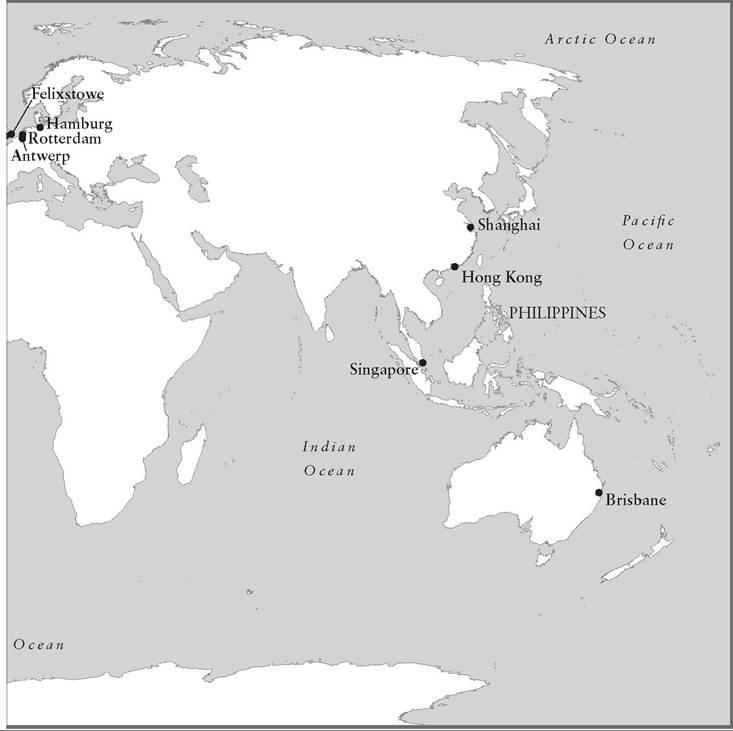
Yet the twentieth century saw a complete transformation in the character of ocean shipping, with the development of cruise lines at the start of the century, the loss of passenger services once jet traffic across the oceans had become safe, and, most importantly, the container revolution, which made it possible to send goods through ports without any need to unload them there, one consequence of which was the rise of new or revived ports such as Rotterdam and Felixstowe and the eclipse of old ones such as Liverpool and London.
As the scale of maritime trade grew exponentially, the lives of people all around the world, mostly far from sea coasts, were decisively transformed.These changes cannot be understood without taking into account railways as well as ports. The increasing ease with which goods could be transported from the interior, added to their position near the mouth of river systems that reached deep into Europe, gave Hamburg, Antwerp and Rotterdam distinct advantages at the end of the nineteenth century, all the more so when the Dutch built a new channel out to the sea. The Belgian solution was to create what is still the densest railway network in Europe.4 Not for nothing is one of the most magnificent buildings in Antwerp its railway station. The benefits for Belgium and Holland were almost immeasurable, as they became, along with Hamburg, the exit points for the products of German heavy industry - as Rotterdam still remains. Two small and, by this time, not particularly prosperous countries were thus given an enormous economic fillip.5 Rotterdam was better placed for access to the urban centres and factories of western Germany, whereas Hamburg was more dependent on eastern Germany, and lands beyond that were more lightly industrialized, or not industrialized at all. However, Hamburg was a busy industrial centre in its own right, with a busy smelting industry and a population that approached 2,000,000 around the time Hitler came to power.
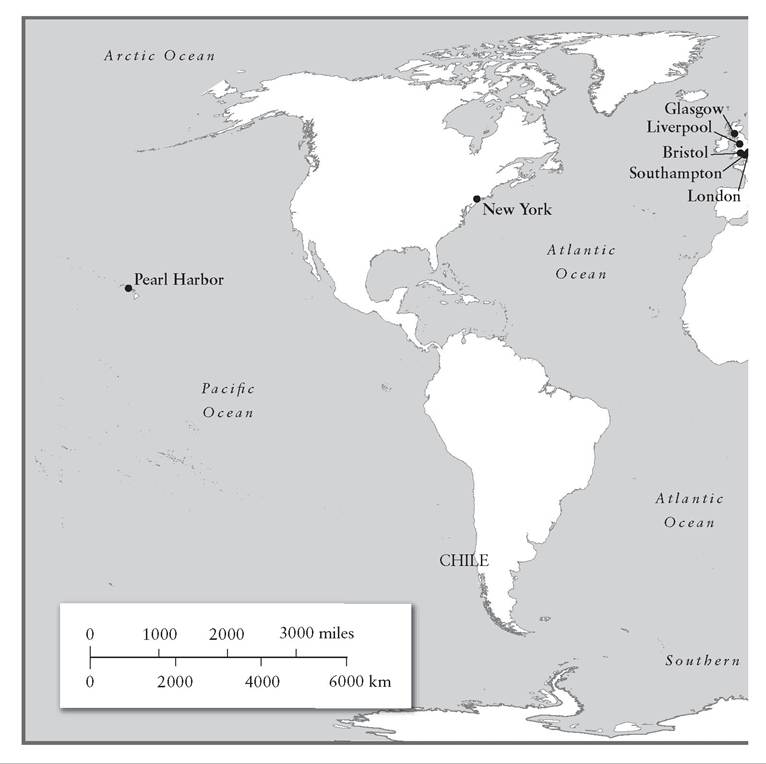
The trading links of Hamburg reached as far as Chile, where the trading company of Vorwerk was already doing business in 1847, while there were also very intense links with Brazil and Argentina. In 1924 a substantial office block known as the Chilehaus was built in Hamburg in the avant-garde style known as Brick Expressionism.6 Not to be outdone, the Dutch invested very heavily in Rotterdam, dredging new channels and constructing large basins where ships could moor and unload.7 Intensely competitive, the three ports improved their facilities in leaps and bounds, determined to attract the largest volume of traffic possible; and ever greater port capacity stimulated companies such as Vorwerk as they worked hard to increase the volume of trade with South America, South Africa and the Far East.
Although New York was also a very successful port, handling a comparable quantity of goods, the northern European ports, taken together, dominated maritime traffic around the world. This becomes even clearer when the role of Great Britain is taken into account: over 8,500 steamships in 1914, 19,000,000 gross tonnage, two fifths of world tonnage. London retained its role as the largest port in Europe throughout the first half of the twentieth century, but the measuring stick is the physical extent of the port rather than the volume of goods it handled. Still, at the start of the century, especially when Liverpool is brought into the calculations, the dominance of Great Britain at sea was impossible to challenge. It had the largest and most effective navy; it had the largest and most successful merchant marine; it was home to extremely prestigious passenger lines, notwithstanding the growth of the Holland-Amerika Line and German firm HAPAG, which was larger than any other shipping company anywhere in the world on the eve of the First World War, boasting a million-ton fleet.8 All this already disturbed the Germans in the decades before war broke out. Admiral von Tirpitz was determined to build a fleet that would outclass the British one, declaring in 1897 that ‘for Germany at the moment the greatest enemy at sea is England’ - für Deutschland ist zur Zeit der gefährlichste Gegner zur See England.9 However, it might be argued that England only became an enemy because Tirpitz wished it so.
II
One can look at the maritime history of the two world wars from many perspectives, most obviously that of naval warfare. The perspective that will be adopted here is that of the shipping companies, particularly those based in Britain such as the Blue Funnel Line, Cunard and P&O. This enables one to see how war brought the shipping industry both disaster and profit; and a comparison with what came before and what came after conflict helps explain the survival, crises and regeneration of these firms.
Although the First World War massively disrupted Britain’s overseas trade, the attacks by U-boats on British shipping had less effect than the continuing command of the seas by British fleets, which left Germany struggling to obtain the goods it needed for its war effort; Germany was in effect subject to a maritime blockade; and Britain, a country whose ability to supply itself depended even more heavily on access to the sea, continued to rule the waves; Britain imported 79 per cent of its grain and 40 per cent of its meat in 1914, while some products such as sugar were still produced entirely overseas. The British government reserved the right to requisition merchant ships for military use, and gradually applied this rule more stringently, but it was obvious that the major role of merchant shipping would have to be the provisioning of Great Britain, including the carriage of large quantities of wheat from Canada and the United States. If anything, the shipping companies were accused of making excessive profits out of the war, partly through the increased freight charges they began to apply. Some companies, such as the Blue Funnel Line of Liverpool, saw their profits soar and suffered relatively minor losses; Cunard doubled the tonnage of its fleet between 1909 and 1919, and its assets soared towards £15,000,000. Even so, one third of Britain’s tonnage disappeared under the waves, particularly after the Germans developed effective U-boats, the carriers of deadly torpedoes. ‘Damned un-English’ was the verdict of a British admiral on the use of boats that hid under the surface of the sea. They were not the only threat: enemy mines stood in the way of merchant shipping.10Naval historians might argue about which side gained the upper hand in the Battle of Jutland at the end of May 1916, but the crucial consideration is the outcome: Germany proved unable to break British ascendancy at sea. It could neither gain a stranglehold on the British Isles nor open up Atlantic waters to its own imperial fleet and merchant navy.
Where the Germans needed to think carefully was the threat they posed not just to British but to American shipping. Attacks on its ships would surely bring the United States into the conflict, however reluctant Woodrow Wilson was to commit his country to what might too easily be classed as a European war. The sinking of the Lusitania off Ireland in May 1915, with the loss of over 1,000 lives, many of them American, hardened opinion in the United States; the German counterargument was that the Reich had declared most of the open Atlantic a war zone and that it had warned American citizens that their safety could not be guaranteed. Even so, it took another two years for the USA to join the fray. And American fears were realized: merchant ships had never in human history been subjected to such relentless attacks. In February to May 1917, 2,500,000 tons of shipping were sent to the bottom of the sea, while P&O lost forty-four ships that year. The Atlantic was the most dangerous ocean, plagued by German U-boats, and British companies that operated in the Indian Ocean and Pacific waters stood to make respectable profits during the war.11 Meanwhile the Germans suffered from the lack of vital metals such as tungsten and nickel, forcing them to leave machinery idle; and the food intake of ordinary Germans, though just about sufficient, was balanced more towards turnips and less towards Wurst, which, if nothing else, demoralized the population.The First World War demonstrated that a global economy, of which Imperial Britain was the example par excellence, was also a fragile one in time of war. It demonstrated too that heavy steelclad battleships were still very vulnerable, once the art of building submarines had been mastered. And for Germany the maritime disaster was catastrophic. Having lost half its merchant navy during the war, it lost much of the rest under the draconian terms of the Treaty of Versailles. A few years after the war ended not even 1 per cent of the world fleet flew the flag of the Weimar Republic. Yet these figures also served as a reminder to Great Britain that its own losses had been devastating: 37 per cent of the merchant fleet, a gross tonnage of at least 7,000,000, maybe 9,000,000 units.12 From this perspective, it is no surprise that economic historians have argued that the post-war period was less ‘globalized’ than the period leading right up to the outbreak of war. In 1920 the total volume of maritime trade around the world had fallen to a level one fifth below the pre-war level.13
Ill
The post-war picture is not all bleak. Slow recovery did take place, even though it was badly punctured by the Great Depression. One country that benefited was Japan: an ally of Great Britain during the war, it had even sent warships to the Mediterranean, but the importance of the First World War for Japan also lay in the experience it brought to the Meiji Empire: its fleet not just of warships but of merchant vessels continued to grow, rising from 1,700,000 tons on the eve of the war to almost 3,000,000 tons at war’s end. Over the next twenty years the scale of the Japanese merchant marine grew exponentially; by 1939 Japan accounted for 13 per cent of world tonnage.14 Others fared much less well: around a third of the German and Dutch merchant fleets was immobile in 1932. One or two places even boomed during the Depression: Hong Kong received ships totalling 20,000,000 tons when the Depression was at rock bottom, and Singapore also prospered, helped by the continued expansion of the Malay rubber industry. Those involved in the shipping industry, including governments as well as companies, strained every nerve to invest in new port structures and even, as will be seen, to stimulate the shipping industry by ordering and building new ships for cargoes and passengers.15
From the perspective of the British shipping companies, there were some significant changes. Shipping companies merged and the new enterprises operated gigantic fleets: Kylsant Royal Mail had more than 700 ships afloat in 1929, adding up to more than 2,500,000 tons - in the process the company had overextended itself. Kylsant Royal Mail collapsed the next year amid scandal: Lord Kylsant was accused of fixing the books to make the company appear a much better investment than it was, and after a sensational trial he became an involuntary guest of His Maj esty the King in a British prison. He was as much the victim of the worldwide slump in business as a misguided chairman with exaggerated ambitions. For the storm clouds were gathering, and the enormous overcapacity of the world’s merchant marine made the shipping industry particularly vulnerable. Problems were accentuated by the slump in business that heralded the Great Depression. In November 1931 Lord Inchcape, chairman of P&O, wrote: ‘I have never known such a period of depression as that through which we have passed in the last 18 months. It has been heart-rending to see the steamers leaving London, week after week... with thousands of tons of unoccupied space - so different from the old days.’16
One positive development concerned shipping technology. Oil-fired diesel engines were introduced, which used less fuel, even though the fuel was more expensive. Still, this reduced reliance on the scattered coal bunkers found all around the globe. There was no rush to oil: the Danish East India Company had introduced motor ships before the First World War, but the temptation to carry on using coal was particularly strong in Britain, given the ready availability of cheap Welsh coal. In 1926 the management of Cunard wondered whether it would have to convert some of the company’s ships back to coal, if oil prices continued to rise. One way to reduce costs on oil-fired ships was to employ Chinese or other Far Eastern labour in the engine room, since one could pay these workers about half what European hands would be paid - a situation that still prevails aboard cruise liners.17 Another possibility was to load oil in places where it was especially cheap, such as Aden.
Then there were sectors of the shipping industry that were hit by political changes in the post-war world. One of the most serious developments that Cunard faced was the increasing restrictiveness of United States policy towards immigrants. This nation whose very foundation lay in the fact that all its citizens (excluding the much-ignored native Americans) were of immigrant descent became mired in what can only be described as racist, and in their fullest form anti-Semitic, policies: in 1921 Congress decreed that immigration would be limited to 3 per cent of the number of each national group living in the USA at the time of the census of 1910. This had the effect of restricting immigration from parts of eastern Europe from which the flow to the tenements of the East Side, New York, had become increasingly strong. In 1923 Congress enacted a new law according to which the criteria would be set not by the census of 1910 but by that of 1890, which had the effect of further restricting numbers from eastern Europe. The result for the shipping companies was that passenger traffic, long dominated by the migrants in steerage, plummeted: in 1921 Cunard had the satisfaction of carrying nearly 50,000 passengers in third class from the British Isles to the United States; the next year there were not even 35,000 steerage passengers, and it was reported that ‘third class space on many of our voyages went comparatively empty’. Needless to say, the shipping companies pressed the British government to argue in Washington for less restrictive measures, and in fact the reversion to the 1890 census meant that a slightly larger number of British and Irish immigrants could be admitted. Then, in 1929, Congress thought again; this time the 1920 census was to be the measuring rod, which greatly favoured migrants from the United Kingdom but slashed the numbers allowed to arrive from the newly constituted Irish Free State and from Germany. Still, Cunard had always carried not just migrants from the British Isles but a great many others who had arrived from continental Europe and Scandinavia in transit to America. The company therefore had to think of ways to diversify - as, indeed, did rival companies in other countries, notably German HAPAG, which developed a tourism department. Earnest German tourists could sail out to the USA, Cuba or Mexico on adventure and study tours, while the French company CGT began to invest in hotels in the vast swathe of the Maghrib that lay under French rule.18
Cunard looked over its shoulder and understood that its rivals had a clear advantage in another form of passenger traffic across the Atlantic: the express liner services that specialized more in first- and second-class accommodation and services. So the decision was made to start building, which also meant that there was an opportunity to adopt oil-fired engines in place of coal. This building programme was already well under way in 1922, and within three years the company was running ten routes, linking Southampton, Liverpool, London and Bristol to the United States, and even services from Hamburg and the Dutch ports to America. Old Cunard ships, including the former German Imperator (a great hulk now known as the Berengaria ), had their first-class accommodation refitted, so that passengers could enjoy private baths and as much running hot water as they wanted; but competition on the Atlantic routes remained tough. Nor did the company neglect the less affluent passengers who traditionally had endured steerage class accommodation in dormitories deep in the hull of these liners. A new version of third class, ‘tourist class’, came into being, aimed in part at the increasing number of people visiting the United States for pleasure. This was intended to provide better accommodation, in cabins, than was offered in third class; the equivalent on a modern aeroplane would be premium economy.19
Cunard was still sailing in choppy waters after the Great Depression drew to an end. It was saved by what had seemed at first a potential disaster of the first magnitude, the building of the RMS Queen Mary, which began its career in 1936, though construction of what was then known as ‘Hull no. 534’ had begun at the end of 1930. The plan was to launch a ship unlike any other: it would be larger, faster, more luxurious and more powerful than any of its competitors, and it would, in conjunction with a sister ship, make possible a weekly service between Southampton, Cherbourg and New York (the second ship, the Queen Elizabeth, was still unfinished at the outbreak of the Second World War). Using one large ship rather than a couple of smaller ones could, in the long run, be economical, and the French shipping company CGT had the same idea when it launched its own mega-liner, the Normandie. Work on the Queen Mary was halted during the Great Depression, and it was only resumed thanks to a loan of up to £4,500,000 from the British government, which saw this as a prestige product that would enable Cunard to outclass its German and French rivals on the transatlantic passenger route. However, there was one important condition: Cunard was to merge with the White Star Line, its old rival, and operator of the doomed Titanic. White Star was in financial trouble, and work on its own rival to Hull no. 534 had also been suspended. The merger took place in 1934, the year that the Queen Mary was launched on the Clyde.20 This degree of government intervention was not unique: Dutch and German shipping companies were also shored up by the state, and in Germany government interference went a stage further, as Jews were forced out of their positions in the HAPAG company: ‘Jewish identity was purged from the collective memory of the firm, although the firm would have had no meaningful history without it.’21
Sir Percy Bates, chairman of Cunard White Star, looked back on the performance of the Queen Mary in 1941, when it and the Queen Elizabeth had been converted into troop ships, with proud nostalgia for its brief but brilliant pre-war career:
I think the time has come for me to be more particular on the financial performance of Queen Mary. She is widely known as a masterpiece of British construction; it may not be equally appreciated that financially she has been very successful from the start, as the progress made in marine engineering has focused in Queen Mary a new economy in transportation across the Atlantic. Since 1922, when the full effect of the U.S. Immigration Quota Law first made itself felt, no steamer has ever made so much money in successive twelve months, as Queen Mary has done since being commissioned.22
It was not, though, simply a matter of profits. The Queen Mary displayed the prestige of the maritime nation that had built it and that sailed it. This too was what had prompted the British government to sink so much money into its construction - not to mention the stimulus that the building of the two Queens gave to the economy of western Scotland. Not just in Great Britain but in France, Germany and elsewhere, sterling efforts were made to climb out of the pit of economic depression, and by the eve of the Second World War they were having some effect. Liverpool, it is true, was slowly losing its pre-eminence as a British port, but that meant business was being dispersed elsewhere around Great Britain, for instance to Southampton and Bristol.23 How the outbreak of another world war, one that really did encompass almost the entire globe, would affect this now needs to be examined.
IV
The Second World War presents a paradox in maritime history, compared to the First. Even if the earlier conflict grew out of events deep within the Balkans, sea power had been a major concern of the Germans on the eve of the First World War, as Tirpitz’s statement about the British threat makes plain. And yet the conflict at sea was largely limited to the Atlantic, despite the heavy losses of merchant marine. The Second World War originated in Germany’s ambitions on land, in eastern Europe, and in 1939 British Appeasers were arguing that Great Britain should seize the opportunity to leave Hitler to his designs within Europe, in which case he would not interfere with British control of the seas. When war with Germany did break out, and when Japan joined the conflict on Germany’s side, the conflict became a truly global one that embraced the three great oceans, and saw the fall of several of Britain’s most precious bases in the Far East, notably Hong Kong (on Christmas Day 1941) and Singapore (on 15 February 1942). Whereas the trading networks of the British shipping companies that operated in the Far East had often prospered during the First World War, they were completely shattered during the Second World War, when even Australia came under Japanese attack. The Blue Funnel Line lost its Far Eastern bases, the longstanding sources of its success.24
The conflict at sea was also even more vicious than it had been in the days of the first U-boats: not merely had submarine technology advanced in leaps and bounds, but the addition of effective air power meant that attacks on ships were no longer being launched solely by other ships, above or below the waterline. The merchant marine not just of the Allied Powers but of neutral nations, including, until its belated entry into the war, the United States, was massively exposed to German and Japanese firepower. This also meant that the threat to Britain’s supply of food and essential industrial goods was constant and serious, to a far higher degree than between 1914 and 1918. Some well-established supply routes were not accessible: sending troops to Egypt involved a massive circumnavigation of Africa.25
After the fall of France the Germans commandeered most of the French merchant navy. The fate of merchant navies in other lands conquered by the Germans was complicated. Much of the Norwegian merchant navy moved over to Britain after Hitler invaded Norway, as did many Dutch ships; after all, sailors had the advantage of mobility. To some extent, Allied losses at sea were compensated by the United States, first in helping to keep the supply lines to Britain open and then, after Pearl Harbor, in the loan of shipping which was being furiously constructed in American shipyards. This did not prevent the destruction of 21,000,000 tons of Allied merchant shipping during the Second World War, with about 15,000,000 tons the victim of U-boat attacks - nearly 4,800 ships. Showing exceptional bravery, merchant sailors were fully aware of the enormous risks as they zig-zagged around the oceans, trying to avoid German submarines.26 In the Pacific, the struggle for control of the sea lanes took on a different character. Here the US fleet was determined to block Japanese trade within the forcibly created ‘Greater East Asia Co-Prosperity Sphere’ that, by the time of Pearl Harbor, included vast swathes of the coasts of China and south-east Asia under Meiji rule. The Americans, using submarines and air power, destroyed Japanese ships carrying iron, coal and oil from China to Japan, or rubber from occupied Malaya, and they also attacked long-distance shipping sent all the way to Japan from Germany loaded with machinery and chemicals.
The British shipping companies played an important role in the war, even if their ships were now under the operational control of the government, following orders issued on 26 August 1939, more than a week before war actually broke out, that permitted the Admiralty ‘to adopt compulsory control of movements of merchant shipping’, initially in the North Sea, Baltic, Mediterranean and Atlantic. The Germans were also prepared; they had already sent the pocket-battleships Graf Spee and Deutschland to the Atlantic, and had positioned thirty-nine U-Boats out of a submarine fleet of fifty-seven around the coasts of the United Kingdom. A lethal U- boat attack on a British liner on the very first day of the war made the British government realize that the Germans were not planning to abide by any rules of war protecting non-combatants. This led to the immediate organization of armed convoys, but Britain lacked sufficient resources to accompany ships deep into the Atlantic, a problem compounded by the abandonment of two British naval bases on the coast of the Irish Free State the year before, which meant that ships were sailing unprotected through a dangerous stretch of Irish waters. German mines, some of them magnetic ones that clamped themselves to the hulls of ships, were an even greater danger than the submarines; in 1939 alone seventy-eight ships were blown apart by German mines, adding up to more than 250,000 tons.
When the Luftwaffe began to attack British shipping in December 1939, the Admiralty stepped up its efforts to provide merchant shipping with anti-aircraft guns; and, again, there had been advance thinking - but the really useful guns had been ordered from Switzerland, and after the fall of France they were unobtainable. That meant Britain had to make its own, or buy them from the United States, but the situation was so bad that some ships were only supplied with fireworks, manufactured by the well-established firm of Brock’s, in the not entirely vain hope that German planes, never very good at identifying what was floating on the sea, would take them more seriously than they deserved. A further problem was that the Royal Air Force did not seem to be keen to co-ordinate its activities with the Admiralty; traditional service rivalries came into play here. This meant that British planes were not available to provide cover for ships beyond Britain’s shores. On the other hand, advance thinking about the Merchant Navy ensured that there were sufficient ships to ferry the British Expeditionary Force across the Channel to France from 9 September onwards. Moreover, Britain enjoyed some success in hunting down and destroying U-boats, even if they were being replaced over and over again, with almost Satanic fury, in German shipyards.27 And then part of the Royal Navy had to be redeployed into the Mediterranean to face Mussolini, who had taken opportunistic advantage of the defeat of France to join Hitler.28 That is just to mention the difficult conditions at the start of the war; the fortitude of the Merchant Navy in the face of what must often have seemed overwhelmingly strong opposition is a story of endurance without parallel in the maritime history of the world.
The experience of four shipping companies, three fully British and one of Norwegian origin, illustrates the difficulties shipping companies now faced. It has been seen that the British government requisitioned the two Queens as troop carriers; in fact, the government had already requisitioned ten smaller Cunard ships before war even broke out; the problem with the Queen Mary was that she was stuck in New York, while the Queen Elizabeth was still in the builder’s yard outside Glasgow, awaiting plenty of work on her cabins and public spaces. Her maiden voyage was an extraordinary event: she was sent to New York to be fitted out, and then on to Sydney, joining the Queen Mary. Both ships transported hundreds of thousands of troops, beginning with Australians bound for the Middle East, and continuing, from 1942 onwards, with American GIs en route to Europe - what the historian of Cunard has called ‘an achievement in transportation without parallel in the history of trooping’. By the time they were working the Atlantic crossing each ship had space for 15,000 men, half an infantry division, so it is no surprise that U-boat commanders competed to catch these mighty ships, and enemy agents plotted to sabotage them.29
P&O was also obliged to hand over shipping which was adorned with eight or so six-inch guns from the days before the Boer War - not much use against German submarines. By the end of the year one of the first P&O ships to be requisitioned, the Rawalpindi, had bravely attempted to sink the powerful German cruiser Scharnhorst in a hopeless encounter between Iceland and the Faroes - hopeless but not futile, as the Prime Minister rose in the House of Commons to praise the sailors on board as ‘an inspiration to those who will come after them’, of whom, alas, there were a great many from the P&O fleet alone. P&O troopships were heavily involved in the north African landings which took place in November 1942, ‘Operation Torch’. But clearly the company’s Far Eastern business had come to standstill.30 This was even truer of those companies that operated from British bases in the Far East.
The Wallem shipping company, operating in Hong Kong and Shanghai, was forced to hand over six ships to the Japanese, although others escaped to India or Australia; its Norwegian origins, and its partly Norwegian staff, proved an advantage, as the Norwegians were at first left free to go about their business - but of course there was now much less business. The Wallem office in Hong Kong closed, and several of its staff were captured by the Japanese. The chief accountant, Kenneth Nelson, was a lucky survivor: he was placed on board a ship carrying more than 1,800 prisoners, but the Japanese had not painted Red Cross markings on the boat, and it was torpedoed by the Allies. Nelson broke out of the sinking ship through the gash left by the torpedo, swimming ashore only to find that he was in Japanese-occupied territory. He was sent back to Hong Kong, escaped from prison there, was shot by a Japanese patrol, but still managed to find his way to his favourite bar, where he ordered his favourite drink with the extra request: ‘Make it a double!’31
Blue Funnel ships were scattered across the globe in Allied service; the fleet of eighty-seven ships managed by Alfred Holt & Co. of Liverpool in 1939 was whittled down to a fleet of thirty-six by war’s end. Losses occurred in all three oceans - one ship was torpedoed off Brisbane, Australia, while German torpedoes finished off one Blue Funnel ship after another off west Africa or in the north Atlantic. For all the advantages of sailing in convoy, the first of Alfred Holt & Co.’s losses at sea occurred when a convoy broke up in strong winds in February 1940, leading to the sinking of the Pyrrhus by a U-boat lurking in high seas off Galicia.32 However, as suspicions grew (more among the British than among the Americans) that Japan was about to attack Pearl Harbor, the company began to move its ships out of Hong Kong, presciently realizing that the threat was not just to the United States but to Germany’s existing enemies. The speed at which the Japanese advanced across the Pacific left some Blue Funnel ships in the firing line. The Tantalus, which had been laid up in Hong Kong harbour for refitting, was spirited away, but its captain wrongly assumed that the Philippines, then under American rule, would offer a safe haven. The Japanese were in fact mercilessly bombarding Manila, and the ship was blasted to pieces, though fortunately the crew was by then on shore - however, the sailors were arrested by the conquering army and sent to a prison camp.33
The damage to shipping is only part of the story. Ports suffered immensely as well. Air raids on the Port of London and on Liverpool in autumn 1940 were directly aimed at the shipping industry, as were attacks on Bristol, Southampton and the great shipbuilding centres on the River Clyde: the Blitz was about much more than demoralization. Winston Churchill saw the attacks on the Mersey and the Clyde as the most significant moments of 1940. After London was knocked out, Great Britain became more dependent on Liverpool, so the fury unleashed against the city knew no bounds: the attacks in 1940 were only the beginning. Liverpool had lost 70 per cent of its port capacity by summer of the next year, by which time the German attacks ceased. The headquarters of Blue Funnel, which had only been in use for nine years, went up in smoke in May 1941. Once the docks were gone, it must have seemed an impossible task to keep the port open, but the Liverpudlians managed to do so; by the end of the war the tonnage passing through Liverpool had returned to the level of 1939. As the balance in the conflict shifted towards Britain, massive destruction occurred on the other side of the North Sea: Hamburg was bombed into near oblivion, while Rotterdam was wiped out following repeated attacks, first from invading Germans and then from the Allies. By the end of the war, HAPAG possessed one insignificant boat.34
The years that followed would, therefore, have to see massive reconstruction if maritime links across the globe were to be restored - ships had to be built, ports had to be repaired, finances had to be arranged. It was a moot point whether Britannia could continue to rule the waves in the new political and economic climate of the 1940s and 1950s.
More on the topic 50 War and Peace, and More War:
- No one is fool enough to choose war instead of peace—in peace sons bury fathers, but in war fathers bury sons.—King Croesus of Lydia (Herodotus I: 87)
- Cold War/Hot Peace
- Capitalism: The Profitability of Peace and the Cost of War
- The new and uncertain strategic environment requires flexible defense strategies and capabilities for both war and peace. It
- Pax Americana: war and peace across the globe
- ‘Roman way of war' in the title of this chapter is a variant of ‘Western way of war', the theory first articulated by Victor Davis Hanson that has been the subject of much critique, and which I do not accept.1
- From European war to World War
- CHAPTER 9 The War at Home: Toys, Media, and Play as War Work
- Si vis pacem, para bellum (“if you want peace, prepare for war”) —General Publius Flavius Vegetius Renatus (Gill, 2019)
- Capabilities for War and Operations Other than War
- War made the state and the state made peace,’ says Ian Morris, changing Charles Tilly’s famous dictum.1 Morris’ main examples of this are the great empires, particularly the Roman and the Chinese.