51 The Oceans in a Box
I
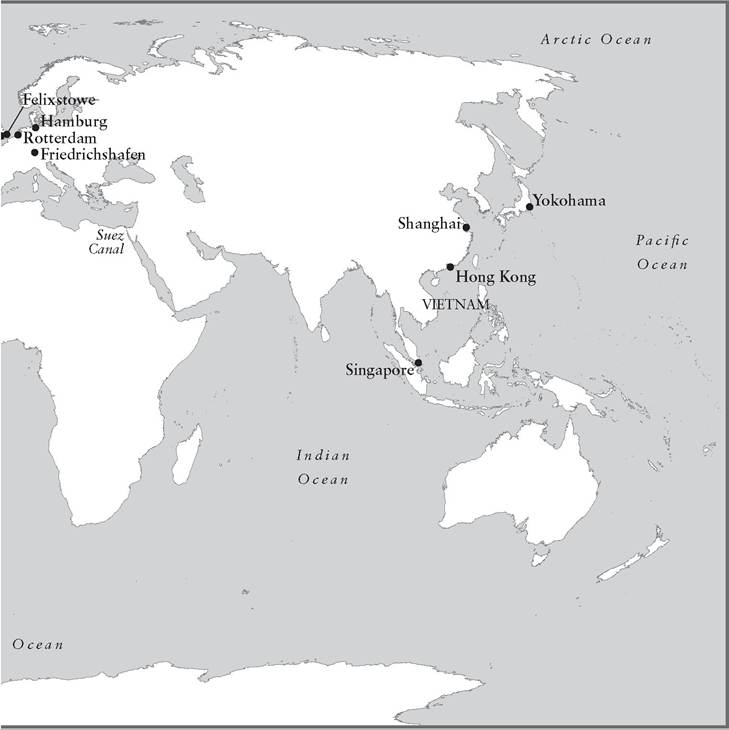
By the end of the war, not just many ships but many ports had turned into wreckage - the Port of London, Liverpool, Rotterdam, Hamburg, but also Singapore, Hong Kong, Yokohama.
Lifting world trade out of this trough was a challenge that was indeed met. As new tensions began to preoccupy the world, questions about the continuing supply of vital raw materials such as rubber acted as a stimulus to recovery. The Far East is a good place to look for evidence that the road to recovery was strewn with obstacles. British-owned firms were mapping out the sources of Malayan rubber within four months of the defeat of Japan. The board of the Sarawak Steamship Company, with no ships left out of its tiny pre-war fleet, began its meeting on 13 December 1945 by solemnly confirming the minutes of its session on 4 December 1941, as if all the misery in between had never occurred. P&O discovered that their Singapore office had been obliterated but their Hong Kong office had actually been smartened up by the Japanese.1 The situation in the Far East was complicated by the withdrawal of the Dutch from Indonesia, a major evacuation involving tens of thousands of Europeans who had been stranded in Japanese-held territory for years; ships were summoned from all over the world, and somehow these survivors were transported up the Red Sea, where the Dutch government created a mock-up of a department store that even offered Dutch delicacies to the often emaciated migrants.2 In the longer term, though, as the countries of south-east Asia gained their independence, the European producers tended to pull out. It was obvious that Malayan rubber would become a concern of the Malaysian government, which was not expected to be especially well disposed to the European companies.The situation in China was a further serious complication, leaving Hong Kong in a parlous position, although both the People’s Republic of China, founded in 1949, and the rival Republic of China, now based in
893 Taiwan, appreciated the value of the colony as a listening post in their conflict with one another.
From the British perspective, Hong Kong was also a valuable bulwark against Communist Chinese expansion towards Malaya; the plain-speaking Foreign Secretary, Ernest Bevin, said he wanted the colony to serve as ‘the Berlin of the Middle East’, though (oddly for someone so involved in the affairs of Palestine) he seems to have confused the Middle East with the Far East. The recovery of Hong Kong was held back by two factors. One was the massive number of refugees flowing into the colony from revolutionary China. The authorities could not cope with the influx. The other factor was a downturn in trade through Hong Kong during and after the Korean War, partly led by the United States, which attempted to impose a total trade embargo on the People’s Republic, while the United Nations banned the import into China of strategic goods. If anything, Hong Kong had stood to gain from the closing down of the European offices in Shanghai and other trading bases along the Chinese coast, so that trade out of China had been funnelled through Hong Kong. But this did not last in the new political conditions of the early 1950s. American embargo officers arrived in the colony. They went to work with unstoppable zeal. Shrimps found their way on to the list of banned goods, because it was not clear that they had originated in the colony; maybe they had lived their lives in the Chinese-controlled waters of the Pearl River.3 The other trading base of the British, Singapore, was not expected to stay under colonial rule for very long. There was plenty of sympathy in London for the independence movement in Malaya, but the emergence of guerrilla forces within Malaya, among whom were many ethnic Chinese who were also Communist, complicated the picture greatly. Moreover, the population of Singapore shot up, soon reaching a million (double the pre-war figure), for this colony, like Hong Kong, acted as a magnet to poverty-striken mainlanders. As in Hong Kong, the result was that impoverished, disease-ravaged and crime-ridden shanty towns grew up around the handsome colonial core. Economic recovery was hindered by the lack of adequate port facilities: a great floating dock had been sunk. The colony pulled itself up by its bootstraps over the next few years, seizing the opportunity to become the world’s biggest market for rubber, and drawing its rubber not just from Malay but from Indonesian trees. It was, then, well able to take advantage of its superb position between the Asian mainland and the former East Indies, and between the Indian Ocean and the Pacific, even if it took a much longer time to convert the squalor of post-war years into a prospering and peaceful powerhouse. When the Federation of Malaya came into existence, the rival Indonesian Republic tried to place an embargo on the export of rubber to Singapore, in the hope that this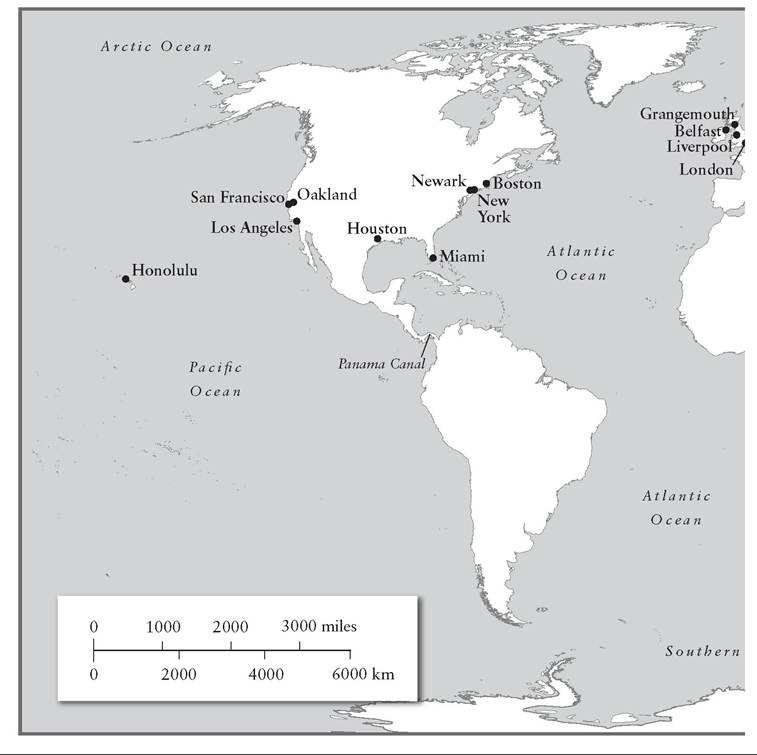
would strangle the trade of the city’s still precarious economy; but exporters rapidly learned that all one needed to do was to set out from Indonesia bound for Hong Kong, and then change direction once far enough out in the South China Sea. Smuggling therefore became good business.4
Still, Singapore could not survive on what was in effect a pirate economy; real doubts were expressed about the possibility of making Singapore work. In i960 the United Nations, seriously worried about the future of Singapore, sent a team to the island, led by a Dutch economist with plenty of experience of the shipping world, Albert Winsemius. He was very gloomy, expressing the view that ‘Singapore was going down the drain’. He was unimpressed by the port facilities. But he was just as much the saviour of Singapore as its charismatic leader, Lee Kuan Yew: he saw that
Singapore could seize the initiative if it learned to handle a new type of cargo, the container. Much more will need to be said about containers; but Winsemius was clearly a man of great vision.
Another route to success was ship repair, taking advantage of the prime position of Singapore between the oceans; and this made it a favourite port of Japanese, Norwegian and Greek shipowners, who were exactly the sort of people the port needed to attract if it was to become a major centre of maritime trade.5 Independence in 1965, following Singapore’s expulsion from the Malaysian Federation (in which, as a Chinese-majority territory, it had not sat comfortably), created frightening new challenges. Attempts to develop local industries were now hampered by greater difficulty of access to raw materials on the mainland. The answer was to build on the ideas put forward by Winsemius and to turn the city into a commercial and financial middleman - one of Asia’s greatest success stories.6II
A full account of the recovery that took place in Europe would examine a great many factors, also present in the Far East, that sometimes slowed the recovery: massive damage to infrastructure, notably in the Port of London; external competition, as Japan in particular became a major centre of shipbuilding and re-created its merchant fleet on an ever larger scale; accompanying that, the decline of the shipbuilding industry in Great Britain. Poor labour relations, particularly the pay of seamen and the role of dockworkers in an increasingly mechanized world, were another factor, becoming more important as ports became less reliant on human labour (more of this shortly); in 1955, i960 and 1966 seamen’s strikes, each more damaging than its predecessor, seriously disrupted Britain’s trade. P&O lost £1,250,000 as a result of the 1966 strike, which left five of its ships stranded.7
Events such as the closure of the Suez Canal in November 1956, following the disastrous Anglo-French attempt to restore European control over the canal following its nationalization by the Egyptian government, threw British shipping firms off balance; and the experience was repeated when the army of Israel roundly defeated the Egyptian army and occupied Sinai again in 1967.8 However, not just the low-paid suffered.
New ways of doing business no longer favoured the merchant middlemen who had played a key role in earlier decades. Middlemen in shipping agencies were being squeezed out as foreign clients tended increasingly to conduct business directly with producers within the United Kingdom; in part this refected the increasing technological sophistication of industrial goods (such as heavy machinery) that middlemen were not best placed to understand and explain.9 British companies too might prefer to go straight to the tea estate, or wherever, from which they acquired their raw materials, making for proud boasts in the television advertisements of the 1950s and 1960s. Still, looked at globally, the post-war years saw a remarkable bounce back to prosperity. During the war P&O had lost just over half of its pre-war fleet of 371 ships, of 2,200,000 tons, but by 1949 it was already operating as many cargo ships as in 1939; as for passenger ships, it owned fewer, but they were larger. Moreover, P&O recognized that the future also lay in oil tankers, and in 1955 orders for this type of ship, which it had not operated before, were placed in British shipyards.10 Within twenty years London had restored its own maritime business to a level one and a half times that of 1939; the 1950s saw the Liverpool shipping companies recover reasonably well too, after a slow start, though these successes were punctuated by the seamen’s strikes, and contraction gradually began; unemployment grew as container ships headed for other ports, much better adapted to their needs. This, as will be seen, was one of the truly great transformations of the late twentieth-century maritime world.11The most impressive European success story was Rotterdam, whose almost total obliteration was the spur to ever more ambitious rebuilding and expansion. Rotterdam proper lies a good fifty kilometres inland and upriver, but the port, including the massive new ‘Europoort’, now extends as far as the North Sea - indeed, with typical Dutch enterprise, it includes the multiple basins of Maasvlakte, built well out into the sea, and capable of handling the vast oil tankers that have been part of Rotterdam’s success story.
As a container port it has achieved within Europe what Singapore has achieved within south-east Asia; another secret of success has been its pivotal role in the oil industry. In the 1960s its business was dominated by the oil that was delivered to and refined in Rotterdam and by the pipelines carrying oil deep into Europe, on behalf of Royal Dutch Shell and other companies.12 The story is not so different from that of Singapore, in the sense that Rotterdam is able to play a vital role as a well-situated entrepot: its port is perfectly situated at the mouth of the long and complex river system of the Rhine, the Meuse and the Scheldt that reaches deep into Germany, France and Switzerland. The Europoort is not just part of the largest port in Europe (and for a time of the world); it is also a truly European port, meeting the needs of European countries within and beyond what has become the European Union.III
Rotterdam, like Singapore, had seen the future and adapted itself to it, as Liverpool did not. During the twentieth century every aspect of transoceanic travel was changing. It was no longer necessary to travel by boat to cross the oceans. In the 1930s Pan American Airways was just that, a pan-continental airline operating in North and South America and offering links between the United States and Panama, Lima, Santiago, Buenos Aires, Montevideo, Rio de Janeiro and the Caribbean. That is a list of ports; yet they could now be reached much more quickly by air. There was also a service from San Francisco to Hawai’i and on to Manila, both destinations being American colonies. On the other hand, the German transatlantic air service, provided by airships, often began from Friedrichshafen, on Lake Constance, deep in the heart of Europe, and some services crossed the United States, to reach Los Angeles. Here was a new way of linking the oceans and landmasses, though the project went up in flames with the crash of the Hindenburg in 1937; thereafter aeroplanes took charge of the skies.13 In any case, the numbers able to travel on the airships were minute: the Hindenburg carried fifty passengers (later on, seventy-two), and that was a record figure; some early KLM flights were full when six passengers were on board.14 Before the Second World War, few passengers travelled by air, and the journey from Europe to Asia with Imperial Airways or Deutsche Lufthansa would often involve stops overnight in hotels.
Some l ong-distance aircraft, such as the Empire Flying Boats jointly operated by Imperial Airways and QANTAS, were seaplanes, fitted out rather like a small ship, with bunks for passengers; these planes would settle down in the water off Mozambique or Crete, or even in the Nile at Cairo, en route to the Far East and Australia. Similar American planes, the Boeing 314 Clippers, could carry up to seventy-four passengers in some comfort; they were miniaturized luxury liners, with seats that converted into beds and a standard of service only perhaps captured in the best first- class cabins of the twenty-first century. Needless to say, this was also an exceptionally expensive way to travel: a return ticket from London to Hong Kong or Brisbane would have cost £288 in 1939, more than an entire year’s salary for a great many people, and the airline made much of its limited profit from carrying the Royal Mail. Rather as with business class on modern aeroplanes, a high proportion of travellers were on expense accounts, for instance colonial civil servants of high or at least middling rank.15 Ferrying such people to their destination much faster than could be done on a steamer made sense if the Empire was to be administered reasonably effectively.
By the early 1950s, with the formation of the British Overseas Airways Corporation, which specialized in flights beyond Europe, intercontinental travel by air was becoming more widely accepted, and that ate into the profits of the shipping companies. Air travel was also becoming much safer. The great breakthrough was the introduction of passenger jets. British technology produced the first Comet aircraft; they began flying in 1952, but they proved to have fatal design flaws, and were withdrawn, so it was only in 1958 that the Boeing 707, built in Seattle, began to provide regular transatlantic services for Pan-American Airways; it was soon followed by the Comet 4, operated by B OAC. These planes were not just fast but smooth, and the more comfortable travellers felt while in the air, the less they were inclined to use even the finest ships - the two British Queens had a reputation for rolling in high seas, so that a voyage was not necessarily five days of bliss. As travellers shifted skywards, one option for shipping companies was to build close ties to the airlines. P&O began to buy airlines, including the somewhat bizarre Silver City Airways, which ferried holidaymakers and their cars across the English Channel in its bulbous little planes.16 From 1962 Cunard jointly operated air services across the Atlantic with BOAC, and passengers had the option to fly out one way, travelling by ship the other way. Travelling by sea between European ports and New York was still seen as a perfectly sensible way to go, if there was no great hurry. But air travel became more common, and as it became more common it became cheaper, and as it became cheaper it rendered sea travel across the Atlantic less profitable by taking away customers. In 1966 the link between Cunard and BOAC came to an end.17
Cunard placed their hopes in another Queen, the Queen Elizabeth 2, which was built on the Clyde, went into service in 1969 and was only decommissioned in 2008; like the Queen Mary it was a statement of prestige as much as a sound economic proposition. When it entered service, Cunard was only operating three passenger ships, and the company had even sold its impressive old headquarters in Liverpool. The modern design of the QE2 did not convey the sense of l ate imperial luxury of the old Queen Mary, but it was used for passenger traffic to and from New York throughout its career - without, however, the possibility of a regular weekly service, since it had no sister ship. In fact, as Cunard realized, its main business was bound to lie elsewhere, in the cruise industry, and even before the QE2 first slid into the sea the two old Queens were pottering around the Bahamas and the Mediterranean.18 Similarly, the handsome SS Canberra was built at the Harland and Wolff shipyard in Belfast at a cost of £16,000,000. P&O originally planned to sail her on passenger routes linking Great Britain to Australia, but by 1974 the competition from air travel had begun to bite, and she became a cruise liner.19 The world of passenger shipping had changed profoundly: cruises had long existed, but only towards the end of the twentieth century did they come to dominate all l ong-distance passenger movements by sea. Even then, they were often associated with air travel, as they might involve a flight from, say, London to Miami to board the ship.
The modern cruise industry has been traced back to Ted Arison, an Israeli chancer who, in 1966, seized the opportunity to acquire control of a Norwegian ship, which he moved across to Miami. He gradually built up his fleet under the name of Norwegian Caribbean Lines, though most of the ships were adapted ferry boats, and he deftly used the lower deck for a roll-on, roll-off cargo service between Miami and Jamaica. Arison had space on all his ships together for about 3,000 passengers, more space than Florida in those days was likely to fill; but the answer was to advertise across the United States, and to make Miami into the cruise capital of North America. His own success prompted others, notably the real Norwegians, to enter the market, making use of purpose-built ships, and further strengthening the role of Miami in the cruise business. One rival, Costa, decided to make Puerto Rico its main base, and began to fly passengers out there, including air tickets in the price of the cruise. The cruise was thus becoming an entire package. Even better than advertising was the effect of a television series, The Love Boat, that ran for nine years from 1977 onwards, was shown across the world, and cast the cruise industry in a rose-coloured romantic light.20
All this cast doubt on what cruises were really for. Is a tour of the Caribbean a chance to see the wonders of sixteenth-century Santo Domingo and to visit the Bridgetown Museum in Barbados, which, according to Wikitravel, one is likely to have all to oneself? That fact suggests that most of those who are daily decanted from cruise ships on to Caribbean shores will go shopping, or maybe try out the local cuisine. Specialist companies such as Swan Hellenic made their name as organizers of high-quality tours by sea, specializing in both human and natural history and expecting passengers to listen to what could be either exciting or boring lectures. That is feasible on a boat carrying 300 passengers or fewer; but the vast Leviathans that now prowl the oceans, bearing 3,000 passengers or more, are to all intents self-contained holiday centres, detached from the world around them, places to eat, sunbathe, sleep and enjoy light entertainment. The largest cruise ship afloat in 2017, the Allure of the Seas, operated by Royal Caribbean Lines, can house 7,148 passengers at peak capacity; it was launched in 2010, and with its two sister ships the total at sea rises to about 21,000 passengers. The company was founded by Norwegian rivals of Arison, and operates several other very large vessels, as does Norwegian Cruise Line. Norway’s outstanding role in the cruise industry is not matched by Cunard, whose Queen Mary 2 is a mere tiddler by comparison with the Norwegian giants, carrying at most 3,090 passengers. The damage these large ships inflict on the environment - a sore point in Venice - is matched by the inability of little towns or historic sites to cope when maybe 6,000 people arrive off cruise ships all at the same time. Setting aside the cruise ships, though, l ong- distance passenger travel by sea across and between the oceans has come to an end.
IV
The triumph of the aeroplane was not total. As cargo vessels, planes are expensive to use, even if they can deliver some fresh goods that ships cannot handle (such as flowers grown in Israel on sale within twenty-four hours in British marketplaces). In our own day, the vast majority of goods exported over long distances travel in container ships between continents and oceans. UNCTAD (the United Nations Conference on Trade and Development) estimates that 80 per cent of world trade by volume (nearly 10 billion tons) and 70 per cent by value is conducted by sea. The cost of bringing a can of beer from Asia to Europe on a container ship is roughly one U S cent per can, five cents for a packet of biscuits and a mere ten cents for each television.
This came about through containerization. The history of the container reaches back into the 1920s, when American railroad companies experimented with steel containers that could be transferred back and forth between lorries and freight cars, using powerful forklift trucks. An obvious constraint on the use of containers to load ships was that the longshoremen were a powerful, unionized group of workers who understandably saw a threat to their own jobs in further mechanization. In the early 1950s this was not a major problem, since what containers there were had to be carefully fitted into the hold alongside loose cargo, which meant that the skills of the longshoremen were still in great demand. The cost of port-side labour might be as much as three times the cost of actually moving a cargo ship across the Atlantic, especially at the American end, since in the 1950s American dockworkers earned about five times what German ones could expect to be paid. Besides, the use of containers did not seem to be economical: containers were by and large not absolutely full, so that shippers who used them were packing empty space on board; by contrast, loose cargo could be slotted into every available nook in the hold.21 This meant that the container could only become the standard form of transport when ships were built or adapted primarily to carry them rather than loose freight.
Traditionally, the creation of the container is linked to one inventive businessman, Malcolm McLean, who had long been frustrated by the cumbersome way that goods brought from the American hinterland had to be unloaded by longshoremen and then carefully replaced in the hold of a ship, a process that then had to be repeated back-to-front when the ship reached its destination. He is often credited with a sudden flash of genius that produced a prophetic vision of the container revolution, but his involvement in the creation of container traffic was more gradual, though it was certainly the product of successive insights. The basic idea of the container was not brand new, but the standardization that followed from his initiatives set in train a massive revolution in sea transport. He started on land: he owned a trucking company with over 600 trucks by 1954, and in the 1950s he worked hard to cut costs and to undercut his competitors. A constant innovator, he built an automated terminal in North Carolina, introduced diesel engines and redesigned his trucks so that they had crenellated sides, to reduce wind drag. His truck services along the east coast, often carrying prodigious amounts of tobacco, were, however, threatened by a different sort of competition. There were plenty of cheap cargo vessels on the market, left over from war service. Moving goods from the Deep South northwards by sea made sense, since the roads were often blocked, especially around the big New England cities - the long-distance highways had not yet been built.22 Rather than attempting to fight a war against the cargo vessels, he would integrate them into his own system. In 1953 he mapped out plans for harbour terminals that would handle truck trailers, which could be driven straight on board, detached from the cab, carried to their destination (wheels and all), and then driven off again at the other end. The New York Port Authority was worried at the fall in domestic cargo and was keen to co-operate.
His fundamental insight was that shipping cargo was about moving goods, not moving ships. Indeed, part of the problem was that with old- fashioned loading ships did not move when they could and should: ‘a ship earns money only when she’s at sea. Where costs rise is in port,’ McLean explained.23 It made perfect sense to take goods trucked in from deep inside America, or brought to the coast by rail, and to send them to some other hinterland without having to unpack them. Still, the days when this would become an international operation were some way in the future. First, a uniform system had to be created. McLean devised an even more efficient way of conveying goods: instead of trailers, the ships should carry the detached bodies of the trailers. This meant that these large boxes could be taken to the side of the ship, lifted on board and - something impossible with wheeled trailers - stacked on top of one another and locked in place. His company analysed the cost of sending beer from Newark, New Jersey, to Miami. Traditional handling at both ends would cost $8 per ton, whereas container handling would cost 50c. It took time to acquire a suitable if ancient tanker and to obtain permission to send it to sea as a refitted and very special cargo ship. Only in 1956 was McLean able to launch his service under the flag of his Pan-Atlantic Steamship Company. Towards the end of April the Ideal-X was loaded with fifty-eight
903 aluminium boxes taken off truck trailers and sent from Newark down to Houston, Texas. In order to do this McLean had had to order the boxes (he asked for 200, such was his confidence), and even had to redesign the cranes that would be able to lift the containers in one quick movement from shore to ship. They were so large and heavy that the rails along which they moved also had to be strengthened. This was not a simple operation, but a massive commitment that soon proved its worth: the cost of loading the Ideal-X was one thirty-seventh of the cost of traditional loading. With a sister ship, the Ideal-X provided a weekly service between New Jersey and Houston, which soon increased to a service every four days, as additional ships were acquired.24
Containers were, it was argued, preferable from the point of view of security. In high seas, cargo on traditional boats could shift around over much bigger spaces and suffer damage; besides, sealed boxes were much less likely to suffer from theft.25 It was also possible to place refrigeration units in containers and to stack these containers along with all the others. McLean’s own containers were thirty-five feet long; but, as it became more and more obvious that this was the way of the future, new standards were applied - from 1958 onwards (very soon, then, after the voyage of the Ideal-X) the American Standards Association pondered this question, and in due course international agreement emerged setting the length of containers at multiples of ten feet, the standard Trailer Equivalent Unit (TEU) being twenty feet.26 The very fact that this name is used harks back to the origins of the container as the tail-end of a massive American truck. By i960 other transport companies in the United States were beginning to eye McLean’s operation enviously. The Hawaiian Citizen, with space for 356 containers, started to operate between San Francisco and Honolulu that year. It was not all plain sailing: longshoremen in Puerto Rico refused to unload McLean’s containers, and McLean’s company had to agree that large teams of dockworkers would be employed on tasks that, more realistically, could have been completed mechanically with far fewer men. This was only the beginning of a long saga: in New York and other mainland ports, the opposition to containerization within the unions was at times visceral. The threat to jobs was real, and along with the jobs traditional skills in handling loose goods disappeared. Eventually mediation by Kennedy, Johnson and government representatives achieved compromises that did something to protect jobs.27
McLean’s company, renamed Sea-Land Service, extended its range to the Pacific and even Alaska. At first there was hesitation about crossing the Atlantic, if not the Pacific, and it took ten years from the sailing of the Ideal-X for a McLean ship to reach Rotterdam, with 226 boxes on board.
On its return it obligingly put in at the Scottish harbour of Grangemouth to load Scotch whisky, for the first time despatched by container. McLean believed that the sight of all this whisky reaching America by container convinced the world of shipping that the future lay with containers. At any rate, the transatlantic route was now open, and rapidly flourished, with European companies such as HAPAG soon taking part as well. HAPAG became a giant operator of container ships.28 Meanwhile one special route did even more than the whisky bottles to convince the world of the usefulness of containers: during the Vietnam War. McLean became a regular supplier of the American army, arguing that containers were perfect for the delivery of vital supplies that otherwise were seeping from the ports of Vietnam into the hands of the Viet Cong. He also showed that the containers could be put to many uses, for example as offices and storage bunkers. In 1968 a fifth of the military supplies sent across the Pacific was sent in containers. It became obvious too that costs could be cut dramatically by making use of containers to supply the American troops in Vietnam, though the U S High Command was slow to recognize the fact. Soon, though, the USA was sending half the military supplies it despatched to Europe in container ships. No doubt this made it even easier for American bases in Europe to supply the troops with half-and-half milk, American pizza, doughnuts American-style and other wonderments that astonish European visitors to these bases to this day - but it was also an important step towards global containerization.
By the 1980s McLean’s operations spanned the world, including South as well as North America. What had begun as a medium-sized trucking company had become an international giant; more than that, its innovations decisively shaped the way in which international trade was conducted. The capacity of modern container ships was at last matched by the capacity of vast container ports such as Rotterdam, Singapore and Hong Kong. Among American beneficiaries of the shift to containers was Oakland, opposite San Francisco - 3,000,000 tons of movements in 1969, excluding what was being sent to American troops across the ocean. This was eight times the container traffic Oakland had handled four years earlier; the downside was that San Francisco saw its own maritime traffic shrink, as did Boston on the other side of the continent. Similarly, in Britain new ports displaced old ones; the London docks closed and only after years of desolation and decay were the Docklands regenerated, but as a financial centre, Olympic arena and even - a sign of how things have changed - an airport. Meanwhile, Felixstowe, previously a small and uninteresting coastal town, became the major British centre of container traffic, with an enormously long quayside and a deep port suitable for the
905 largest cargo ships; by 19 69 its annual tonnage was approaching 2,000,000. Its owner, Hutchison Ports, which traces its origins to the nineteenthcentury Hong Kong and Whampoa Dock Company, also owns or has interests in a vast number of container ports across the world, including Hong Kong; its market share stands above 8 per cent and it was handling over 33,000,000 TEU (standard container units) in 2005. One beneficiary is Trinity College, Cambridge, which owns some of the land at Felixstowe and has increased its already enormous financial portfolio accordingly.29 The largest container ship in the world in 2017, the CSCL Globe, owned in China, has put in at Felixstowe and can carry an astonishing 19,100 standard-size containers. Meanwhile, Maersk, the largest container shipping company in the world, which is a Danish enterprise, operates 600 ships; added together, its containers have a capacity well over 3,000,000 TEU. This is only the beginning: the future may well lie with a great power in the East which has a new vision of its place in the world. The era of Western dominance that began with Columbus and da Gama, and came to embrace North America as well, is coming to an end.
More on the topic 51 The Oceans in a Box:
- The beetle in the box
- Proximity to oceans influences regional climates
- The Baltic as a Crossroads to Other Seas and Oceans
- Box 1.1 Early history of the epidemic
- 31 The Binding of the Oceans
- Part I Oceans
- BOX 6-2 Guidelines for Determination of Specific Food Allergies
- Oceans cover 71% of Earth's surface and contain a rich diversity of life.
- Skill-biased technical change: Inside the black box
- 48 Continents Divided, Oceans Conjoined
- PART FOUR Oceans in Conversation, AD 1492-1900
- PART FIVE The Oceans Contained, AD 185O-2OOO
- In patients infected with HIV, the whole neuraxis is vulnerable to damage. Up to 10% of patients may present with a neurological disorder at seroconversion (Box 8.1).