Proximity to oceans influences regional climates
Earlier we noted that water requires greater energy input to change its temperature (i.e., it has a higher heat capacity) than land. As a result, seasonal temperature changes are smaller over oceans than over continental areas (see Figure 2.15).
In addition, oceans provide a source of moisture for cloud formation and precipitation. Coastal terrestrial regions that are influenced by an adjacent ocean have a maritime climate. Maritime climates are characterized by little variation in daily and seasonal temperatures, and they often have higher humidity than regions more distant from the coast. In contrast, areas centered in large continental land masses have a continental climate, which is characterized by much greater variation in daily and seasonal temperatures. Maritime climates occur in all climate zones, from tropical to polar. In the temperate zones, the influence of oceans on coastal climates tends to be accentuated on west coasts in the Northern Hemisphere and on east coasts in the Southern Hemisphere because of the prevailing wind patterns. Continental climates are limited to mid and high latitudes (primarily in the temperate zones), where large seasonal changes in solar radiation accentuate the effect of the low heat capacity of land masses.The influence of land and water on climate can be exemplified by comparing the seasonal temperature variation in locations at similar latitudes and elevations in Siberia (FIGURE 2.17). Sangar, a town on the Lena River in the middle of the Asian continent, exhibits more than double the seasonal temperature variation of Khatyrka, on the Pacific coast. Note that the maximum and minimum temperatures occur slightly later in the year in the maritime climate (Khatyrka), another reflection of the high heat capacity of the ocean and its effect on local
climate.
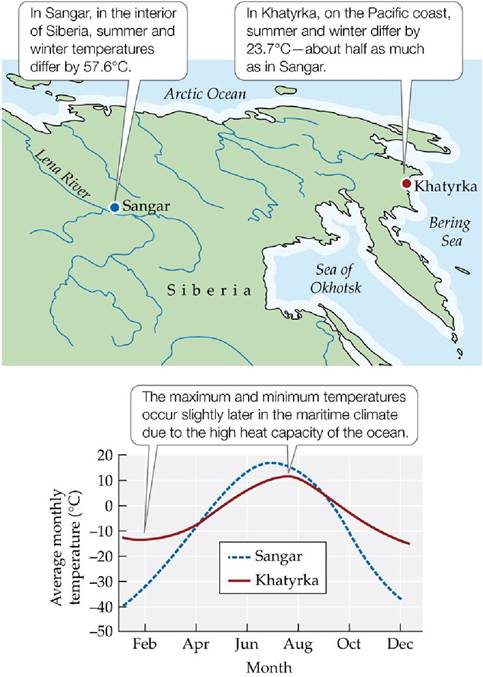
FIGURE 2.17 Average Monthly Temperatures in a Continental and a Maritime Climate
The difference in seasonal temperature variation between two locations in Siberia at about the same latitude and elevation illustrates the effect of the high heat capacity of ocean water. (Data from NOAA GHCN-Monthly, version 2; T. C. Peterson and R. S. Vose. 1997. Bull Am Meteorol Soc 78: 2837-2849.) View larger image