Mountains influence wind patterns and gradients in temperature and precipitation
The effects of mountains on climate are visually apparent in the elevational patterns of vegetation, particularly in arid regions. As we move up a mountain, grasslands may abruptly change to forests, and at higher elevations, forests may give way to alpine grasslands.
These abrupt shifts in vegetation patterns reflect the rapid changes in climate that occur over short distances in mountains as temperatures decrease, precipitation increases, and wind speed increases with elevation. What causes these abrupt changes? The climates of mountains are the product of the effects of topography and elevation on air temperatures, the behavior of air masses, and their own generation of unique local wind patterns.Air moving across Earth's surface is forced upward when it encounters a mountain range. This uplifted air cools as it rises, and water vapor condenses to form clouds and precipitation. As a result, the amount of precipitation increases with elevation. This enhancement of precipitation in mountains is particularly apparent in north-south-trending mountain ranges on the slopes that face into the prevailing wind (the windward slopes). In the temperate zones, where the prevailing winds blow toward the east, moving air encounters the western slopes of mountain ranges (such as the Sierra Nevada and coastal ranges in North America) and loses most of its moisture as precipitation before cresting over the summits. The loss of moisture, as well as the warming of the air as it moves down the eastern slopes, dries the air mass (FIGURE 2.18A). This rain shadow effect results in lower precipitation and soil moisture on the slopes facing away from the prevailing wind (the leeward slopes) and higher precipitation and soil moisture on the windward slopes. The rain shadow effect influences the types and amounts of vegetation on mountain ranges: lush, productive plant communities tend to be found on the windward slopes, and sparser, more drought-resistant vegetation on the leeward slopes (FIGURE 2.18B).
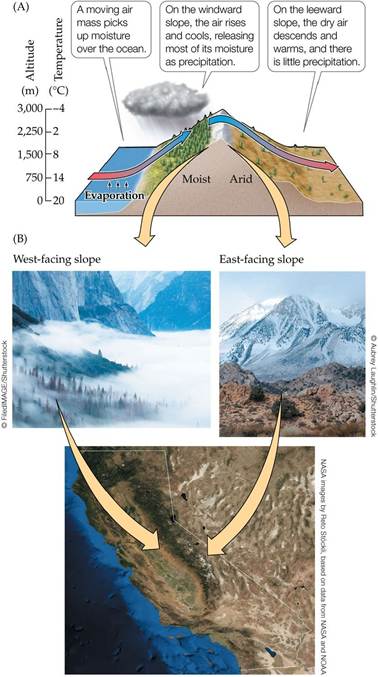
FIGURE 2.18 The Rain Shadow Effect (A) Precipitation tends to be greater on the windward slope of a mountain range than on the leeward slope.
(B) Vegetation on west-facing and east-facing slopes in the Sierra Nevada of California reflects the rain shadow effect.Which slope aspect (north, south, east, or west) on a north-south-trending mountain range in the tropical zone would have the highest precipitation, and which aspect would be in the rain shadow?
View larger image
Mountains can also generate local wind and precipitation patterns. Differences in the direction that mountain slopes face (referred to as the slope exposure or aspect) can cause differences in the amounts of solar radiation the slopes and surrounding flatlands receive. As we saw in the case of the large-scale circulation patterns that generate Hadley cells (see Figure 2.8), differences in solar heating of the ground surface can cause the uplift of air pockets that are warmer than the surrounding air. In the morning, east-facing slopes receive more solar radiation from the rising sun and thus become warmer than the surrounding slopes and lowlands. This differential heating creates localized upslope winds in the mountains. Depending on the moisture content of the air and the prevailing winds at higher elevations, clouds may form on the eastern flanks of the mountains. These clouds can generate local thunderstorms that may move off the mountains and into surrounding lowlands, increasing local precipitation.
At night, the ground surface cools, and the air above it becomes denser. Nighttime cooling is more pronounced at high elevations because the thinner atmosphere absorbs and reradiates less energy and allows more heat to be lost from the ground surface. Air can flow like water, with the cold, dense air moving downslope and pooling in low-lying areas. As a result, valley bottoms are the coldest sites in mountainous areas during clear, calm nights. This cold air drainage influences vegetation distributions in the temperate zones because of the higher frequency of subfreezing temperatures in low-lying areas. Daily upslope and nightly downslope winds are a common feature of many mountainous areas, particularly in summer when the input of solar radiation is highest.
At continental scales, mountains influence the movement, position, and behavior of air masses, and as a result they influence temperature patterns in surrounding lowlands. Large mountain chains, or cordilleras, can act to channel the movement of air masses. The Rocky Mountains, for example, steer cold Arctic air through the central part of North America to their east and inhibit its movement through the intermountain basins to their west.